
It was two in the morning in a hotel room in San Diego, and my husband and I woke to a cry every parent dreads hearing–especially so far from home. I fumbled around in the dark to find the nightlight switch and turned it on. There she was across the room, sitting amidst white, crinkly hotel sheets, her cheeks flushed, a cough caught in her throat, and the unmistakable look of agony that comes with a fever.
Immediately, I rushed into the bathroom and dug through my toiletry bag to find the bottle of Dimetapp I never travel without–just in case; the same bottle my parents relied on as the universal solution for misery.
In tandem, my husband reached for his phone. He was typing her symptoms into ChatGPT.
I came out of the bathroom. “Here’s the Dimetapp,” I said, proud to have come prepared for the moment.
“We can’t give her that,” my husband said without looking up from his phone. I stood there with the Dimetapp that I had given our daughter dozens of times. I’m her mom–I know her body, and I know what works.
“Look,” he says as he holds up his screen. “Read this.”
The Anatomy of Interrogation
Imagine a sandwich. Think of AI as the bread, and everything else is what sits in between.
But there’s a problem with this, and it’s a well-documented cognitive phenomenon. When the first answer appears after a prompt, our brains anchor to it. This is called “Anchoring Bias,” which means that we struggle to envision alternatives once an initial frame has been established. Our brains stop generating (i.e., thinking) and, instead, start editing.
We stop questioning the premise, and move straight to polishing the execution.
Here’s the fix: Think of that open-faced sandwich I asked you to imagine earlier. Organizational Psychologist, Dr. Sumona de Graaf calls that sandwich “The Think Sandwich.”
The approach? Think first, augment with AI, then think again. It’s a framework that matters far beyond parenting, and serves as a blueprint for leading with discernment instead of dependency.
To treat automated tools as a generator rather than an oracle, we need to interrogate. To interrogate is the active discipline of stress-testing an answer before it hardens into a decision. The anatomy of interrogation has three components.
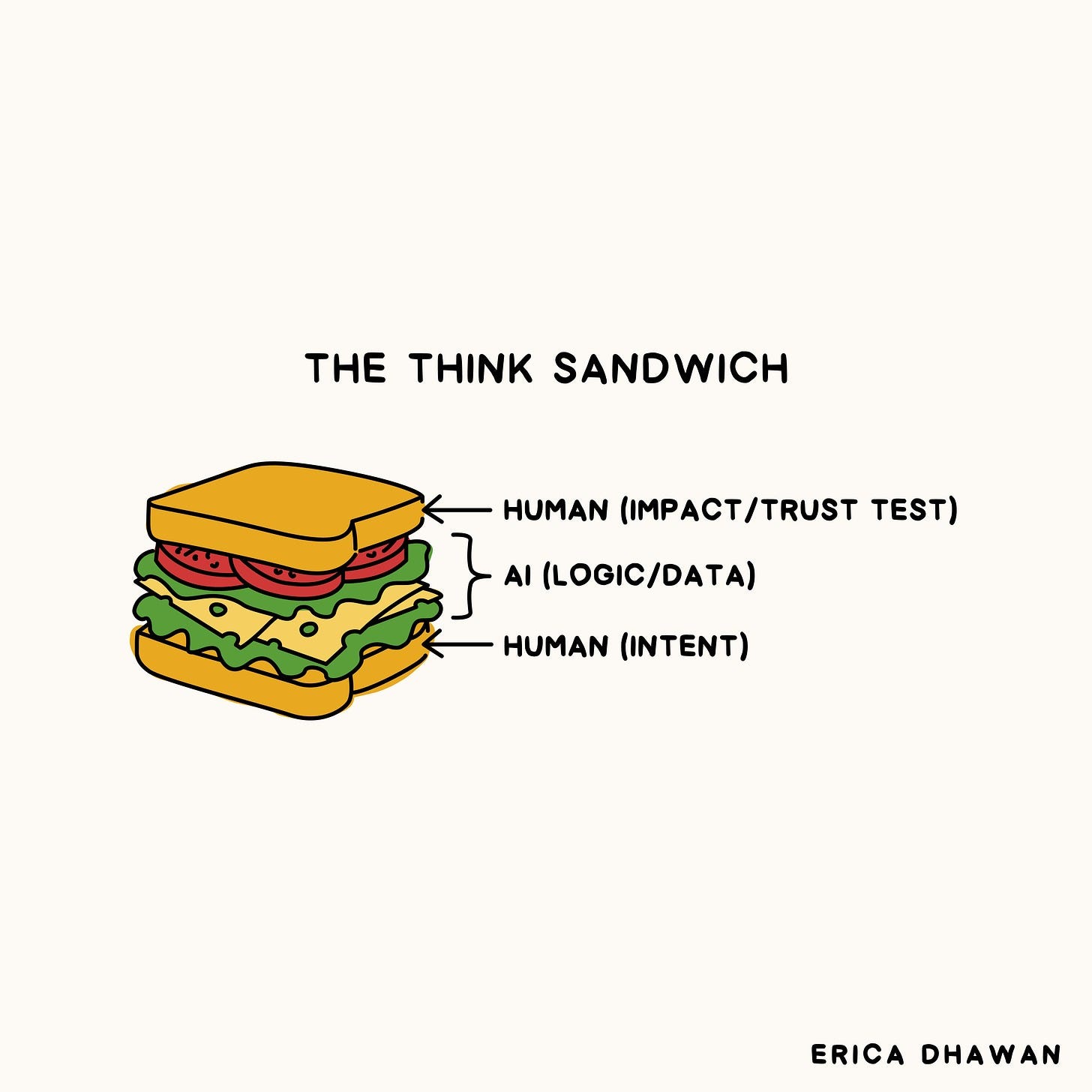
Interrogate the Intent
Before you even open an AI chatbot and type in a single word of your prompt, take a moment to articulate what you already know. Interrogate your intent. What is the problem you’re trying to solve? Think about the context you have that the chatbot doesn’t.
Not taking the time to establish your own frame first leaves AI’s output to become the default frame. In the hotel room, my frame was clear, and with my experience as my daughter’s mother serving as my dataset. For my husband, not so much.
Interrogate the Logic
In our moment of panic as parents, ChatGPT wasn’t necessarily out of place. Its warning about medication interactions was a risk I hadn’t fully considered and valuable to my frame. But without identifying what he already knew, my husband was asking the tool to do the thinking.
Professionally, I see leaders do this all the time. They sit down, prompt, and run with whatever it spits out, making the most costly mistake.
In any scenario, when the machine speaks, does the argument it’s making hold water? What are the edge cases? Are there any hallucinations? This invites AI to be our sparring partner, sharpening our critical thinking skills by providing a counterargument that gives you a position to defend.
Interrogate the Impact
With your initial thinking and the counterarguments you received from using AI as your sparring partner, make a decision tested against both your experience and the tool’s analysis.
As my husband and I stood there, frozen, our daughter looked up at us with glassy-eyed exhaustion and desperation for sleep. It was all I needed to snap out of it, pick up my phone, and call my father, who’s a retired physician.
“What should we do?” I asked, my voice in a frenzy over the phone line. Instead of saying “Do this” or “Don’t do that,” he interrogated. After a quick back and forth of him asking questions and us answering, he acknowledged what ChatGPT had flagged about the interaction risk.
“More than anything, she needs sleep,” he said. “ChatGPT is right. Don’t give her a full dose of a suppressant, but you do need to help her calm down so panic doesn’t further constrict her airways.”
A quick call to my father applied judgment to a situation AI could only partially understand. The third layer is the place where information becomes judgment, and data becomes decision.
The Struggle is the Skill
Interrogation isn’t easy. It takes time, and it can feel inefficient, but the struggle is the skill. When you interrogate, you’re doing the work of a leader by refusing to be a passenger in your own decision-making process and creating friction.
Looking back, my husband and I were both just trying to do the best thing for our daughter in that hotel room in San Diego at 2:00 AM–and unbeknownst to us, we were building a Think Sandwich.
The next time the screen turns up a perfect answer like a magic 8 ball, be suspicious, ask the hard question, and build a Think Sandwich: think, prompt, decide.
Because the only thing worse than not knowing the answer. . . is trusting the wrong one.
No posts
Comments
Nothing yet. Say the first thing.
Sign in to join the conversation.