
I wonder how 2026 will be viewed by future humans.
I wonder how the behaviour of humans in 2026 will be viewed by future humans.
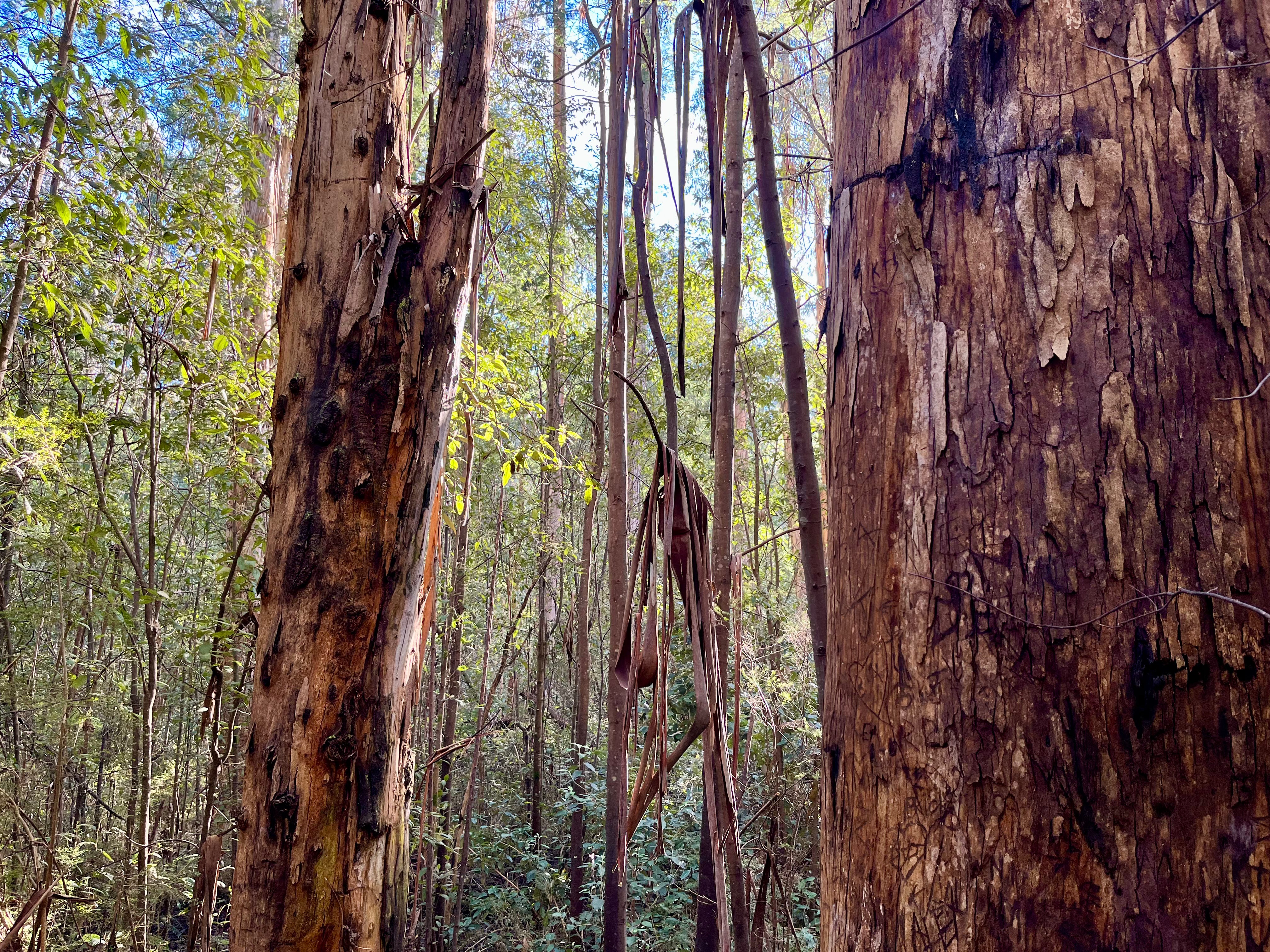
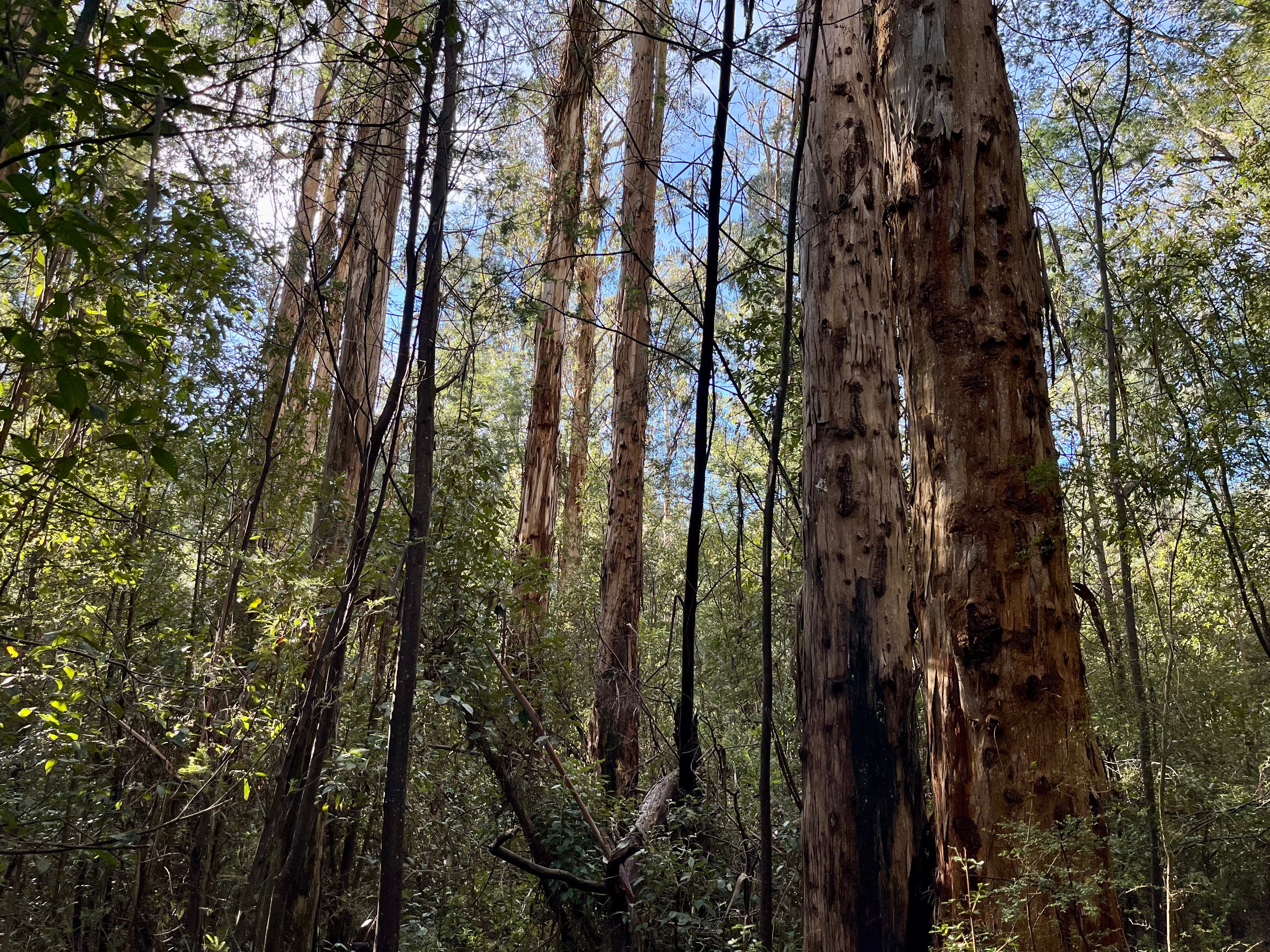
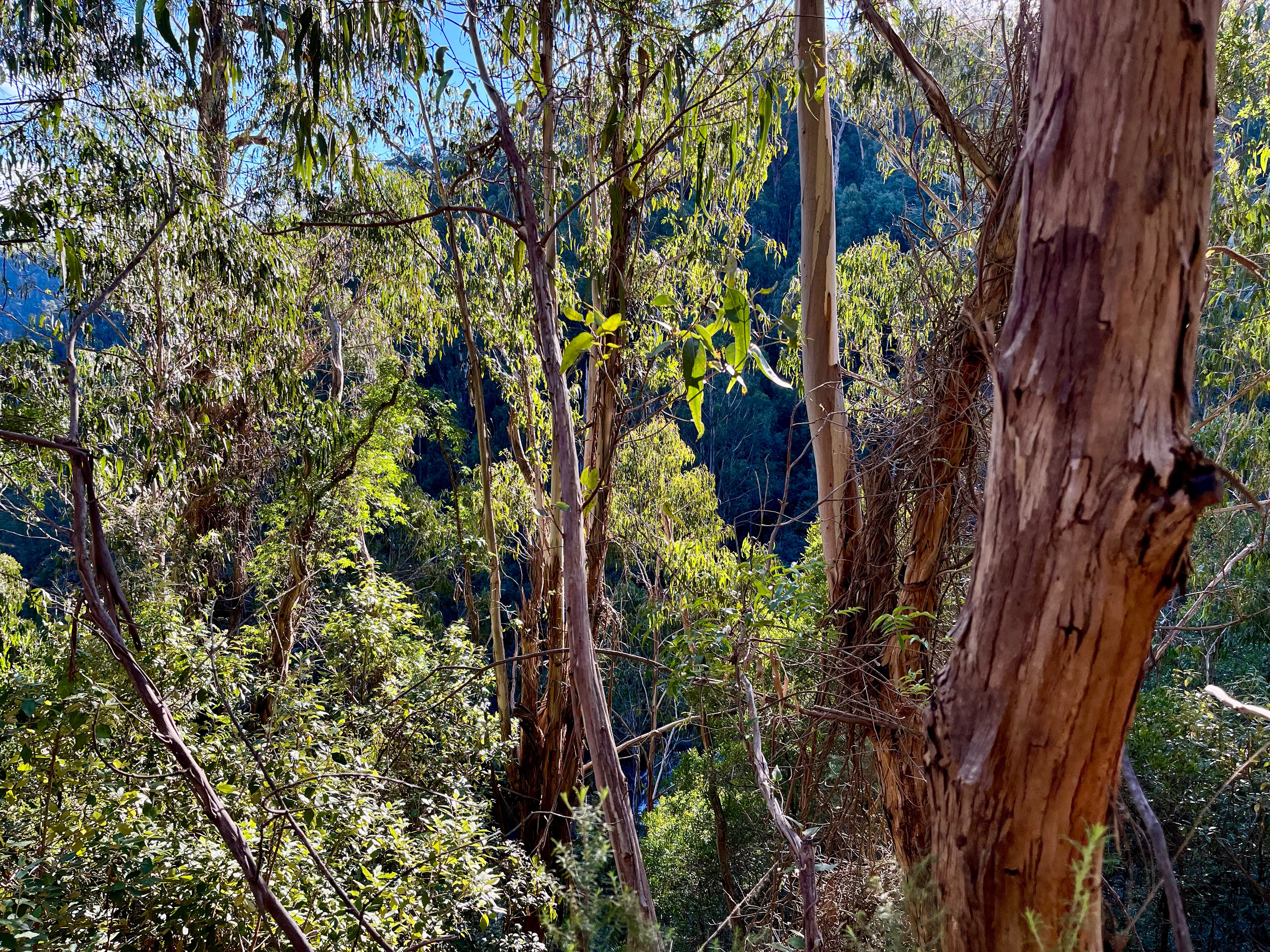
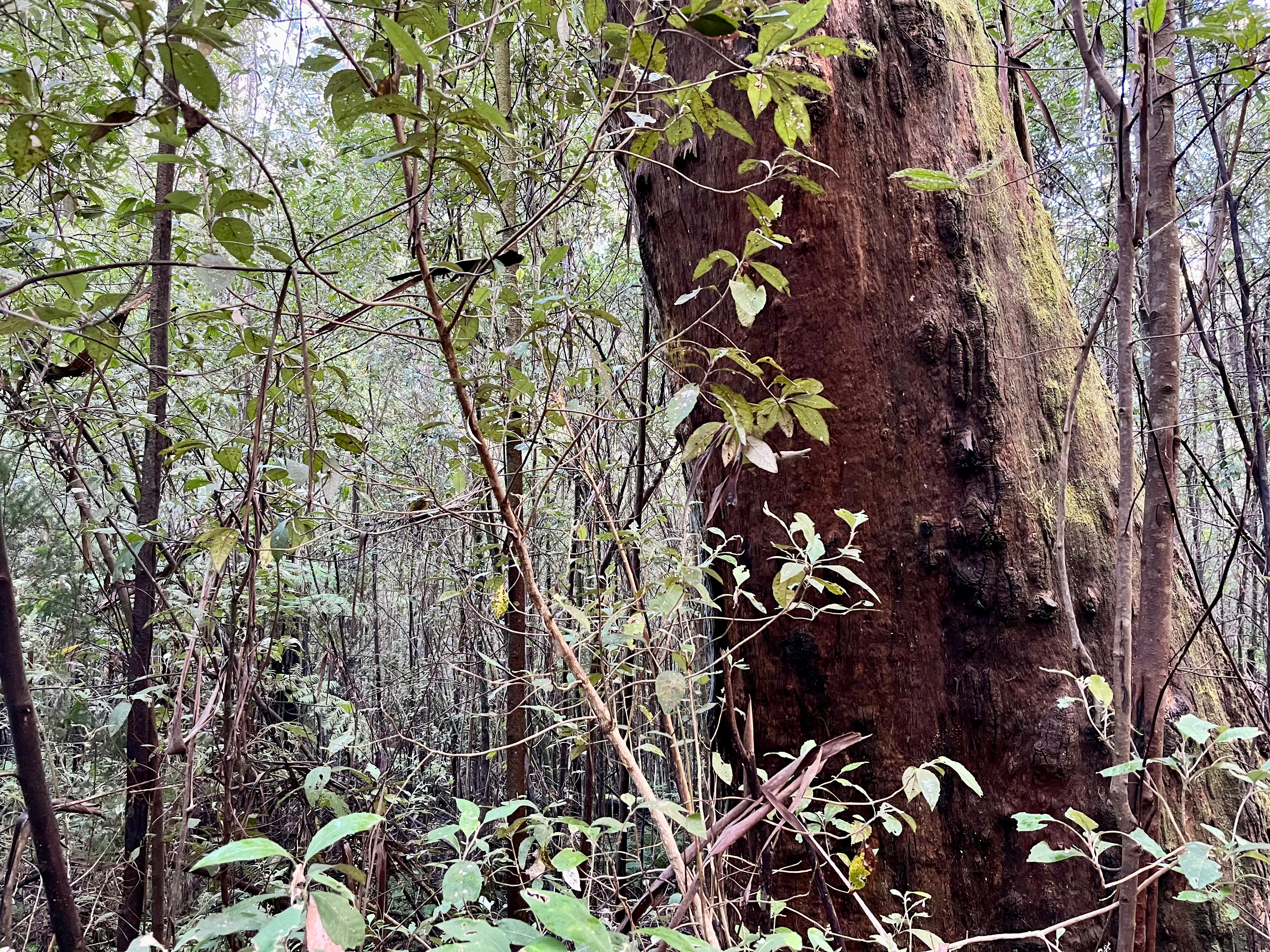
On Sunday I scratch a personal itch I have to see some big trees. This means driving for about 90 minutes in a car powered by internal combustion engine (problematic), to the hills around Kinglake West.
Victorian readers (readers from the Australian State of Victoria, rather than readers born under the rule of Queen Victoria) might remember Kinglake as somewhere severely burnt by the Black Saturday bushfires of 7 February 2009.
Driving to Kinglake, I am struck to notice that by the time I reach Whittlesea, the surrounding hills (still) feature silhouettes of burnt gum trees. Seeing evidence of devasting fires leaves an impression. I wonder about the impression it leaves on people who see this evidence every day.
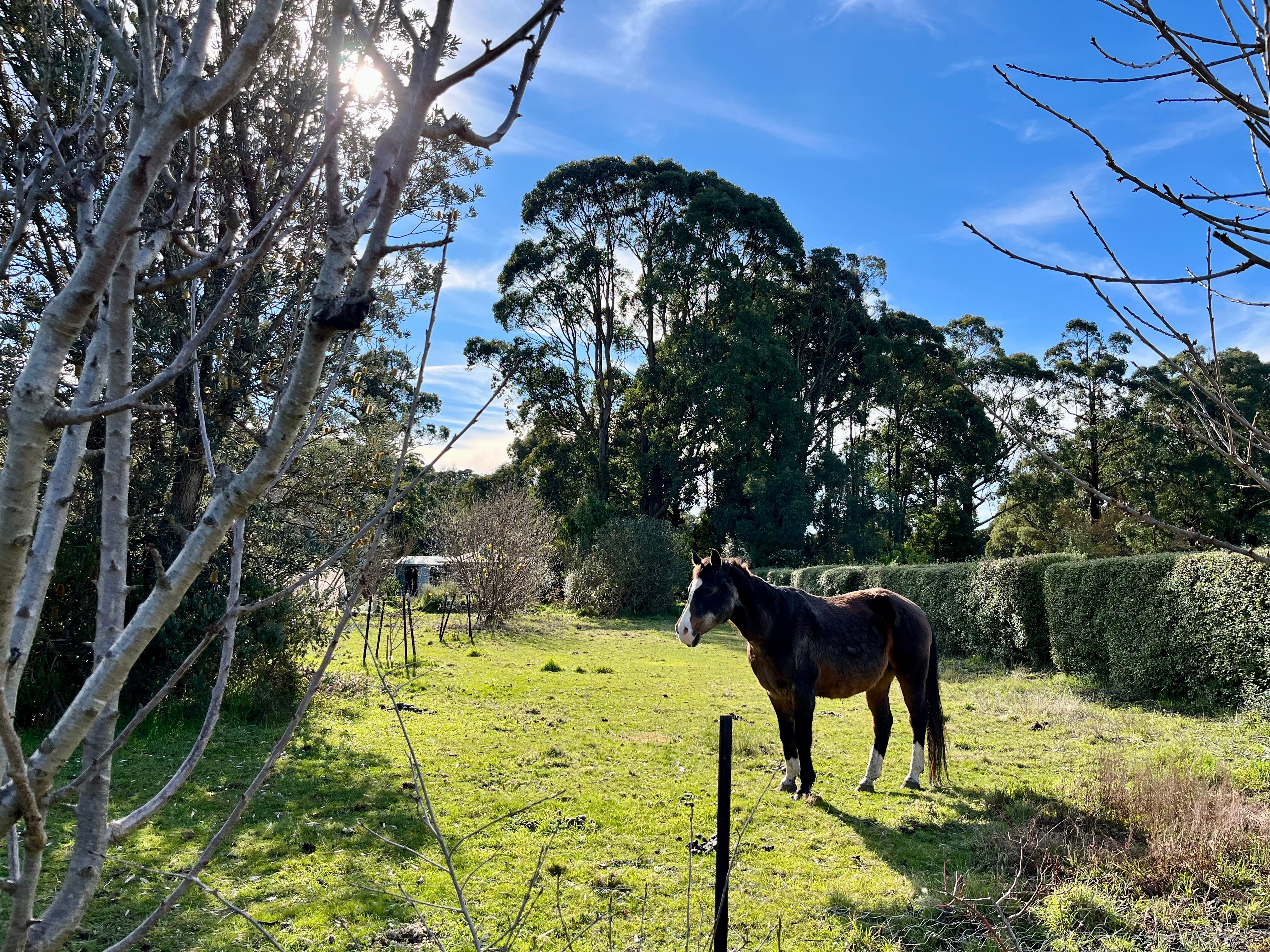
Before reaching Masons Falls, I pull over and stop to speak with a local horse. I really would like to know how the behaviour of humans in 2026 will later be viewed by future humans. The horse looks to me. The horse stands perfectly still. The horse blinks.
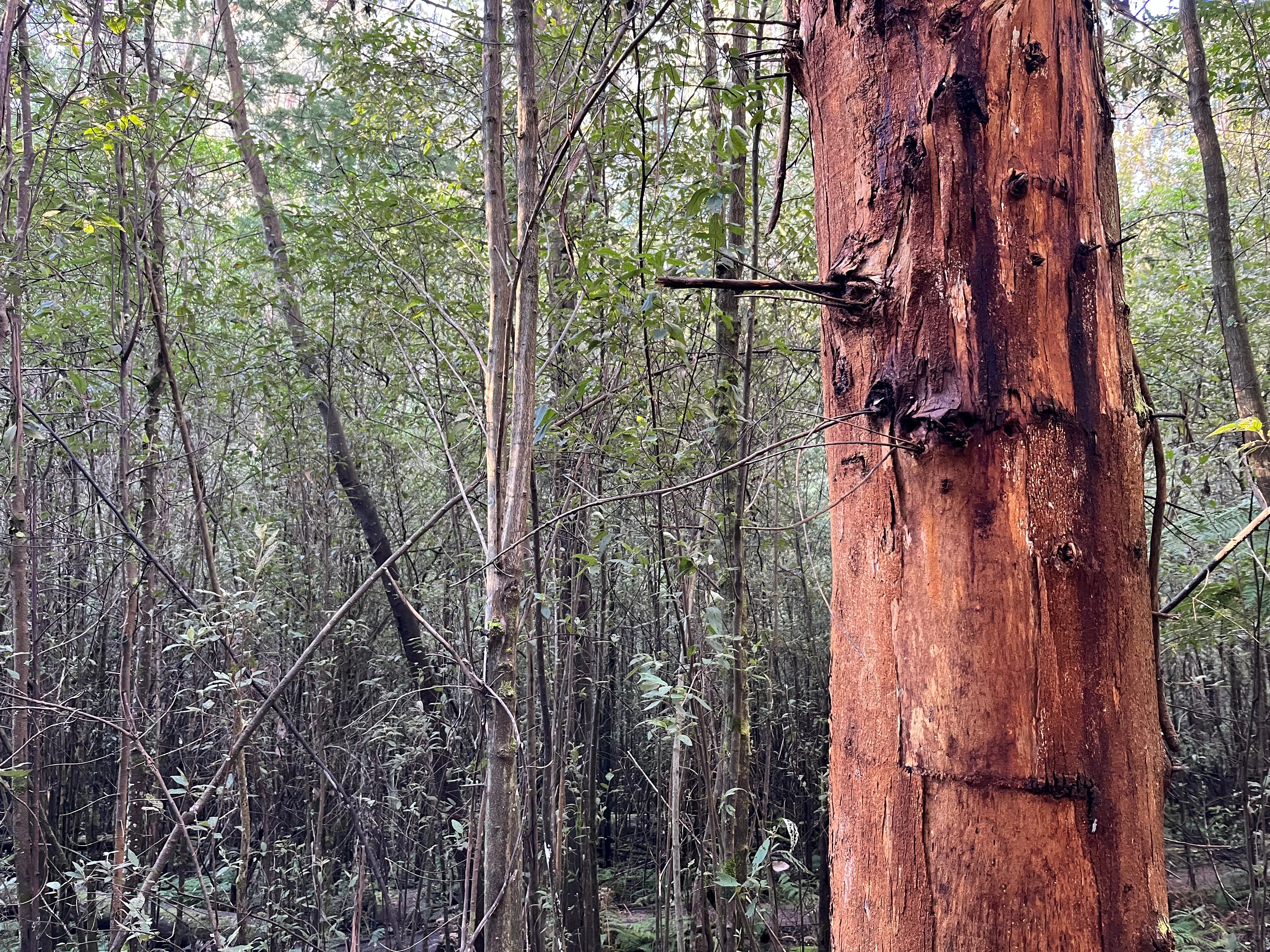
Near the Masons Falls car park, interpretive signs display information about days of yore. Days of old wood mills. Train lines through the valley. Cross-cut saws and timber selection.
I imagine that this small area of National Park forest lies on this land, on this particular fold and valley, like a handkerchief might lie on a king-sized bed sheet. Surrounding area cleared, developed, in some way “improved” my human activity. And I feel sick.
Twenty-first century summers in Victoria bring hardship and risk. Just six months ago, in January, I cancelled a camping holiday to Bright because of forecast heat and threat of bushfire. We know heat. We know fire danger. We know smoke pollution from far-away bushfire. I know that what we see now is just the start.
I know that the conditions that produced northern summer 2025 are not the same as those that are producing northern summer 2026. Conditions are getting worse. ore extreme. Summer 2027, summer 2028, … summer 2058 … all of them, each one, will be loaded with more and more energy. It’s crazy that humans have chosen this furture, but we have.
Even if we stopped burning fossil fuels now, a decades-long lag effect would still play out. The climate of the world as we knew it is over.
The United Kingdom Met Office said as much last week. Mike Kendon, Met Office climate information scientist:
“Every year is adding to the body of evidence showing climate change in the UK. We are right now living in a time of historic and unprecedented change and in terms of temperature, on annual, seasonal, monthly and daily timescales, this evidence shows the climate of the 20th Century has now gone.”
The climate of the 20th Century has now gone.
It has gone.
==
Today, Sunday, the maximum temperature at Mt Hotham, Victoria, is later shown to be hotter than ever recorded in July. The average maximum temperature at Mt Hotham in July is 1.0 °C. Prior to 2026, the highest July maximum temperature every recorded at Mount Hotham was 8.7°C, in 1994. That record has been broken three times already this month.
Tuesday 7 July 2026: 8.9 °C
Saturday 18 July 2026: 11.1 °C
Sunday 19 July 2026: 12.0 °C
The Guardian reported on this.
Thousands of excess deaths are being attributed to heatwaves in Europe already this northern summer. Wildfires in Canada are affecting cities and towns over great distances.
Things we thought we knew, we need to revisit. As such, this is conceivably a perfect time for deep humility from our species.
Instead, the loudest voices or our species are those of the latest incarnation of capitalism: the tech bros. They talk up AI and all that goes with it. But at what cost?
“We need it,” say the bros.
“If you don’t build it, someone else will,” they say.
“Don’t you want to get on the ground level?” they say.
Such arrogance. Such disdain for serious risk, serious consequences.
It has me in mind of timber millers of last century. They thought they were on a winner. Guaranteed returns from exploiting public asssets. When I look at the Tech Bros I see irresponsible, wealthy grifters.
If their profit comes at our expense, of the expense of others, they are fine with that.
Here in Australia in 2026, data centres are being approved left, right and centre – here – on the driest populated continent on Earth.
Here where I stand, the Kinglake area was logged between 1860 and 1927. At a low point in the gully, a sign reads:
“The sawmill that operated at this point between 1919 and 1922 provided pailings for use in the growing suburbs of Melbourne. All that remains of the mill now is the sawdust heap. Some of it has rotted to form soil, but the more acid sections deeper in the mound remains as a light-coloured sawdust. Lyrebirds are attracted to the mound, as it is a great source of mealy worms…”
As bright sun blazes here on a day of extraordinary warmth in southern winter 2026, I think of the explosion of data centres, the almost unfettered race to build them, to be seen to build them, to somehow court power.
I wonder: will AI and data centres really make life better? For whom? And for how long?
I wonder: what about protecting valuable things that we already have? Like access to fresh water. Like memories of what our climate used to be. As fossil fuels are still burning.
It is time to go.
Somewhere, a lyrebird calls.
The horse nods.
==
P.S. well done to World Cup winners Spain. Magnificent football.
P.P.S. Another writing competition informed me that a story of mine failed to make their long-list. No worries.
P.P.P.S. This has been Sproutings #148. Thanks for reading. Go well.
P.PP.P.S. You might enjoy Jeanette Winterson here:
Comments
Nothing yet. Say the first thing.
Sign in to join the conversation.