
Think of the Indian economy as a city that has spent years building roads but has been waiting for people to start constructing houses. For much of the post-pandemic period, the government played the contractor: highways, railways, airports, power transmission, logistics corridors. Private companies watched, calculated, saved cash, paid down debt and generally behaved like a family that has ₹10 lakh in the bank but still refuses to buy a sofa because “something may come up.”
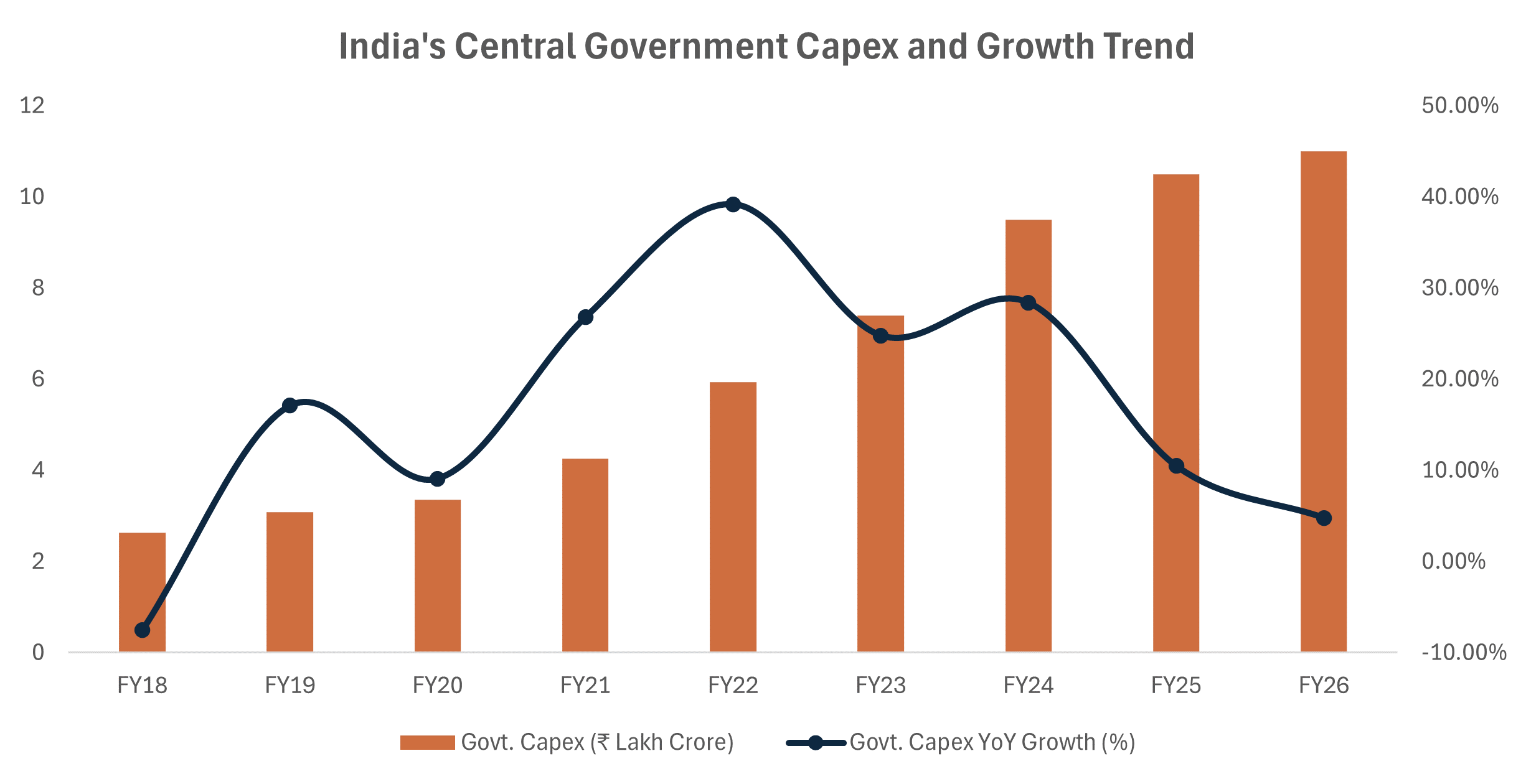
Something finally seems to have come up.
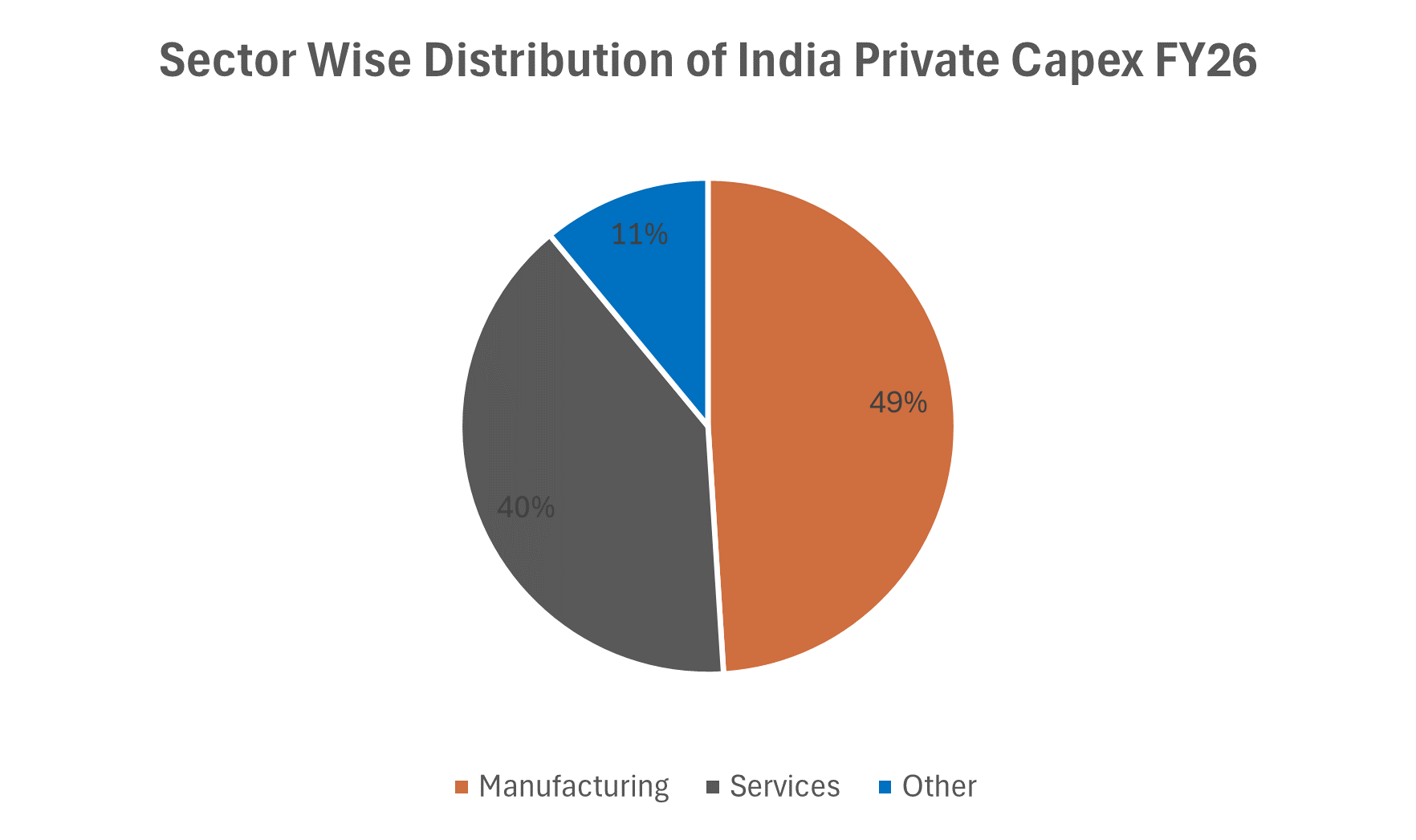
Private capital expenditure is rising sharply. The Confederation of Indian Industry’s analysis of nearly 1,200 companies in the CMIE Prowess database estimates private capex at ₹7.7 lakh crore by September 2025, up 67% from ₹4.6 lakh crore a year earlier. Manufacturing accounted for roughly ₹3.8 lakh crore, while services contributed around ₹3.1 lakh crore.
That sounds like the investment cycle India has been waiting for.
But there is a catch.
The more closely we look at the numbers, the more the story begins to resemble a giant apartment building where construction is happening at record speed but a surprisingly large share of the cranes belong to just a handful of developers.
So the question is not whether private capex has revived. It has.

The more interesting question is whether this is the beginning of a broad-based private investment cycle, or whether India is witnessing something narrower: a mega-conglomerate-led infrastructure and technology investment boom.
That distinction matters enormously.
The headline number is impressive. But before we declare the private investment cycle “back”, we need to ask a slightly annoying question: what exactly are we measuring? A rising number is useful; knowing what sits inside that number is much more useful.
The excitement around India’s private capex revival largely began with a CII analysis released in May 2026. Its headline was hard to ignore: private sector capital expenditure had risen 67% year-on-year, from ₹4.6 lakh crore in September 2024 to ₹7.7 lakh crore in September 2025. The estimate covered nearly 1,200 companies using the CMIE Prowess database, and measured private investment through the annual change in net fixed assets and capital work-in-progress. Manufacturing accounted for about ₹3.8 lakh crore, or nearly half of the total, while services contributed another ₹3.1 lakh crore.
At first glance, this looks exactly like the number we have been waiting for. After years of government-led capital formation, corporate India appears to have finally picked up the baton. But there is an important accounting distinction hiding underneath the celebratory headline. This is not a direct count of every new factory, machine or greenfield project being commissioned during the period. It is an estimate derived from changes in corporate balance sheets—net fixed assets and capital work-in-progress. That makes it a valuable measure of corporate asset creation, but it does not automatically mean that every rupee represents a brand-new productive facility entering operation.
And this is where economic journalism can get itself into trouble. A balance sheet can tell us that capital has moved. It does not always tell us exactly why it moved.
The CII data clearly tells us that corporate India is adding capital at a much faster pace than a year earlier. That is significant. Manufacturing’s roughly ₹3.8 lakh crore contribution suggests the revival is not simply a telecom or software phenomenon; metals, automobiles and chemicals are adding physical capacity. Services, accounting for around ₹3.1 lakh crore, show that the modern investment cycle is also increasingly about telecom networks, digital infrastructure and large-scale commercial assets.
But net fixed assets are not synonymous with greenfield investment. Changes in corporate asset stocks can reflect additions to productive capacity, but also acquisitions, consolidation, depreciation and other accounting effects. Capital work-in-progress is somewhat more revealing because it captures projects that are still being built, but even here the economic story is not complete until those projects become operational and generate output.
That distinction becomes especially important in India because the investment story is unusually concentrated. A sample of 1,200 companies may sound enormous, but India has millions of enterprises and an enormous MSME sector. The firms that appear most clearly in databases such as Prowess are disproportionately formal and relatively large. So when the measured corporate sector accelerates, we should resist the temptation to automatically translate that into “Indian business” accelerating uniformly.
Corporate India and India Inc. are not synonyms for the entire Indian economy.
The neighbourhood kirana owner, the small auto-component manufacturer in Pune and the textile unit in Tiruppur do not suddenly become more willing to invest because Reliance or Tata announces a ₹20,000 crore project.
That is why the next question is not merely whether capex increased.
It is who increased it.
A very large part of India’s investment wave is being driven by its largest business groups.
Take Adani. The Adani Portfolio reported FY26 capex of ₹1.53 lakh crore, the highest annual capex reported by an Indian corporate group, with nearly 80% directed towards infrastructure platforms spanning energy, utilities, transport and logistics.
Reliance Industries, meanwhile, reported FY26 capital expenditure of ₹1.44 lakh crore. Its investment agenda spans digital infrastructure, telecommunications, retail, energy and new-energy assets.
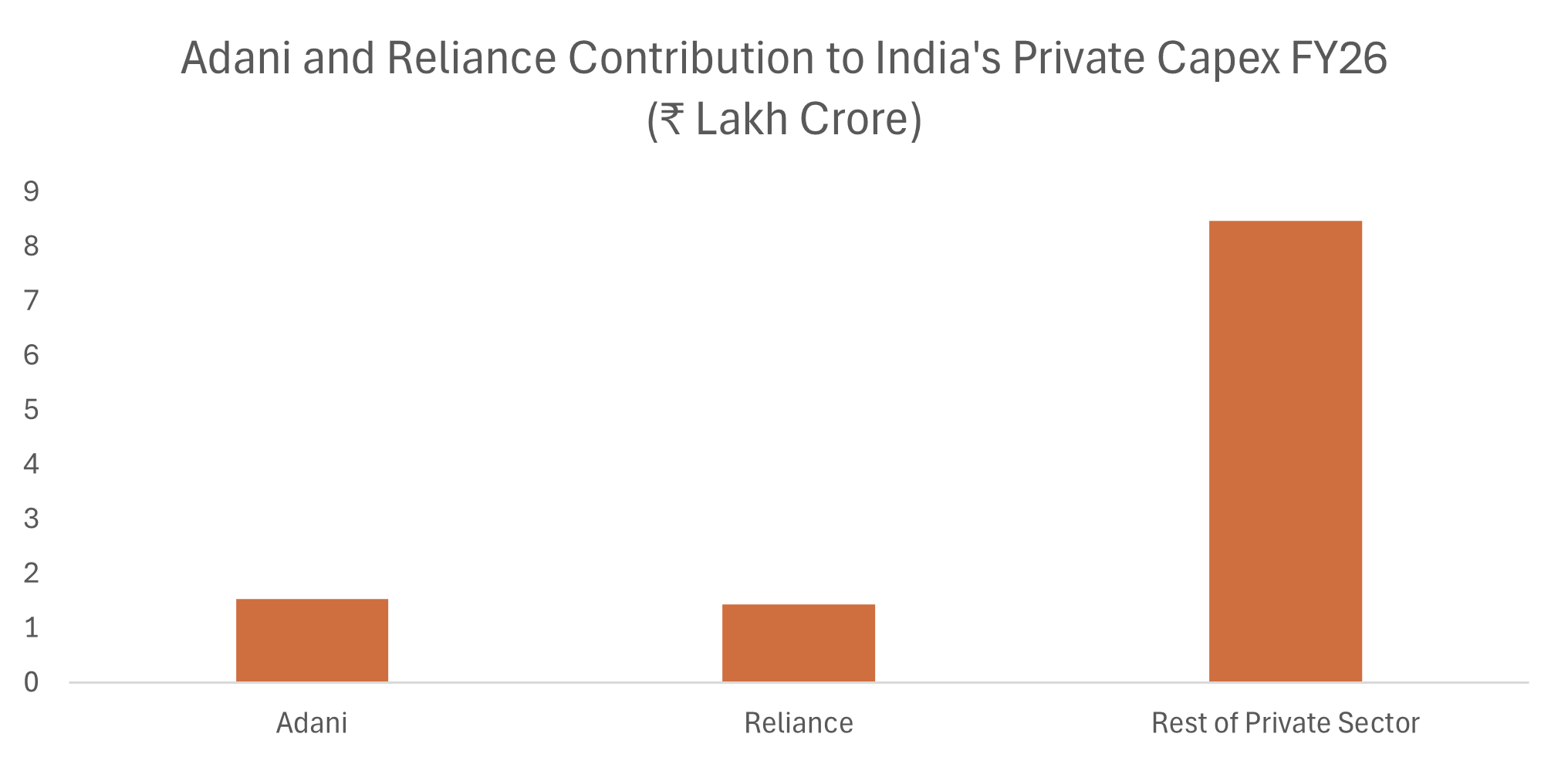
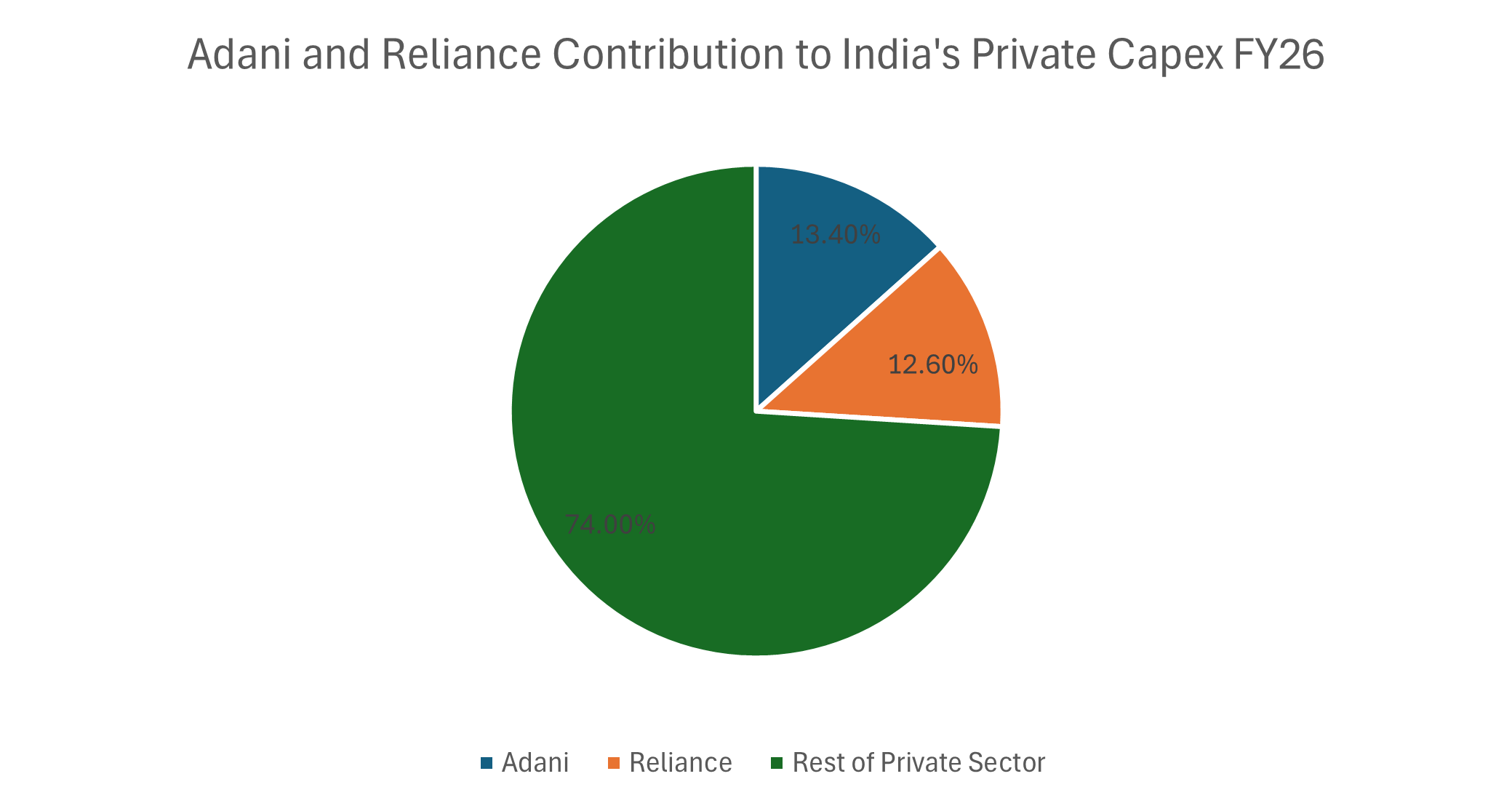
But it changes its character.
A broad investment boom would look like thousands of firms from large industrial companies to mid-sized manufacturers independently deciding that demand is sufficiently strong to justify new capacity. A concentrated investment boom looks different. A small group of firms with enormous balance sheets identify sectors with favourable structural demand, policy support and high barriers to entry, and then deploy capital at a scale that smaller competitors simply cannot match.
India is clearly seeing the second phenomenon. And perhaps that is not surprising. When an economy wants to build airports, renewable parks, power grids, data centres, telecom networks and semiconductor facilities simultaneously, it is not exactly the sort of shopping list you expect a family-owned SME in Ludhiana to finance.
Something similar is happening in digital infrastructure.
India’s data-centre expansion is an excellent example of why looking only at the number of factories can mislead us. The economy increasingly needs physical infrastructure to support something that looks intangible on a smartphone screen.
Cloud computing requires buildings. Artificial intelligence requires servers. Servers require power. Power requires generation and transmission. All of that requires land, cooling systems, fibre connectivity and enormous amounts of capital.
So the AI economy is not floating somewhere above the physical economy. It is quietly consuming the physical economy at an astonishing pace.
That makes data centres an important component of the current private capex story. But again, they illustrate the central paradox. They involve enormous capital deployment while creating relatively limited direct employment compared with a traditional labour-intensive factory.
The investment multiplier can still be large because these facilities enable entire digital ecosystems. But the relationship between capital expenditure and mass employment is becoming much weaker.
That is an important distinction for an economy like India, where job creation remains central to the development story.
The energy transition provides another window into the new capex cycle.
India is expanding solar, wind, transmission, storage and associated manufacturing capacity because future electricity demand is expected to rise dramatically. Data centres, electric vehicles, industrial electrification and urbanisation all point in the same direction.
This means a portion of today’s investment is effectively a wager on tomorrow’s demand. And that is not necessarily a problem.
In fact, that is what investment is supposed to do.
Capital expenditure is inherently forward-looking. A company does not build a factory because today’s demand was wonderful yesterday. It builds because it expects demand to justify the factory tomorrow.
But the larger the investment and the longer the gestation period, the more dangerous an incorrect forecast becomes.
This is why the current capex cycle should not be judged merely by how much money is being spent. The real test will be asset utilisation and return on capital once the assets are operational.
A ₹50,000 crore project that eventually runs at high utilisation and produces globally competitive output is transformative. A ₹50,000 crore project that spends five years waiting for demand is simply a very expensive monument.
Capital has a sense of humour like that.
One of the defining features of this cycle is that the government is not simply creating infrastructure and waiting for markets to respond.
It is actively changing the incentive structure. The PLI schemes across 14 sectors had generated more than ₹2.40 lakh crore of actual investment by March 2026, according to the government, along with more than 14.15 lakh direct and indirect jobs and exports above ₹15.2 lakh crore.
That is meaningful evidence that policy support has been able to convert at least some investment intentions into actual deployment.
But industrial policy comes with a simple economic bargain. The state can reduce the risk of entering a sector. It cannot guarantee that the sector will ultimately be competitive.
That second part has to be earned.
The difference matters because a capex boom based heavily on incentives can initially look spectacular. Factories are announced, investment figures rise and capacity is created. The real test arrives later, when the subsidy becomes a smaller part of the economics and the company has to compete on productivity, cost, quality and exports.
Now compare the new-economy sectors with traditional labour-intensive manufacturing. This is where the celebratory story becomes less comfortable.
Textiles, apparel, leather, basic consumer manufacturing and smaller fabrication businesses do not enjoy the same combination of giant government incentives, strategic urgency and barriers to entry. Their investment decisions remain much more closely connected to everyday demand, margins, working capital and access to affordable finance.
And households have not yet delivered an overwhelming consumption boom.
That is important because consumer-facing manufacturers have a much simpler investment test. They do not need to forecast India’s semiconductor ambitions or the global AI economy.
They need to answer one question:
Will consumers buy more of what we make?
When consumption is strong, a textile manufacturer can add looms. A packaged food company can add production lines. An appliance manufacturer can add another assembly line. A small auto-component supplier can buy machinery because its customer is asking for more parts.
That chain is more decentralised. It also tends to spread investment much more widely across firms and regions. The current cycle is stronger in sectors where the government or large enterprises are already creating the demand conditions.
That is why calling it a completely broad-based private capex boom would be premature.
This is ultimately where the investment story will either prove itself or disappoint.
India can build spectacular semiconductor fabs and enormous data centres and still have an underwhelming investment cycle if the thousands of businesses surrounding those assets do not invest.
The real capex multiplier appears when a large project creates orders for smaller firms. The automobile plant buys components from hundreds of suppliers. The port generates logistics businesses.
The electronics ecosystem creates demand for packaging, tooling and precision engineering. A renewable project requires cables, structures, transformers, engineering services and maintenance.
That is when capex becomes an ecosystem rather than a headline.
The danger is that a highly concentrated capex cycle creates islands of modernity while leaving large parts of the business economy stuck in cautious replacement investment.
The question is therefore not whether India’s largest companies can spend ₹1 lakh crore. They clearly can. The question is whether their spending causes ten thousand other firms to spend ₹10 crore each.
That is the difference between concentration and diffusion.
There is an easy temptation here to look at concentration and immediately conclude that something is wrong.
That would be too simplistic.
Large conglomerates are often exactly the firms capable of undertaking projects that require enormous upfront capital, long gestation periods and complex execution. A semiconductor facility, a large renewable-energy platform, a new airport, a national telecom network or a hyperscale data-centre campus cannot realistically be financed like a neighbourhood manufacturing unit.
Scale matters. Balance-sheet strength matters. Access to capital matters.
The problem arises when we mistake concentrated investment for broad investment dynamism.
A country can experience a huge rise in aggregate capex while thousands of smaller companies remain cautious. In fact, this is one of the most important things to remember when reading India’s investment numbers. The NSO survey itself captures the formal private corporate universe rather than the entire universe of Indian businesses. The MSME sector remains much more sensitive to working-capital constraints, financing costs and uncertain demand.
So there are really two capex stories running simultaneously.
One India is building semiconductor fabs, renewable parks, ports, airports and data centres. Another India is asking whether next year’s order book is strong enough to justify buying a new machine.
There is another distinction that becomes unavoidable once we start looking at large projects. India has always been extraordinarily good at announcing investment.
The difficult part is building it.
Every investor summit produces MoUs. Every MoU eventually produces a press release. Some press releases produce board approvals. Some board approvals become capital work-in-progress. Some projects eventually become factories.
The economic value begins only when the factory actually produces something.
Think of the investment process as a funnel. At the top sits an ambitious announcement. Then comes land, financing, permits, equipment orders and construction. Only at the bottom do we get a commissioned productive asset generating revenue and employment.
This distinction matters because headline announcements can rise much faster than actual capital formation.
CMIE’s project database has repeatedly shown that projects can be delayed, shelved or withdrawn as financing conditions, trade policy, input costs and geopolitical risks change. The ₹14.3 lakh crore of project withdrawals recorded in a single quarter in late 2025 is a useful reminder that corporate optimism is not the same thing as irreversible capital deployment.
In other words, the boardroom can say “approved” while the construction site is still waiting for the bulldozer.
And this is where the current cycle differs from some of India’s earlier investment booms.
The latest NSO survey provides an important counterweight to the announcement-versus-execution concern. For FY25, enterprises estimated capex of ₹180.2 crore per enterprise and actual capex of ₹173.5 crore, producing a realisation ratio of 96.3%. The gap between what companies intended to spend and what they actually spent was therefore relatively small.
That is encouraging. It suggests the current investment cycle is not simply a festival of corporate promises. Companies are, by and large, following through.
The story is therefore more nuanced than either extreme. It is not “companies are announcing everything and building nothing.” Nor is it “every announced project is already producing.”
Instead, the evidence points towards a genuine increase in capital deployment, accompanied by a normal—and sometimes substantial—filter between intention and execution.
That is exactly what we should expect in a functioning investment cycle.
So why has the animal finally begun to move?
The first reason is policy.
The government’s PLI architecture has changed the economics of entering several strategic industries. More than ₹2.40 lakh crore of investment had materialised under PLI schemes by March 2026, according to government data, alongside cumulative exports of more than ₹15.2 lakh crore.
The second reason is geopolitics.
For years, globalisation meant optimising for the lowest cost. Now companies are increasingly optimising for resilience as well. The China+1 strategy, supply-chain diversification and concerns about geopolitical disruptions have made India more attractive as an additional manufacturing base.
The third reason is balance-sheet strength.
The great corporate deleveraging of the last decade has left large Indian companies in a remarkably different financial position from the one they occupied before the previous investment bust. The NSO’s survey reinforces this point: around 65% of FY26 planned corporate capex was expected to come from internal accruals.
That is important because companies invest differently when they are using their own cash. A company that needs to borrow every rupee asks, “Can we afford this?” A cash-rich company asks, “Should we do this?”
Those are very different questions.
One reason the capex cycle should be taken seriously is that corporations are not building entirely on imagination.
The factories that already exist are getting busier.
The RBI’s capacity-utilisation data show manufacturing utilisation recovering strongly from the extraordinary low reached during the pandemic. The historic trough was 47.3% in June 2020. As economic activity normalised, utilisation rose steadily, and the latest cycle has moved well above the levels seen during the pandemic period. The RBI continues to track this through its OBICUS survey of manufacturing companies.
A useful economic intuition is that capacity utilisation is the pressure gauge of an investment cycle. At very low utilisation, companies have little reason to build new factories. They have spare machinery sitting idle. As utilisation rises, existing plants become more profitable.
Once utilisation becomes persistently high, management faces a choice: squeeze more production from the existing asset base or spend money expanding it.
The second option becomes increasingly attractive when management expects the demand increase to persist. So when we see stronger private capex alongside rising capacity utilisation, the story has a stronger economic foundation.
There is another reason this cycle looks healthier than the investment boom that ended badly in the previous decade. Corporate balance sheets have been repaired. That matters because the same project can look very different depending on the company’s financial position.
A heavily indebted company with thin margins sees a new factory as a gamble. A company with strong cash flows and manageable leverage sees the same factory as an opportunity.
The post-2010s deleveraging process fundamentally changed India’s corporate sector. Large firms spent years reducing debt, cleaning up operations and strengthening cash generation. The banking sector went through its own painful balance-sheet repair.
That earlier pain is now providing the financial foundation for today’s investment cycle. The irony is almost beautiful. India spent years complaining that companies were not investing. Companies spent those years complaining that banks were not lending. Banks spent those years cleaning up bad loans.
And now everyone has emerged from the same mess with significantly healthier balance sheets.
Sometimes economic cycles are just very long arguments followed by one surprisingly sensible decision.
The banking side of the equation also looks considerably stronger than it did during the previous investment cycle.
Bank credit expansion has accelerated, while asset quality has improved significantly from the stressed period of the mid-2010s. This matters because private capex eventually requires external finance somewhere in the system, even when the largest corporations can fund a meaningful part of investment internally.
But there is an important caveat. Access to credit is not evenly distributed. A large, cash-rich conglomerate can raise money through multiple channels and finance long-gestation projects. A mid-sized manufacturer may face a completely different borrowing cost, collateral requirement and risk assessment.
This is why the strength of large-corporate balance sheets can coexist with relatively cautious capex among smaller firms. The aggregate banking number can look healthy while the credit experience underneath remains very uneven.
And that is another reason why concentration matters.
There is something slightly unusual about India’s current investment cycle. Investment is accelerating faster than household consumption. Real gross fixed capital formation grew by 7.3% in FY24 and 6.4% in FY25 under the new GDP series, while the latest national accounts show that consumption has also remained resilient. The broader point is that investment is no longer merely responding to today’s consumer demand; increasingly, it is being placed ahead of tomorrow’s demand.
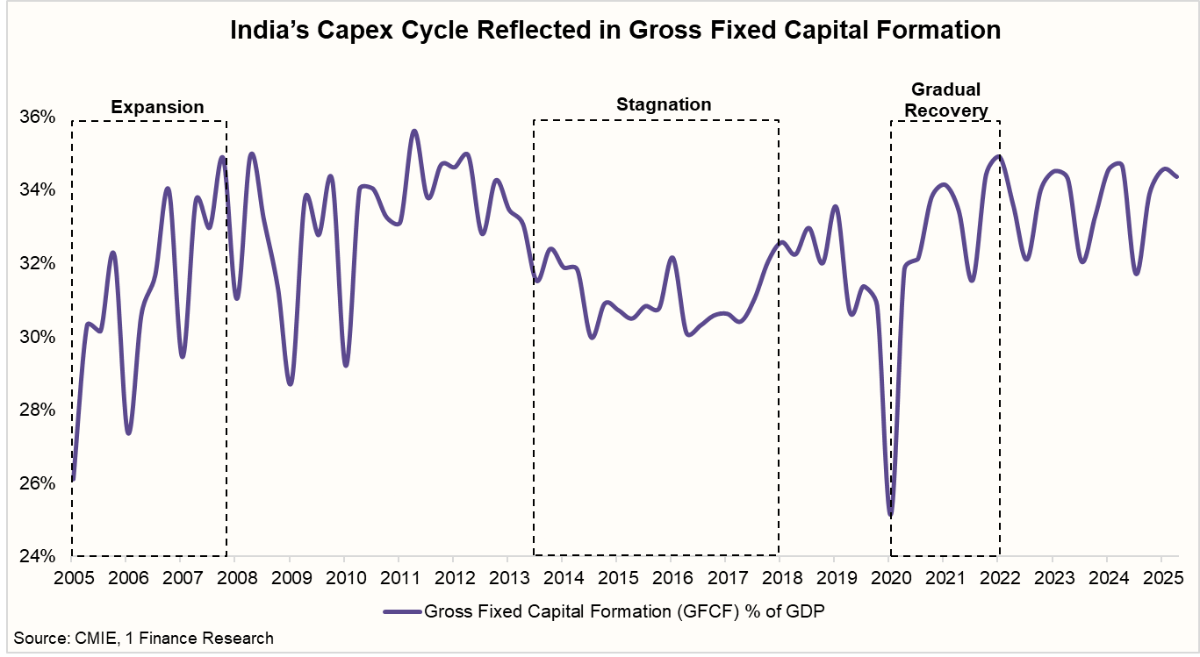
That distinction matters.
In a conventional industrial expansion, the chain is fairly intuitive. Households buy more cars, refrigerators, homes and packaged goods. Companies see their factories getting busier. Capacity utilisation rises. They add another production line. Suppliers order new machinery. Banks extend more credit. Employment rises. Wages rise. Households spend more. And the cycle feeds itself.
India’s current cycle is somewhat different.
A company building a semiconductor fab is not doing so because Indian households suddenly decided they need 28-nanometre chips for breakfast. A data-centre operator is not waiting for every family to buy another laptop before constructing a hyperscale facility. A renewable-energy developer is building capacity because electricity demand, industrial electrification and policy targets are expected to rise over many years.
In other words, a significant part of today’s capex is anticipatory.
The company is investing not because demand has fully arrived, but because it expects the economic structure of tomorrow to require the asset. That is not a weakness. In fact, it is how structural investment works. But it creates a different risk.
If demand eventually catches up, today’s excess capacity becomes tomorrow’s competitive advantage. If demand does not, today’s strategic investment becomes tomorrow’s underutilised asset. And economists, unfortunately, do not get to send a reminder email to future demand.
Eventually, however, the economy cannot escape the household.
Even when investment begins as a supply-side story, it ultimately has to translate into incomes, consumption and productivity.
Imagine a company builds a ₹10,000 crore facility. During construction, thousands of workers receive wages, contractors receive payments and suppliers sell equipment. Once operational, the facility produces goods or services. Those goods are sold domestically or exported. Profits rise. Workers are paid. Suppliers get new orders.
That is the investment multiplier at work. But the multiplier is not automatic.
A highly automated facility that creates enormous output with relatively few permanent workers has a different transmission mechanism from a labour-intensive garment factory employing tens of thousands of people.
This is why the composition of India’s capex matters so much. The country can accumulate an impressive stock of productive assets without generating an equally rapid increase in mass-market purchasing power. And that brings us to perhaps the most important question surrounding this entire investment cycle:
Will India’s new capital stock create enough income to generate the next round of demand?
This is probably the most politically and economically important part of the argument.
Capital expenditure raises GDP through investment itself, but the long-term value comes from what the new capital allows the economy to produce more efficiently.
A highly automated manufacturing facility can increase output enormously. It can also reduce the number of workers required per unit of output. That sounds contradictory until we remember what productivity means.
Productivity rises precisely because the same number of workers can produce more. The challenge for India is not that productivity-enhancing investment is undesirable. The challenge is that India has a very large workforce that still needs employment outside low-productivity agriculture.
This creates a policy balancing act. India needs capital deepening because it cannot become rich by keeping workers trapped in low-productivity activities. But India also needs sectors that can absorb labour at scale.
That means the ideal investment cycle is not one in which every rupee goes into automated infrastructure. It is one in which high-productivity capital-intensive industries create ecosystems around themselves.
The semiconductor factory may directly employ a relatively small specialised workforce, but its supply chain can support engineering firms, construction companies, equipment suppliers, logistics providers, maintenance businesses and specialised services.
The data centre may need relatively few permanent employees after construction, but the cloud economy built on top of it can employ thousands more. The renewable project may be capital intensive, but its construction, manufacturing and maintenance ecosystem can spread far beyond the plant itself.
This is the second-order effect that matters.
So, is this really a manufacturing boom? Yes but with an asterisk the size of a factory gate. India is clearly entering a new investment phase, but it is not the old manufacturing story of steel mills, textile factories and armies of workers. It is a more capital-intensive, technology-heavy story of semiconductors, electronics, renewable energy, data centres, defence and logistics.
That is good news for productivity, competitiveness and the productive capacity of the economy. But it leaves one uncomfortable question hanging in the air: can a capital-rich investment cycle become an employment-rich growth cycle?
That is ultimately what will decide whether this is merely a capex boom or the beginning of a new economic era. The cranes are up. The money is being committed. Balance sheets are healthier. The government has built much of the road. But the most important part of the journey is still ahead: whether this investment spreads beyond a few conglomerates, whether it pulls thousands of smaller firms along, whether it creates better jobs, and whether those jobs create the consumption needed to justify the next wave of investment.
India may finally have solved the problem of getting capital to move. The harder problem is what that capital does once it arrives.
Will tomorrow’s factories create tomorrow’s middle class—or simply tomorrow’s more productive machines? Will the conglomerate-led capex boom eventually diffuse into the MSME economy? And perhaps the most difficult question of all: are we building an economy that creates more capital, or one in which more Indians can genuinely share in the returns to that capital?
Sources- FinancialExpress, IndiaMacroIndicator, Mint, Ceicdata, EY, CSIS, CommunicationToday, Mint, opindia.
Comments
Nothing yet. Say the first thing.
Sign in to join the conversation.