
Essay 11 of 13
Everyone wants sustainable success. Far fewer organizations ask what has to be true for success to become sustainable in the first place. That question changes the conversation. Instead of asking how to win once, it asks how each success leaves the organization more capable of succeeding again.
Sustainable Success is not a finish line. It is the ability to keep moving, keep learning, and keep delivering value over long, uncertain horizons. It is the capacity to evolve without losing sight of why the organization exists.
By now, CHAMPS® has described how leaders choose with integrity, stay oriented around customers, measure what matters, adapt through accountability, and protect people when they help the organization face reality. Sustainable Success asks a different question: what allows an organization to keep making successful crossings while becoming stronger with each one?
Imagine a voyage across the Atlantic in the 1500s. There are no satellites. No weather radar. No GPS. No guarantee that favorable winds will last another hour. Every departure is a decision to move into uncertainty. Each day at sea is its own accomplishment: the crew survives, the vessel stays afloat, the cargo remains secure, and small repairs become the difference between continuing the voyage and ending it.
Eventually the vessel reaches port. From the dock, the story appears complete. But an experienced captain knows something different. The real value of the voyage is not simply that the vessel arrived; it is everything the voyage taught before the next departure.
The crew understands the sea a little better. The captain better understands the vessel. The shipwrights know which parts held under strain and which need redesign before the next crossing. They draw better maps. They refine their practices. They replace old assumptions with better judgment. The goal of each crossing is not merely to reach the next port. It is to arrive with a crew willing to sail again, a vessel capable of sailing again, cargo that created value, and a deeper understanding of the ocean than when the voyage began.
When people capture, share, and apply what they learn, every voyage improves the next one.
Centuries later, the crossing looks very different. Shipwrights build stronger vessels. Navigators develop more precise charts. Sailors improve communication. Designers create better safety systems. Each generation passes what it has learned to the next. Yet one thing remains remarkably familiar: the ocean remains. Storms still arrive. Conditions still change. Competition shifts. Customer expectations evolve. Uncertainty has never asked permission before appearing on the horizon.
What changed was not the environment. The vessel evolved.
That is Sustainable Success. It is not waiting for calmer seas. It is becoming better prepared for whatever seas come next.
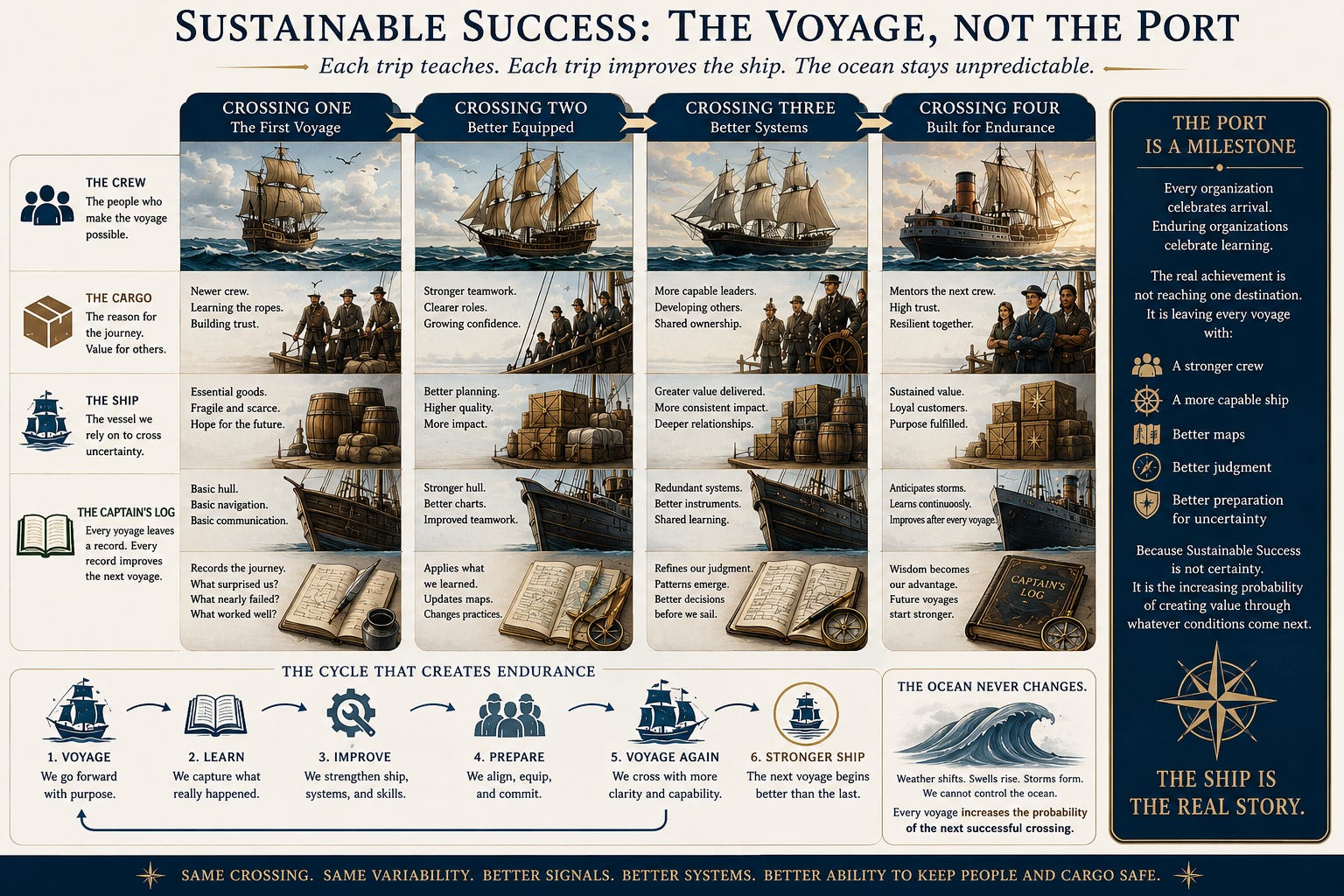
A single successful voyage proves very little. It proves the crew reached port. It does not prove they are ready for the next crossing.
Organizations often make the same mistake. They celebrate quarterly results, successful launches, acquisitions, or turnarounds as though each victory stands alone. Those accomplishments matter. They deserve recognition. But Sustainable Success asks a different question: what did this victory teach us that makes the next one more likely?
A vessel may reach port after a crossing that exhausted the crew, weakened the hull, depleted its provisions, and left little margin for another voyage. From the harbor it looks successful. From aboard the vessel it feels unsustainable.
Organizations experience the same illusion. An impressive quarter can conceal declining trust. A successful launch can leave teams burned out. Record profits can mask deteriorating customer relationships. A celebrated turnaround can quietly consume capabilities that took years to build.
Sustainable Success asks a harder question.
Can we keep doing this? Can we continue creating value for customers, developing our people, adapting to changing conditions, and strengthening the enterprise itself—not just once, but repeatedly? If the answer is no, today’s success may simply become tomorrow’s constraint.
One voyage rarely transforms an organization. Repeated voyages do.
Each crossing leaves behind more than delivered cargo. It leaves behind judgment. It leaves behind stronger relationships. It leaves behind better questions. It leaves behind improved systems. Most importantly, it leaves behind a more capable vessel. Every voyage becomes an investment in the next one.
Organizations evolve in much the same way. Markets shift. Technology advances. Competitors emerge. Customer expectations change. Regulations evolve. Organizations cannot control the ocean. They can continually improve the vessel that carries people, purpose, and value through it.
Looking back across the previous essays, it becomes easier to see that none of these functions stands alone.
Customer-Centric Mindset gives the voyage purpose because the cargo is the value entrusted to customers. High-Integrity Leadership shapes the choices people make when conditions become uncertain. People-Protected Culture ensures that reality reaches the captain instead of disappearing below deck. Metric-Driven Excellence helps the crew distinguish changing conditions from comforting stories. Agility & Accountability allow the vessel to adjust course before small deviations become dangerous.
Used together, these functions help the organization evolve.
Sustainable Success is different. It is not simply another function. It is what emerges because every voyage leaves the organization better prepared for the next one. Organizations that endure are not those that avoid uncertainty. They are the ones that continue learning from it.
Sustainable Success rarely announces itself through dramatic moments. It reveals itself quietly through patterns that become visible over time.
The first appears in how organizations pay for their victories. Some wins leave people exhausted, trust diminished, and systems weakened. Other wins leave the enterprise more capable than it was before the journey began. The difference rarely appears in a quarterly report. It becomes obvious only after years of repeated crossings.
The second appears when conditions become difficult. Storms reveal the quality of a vessel more honestly than calm seas ever can. Organizations committed to Sustainable Success do not pretend uncertainty can be eliminated. They learn, repair, recalibrate, and continue the voyage.
The third appears in how leadership thinks about time. Some organizations optimize for the next quarter. Others invest in the next decade. That difference shows up in seemingly ordinary decisions: whether people capture lessons, improve systems, develop capability, and leave each crossing better prepared for the next one.
These patterns rarely fit on a dashboard. Yet over time they determine whether success becomes repeatable or accidental.
The phrase Sustainable Success can sound static, as though success is a destination that, once reached, remains permanently secured. CHAMPS® argues almost the opposite.
Success is a living process. Every voyage becomes an opportunity to evolve. Every customer interaction becomes feedback. Every difficult decision becomes a lesson. Every setback becomes information. Every successful crossing becomes an investment in the probability of the next successful crossing.
Organizations that think this way stop asking whether they have arrived. Instead, they ask whether they are becoming more capable of serving tomorrow’s customers than they were yesterday’s. That subtle shift changes everything. Progress is measured not only by where the organization arrives, but by what it becomes along the way.
By now, the six CHAMPS® functions should feel less like separate ideas and more like parts of a living system. They were never intended to stand alone. They reinforce one another.
Customer focus provides purpose. Integrity allows truth to enter. People-Protected Culture allows truth to travel. Metrics preserve reality. Agility changes behavior. Over time, the organization evolves.
Sustainable Success is what emerges because the entire system continues learning from each voyage instead of merely surviving it.
Every organization celebrates reaching port. They should. Arrivals matter. But ports are milestones, not destinations. The real achievement is leaving every voyage with a stronger crew, a more capable vessel, better judgment, and a deeper understanding of the ocean than when the journey began.
The ocean remains. The voyages continue. The vessel evolves. Every crossing becomes an investment in the probability of the next successful one.
That is Sustainable Success.
Dr. Mel Davis Jr., Conductor of the CHAMPS® Leadership System
Follow on LinkedIn and X (@DrMelDavisJr) for more essays and tools on high-integrity leadership and sustainable success.
No posts
Comments
Nothing yet. Say the first thing.
Sign in to join the conversation.