
AI was used to translate around 20 minutes of talking out the entire post. The post was then edited fully by a human.
In our phylogeny of agents post, we argued that different scientific fields evolved different conceptions of agency — like Darwin’s finches evolving different beaks for different feeding environments. Control theory, economics, biology, cognitive science, and AI research all use the word “agent” to mean different things. The idea is that we put on our anthropologist hat and we say “huh, I wonder if there’s anything to gain in exploring why that is?”
What we argued for in the phylogeny post was that we should look at the evolutionary history of agency. Yet in order to look at the history of agency we first need to know what the conceptions already are in different fields.
We’ve been wanting to do this for some time and we don’t know exactly what a good output would look like so before embarking on this longer project we would like to get some feedback on what outputs would be useful.
Following Dennett’s intentional stance and ideas similar to DeepMind’s “Agency is Frame-Dependent” paper, we’re treating agency as a compression strategy observers use. Our frame is that different fields compress differently because they face different prediction challenges and that they therefore treat what an agent is differently. We want to map those compressions across fields and understand why they differ.
It’s better to see this is an operation trying to gather clues rather than an operation trying to solve the problem. That is, we’re not making an ontological claim that Dennett’s intentional stance is what agency is, we’re rather suspending our disbelief and trying to see if treating “agency” from the intentional stance perspective leads to interesting observations that might then be used to provide evidence for or against theories of agency.
We’re going to write a series of short posts, one per domain. Each post will take a specific field and try to compress its conception of agency down to the core: what’s the concrete system this field treats as its canonical agent, what features does their model require, and why does that compression make sense given what they’re trying to predict?
We’ll try to identify the sub-functions and sub-modules that each field treats as essential, draw connections to how other fields handle the same features differently, and look at where bridging functions exist between fields — places where the same underlying structure shows up in different mathematical clothing. (The broader methodology behind this — why we think cross-field composition with verification is the right approach — is described in A Compositional Philosophy of Science for Agent Foundations.)
For each domain, we’re going to write our initial take and then verify it with an actual expert in that field. We’ll invite a researcher onto a conversation or podcast where we present our characterization and ask them to correct it — what did we get right, what did we get wrong, what are we missing? Each domain will then have both a written post and a recorded conversation.
We can’t say exactly what each post will look like because the expert conversations will shape them. But the rough sequence of domains we’re planning:
Control theory / cybernetics — the simplest case. Thermostat as canonical agent. Minimal features, clear engineering motivation, establishes the baseline.
Economics / behavioral economics — where strategic reasoning enters. Bounded rationality, level-k thinking, why memory and learning become necessary for prediction and the difference between agents in single vs repeated games.
Evolutionary systems — population-level dynamics. How sophisticated collective outcomes emerge from minimal individual agency.
Developmental biology — Levin’s multiscale competency architecture. Cells, tissues, organisms as agents at different scales.
Active Inference & Cognitive Science — looking into questions about theory of mind, self-reflection and action perception loops among other things.
Machine Learning - what are the existent ideas about what an agent is within machine learning and how does it couple with what other fields are thinking?
We’ll see what happens after this but we might try to put together a paper with the findings.
We’ve been thinking about different ways of expressing the outputs of this project and we want to figure out what will be most useful. One artifact we’ve considered is a comparison table — something like a matrix of fields against features (goal-directedness, memory, strategic reasoning, theory of mind, etc.) showing which features each field treats as necessary versus optional for their models to work:
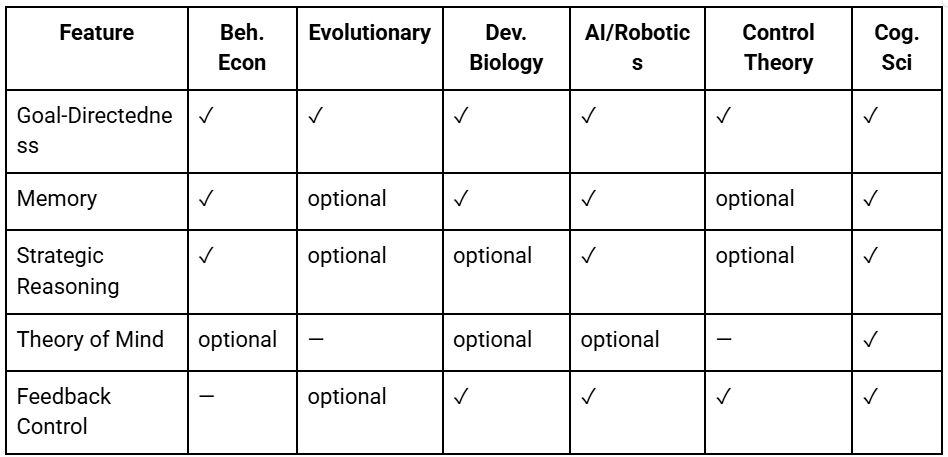
Table: This is an initial table we created from a literature review we did with around 10-15 papers in each field. It’s a bit long and we’re not certain about the validity of it so see this more as a potential output than something verified.
Whether that’s actually the most useful artifact is an open question though. Maybe a translation guide between fields would be more practical — showing when an economist’s “utility function” and a control theorist’s “setpoint” and a biologist’s “fitness landscape” are pointing at the same underlying structure. Maybe it’s the bridging functions themselves that matter most. Maybe it’s something we haven’t thought of.
What would be useful? If this project produced one thing you’d actually use or reference, what would it be? A table? A translation guide? A set of diagnostic questions? Something else?
On domains: Are there fields we’re not covering that would significantly change the picture? Mechanism design, multi-agent systems, and artificial life all sit awkwardly across our current categories. What else should be on the list?
On experts: For any domain you know well — who should we be talking to?
On the frame: Does the Dennett-style frame-dependent approach seem productive, or do you think agency really is a natural kind rather than a compression strategy? How do you make the anthropologist strategy as useful as possible?
On connections: If you work across fields and have noticed places where different agent concepts create confusion or where translations between fields have been productive, we’d love to hear about it.
No posts
Comments
Nothing yet. Say the first thing.
Sign in to join the conversation.