
For years, the assumption has been simple: if equality is the law, then equality can be enforced.
That assumption is beginning to break.
Not because the argument for equality is weak. Not because the facts are unclear. But because even when equality is argued directly — inside a courtroom, under the Constitution — the system responsible for recognizing it can step back and say, in effect, that it does not have the authority to act.
On March 24, 2026, in federal court in Massachusetts, the argument was made plainly: that the Equal Rights Amendment has already met the requirements of the Constitution, and that equality under the law should be recognized accordingly.
The response was not that the argument was wrong.
It was that the court is bound — by precedent, by hierarchy, by what higher courts have already allowed — and therefore could not declare it.
That distinction is easy to miss, but it changes everything.
Because it means the question is no longer just whether equality exists under the Constitution.
It is whether any court will move beyond established precedent to say so.
This is the gap most people don’t see.
We tend to think of equality as something that either exists or doesn’t — something written into law, decided, settled. But what this moment reveals is something more difficult to confront.
Equality can exist in principle, and still not be enforceable in practice.
Not because anyone is openly rejecting it. Not because the argument fails. But because the system operates through layers of deference — to precedent, to hierarchy, to process — that allow courts to decline to act even when the underlying claim remains unresolved.
The law can say one thing. The system can do another.
At this point, the Equal Rights Amendment begins to take on a strange quality — existing in a state that feels both recognized and unrecognized at the same time. As Jesse Wegman once described it, something like a constitutional version of Schrödinger’s Cat — both part of the Constitution and not, depending on how and where it is treated.
Over time, that ambiguity is replaced by an assumption:
if equality were truly required, it would already be enforced.
In the Massachusetts federal courtroom, during the hearing in EQUAL MEANS EQUAL v. Trump, I witnessed something I had not seen this clearly before.
As Wendy Murphy argued on behalf of EQUAL MEANS EQUAL, the case was presented plainly: that the Equal Rights Amendment has met the requirements of the Constitution, and that equality under the law should be recognized accordingly.
It was evident that the argument was strong — coherent, grounded, and directly responsive to the law. And as I watched the judge engage with it, there was a point where it seemed possible that he not only understood it, but had an affinity for it — for the logic, for the argument, and for what was at stake.
That there was, in fact, a path available to him to recognize it.
I had seen something related before — but inverted. In a state legislative hearing in Missouri, I watched similarly grounded arguments met not with restraint, but with open hostility — religious and political certainty overriding reason entirely.
This was not that.
Here, the reasoning held.
And then something else happened.
Not a rejection of the argument, but a shift away from it.
A return to structure — to precedent, to hierarchy, to what higher courts have chosen not to allow, and to the expectation that a lower court does not move beyond those boundaries.
It was subtle. Procedural. Entirely within the rules.
And yet the effect was unmistakable.
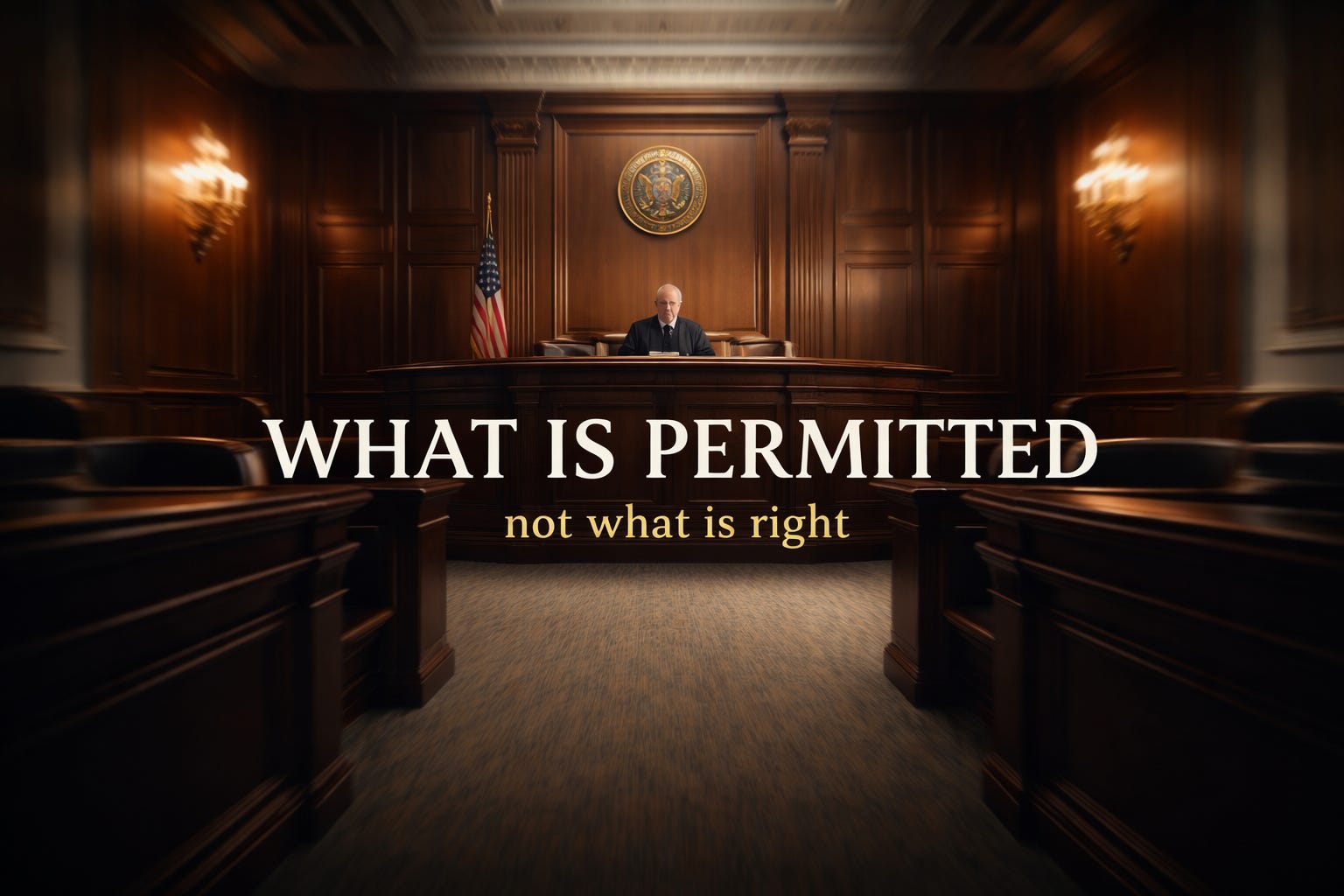
The question was no longer what was right, or even what was possible.
It was what was permitted.
It came into focus the way an image shifts in a dolly zoom — the subject held steady, while the background stretched and receded. The argument remained intact. What changed was everything around it.
Even within a system made up of individuals who may understand the argument — who may even agree with it — outcomes are governed by a deeper pressure to remain within established lines.
Not necessarily out of bad intent, but out of adherence to the structure itself.
And that structure has its own gravitational pull.
The system does not need to punish deviation.
It only needs to normalize non-deviation.
This is not without precedent.
It reflects a pattern that has been in place for decades.
As I wrote previously in When the Court Chose to Wait, which you can read here, the Supreme Court came close in the early 1970s to recognizing sex discrimination as a violation requiring the highest level of constitutional protection — and then stopped short.
Rather than fully establish that standard, the Court deferred — in part on the assumption that the Equal Rights Amendment would resolve the question.
It never did.
What followed was not a return to finish that work, but the adoption of a lower standard — one that acknowledges inequality, but does not treat it as constitutionally intolerable.
That structure remains in place.
Which means that what appeared in the courtroom was not a new limitation, but a familiar one.
A system that can recognize the strength of an argument — and still decline to act on it.
It’s also important to be clear about what this case is — and what it is not.
EQUAL MEANS EQUAL v Trump not about drafting women.
It is not about expanding military obligation.
The Selective Service issue arose in this case under very specific circumstances. Two separate lawsuits had already been filed — one in California, one in New Jersey — both brought by men’s rights organizations (cases linked above). Those cases asked courts to require women to register for the draft, while leaving intact a system in which women do not have full and equal constitutional protection.
This case responded to that posture.
Not to argue for military inclusion as a goal in itself, but to challenge the contradiction it exposed: that women could be asked to assume the same obligations as men — even to risk their lives — while remaining subject to a lower standard of legal protection under the Constitution.
The Selective Service law, in that context, becomes something else.
Not a policy objective, but a clear example.
A place where inequality is not hidden in discretion or practice, but written directly into law: men must register. Women cannot.
And where the deeper question becomes unavoidable — not whether women should be included, but whether equality under the law is being applied at all.
What begins to emerge from this is a different understanding of the problem.
The barrier to equality may no longer be whether women deserve it, or whether the Constitution can support it.
The barrier is whether the system is willing — or able — to recognize it.
And, more fundamentally, whether it is capable of examining itself when the conditions it was built on have changed.
For decades, the assumption has been that progress would move forward through clearer laws, better arguments, and broader agreement. That once equality was articulated strongly enough, it would be enforced.
But what happens when the argument is clear, the facts are established, and the system still declines to act?
The Equal Rights Amendment has already been ratified by three-fourths of the states — the constitutional threshold required for adoption — and public support for constitutional sex equality consistently exceeds 80 percent.
What this moment suggests is that inequality does not persist only because it is actively defended.
It persists because the system does not require itself to resolve it.
Because a system built on precedent and hierarchy can continue to function while leaving the question open.
And over time, what remains unresolved begins to look settled.
What this moment also makes clear is that the path forward cannot rely on a single argument, or a single mechanism.
For years, the focus has been on recognition — on establishing that equality exists, and should be acknowledged.
But when recognition alone does not produce enforcement, the strategy has to expand.
Not away from equality, but into the structure that governs how it is applied.
This means engaging the Constitution more directly — through the guarantees of equal protection under the Fifth and Fourteenth Amendments — and confronting the standard that has allowed unequal treatment to persist.
As Justice Antonin Scalia once observed, “The Constitution does not require discrimination on the basis of sex. The question is whether it prohibits it.”
What that means in practice is often overlooked.
Judges are not required to treat women unequally.
Which raises a different question entirely: why we continue to accept outcomes in which judges choose to treat women unequally, even when they are not required to do so.
That means not accepting a lower level of protection as given.
Not treating it as settled.
But challenging the standard that permits unequal treatment, repeatedly, in the courts where it is applied.
This is not about a single case.
It is about pressing the question, repeatedly, in courts across the country until it can no longer be deferred.
Alongside the Equal Rights Amendment claim, we filed a separate Equal Protection claim under the Fifth Amendment. The court did not issue a final decision on that question. It has been taken under advisement, and a written ruling will follow.
This is not the end of the argument.
It is a shift in how the argument is made.
Not only about what the Constitution requires, but about how that requirement is applied — and whether courts will enforce it at all.
What is now visible is a system that does not require equality to be enforced.
And once that becomes clear, the work changes.
It moves from asking whether equality matters to requiring that it be applied — within the framework that already exists.
What changes now is not the argument, but its persistence.
Not a single case, but a pattern that continues until it can no longer be set aside.
This is not a single moment.
It is a sustained effort.
And it is already underway.
No posts
Comments
Nothing yet. Say the first thing.
Sign in to join the conversation.