
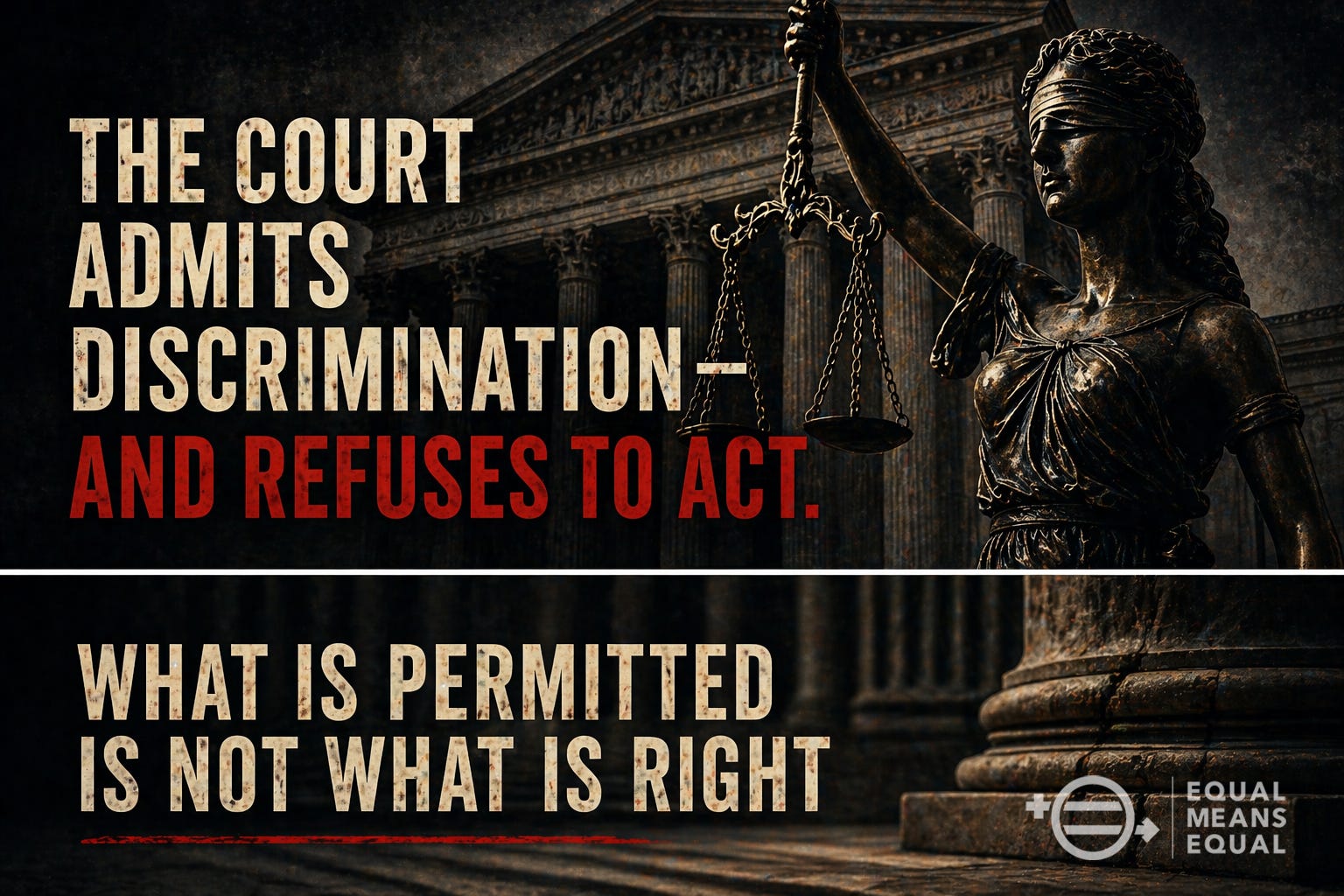
This week, a federal court made something unmistakably clear:
A woman who is denied the right to register for the draft because she is a woman suffers a real legal injury.
The court says so.
It acknowledges that our plaintiff, Jacqueline Fenore, is rejected from the Selective Service system solely because of her sex — and that this exclusion is a concrete, personal harm.
That should be the beginning of accountability.
Instead, it is the end of the case.
Because after recognizing the discrimination, the court refuses to act.
The ruling exposes a contradiction that defines the legal status of women in America today:
Women can be harmed.
Women can be discriminated against.
Women can even be recognized by the courts as having suffered a real injury.
But women still cannot get relief.
The court dismisses our claims not because the discrimination doesn’t happen — but because it says it is bound by a 1981 Supreme Court decision, Rostker v. Goldberg, which upholds a male-only draft.
That decision is based on a world that no longer exists.
At the time, women were excluded from combat roles. Today, they are not.
And yet, the court’s position is simple:
Until the Supreme Court revisits the issue, discrimination stands.
It would be easy to read this case as a narrow dispute about military policy.
It is not.
The draft is one of the clearest places where sex-based discrimination is written directly into federal law.
A woman attempts to sign up for the selective service.
She is rejected.
Not because of her ability.
Not because of her willingness to serve.
But because she is a woman.
And the court agrees this happens.
What this case exposes is something much larger:
If a law openly discriminates on the basis of sex, and the courts acknowledge that discrimination but still refuse to intervene, then the question is no longer about one statute.
It is about whether sex discrimination is meaningfully prohibited at all.
Because the same legal structure applies everywhere.
In cases of violence.
In family courts.
In workplace discrimination.
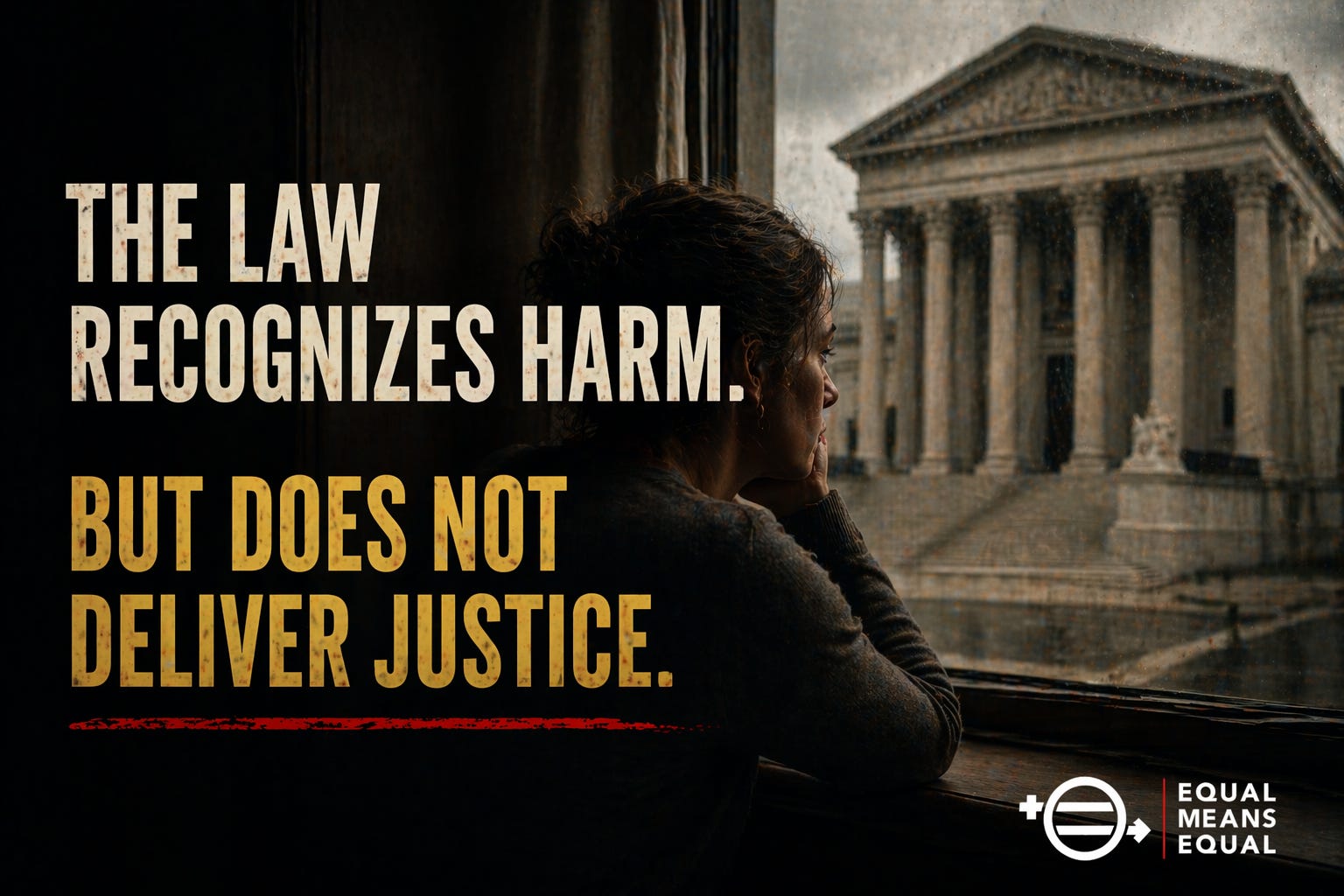
The law may recognize harm.
But without a constitutional standard that requires enforcement, recognition does not lead to justice.
The court does not dispute the facts.
It does not dispute that:
A qualified woman attempts to register
She is denied
The denial is based solely on sex
The court does not dispute that this is discrimination.
In fact, it explicitly holds that this kind of exclusion creates a real injury — what the law calls a “stigmatic injury” — caused by being personally subjected to unequal treatment.
This matters.
Because for years, women have been told they cannot even get into court to challenge systemic discrimination.
Now a federal court says the opposite.
A woman denied equality can get into court.
Yet still, equality is denied.You can review the full case record, including the briefs and the court’s ruling, here:
https://equalmeansequal.org/legal-actions/
For decades, Americans have been told that equality for women is already the law.
That discrimination is illegal.
That the Constitution protects women.
But that belief depends on something critical:
Enforcement.
This ruling shows what happens in its absence.
A court can acknowledge discrimination.
A court can acknowledge harm.
And still refuse to act.
That is not a functioning guarantee of equality.
It is the appearance of one.
The court also dismisses EQUAL MEANS EQUAL, the organization, on procedural grounds.
Not because the harm isn’t real.
Not because the discrimination doesn’t occur.
But because of technical rules governing how organizations must identify members in order to bring claims.
This is how systemic inequality is preserved — not through direct denial, but through procedural narrowing.
Women are told to bring individual cases.
And when they do, they are told the courts cannot act.
We do not bring this case because we expect a trial court to overturn decades of precedent.
We bring it to expose the reality of how inequality persists.
Not through explicit rejection — but through a system that:
Recognizes discrimination
Acknowledges harm
Refuses to enforce equality
This is not a failure of argument.
It is a demonstration of the limits of the current legal framework.
The court made clear that it believes only higher courts can address this issue.
So that is where we go.
We appeal.
Because now, the question cannot be avoided:
If a woman is denied a right solely because of her sex — and the courts admit that harm — on what basis can that discrimination continue?
For decades, Americans have been told that equality is already guaranteed.
This ruling shows something very different.
Even when discrimination is acknowledged, it is not remedied.
Even when harm is recognized, it is not corrected.
Equality, in practice, remains conditional.
This case now moves to appeal.
That is where the real constitutional questions will be decided.
If higher courts are forced to confront this issue, they will have to answer a question the lower court avoids:
Can the government openly discriminate on the basis of sex — even when that discrimination is acknowledged?
That fight does not happen on its own.
It happens because people decide it matters.
If you are reading this, you are already part of that awareness.
If you want to be part of what comes next — in the courts, in public awareness, and in ensuring this issue cannot be ignored — there are two ways to support this work:
Subscribe to stay informed as the case moves forward:
Or support EQUAL MEANS EQUAL directly so we can continue to bring these cases and push them as far as they need to go:
https://equalmeansequal.org/donate-to-equal-means-equal
This is not the end of the case.
It is the beginning of the next stage.
No posts
Comments
Nothing yet. Say the first thing.
Sign in to join the conversation.