
Welcome to the Epoch Brief! Plenty has landed since the last edition:
The launch of the expanded FrontierMath: Open Problems, our benchmark of unsolved problems in research mathematics.
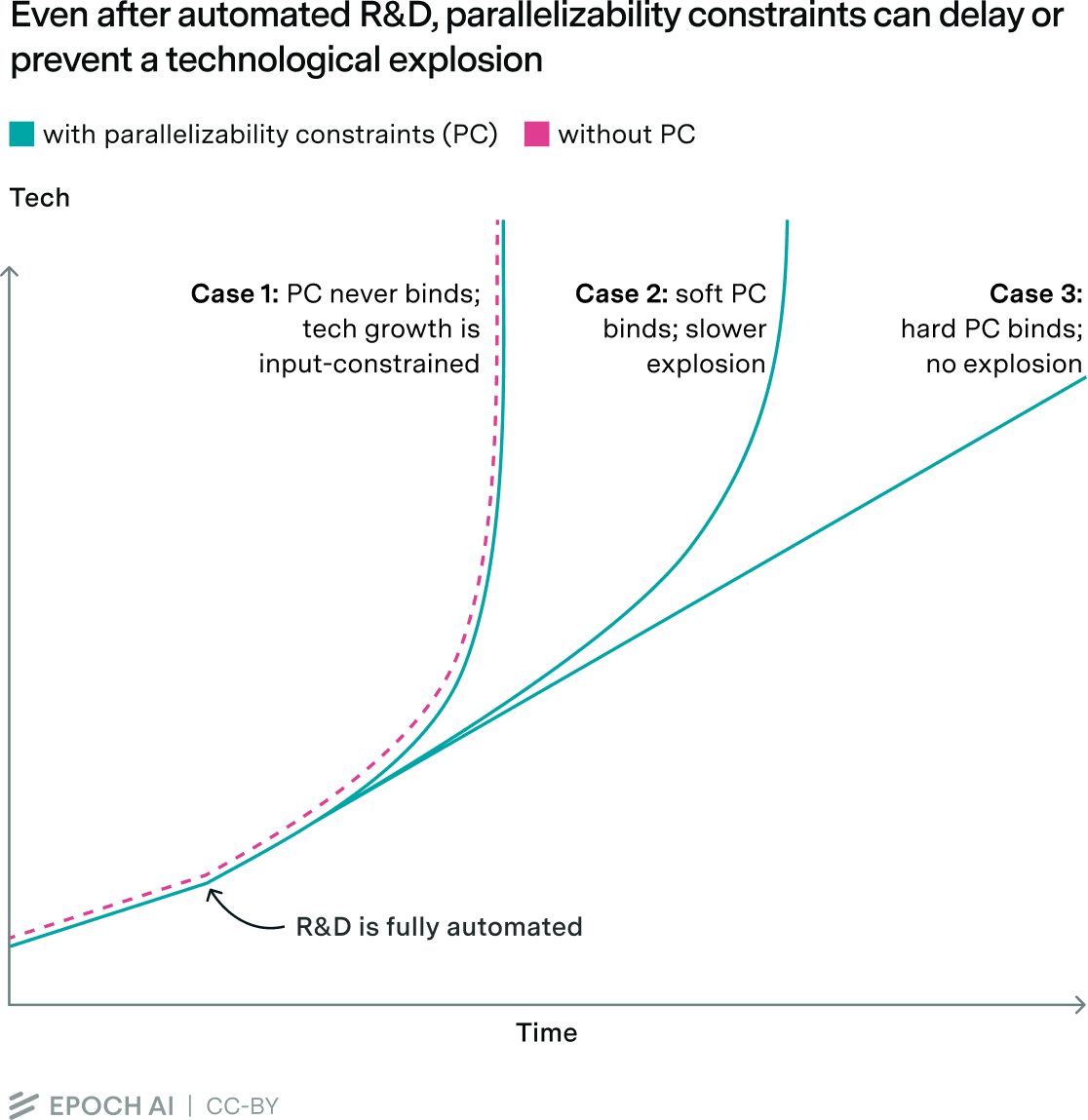
A report on the parallelizability of AI R&D, a critical and overlooked parameter for determining when, or even if, a technological singularity will happen.
A guide for what you need to know about AI's growing energy demands, including the reality of its impacts on climate and local communities.
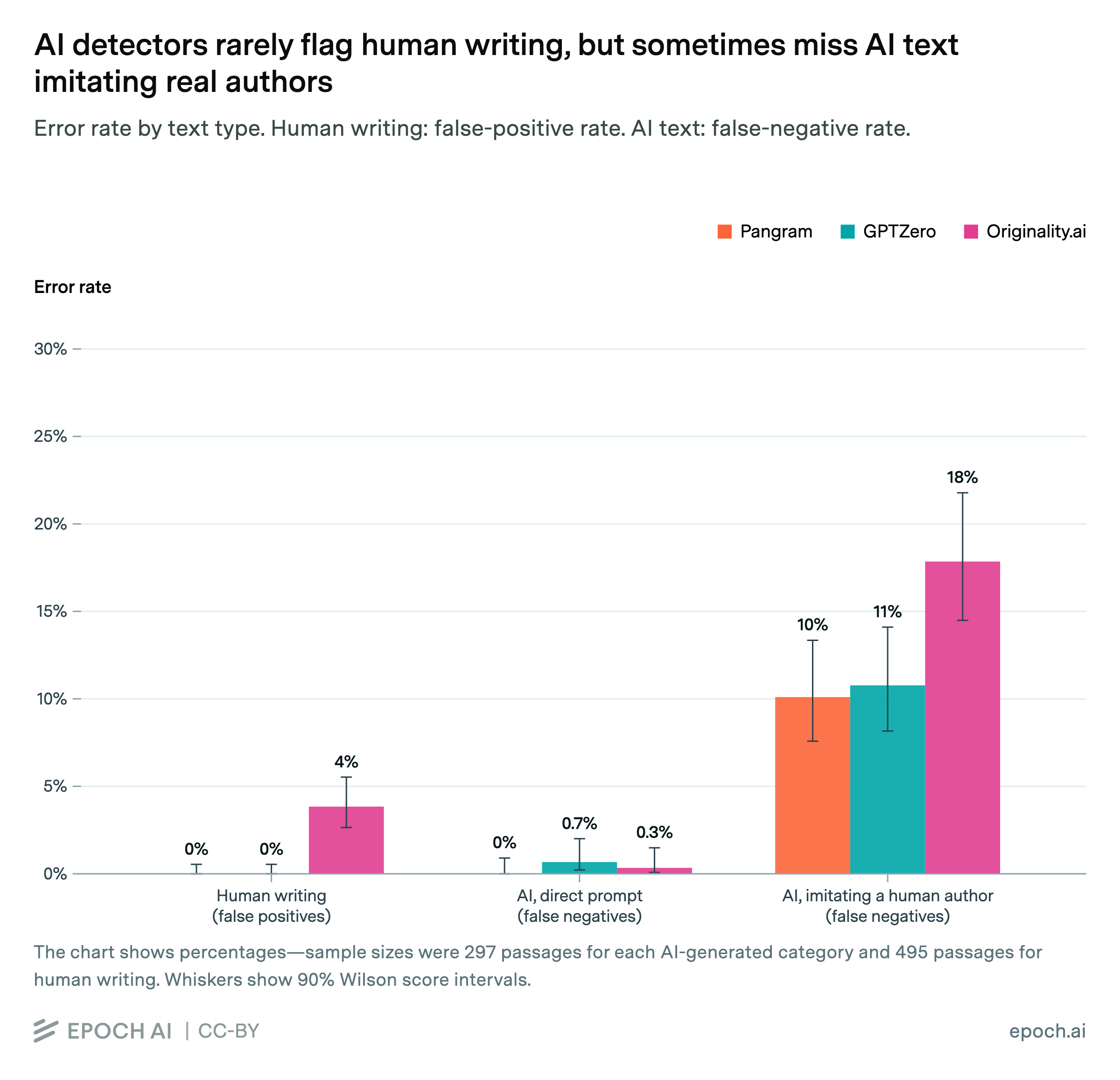
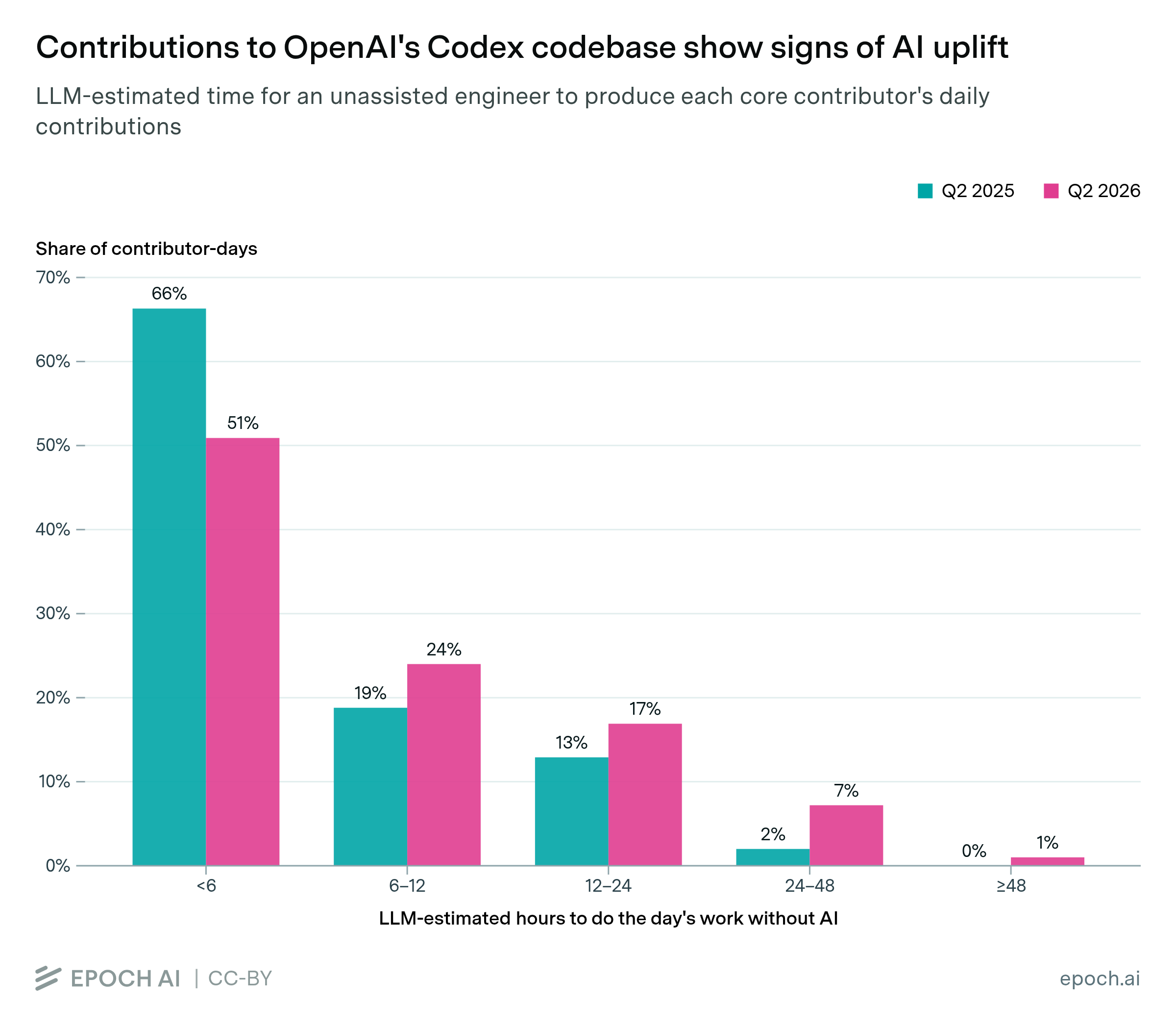
Two Data Insights: an analysis of the reliability of AI-text detectors, and evidence of AI uplift in OpenAI’s Codex repo.
Plus open roles across research, engineering, and operations.
We’ve expanded FrontierMath: Open Problems (FM:OP), our benchmark of unsolved research mathematics. The benchmark now contains 50 significant problems, all of which have resisted serious attempts by professional mathematicians to solve them. AI has solved three so far. Explore the problems on our website, where you can filter by notability, problem type, and field of origin.
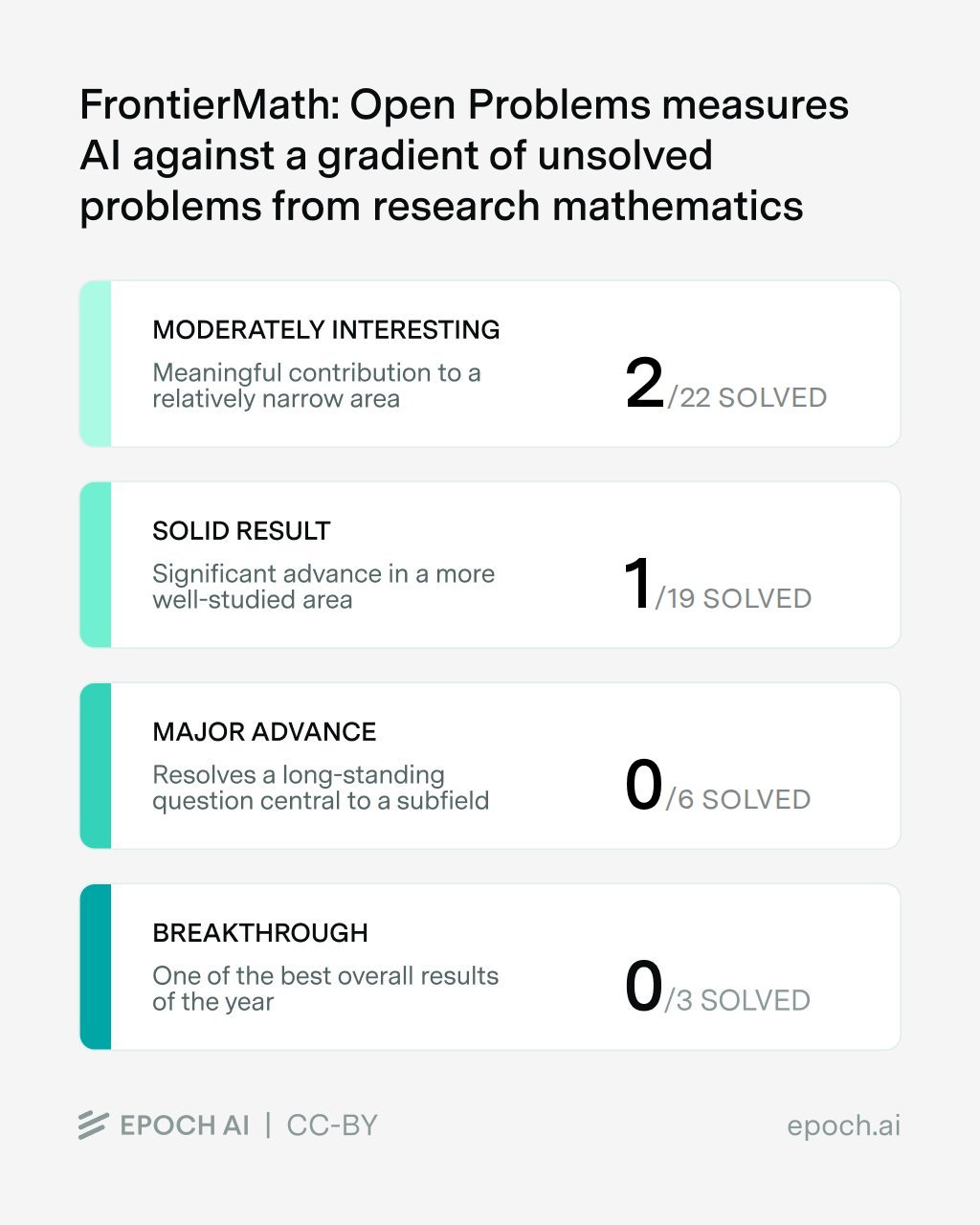
The difficulty of the benchmark means that AI solutions would meaningfully advance human mathematical knowledge, and may even provide a glimpse into something not yet seen in AI’s progress in mathematics: innovation. Even the most impressive AI contributions to math have, so far, consisted of applying known techniques. It would mark a significant step forward for AI if it could develop new theory from whole cloth to solve a problem.
The hope, according to Thomas Bloom, Royal Society University Research Fellow and a member of FM:OP’s expert editorial board, is “that many of these problems are difficult enough that an AI will have to invent new techniques to make progress.” Read the full commentary from Bloom and fellow editorial board members Daniel Litt, Assistant Professor of Mathematics, University of Toronto, and Dan Romik, Professor of Mathematics at the University of California, Davis.
Epoch’s head of economics, Philip Trammell, argues that constraints on the parallelizability of AI R&D (the ability to divide, coordinate, and recombine work) are missing from models of technological growth. Standard models assume that R&D can be parallelized without bound: however many “virtual researchers” we obtain, doubling their number will accelerate technological progress by a constant proportion. In these models, the arrival of a technological singularity is limited only by how many resources we pour into making more “virtual researchers”.
Philip explains why this extrapolation is implausible and lays out how constraints on parallelization could delay, or even prevent, a technological singularity. You can read his detailed write-up, or dive into the full research paper.
Nikita Ostrovsky answers the key questions around AI’s growing energy demands. Is AI really impacting energy bills and the environment? What are the consequences of the rapid buildout of energy-intensive AI data centers across the US and around the world? This is the latest in our “What you need to know” series, alongside AI chips and AI data centers.
Since the last edition of the Brief, we published two new Data Insights, our digestible snapshots of complex trends in AI.
We tested three of the most prominent AI text detectors (Pangram, GPTZero, and Originality.ai) on both AI and human text. For AI text generated from basic prompts, false-negative rates were near zero (at most 0.7% across detectors). However, when we gave models five samples of a specific author’s work and asked them to mimic it, an average of 38 of 297 (~13%) of the resulting passages went undetected. Detectors performed particularly poorly on mimicked scientific writing, failing to detect ~26% of AI-generated passages. When judging genuine human text, detectors were more reliable.
How much does AI speed up the engineers building it? We analyzed 41 core contributors to OpenAI’s public Codex repository, asking LLM judges to estimate how long each merged pull request would take an experienced engineer without AI assistance. In Q2 2026, 8% of contributor-days reflected work estimated at over 24 hours of unassisted effort, more than a skilled engineer could do in a day, even working around the clock. That’s up from 2% in Q2 2025.
Epoch senior researcher Alexander Barry responds to news that OpenAI models autonomously hacked Hugging Face while attempting to cheat on a cybersecurity benchmark. He argues that a frontier model autonomously finding and exploiting a real vulnerability shouldn’t be too surprising. Several evaluations, including by the UK AI Security Institute, have shown models are capable of discovering vulnerabilities and building working exploits against realistic systems.
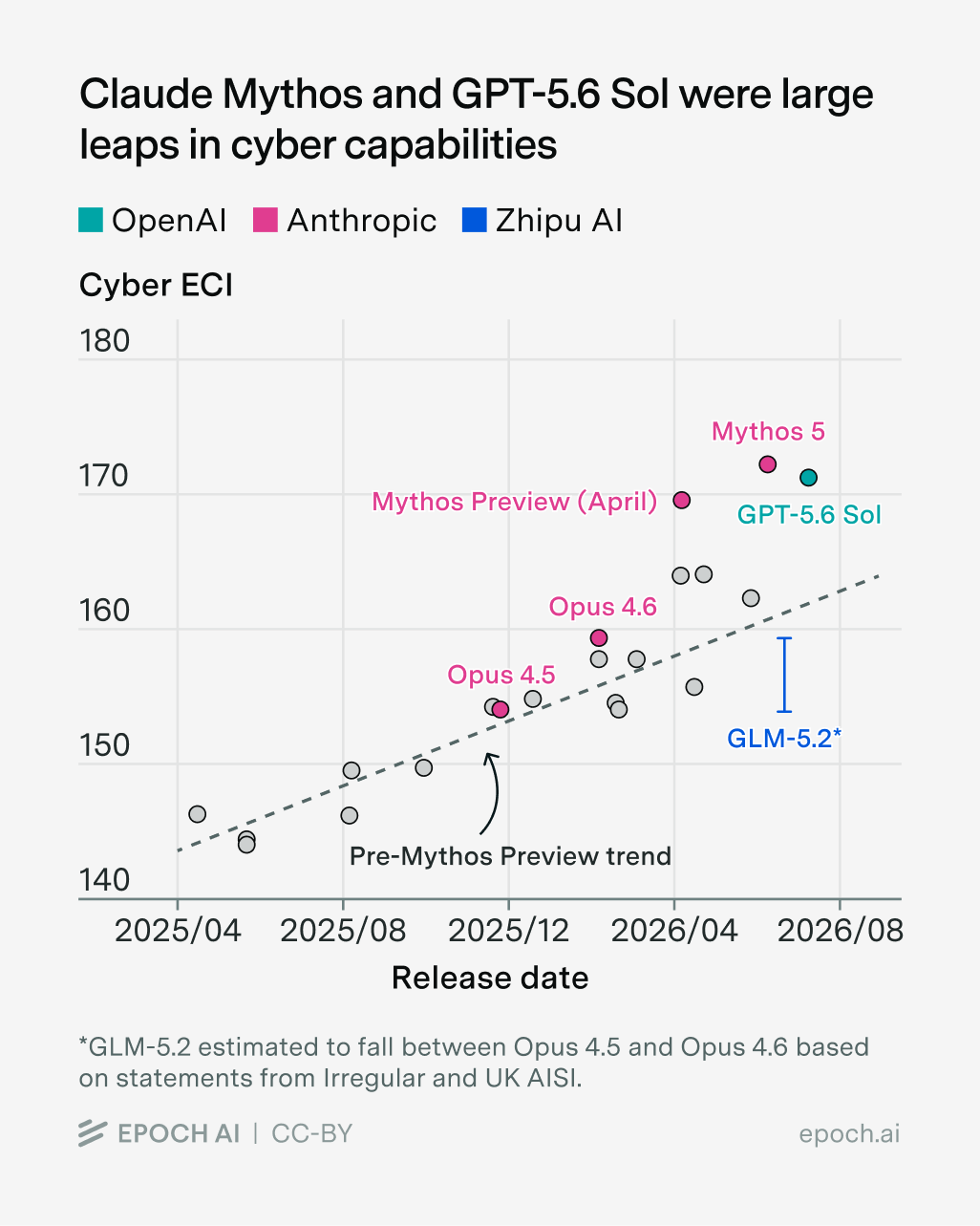
Barry notes that access to this level of cyber capabilities remains gated by OpenAI's and Anthropic’s cyber access programs, but that wider availability could lead to many more instances of real-world cyberattacks of equal or greater sophistication to the Hugging Face incident. For more on AI cyber capabilities, check out our recent Data Insight on the spike in serious CVE disclosures around the Claude Mythos Preview release.
Gradient Updates represent the views of the authors, and do not necessarily reflect the views of Epoch AI as a whole.
We now have a Twitch channel, EpochAIPlays, where we're observing how well frontier LLMs can play video games out of the box. Zvi Mowshowitz, author of Don't Worry About the Vase, joined us this week to provide commentary.
Epoch is growing quickly, and the ceiling on what we can do is the people we can bring in. We’re hiring for:
Head of People: lead people and events strategy as we grow from roughly 30 to 70 people globally
Events Lead: own planning and execution of our events and live activities
Researcher, Benchmark Reviews: develop and publish critiques and reviews of AI benchmarks
Researcher, Evaluations: assess frontier models on challenging, real-world scenario tasks
Software Engineer, Benchmarking: maintain our benchmarking infrastructure and build new benchmarks
Data Scientist (Contract): part-time literature review and data tracking on AI models and infrastructure
Comments
Nothing yet. Say the first thing.
Sign in to join the conversation.