
“Politics make strange bedfellows.” - Charles Dudley Warner
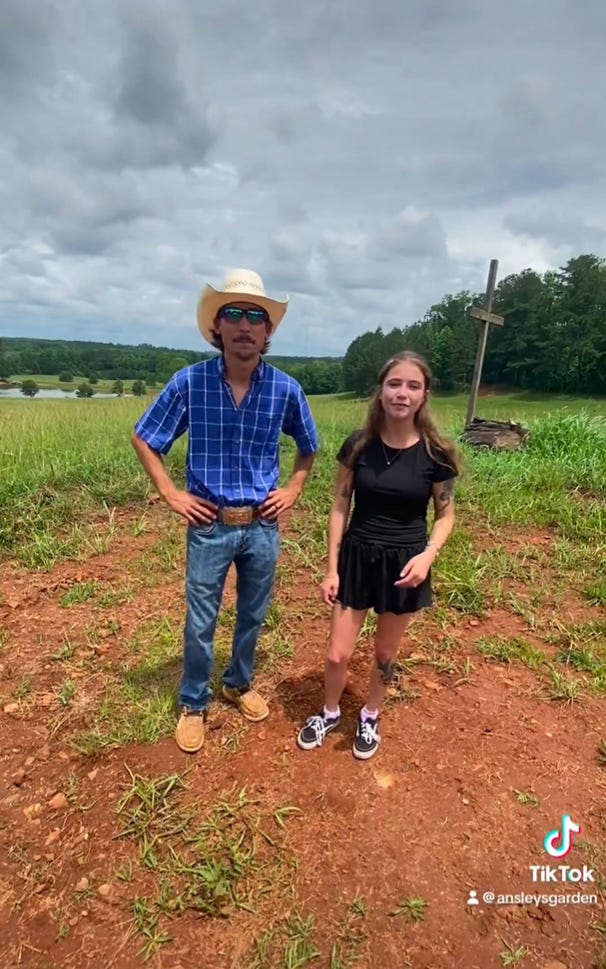
The most visible face of the opposition to Project Sail and Georgia Power’s Ashley Park - Wansley High kV Transmission line project is a young local named Ansley Brown. Her childhood home is one of the 20-30 houses slated for demolition to make way for the transmission line being built to serve QTS and Project Sail under the generalized veil of growth in electricity demand. Her TikTok videos have garnered more than 6 million views and gained Project Sail opponents national attention.
Opposition from local environmental groups like the Chattahoochee Riverkeeper focuses on impacts to the watershed that serves as the freshwater resource for millions of Georgians. The Chattahoochee River watershed is vital enough to Georgia, Alabama, and Florida that the three states have been engaged in “Water Wars” over the resource for decades. This pits local Team Blue “environmentalists” against Big Tech. But the Riverkeeper is made up almost entirely of citizens in the region.
Opposition from rural landowners who wish to preserve the character of a county on which metro Atlanta has been encroaching for more than three decades similarly pits Team Red rural Republicans (who, in Georgia are not particularly fond of government to begin with) against the Silicon Valley Carpetbaggers.
A few other environmental groups have their guns pointed at either Project Sail or the Georgia Power Ashley Park – Wansley High kV Transmission line project (or both) as well. These are not part of the local community. Their funding and interests go far beyond Coweta and Fayette County or citizens in the state of Georgia. Clues that outside “environmental” interests are involved in the fight against the projects became clear in the research for this post.
The first clue was found in a legal filing. On January 9th of this year, the Southern Environmental Law Center (SELC) filed a Joint Petition for Reconsideration with the Georgia PSC on behalf of Georgia Interfaith Power & Light and Southface Institute, the Sierra Club, and the Southern Alliance for Clean Energy (SACE).
The Sierra Club needs no introduction in these pages. SACE is a “progressive” non-profit “climate change” advocacy group for “renewable” energy in the southeast U.S. The SELC is a “progressive environmental” legal advocacy non-profit doing Sierra Club’s and SACE’s local bidding. The Petition asks the PSC to undo or narrow its approval of Georgia Power’s 2025 IRP plan provisions that add large amounts of new fossil gas capacity, particularly the nearly ~2,700 MW of new gas-fired generation referenced above. (Shocker, we know.)
One day after filing the Petition for Reconsideration, SELC filed a second petition with the Georgia PSC requesting oversight of new large-load customer contracts (a request with plenty of merit targeting data centers). That filing specifically identifies the QTS data center in Fayette County and Georgia Power’s Ashley Park – Wansley High kV Transmission line as a cause for Georgia Power’s new generation infrastructure. It also accuses Georgia Power of back-room negotiations with data center developers out of the public eye, something that caused the smell of rotten eggs involving Project Sail in Coweta County (emphasis added):
“Georgia Power made QTS an offer before the 35-mile line was identified in public transmission planning documents.”
Whether you’re fans of environmental non-profits like Sierra Club, SACE, and the SELC or not, the lack of transparency they have alleged is a real political problem for data center developers and their power-hungry customers like Meta, Microsoft, and others.
Our second clue as to outside “environmentalist” interest around Project Sail and the Ashley Park – Wansley High kV Transmission line project showed up on the Stop Project Sail website. Readers might recognize the name we circled in the lower left corner in the graphic below from an article linked there.
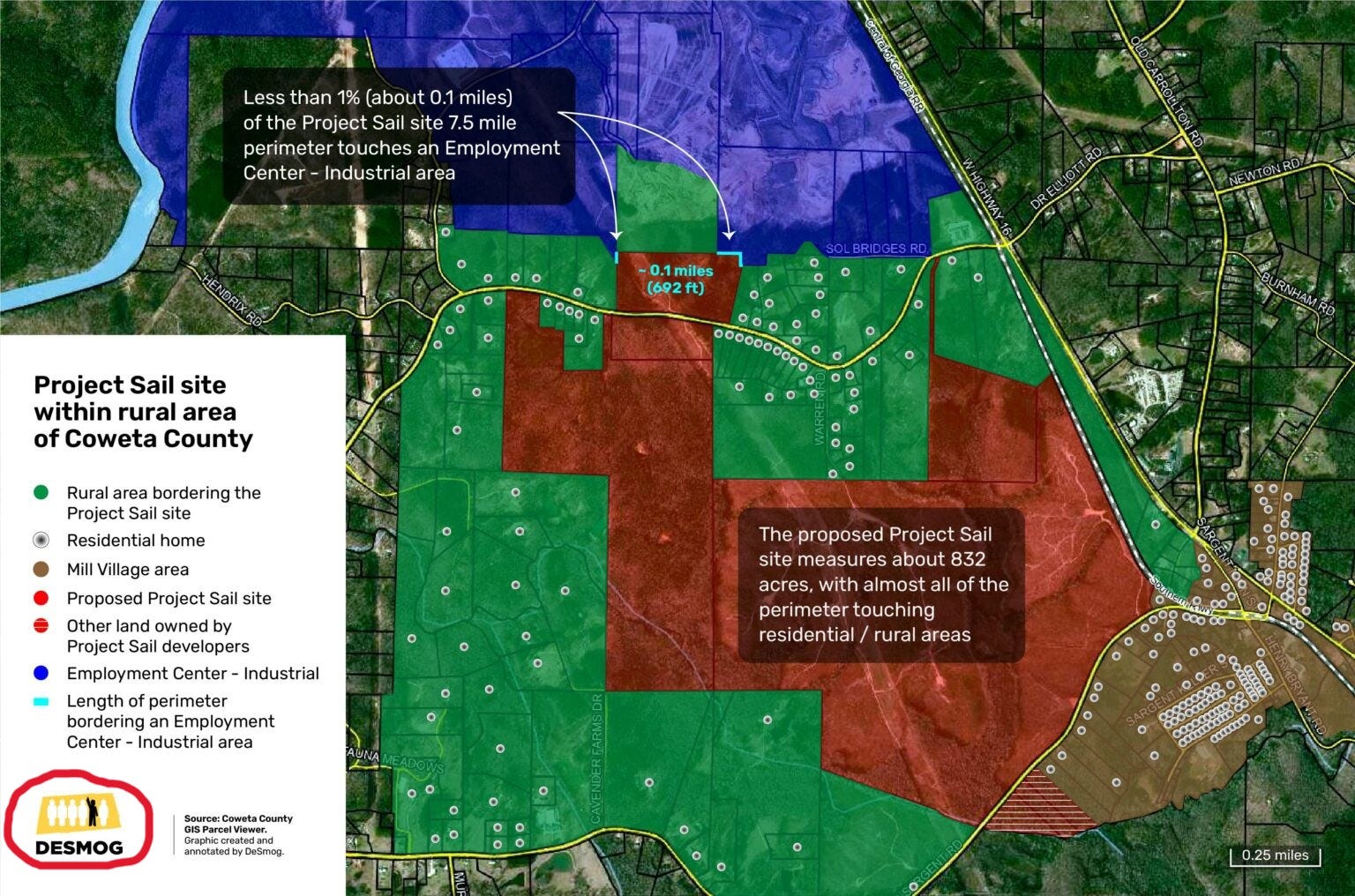
Desmog bills itself as a global climate investigations journalism outlet. But in reality Desmog is a well-known leftist environmental propaganda machine, much like John Cook’s Skeptical Science website. Desmog maintains a Climate Disinformation Database that lists many highly credentialed scientists who challenge the prevailing climate apocalypse paradigm like Judy Curry, Roger Pielke, Jr., and NASA Exceptional Scientific Achievement Medal winners (for contributions to climate science) Roy Spencer and John Christy. The fact that the database also includes Czech Canadian polymath Vaclav Smil is quite telling. Every one of these experts believes that - all things equal - humans contribute to warming earth’s atmosphere by burning fossil fuels. The fact that they believing that “climate change” is not a “crisis,” and present forms of “renewable energy” are a non-solution, is enough to earn the privilege of listing in Desmog’s database.
Desmog, the Sierra Club, and the Southern Environmental Law Center, unlike the Chattahoochee Riverkeeper, are not local environmental organizations, made up of local residents, concerns about their own backyards. In the case of Project Sail and the Ashley Park - Wansley transmission project, they’re merely environmental activist carpetbaggers riding on the backs of pissed off locals to advance their own broader interests.
What are those interests? Stopping any new hydrocarbon or nuclear-based electricity generation projects. The kinds that Big Tech has clearly decided to bet their future on, acknowledging that “renewables” were a quaint thing that bought them green street cred, and that the Renewable Energy Certificates they purchased just enabled lots of wind and solar projects that would have otherwise never been built. The kinds we told you Big Tech was going to rely on at the expense of “renewable energy” interests in Natural Gas & Nuclear’s New BFFs more than two years ago.
Renewable energy interests are butt hurt somewhere on the spectrum between sad and angry that, instead of relying on wind and solar and batteries, when it came to betting on their own futures, Big Tech ditched them faster than urban gangs ditch out-of-gas stolen cars. Big Tech’s commitments to natural gas and nuclear energy the last two years for the on-demand electricity their data centers require 8,760 hours per year with 99.999% reliability makes that crystal clear.
Hiding behind “we’re just tenants!” in facilities like QTS in Fayette County or Project Sail in Coweta County, or Georgia Power including a few hundred MW of “BESS” (battery energy storage systems) projects when repowering former coal plants with thousands of new MWs of natural gas, only makes those renewable energy interests’ angrier. They would rather starve the data centers - including, if needed, the local community - of electricity than see the projects fueled by hydrocarbons or nuclear power. In our view, the Petitions for Reconsideration and Regulatory Oversight described above make the Sierra Club’s and SELC’s real objectives very clear.
Knowing the area quite well, we can say with a high degree of confidence that the objectives of Desmog, the Sierra Club, the SACE and the SELC do not align with either the interests or the values of the more than two thirds of Coweta County residents who voted Republican in the last three presidential elections. The “climate journalists” and the non-profits clearly object to natural gas plant expansion in Georgia. While portraying themselves as aligned with those two thirds of rural landowners over eminent domain or other concerns as relates to Georgia Power’s Ashley Park – Wansley Transmission Line project or Project Sail, they are simply using the local citizen’s anger. Those voters would be the first to approve using natural gas to meet Georgia’s growing electricity demand, generally, were it not for the data center sprawl.
Why is this playing out in Georgia? The state has a Republican led State Assembly and pro-business regulatory environment, and competitive residential and industrial electricity rates. Georgia also has growing baseload generation capacity, adding 2,200 MW (2.2 Gigawatts) of new nuclear capacity at Plant Vogtle over the last few years, and plans to add thousands of additional MWs of natural gas generation.
But perhaps most importantly, Georgia Power is a vertically integrated, state‑regulated monopoly that controls generation, transmission, and distribution end-to-end. It trades off being subject to PSC rate regulation and punishment for failure to meet service obligations for being economically rewarded for building new generation capacity when the PSC approves its IRPs. And electricity devouring Big Tech data centers are the perfect “justification” (read: economic incentives) for load growth.
What’s a poor utility supposed to do? It’s our mandate to serve all customers! (Wink, wink…)
Red Team voters in Coweta and Fayette counties certainly have good reason to be pissed off at the Republican leaders they elected. But ironically, Georgia Power’s position as a vertically integrated, PSC-regulated, investor-owned utility with a monopoly that owns virtually all of the generation and transmission assets in the greater metro Atlanta area dates back to the days “Dixiecrats” (Democrats) controlled everything in the state.
But if it makes them feel any better, the Virginia legislature has been controlled by Democrats since 2024 and, like Georgia Republicans, the state’s Democrats have failed to reign in data center sprawl. When one looks closely, one finds that all of the meaningful attempts to stop the sprawl there, even in Loudon County’s “data center alley,” have occurred at the local level, with county and municipal ordinances doing the job the state legislature and Governor won’t.
It is also important to distinguish the differences between Virginia’s electricity market and Georgia’s. Virginia’s system resides within the Federal Energy Regulatory Commission (FERC)-regulated PJM Interconnection (a regional transmission organization or RTO) electricity market. PJM does not own any generating plants or transmission wires. It operates the grid and competitive generation markets. Utilities and merchant operators own the generation plants, and utilities own the transmission infrastructure (e.g., Dominion, American Electric Power, etc.), but PJM controls competitive market bidding for generation as well as the transmission dispatch and planning.
So, unlike Georgia, the decision to build a big large amounts of new generation and 500 kV transmission lines in Virginia is less a single utility’s internal planning and more a regional decision involving FERC and PJM, with multiple utilities and merchant power plant developers at the table. Perhaps it is fair to say that as imperfect as that system is, in the case of data center sprawl, it probably provides a bit more transparency to the public than the system that affords Georgia Power a monopoly. As utility expert Meredith Angwin has made clear, neither arrangement is perfect or ideally suited for the challenges the U.S. electricity market faces more broadly.
In Georgia, data‑center deals are negotiated largely between Georgia Power, the PSC, and local governments. Transmission grid expansion projects that follow are decided based on Georgia Power’s IRP and rate cases.
In Virginia/PJM, big new loads and lines are more visible in PJM stakeholder processes, with other utilities, independent generators, and regulators watching. This doesn’t stop the sprawl, but it probably reduces the “home cooking” and creates more venues for challenge.
The Georgia Power monopoly incentive to chase data‑center load is almost pure—every gigawatt of new demand is new steel in the ground recovered through the rate base. In PJM, the spoils are at least divided among multiple market utilities with regional and FERC oversight (for what that’s worth).
In Georgia, Georgia Power can argue in PSC filings that 500 kV lines and new gas units are needed for systemwide load growth, but because it controls both generation and transmission assets, it appears to local ratepayers and landowners as a single corporate actor using state‑backed monopoly privileges and eminent domain for private clients. And, politically, that dog don’t hunt in rural areas in the South.
Multiple bills have been introduced in Georgia’s and Virginia’s state’s legislatures to try and constrain data central sprawl over the last two years as Big Data increasingly clawed their way into rural areas. None have been signed into law, and few ever made it to their Governor’s desks.
Local voters in both parties in many areas of the country feel let down by their representatives on this issue, across the municipal, state and federal levels. Are data centers the issue that finally causes America to have its Uniparty “aha!” moment?
This is how Big Tech aligned two political adversaries that could not have been more unlikely to join forces. Green haired environmentalist Democrats and pickup truck driving conservative Republicans with Trump bumper stickers standing, not across the street yelling at each other, but joined at the hip ready to burn Big Tech at the stake.
We close by noting that the alignment of Team Red rural landowners with Team Blue “environmentalists” is a phenomenon that Charlaticians™ in both parties and Big Tech and its local developer bagmen created. Billionaire investor turned data center developer (of Shark Tank fame) Kevin O’Leary’s appeared on Fox News “Big Weekend Show” a few days ago as the industry standard bearer to make it clear that they have not figured out how to deal with the problem.
That’s when host Joey Jones questioned O’Leary about the matter of the growing opposition to Big Tech and its data centers. O’Leary’s Box Elder County, Utah data center project has become a lightning rod gaining national attention just like Project Sail.
Jones is a native of Georgia who lost his legs serving as a Marine Corps Explosive Ordnance Disposal technician in Afghanistan. Though he was born in Dalton (the northwest Georgia textile hub known as “Carpet-town”), biographies and background material list his current residence as (wait for it..) Newnan Georgia, a rifle shot from Project Sail and the Georgia Power Ashley Park – Wansley project in Coweta County.
What was O’Leary’s strategy? Claim that the loudest protesters are astroturf: outsiders, brought in to protest, funded by foreign interests.
Now the question of whether foreign interests have been funding anti-fossil fuel environmental groups in the U.S. (and Canada for that matter) is a fair one, and something we have long been concerned about. But we know Coweta and Fayette counties well and can assure you that the environmental group Chattahoochee Riverkeeper, Joey Jones’ pickup truck driving Red Team neighbors, and all the landowners Ansley Brown are interviewing are not funded by China, Russia, or any other foreign interests.
Give O’Leary credit for correctly identifying the motivations of the out-of-towners, the carpetbagger environmental non-profit Hatfield’s, when he states:
“This is happening all over America. People want to stop the development of power.”
On the other hand, we’ll let you judge how effective O’Leary’s argument and demeanor were. And how well the billionaire genius acquitted himself and Big Tech attempting to pull the “foreign interest” card on Joey Jones and the folks in Georgia.
The issue is a bipartisan hot potato of politicians’ own making. Democrats in Virginia can’t run away from the problem any more than the Republicans in Georgia. Even within the Republican race for governor, data centers and eminent domain are being used as an “us vs them” wedge. Witness the campaign flyer being run by an opponent of Trump’s endorsed Georgia gubernatorial candidate, Burt Jones:

It took Big Tech to make strange bedfellows out of Prius and pickup truck drivers, Blue Team “environmentalists” and Red Team rural Trump voters. But electric power and land are the gating functions for the grand data center plans of our Silicon Valley Overlords over the next several years, and now Big Tech has pissed off both groups, aligning the Hatfield’s with the McCoy’s to fight Big Tech Data villains they like even less than each other. Imagine that!
As for us, we’re mixing a jug of peach sweet tea and putting a bowl full of Orville Redenbacher’s in the microwave. We’re going to enjoy the show.
“Like” this post or we’re sending Ashley Brown and the cowboy to your house.
Leave us a comment. We read them all and reply to most. Refuels the tank here.
environMENTAL is a reader-supported publication. Subscriptions are free but please consider a voluntary paid subscription.
Share this post. Helps us grow. We’re grateful for the assist.
No posts
Comments
Nothing yet. Say the first thing.
Sign in to join the conversation.