
Organizational research over the past three decades has shown the importance of something called psychological safety as the critical factor for high performing teams and organizations. If you are a business leader or a team leader, this is important to understand.
What exactly is psychological safety?
Amy Edmonson provided a definition in her widely read book on the subject [1]:
Psychological safety is broadly defined as a climate in which people are comfortable expressing and being themselves.…[T]hey feel comfortable sharing concerns and mistakes without fear of embarrassment or retribution. They are confident that they can speak up and won’t be humiliated, ignored, or blamed. They know they can ask questions when they are unsure about something. They tend to trust and respect their colleagues.…[M]istakes are reported quickly so that prompt corrective action can be taken… [2]
What are some signs that you’re not in an environment of psychological safety? It’s not difficult. You can feel it. It’s a work culture where fear and silence dominate over openness and collaboration. It’s not fun.
Such organizations have high levels of turnover. Leaders complain about the lack of “employee engagement” but do not see their own behavior as the root cause. If such an environment persists, the organization will earn a reputation for being a toxic workplace.
In this post, we’ll summarize why psychological safety is so important: first, where human life is at risk and then in the workplace generally.

Edmonson gives examples where psychological safety has significant impact in saving lives. The first is in healthcare settings.
She tells the story of a medical team in a busy urban hospital, where a young neonatal nurse, caring for a set of premature twins, was worried that the doctor had not administered a key medication, a “surfactant,” a best practice to promote lung development. She thought about reminding the doctor but then caught herself:
Last week she’d overheard him publicly berate another nurse for questioning one of his orders. She told herself that the twins would probably be fine – after all, the doctor probably had a reason for avoiding the surfactant, still considered a judgment call – and she dismissed the idea of bringing it up. Besides, he’d already turned on his heel, off for his morning rounds, white coat billowing.
The nurse had made a subconscious calculation of the risk to the babies versus the risk that she might be belittled or berated. In other words, her healthcare team had a low level of psychological safety. It is not difficult to see that multiplied across hundreds or thousands of patients how such an environment could lead to medical errors.
In fact, Edmonson’s own doctoral research found that teams with high levels of psychological safety uncovered more errors, therefore ensuring better levels of patient outcomes.
Edmonson also points to aviation as another environment where psychological safety is the critical factor in saving human life. She outlines several case studies, including these two, one negative, the other positive:
The 1977 Tenerife disaster. This was the worst accident in civil aviation history, where the KLM copilot was afraid to speak up to the pilot, who was senior and widely respected. The copilot indicated that they had not been cleared for takeoff and radioed air traffic control to clarify. But the pilot continued to roll forward, insisting on continuing takeoff. At this point, the copilot should have spoken up and insisted that they wait for clearance. But he did not feel safe to do so. The result was nearly 600 fatalities when the aircraft collided with a Pan Am flight still on the runway [3].
Flight 1549 from LaGuardia. On the positive side, there is the story of Captain Sullenberger (“Sully”), co-pilot Stiles, and air traffic controller Harten, who, despite having never met previously, had a high degree of trust and were able to take decisive action without interpersonal conflict or debate. It greatly helped that Sully and Stiles were both trained in protocols (instituted after the aforementioned Tenerife disaster) that instruct aviation crews to “speak up to their captain when they feel something is wrong and likewise instructs captains to listen to crew concerns…well suited to creating environments of psychological safety.”
But the need for psychological safety in the airline industry goes beyond individual incidents. The two Boeing 737 Max crashes in 2018 and 2019 can be traced to a lack of psychological safety in the culture at Boeing. Individual engineers knew there were problems with the aircraft design but were afraid to speak up for fear of consequences to their careers.
Most of us do not work in jobs where human life is at risk. But psychological safety is still important in the workplace, generally. Edmonson points to several case studies. Here’s one:
Pixar’s Braintrust group “meets every few months so to assess a movie in process, provide candid feedback to the director, and help solve creative problems.” But, according to Pixar, the key to this group’s success is candor—not giving polite praise to the director but “feeling safe enough to candidly say what they felt was wrong, missing, or unclear or made no sense.”
According to Pixar co-founder Ed Catmull,
“When people feel psychologically safe enough to contribute insight, opinion, or suggestion, the knowledge in the room thereby increases exponentially. This is because individual observations and suggestions build on each other, taking new shape and creating new value, especially compared to what happens when individual feedback is collected separately.”
This peer-review process at Pixar reminds me of my experience leading the research team at Computer Economics for over 20 years. In any well-run editorial group, candid but respectful feedback is critical. But this can only take place in an atmosphere of psychological safety. Everyone needs an editor, from the new hire to the team leader, where everyone feels safe in offering constructive feedback.
Other studies confirm the need for psychological safety in the workplace. For example, Google’s Project Aristotle, studied 180 engineering and sales teams, ranging from three to 15 people, looking at 250 team attributes. The research found that psychological safety was the top factor in Google team effectiveness, as shown in the figure below.
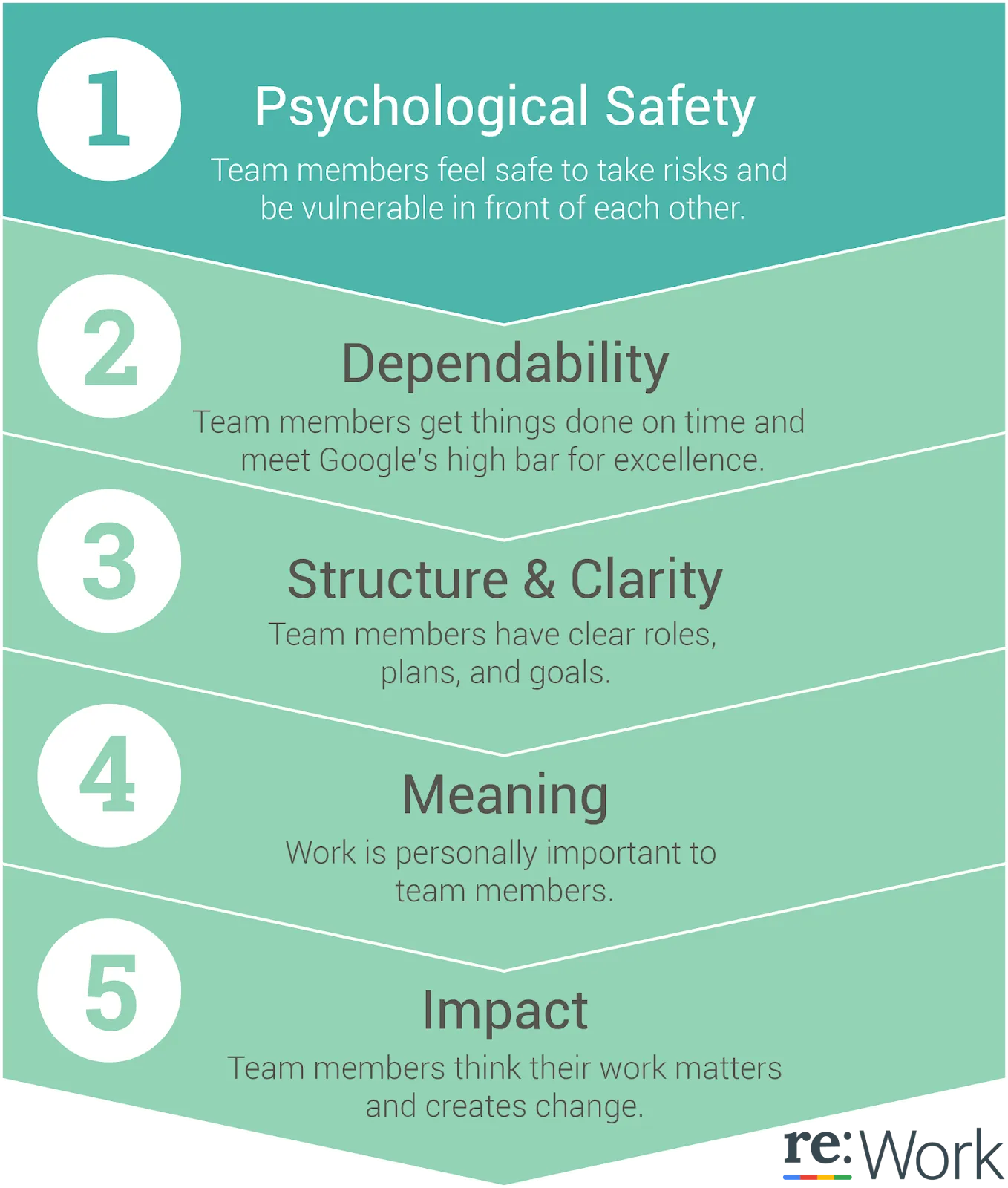
Specifically:
A strong team culture was correlated with each member’s perception of the consequences of taking an interpersonal risk. Those on teams with strong cultures feel safe taking risks in the face of being seen as ignorant, incompetent, negative, or disruptive. In a team with high psychological safety, teammates feel safe to take risks around their team members. They feel confident that no one on the team will embarrass or punish anyone else for admitting a mistake, asking a question, or offering a new idea. [4]
The level of psychological safety can vary greatly within an organization. Some work groups may have a high degree of psychological safety, while those in other groups may not feel safe in speaking up.
As with many things in business, it starts at the top. If the organization as a whole is driven by fear, it will be difficult for an individual team or business unit to maintain an atmosphere of safety. It can be done, but it’s not easy. This is especially true if the CEO does not tolerate contrary points-of-view and is surrounded by “yes-men.”
For example, despite its own research showing the essential role of psychological safety, Google itself has had problems tolerating viewpoint diversity.
Although the term psychological safety is relatively new, the concept goes back many years. For example, the eighth point in Edward Deming’s 14 points is “Drive out fear.” He writes,
Encourage effective two-way communication and other means to drive out fear throughout the organization so that everybody may work effectively and more productively for the company.
And psychological safety is needed not only in the workplace but also in our personal lives, whether in religious organizations, community service, sports teams, and even families. If people do not feel safe in speaking up in a respectful way, no one will be able to reach their full potential.
In running a management consulting firm and an IT research firm for over 20 years, I tried to manage others the way I liked to be managed, that is, tolerating diversity of opinion and giving others the freedom to take initiative. Looking back, I was promoting psychological safety, even though I didn’t have the term. This doesn’t mean I put up with substandard performance, and at times I did have to take corrective action, even terminating employees. But that was the exception, as most of those who worked for me wanted to do their best and just needed support.
And after I sold those businesses, I continued working for the new owner for four more years. Then, a few days before I fully retired, one coworker shared something with me. She said that what she appreciated most about me was that I was not afraid to speak up.
I consider that to be a high compliment.
[1] Edmondson, Amy C. The Fearless Organization: Creating Psychological Safety in the Workplace for Learning, Innovation, and Growth. Available on Amazon.
[2] One note of clarification is needed. Psychological safety has nothing to do with the recent trend to establish “safe spaces” on some college campuses—rooms where students can take refuge when a speaker comes on campus with a viewpoint different from theirs. Such “safe spaces” do not prepare students for the workplace, where they will need to tolerate those who see things differently than they do. So, ironically, “safe spaces” are exactly the opposite of an environment of psychological safety.
[3] The full story of the Tenerife disaster provides more details and how it led to establishment of crew resource management that is now a fundamental part of pilot training, which, as noted, was a positive factor in the Sullenberger case study.
[4] Interestingly, Google also found that the following factors do not contribute to team effectiveness: colocation of teammates (sitting together in the same office), consensus-driven decision making, extroversion of team members, individual performance of team members, workload size, seniority, team size, and tenure of team members.
Please share with others to support my work.
Like this post? Browse my past posts.
Comments
Nothing yet. Say the first thing.
Sign in to join the conversation.