
Dear Curious Minds,
Long week here. The Select Committee reported back on the Disability Services Amendment Bill. I should read it, but I kept procrastinating because I feared my already tired brain couldn't handle it. Thankfully, there are stronger people who’ve done it properly; Huhana Hickey’ breakdown is the most rigorous thing I’ve read on it, and Dr Bex’s response is the one I keep returning to for reasons I’ll get to.
What I want to talk about is a shape I recognise, because today is 14 August, and my thoughts have been tangled with people who lived inside that shape for decades. Thank you for being here, I appreciate you.
We can take a loss. What I find insulting is finding out the process was decorative.
Procedural justice research has held up well since Tyler’s work in 1990; people accept unfavourable outcomes at surprisingly high rates if they believe the process was fair. Voice, neutrality, being treated as though your account mattered. This is when legitimacy is manufactured almost entirely in the procedure, not in the result.
Which is why you’d rarely see straight-up denial anymore. Because the institutions have learnt the most efficient instrument isn’t denial. It’s the requirement to keep proving. Reapply, resubmit; the criteria have changed. Demonstrate need again, although we know your permanent disability isn’t going to change, and tell us what happened one more time. Oh, maybe three more times because there are now no humans and a new chatbot. Delay is cheaper than refusal, and it multiplies like a glitter bomb.
Here is what that looks like when you run it for fifty years.
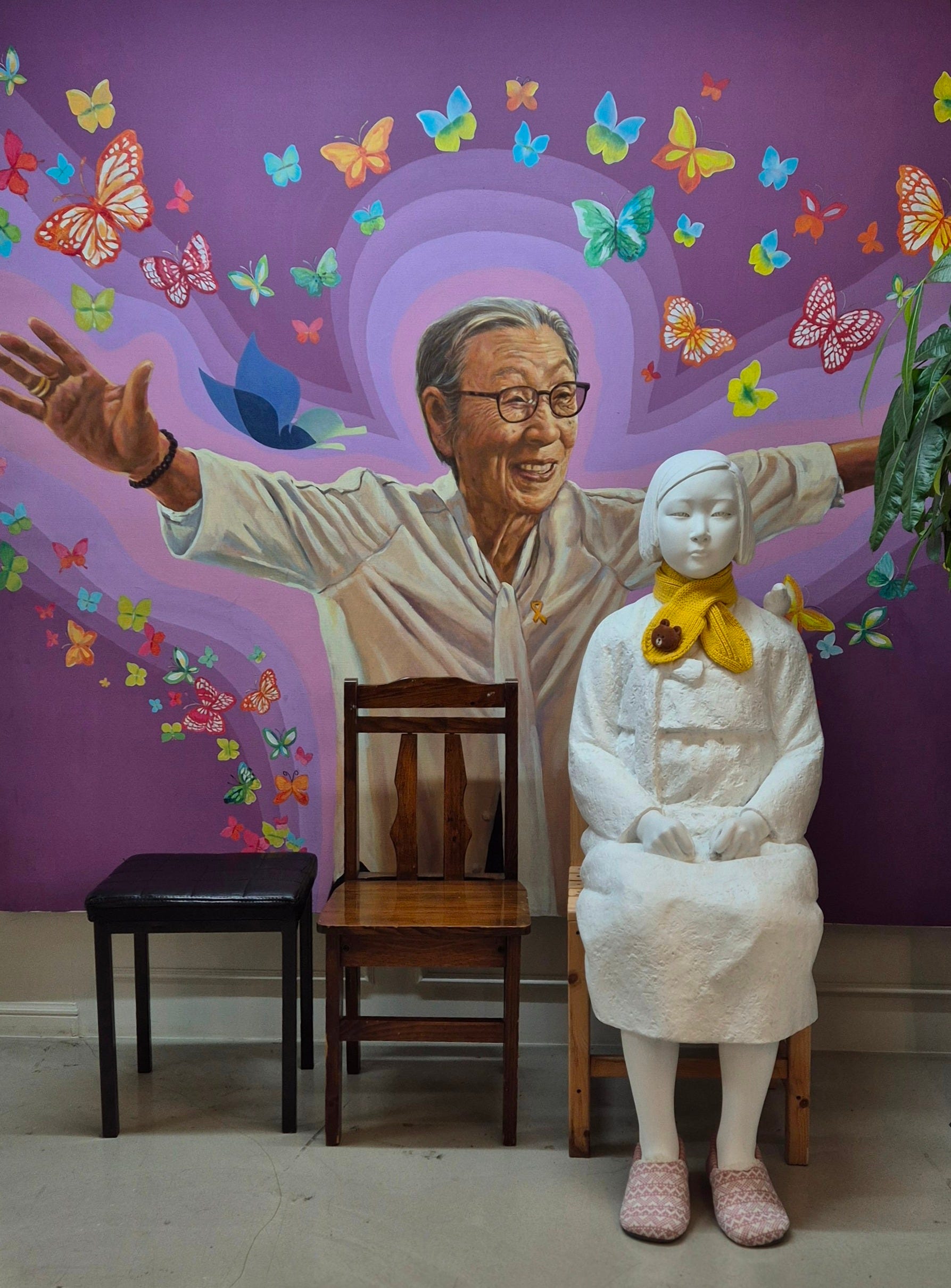
Thirty-five years ago today, 김학순 할머니, Kim Haksoon halmoni, sat in front of reporters in Seoul and used her own name.
She was 67. She did the maximum correct thing - the thing every process asks of a person and only very few can deliver. Public testimony about military sexual slavery when she was a child, with her face, at enormous cost, in a country that had spent five decades treating what happened to her as something she had done rather than something done to her.
Japan’s position, then and now: it was settled in 1965.
Worth knowing what was ‘settled’ and what signing a document means when the people most affected by that document and their representatives aren’t in the room or invited to the process.
Korea was twenty years out of colonisation, during which its natural resources and social structures were extensively exploited. It was twelve years out of a war that killed around three million people on the peninsula in three years. Park Chung-hee had taken power in a military coup. Washington wanted its two Cold War allies normalised and applied pressure. Japan pledged US$500 million in grants and loans, categorised not as compensation but as economic cooperation, and, at the time, described as a congratulatory gesture for Korea’s independence. It went to the state. It built the Gyeongbu Expressway and POSCO. A decade later, the Korean government paid families of forced-labour victims 300,000 won per death, roughly just under NZ$400 at today’s exchange rate.
When the draft terms leaked, students filled the streets in protest. The militant dictator-led South Korean government declared martial law. The negotiating records were then classified for forty years. Koreans couldn’t read what had been signed in their name until 2005.
The women were not on the agenda. The survivors weren’t invited or involved in the process. The system wasn’t designed to serve them.
So: a settlement of claims nobody had yet been able to make, agreed in secret by a government born of a coup, concerning women who had not been permitted to speak. That’s the document that answered her questions before she was allowed to appear on camera.
Everything after has been a variation on it.
In 1993, the Kono Statement acknowledged military involvement and expressed feelings of remorse. I’ve crossed paths with several academics and charity workers who saw this as an inspirational example of leadership in a colonial state, because the English translations render it as an apology. A subtle but critical linguistic nuance. It wasn’t, and survivors never accepted it as one. Because a Cabinet Secretary’s statement with no legal status, expressing a sentiment rather than accepting responsibility. The actions that followed proved as much.
Then, in 2015, Seoul (led by Park Chung-Hee’s daughter, who later got impeached) and Tokyo announced a “final and irreversible resolution,” one billion yen, and again it did not consult the women it was about. They rejected it. The foundation administering it was dissolved within four years.
A Seoul court finally found Japan liable in 2021. Japan declined to participate and declined to pay. Months later, a different court threw out a near-identical case on sovereign immunity.
김학순 할머니 had done everything right. She got thirty years of technically responsive non-answers, and died in 1997 without any of it.
I only have language for 2015 because of disability advocates.
Nothing about us without us isn’t my phrase, and it isn’t Korea’s. It comes out of disability rights organising; it’s in the UNCRPD, and it’s the exact principle Huhana Hickey names when she points out that select committee scrutiny of a government-drafted bill is not the same thing as being in the room when it was written. MSD’s own disclosure statement states that there was no external consultation prior to drafting.
That distinction is the whole of 2015. Two governments settled a question about women who were still alive, still organising, still turning up every Wednesday demanding a simple acknowledgement of what happened and what they experienced. They simply chose not to include them. Final was doing all the work. Irreversible was doing the rest.
They could tell the difference between being compensated and being closed. That’s why they said no to money, twice, many in their eighties.
They are not a parable for anyone’s campaign, and I’m not offering 할머니들 as inspiration. I have come to learn they weren’t enduring in order to be instructive. Most died before anything they asked for arrived, and turning them into a lesson about resilience is its own small erasure.
But I notice the shape, and noticing is worth something. Mostly because the alternative on offer this week is apathy, and apathy is what the shape is built to produce. Exhaustion is the proof the mechanism is working.
Which brings me to Dr Bex. When the Minister’s press release came out, she printed it in the large-print alternate format and made a blackout poem out of it. Blacked out the language until what was left said the thing the document was constructed to avoid saying.
55,000 milestones. End Bill.
I’ve now gone down many rabbit holes, spoken to many, and spent hundreds of hours on stories of women who responded to institutional silence by making things. Painting at 72 with no training. Embroidering testimony. A filmmaker, without formal training, decided to pick up a camera and make which became a 3-part 낮은 목소리 series, the first Korean documentary with survivors to get a theatrical release. This film was funded in small amounts by people willing to put their names on a list, because the industry wouldn’t touch it.
Last month I sat in a cinema in Auckland during NZIFF and quietly cried at ‘세계의 주인(The World of Love)’, 윤가은(Yoon Ga-Eun)’s film about a girl after sexual violence and the exhausting labour of being the person something happened to. I only learnt afterwards that Yoon was part of the crew for the 3-part documentary when I looked her up on IMDb, with a pang from The World of Love still in my chest.
Satellites, which administers the Asian Artist Fund on behalf of Creative New Zealand and Auckland Council, has announced that the fifth round of the Asian Artists Fund will be the last in its current form.
I’m biased, obviously. I’m surrounded by artists for whom Creative NZ and the Film Commission are the load-bearing walls, and I’d like to keep them. At the same time, any organisation or practice on a single revenue channel gives me heart palpitations. Grant dependency is a strategic vulnerability, and I dissuade many from this.
What I object to is the word handout. And the phrase “in its current form” gives me a familiar, low humming growl because that’s where the real decision hides. Not whether to fund, but what shape the money takes, what it now requires you to prove, and what accepting it concedes.
Not every artist has the commercial acumen of a corporate business development executive, and it’s increasingly hard to stay a working artist without performing exactly that. Some of the best practitioners I know would physically gag and baulk at certain art circles that get quite cliquey. If I say the quiet part out loud, inconveniently, the surefire route to becoming a repeat guest and eventual darling of the institutions.
Meanwhile, the work least legible to a funder is reliably the one that crosses too many categories at once. A history belonging to nine countries. A story implicating a trading partner, oh, just some particular trading partners. A community that won’t resolve to a single ethnic line item.
It’s the same machinery. Prove you’re a category we already have and feel comfortable with.
Nothing in that thirty-year sequence moved because the procedure worked. It moved because people made things the procedure had no box for.
I’m not writing today because I’m angry. I’m writing to remember that they were entitled to their anger and that they didn’t only live inside it. There were dishes they liked. Friends whose laughter they cherished. Quiet afternoons they chose, rather than the silence imposed on them.
Some wanted the whole world to hear. Some testified anonymously. Some confided in one researcher, once. Some never told even their families. When a system denies and delays for decades, I can’t read silence as failure. Don’t make the mistake of blaming them or thinking that’s weakness.
Entangled Curiosities is reader-supported. If this made you uncomfortable in useful ways, it would mean a lot if you could support this mahi with a subscription or a one-off virtual coffee.

Comments
Nothing yet. Say the first thing.
Sign in to join the conversation.