Doug Binks - - edited # Avoyd # Game Technology
This release of Avoyd Voxel Editor has been a long time coming, but it adds a significant feature - a GPU accelerated path tracer for faster renders. In this post I summarise the renderer development, cover the performance gains (with data) and discuss future plans.

I started to move the CPU path tracing code to the GPU back in August 2023, and showed early results in the devlog post "Implementing a GPU Voxel Octree Path Tracer" and our regular beta releases. The journey has been somewhat convoluted, as I hit a number of issues with complex shader optimization along the way. Avoyd is able to render massive voxel scenes due to the use of a fairly complex data structure, a Direct Acyclic Graph style Sparse Voxel Octree (DAG style SVO). I first discovered that the GLSL code ran over ten times faster using Vulkan instead of OpenGL, found issues with shader optimizers (SPIRV-opt) on some GPUs, and moved the path tracing from a mega-kernel to wavefront path tracing.
If you have a modern discrete GPU you should see a 5x to 10x improvement in render performance over a similarly priced CPU, depending on scene and settings. The CPU renderer remains useful, not only for those with integrated or lower performance GPUs, but also because CPU memory is a lot cheaper so PCs usually have more, making it possible to render extremely large voxel models.
Voxel model GPU rendering in Avoyd.
I took some measurements of performance on two systems to give you an example of what you might expect:
| Voxel Model (Dimensions in voxels) |
Resolution pixels |
CPU Intel i9 7980XE 35/36 MLP (*) |
CPU AMD Ryzen 9 7950X 31/32 MLP (*) |
GPU AMD RX 7900XTX |
GPU NVIDIA RTX 4070 |
|---|---|---|---|---|---|
| Cornell_Box (64 x 64 x 64) |
1280x720 | 25.2s | 16.6s | 2.9s | 2.3s |
| 1920x1080 | 56.3s | 37.4s | 4.9s | 3.4s | |
| Box_Transparency (1024 x 256 x 1024) |
1280x720 | 39.2s | 25.4s | 6.6s | 3.5s |
| 1920x1080 | 88.2s | 57.3s | 10.0s | 5.6s | |
| Box Transparency + Vase (4096 x 321 x 4096) |
1280x720 | 48.1s | 30.8s | 12.6s | 6.6s |
| 1920x1080 | 107.7s | 69.2s | 18.4s | 10.6s | |
| Drehmal v2.1 village (33696 x 256 x 13312) |
1280x720 | 50.5s | 33.5s | 8.1s | 4.5s |
| 1920x1080 | 115.7s | 75.3s | 14.9s | 8.1s | |
| Drehmal v2.1 top-down (33696 x 256 x 13312) |
1280x720 | 58.4s | 37.7s | 20.7s | 13.0s |
| 1920x1080 | 130.7s | 84.4s | 42.8s | 19.5s |
Render times are measured at 128 SPP (Samples Per Pixel).
GPU render times are averaged over 5 measurements, discarding the first render.
GPU Render Priority is set to `High`.
Avoyd voxels set to `Full Voxels` (all full cubes, no morphing voxels).
(* CPU Multithreading: MLP (Max Logical Processors) is set to default (MLP / Logical Processors).)
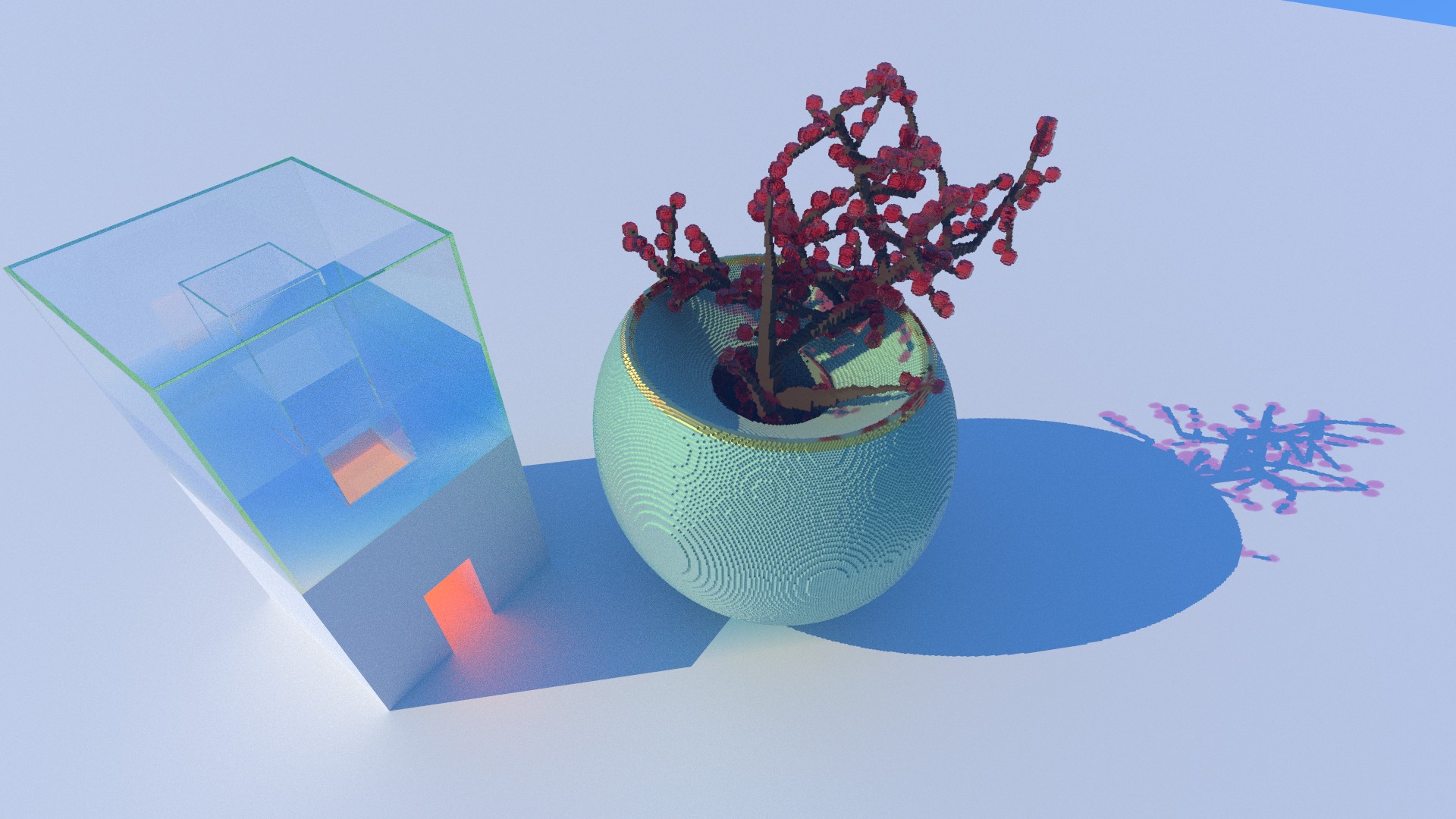
Voxel models GPU rendered in Avoyd at 128 SPP.
I'll continue to investigate improving performance after this release, so check out future Beta releases. We plan to work on Renderer Post Process effects (Bloom and Tone Mapping), Video Rendering, and Multi-Model editing whilst also investigating optimising memory consumption and performance.

[ Edit 03 May 2024 - Added performance data for Minecraft map Drehmal, village and top-down renders.]
Comments
Nothing yet. Say the first thing.
Sign in to join the conversation.