
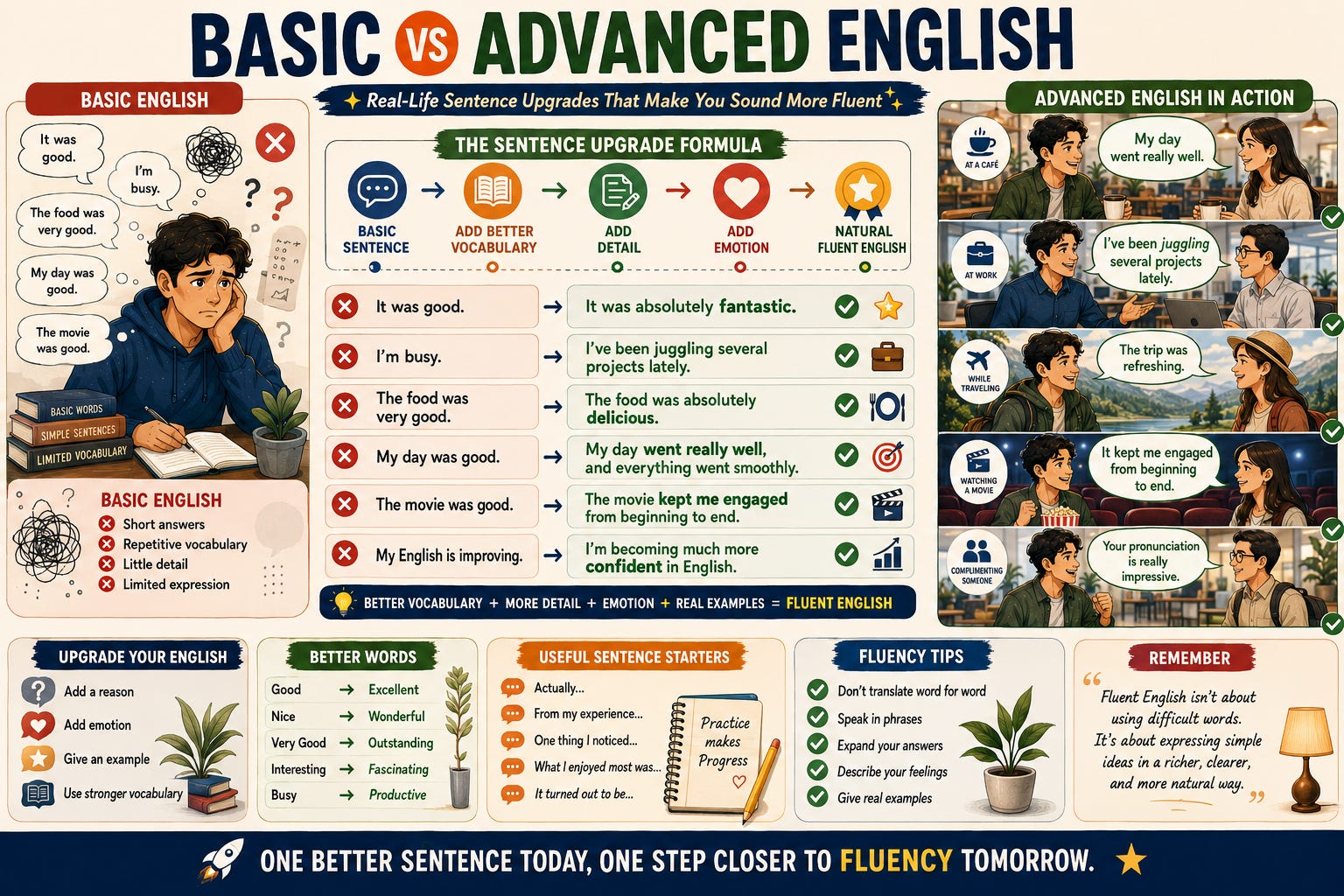
Have you ever listened to a fluent English speaker and wondered,
“Why do they sound so natural?”
Is it because they know thousands of difficult words?
Not really.
In fact, most native speakers use simple vocabulary every day.
The difference is how they express their ideas.
They don’t always use bigger words—they use better sentences.
That’s exactly what you’ll learn in this article.
We’ll take everyday English sentences and upgrade them into more natural, expressive, and confident English that you can start using immediately.
Let’s begin.
When people hear the word advanced, they often imagine long, complicated sentences full of difficult vocabulary.
But real-life English isn’t like that.
Advanced English is about:
expressing your thoughts more clearly,
using natural sentence patterns,
adding detail when needed,
and choosing words that fit the situation.
Sometimes changing just one or two words can completely transform a sentence.
“My day was good.”
“My day went really well.”
“I had a really productive day, and everything went smoothly.”
Why it sounds better:
Instead of simply saying your day was “good,” you’re giving the listener more information about how your day actually felt.
“The food was very good.”
“The food was delicious.”
“The food was absolutely delicious. Every dish was full of flavor.”
Why it works:
Specific words create stronger images in the listener’s mind.
“The movie was good.”
“The movie was really entertaining.”
“The movie kept me engaged from beginning to end.”
Notice that the advanced version describes your experience instead of simply giving an opinion.
“I’m busy.”
“I’ve been quite busy lately.”
“I’ve been juggling several projects recently, so it’s been a busy week.”
This sounds much more conversational and realistic.
“My English is improving.”
“I’m becoming more confident in English.”
“I’ve noticed that speaking English feels much more natural than it used to.”
Instead of only talking about improvement, you’re describing the change you’ve experienced.
“The trip was nice.”
“I really enjoyed the trip.”
“The trip was refreshing, and I came back feeling completely recharged.”
Now your listener can imagine how the trip made you feel.
“It was difficult.”
“It was quite challenging.”
“It was definitely challenging, but I learned a lot from the experience.”
Fluent speakers often include what they learned, not just what happened.
“I’m happy.”
“I’m really pleased.”
“I’m genuinely proud of what I’ve achieved.”
The advanced sentence expresses emotion more naturally.
Have you noticed something?
The advanced sentences aren’t necessarily longer.
They simply include one or more of these elements:
a reason,
an emotion,
a specific detail,
or a personal experience.
That’s what makes English sound natural.
Instead of:
“I like reading.”
Say:
“I enjoy reading because it helps me relax.”
Instead of:
“The presentation was good.”
Say:
“The presentation was inspiring and gave me a lot of new ideas.”
Instead of:
“I like traveling.”
Say:
“Last month, I visited the mountains, and it was one of the most peaceful trips I’ve ever had.”
Examples make your English feel authentic.
Instead of saying:
very good
very bad
very interesting
Try:
excellent
terrible
fascinating
A stronger word often says more than two weaker ones.
Choose five simple sentences you use regularly.
For example:
I’m tired.
It’s nice.
I like it.
I’m busy.
It was good.
Now ask yourself:
Can I add a reason?
Can I describe how I felt?
Can I give an example?
Can I choose a stronger word?
Practice this every day, and you’ll gradually stop sounding like you’re translating from your native language.
Instead, you’ll begin expressing yourself naturally in English.
The goal isn’t to impress people with difficult vocabulary.
The goal is to communicate clearly and naturally.
Fluent English isn’t built one complicated word at a time.
It’s built one better sentence at a time.
So the next time you’re about to say,
“It was good.”
Pause for a second.
Ask yourself,
“Can I make this sentence a little more interesting?”
That simple habit will slowly transform the way you speak.
And over time, those small upgrades will become your natural way of communicating.
Example:
“I’ve noticed that I’m speaking more confidently these days.”
Example:
“One thing I really enjoyed was meeting new people.”
Example:
“What I liked most was the friendly atmosphere.”
Example:
“It turned out to be much better than I expected.”
Example:
“From my experience, practicing every day makes a huge difference.”
Meaning: Improve your skills significantly.
Example:
“It’s time to step up your game if you want to sound more fluent.”
Meaning: Make extra effort.
Example:
“She always goes the extra mile to improve her English.”
Meaning: Learn how something works.
Example:
“It takes time to learn the ropes when speaking a new language.”
Meaning: Say exactly the right thing.
Example:
“Your explanation hit the nail on the head.”
Meaning: Set a higher standard.
Example:
“These sentence upgrades will help you raise the bar in your English communication.”
Remember, becoming fluent isn’t about replacing every simple word with a difficult one.
It’s about expressing simple ideas in a richer, clearer, and more natural way.
Every upgraded sentence is another step toward sounding like a confident English speaker
.
No posts
Comments
Nothing yet. Say the first thing.
Sign in to join the conversation.