
Yesterday’s note highlighted the word “work” because it’s a commonly used word that can cause some confusion. English grammar is messy and, frankly, I’ve come to the conclusion that many people, both students of English and native speakers, don’t understand it well enough.
I started Conversation Starters to help students and teachers of English as a second or foreign language find topics to work on during lessons. I think that fluency can be obtained only by doing: the more real conversations you have with people, the better you get at expressing yourself. Learning how to use grammar rules effectively will definitely help you achieve that goal much faster.
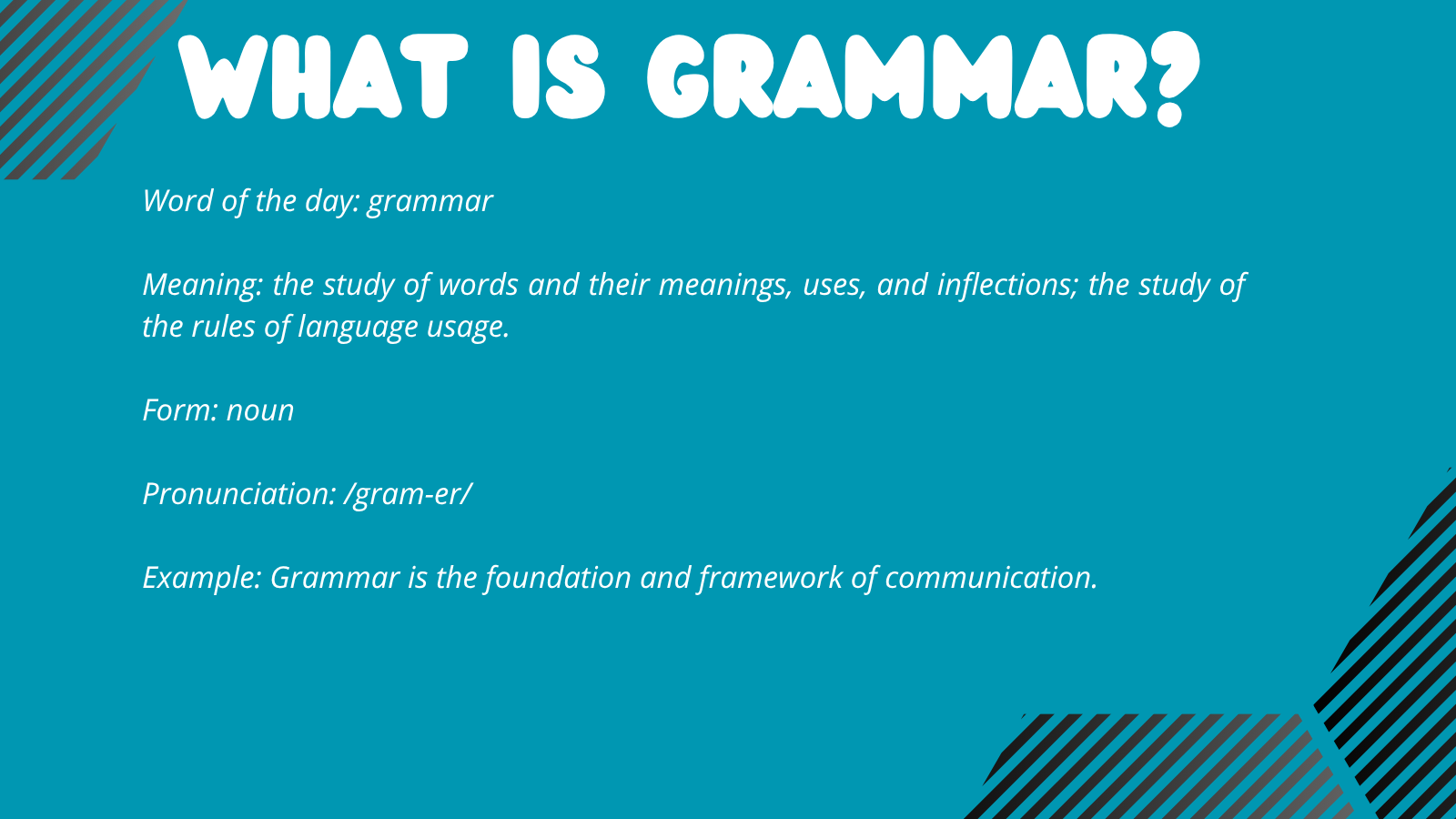
Grammar is the foundation and framework of communication in all languages. Different words do different things, and some words (like “work”) can do more than one thing. Some have restrictions, like uncountable nouns, and some are vital to correct expression (like the presence of articles and determiners).
Let’s start with a recap of things you may not have dealt with since elementary school.
This term helps us classify words according to the functions they have in a sentence. The English language has nine parts of speech and several variations of these categories.
Noun: a person, place, thing, or idea;
Verb: an action or state of being;
Pronoun: a word that stands in place of a noun (so we don’t have to repeat it);
Adjective: these words modify nouns and pronouns;
Adverb: these words modify verbs;
Prepositions: these words show “spatial, temporal, and role relations between a noun or pronoun and the other words in a sentence” (quoted from this ThoughtCo. article);1
Article or determiner: these words specify and identify nouns;
Interjection: words that show strong emotion or reactions and that can stand on their own as complete thoughts (such as ouch, whoops, and all the so-called 4-letter-words)
The articles and books published today have been affected by machine translation, generated content, and sparingly proofread AI-assisted writing. Quality is improving, as could be expected, but sometimes writers aren’t that critical of what their prompt has produced before publishing it.
Sometimes, they simply don’t know the rules. I noticed this when I saw a person in a video ask his viewers to think about a book they had read recently. Only he said “think to a book”.
Another word is “information”. In English, it’s uncountable: that means that it has no plural. You can’t say “give me an information”. You have to ask for some information. But frequently, if you speak with non-native speakers, you’ll here them say “informations”.
Now, in the age of AI, our personal knowledge of grammar has become crucial, especially if we want to produce good writing. AI was trained on all sorts of written material, so when you ask it to write something, it pulls out what was used to train it and sometimes it makes up things that seem to fit.
Revision is paramount! But in order to go a good job, writers need to understand the tools of writing: the parts of speech, the punctuation rules (which are different for different languages), and the true meaning of your piece of writing. We can’t just wing it any more.
Have you already learned about the parts of speech? If so, what do you remember about how to use them?
Do you review your AI-generated articles thoroughly before posting them? Can you identify AI-generated content? If so, what tips you off?
Do you adopt every suggestion the word processing program gives you? Or do you make sure your words convey your meaning, even if they’re underlined in red or yellow?
Let me know what you think. Please! Even if you disagree, I appreciate you being here and reading.
Talk to you soon,
Marsha
Nordquist, Richard. (2024, May 2). The 9 Parts of Speech: Definitions and Examples. Retrieved from https://www.thoughtco.com/part-of-speech-english-grammar-1691590
Comments
Nothing yet. Say the first thing.
Sign in to join the conversation.