
Picture this. You’re in a meeting and your manager says:
“Let’s circle back on this. I want to make sure we’re all level set before we move forward.”
You understood every single word. And yet you have absolutely no idea what was just said.
You’re not alone — and you’re not missing something obvious. Here’s something nobody tells you when you start working in a U.S. office: the English you learned and the English people actually use at work are two very different things.
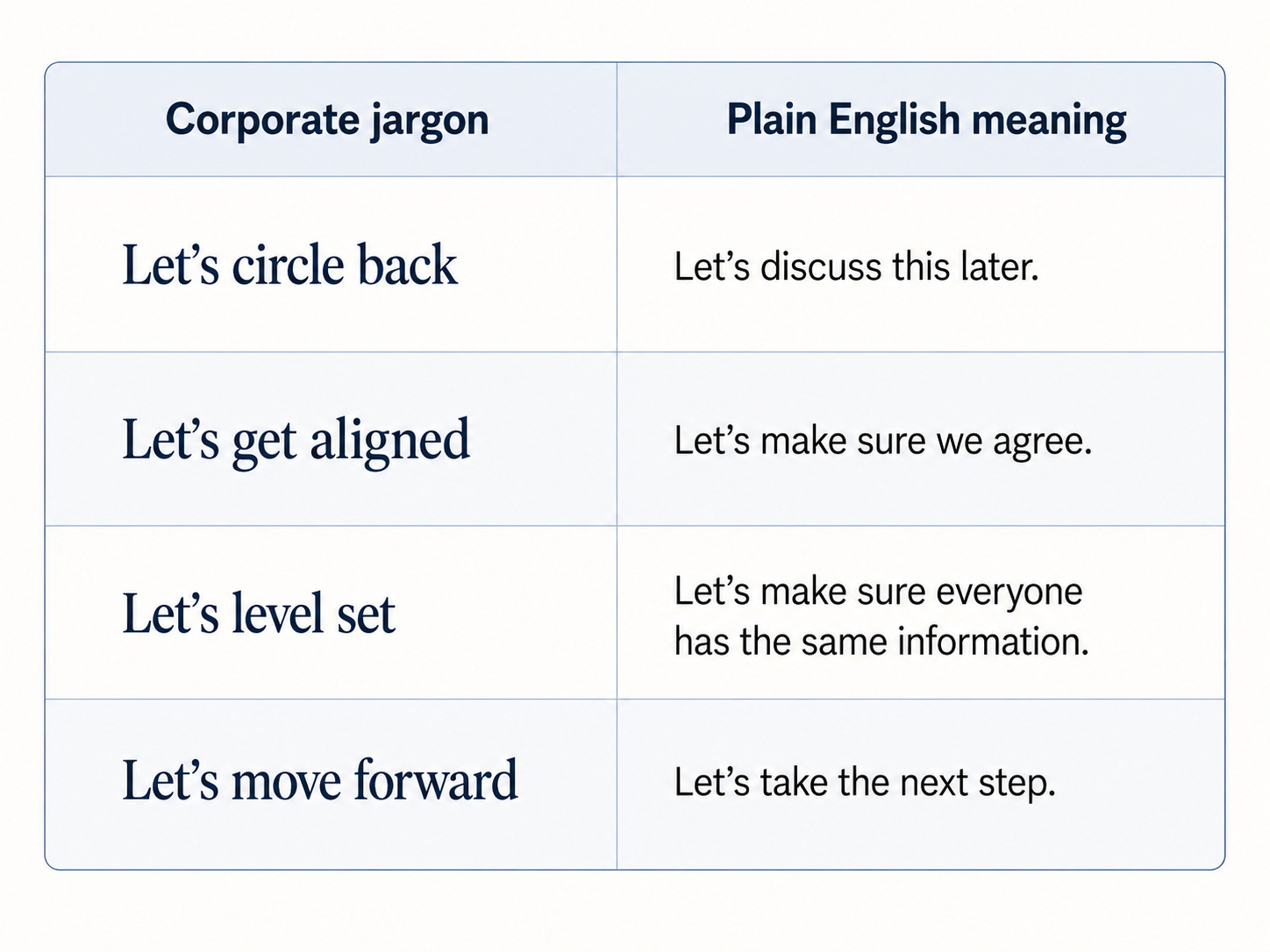
In the classroom, you learned to say things like: “Let’s discuss this later.” “I want to make sure everyone understands.” “Then we can decide what to do next.”
That language is clear, direct, and logical. But walk into a U.S. office and those same ideas often come out sounding like this:
“Let’s circle back.” “Let’s level set.” “Let’s move forward.”
Same meaning but a completely different language. Welcome to American corporate jargon. Today we’re going to decode it together!
You may be happy to learn that corporate jargon does not only confuse English learners. It confuses native speakers, too.
A 2026 Cornell University study looked at what researchers called “corporate BS receptivity” — basically, how likely people are to be impressed by vague business language that sounds smart but does not say very much. The researchers studied more than 1,000 office workers and found that people who were more impressed by this kind of language performed worse on tests of analytical thinking and workplace decision-making.
In plain English: vague business language can make unclear ideas sound smart. And that matters even more when English is your second language. When someone says “let’s circle back once we’re aligned,” you may wonder: is this an action item? A decision? A polite way to disagree? Am I supposed to do something?
So here’s the good news. First, the problem is often not your English. The problem is that corporate jargon frequently hides the real meaning. Second, once you know the code, you can use it too. And that matters — because in U.S. workplaces, using these phrases naturally signals that you understand the culture and belong in the room.
This post decodes 25 of the most common phrases you’ll hear in U.S. workplaces — what they sound like, what they actually mean, and how to use them naturally.
Let’s start with 8 corporate jargon phrases you’ll hear again and again in U.S. workplaces.
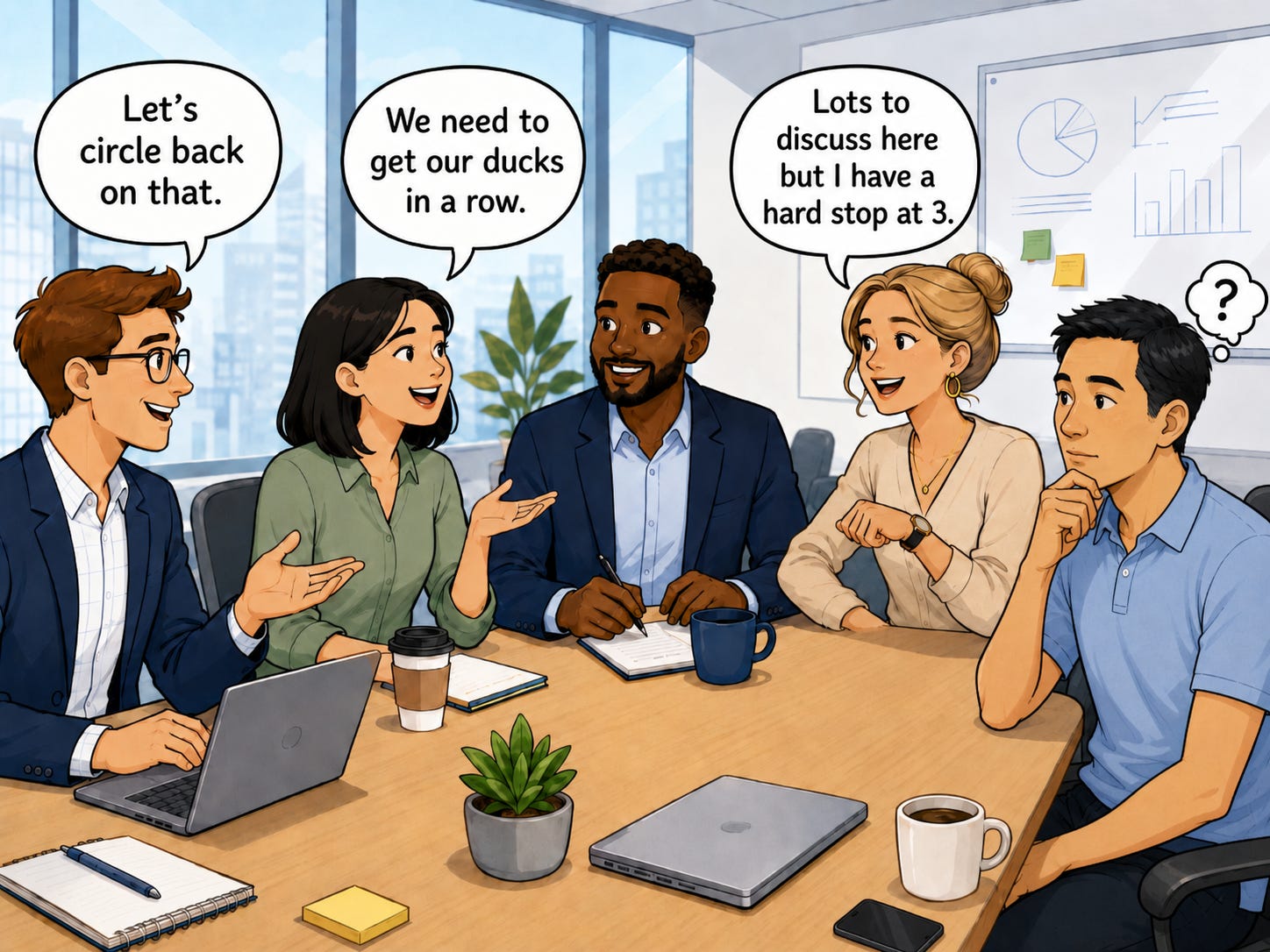
🔊 Example:
“Let’s circle back on this later in the week.”
Plain English meaning:
Let’s return to this topic later.
How it’s usually used:
People use circle back when they want to delay a conversation, revisit an issue, or come back to something after getting more information. The tricky part is that “later” is often not specific. It could mean tomorrow, next week, or sometimes never.If the topic matters to you, it’s smart to follow up with a clear time.
✅ Try saying:
“I don’t have all the information yet — can we circle back on this after I’ve had a chance to review the numbers?”
🔊 Example:
“Good question — let’s take that offline.”
Plain English meaning:
Let’s discuss this separately, not in this meeting.
How it’s usually used:
This phrase has nothing to do with the internet. People say take that offline when a topic is too detailed, too sensitive, or too off-topic for the current meeting.It can be a polite way to say: “This is not the right time or place to discuss this.”
✅ Try saying:
“There are a few things I’d like to discuss in more detail. Would it be okay to take this offline after the meeting?”
🔊 Example:
“I have a hard stop at 3.”
Plain English meaning:
I must leave or end the meeting at exactly that time.
How it’s usually used:
A hard stop is a fixed end time. The person is saying they cannot continue past that time.In U.S. workplace culture, this is not rude. It is a normal and professional way to protect your schedule and respect other people’s time.
✅ Try saying:
“Just to let everyone know, I have a hard stop at 2:30 today — happy to follow up by email on anything we don’t get to.”
🔊 Example:
“Our North Star is customer satisfaction.”
Plain English meaning:
Our most important goal or guiding principle.
How it’s usually used:
The North Star is borrowed from navigation. Sailors used the North Star to find direction.In business English, your North Star is the main goal that should guide decisions. When someone asks, “What’s our North Star?” they mean: What is the one thing we should keep focused on?
✅ Try saying:
“Before we go further, it might help to align on our North Star for this project — what’s the one outcome that matters most?”
🔊 Example:
“We’ve tried a few things, but nothing has really moved the needle.”
Plain English meaning:
To make a noticeable or meaningful difference.
How it’s usually used:
This phrase comes from the image of a dial or gauge, like a speedometer. The needle only moves when something significant happens.At work, people use move the needle when they want results that are big enough to matter. Small changes, tiny improvements, or minor adjustments usually do not “move the needle.”
✅ Try saying:
“I think this new approach could really move the needle on customer retention — it’s more targeted than what we’ve tried before.”
🔊 Example:
“Before we get started, let’s level set.”
Plain English meaning:
Let’s make sure everyone has the same information and understanding.
How it’s usually used:
People use level set at the beginning of a meeting, project, or discussion. It means getting everyone to the same starting point before making decisions or moving forward.Think of it as pressing a reset button: first, we make sure everyone understands where things stand.
✅ Try saying:
“I’d love to level set before our next meeting — can I send around a quick summary of where things stand?”
📝 Note:
Level set is sometimes written as level-set or levelset. All three versions are common.
🔊 Example:
“I just don’t have the bandwidth for that right now.”
Plain English meaning:
I do not have enough time, energy, or capacity to do that right now.
How it’s usually used:
Bandwidth originally comes from technology and telecommunications, but in U.S. workplaces it is now used to talk about workload and mental energy.When someone says they don’t have the bandwidth, they mean they are too busy, stretched, or overloaded to take on something new.
It sounds softer and more professional than saying, “I’m too busy.”
✅ Try saying:
“I’d love to help with that. Could we revisit next week? I don’t have the bandwidth to do it justice right now.”
🔊 Example:
“We need to do a deep dive on this before we make a decision.”
Plain English meaning:
A detailed and careful examination of something.
How it’s usually used:
A deep dive is the opposite of a quick look or a general overview. When someone asks for a deep dive, they want analysis, detail, and substance.This phrase is often used when a situation is complex, something has gone wrong, or a decision has important consequences.
✅ Try saying:
“I’ve done a quick review of the data. I think it’s worth scheduling time for a proper deep dive before we finalize the strategy.”
📝 Note:
High-level is often the opposite of deep dive. A high-level overview gives the big picture without going into much detail.
You may hear both phrases together:
“Let’s start with a high-level overview and then do a deep dive on the parts that need more attention.”
Elena is a financial analyst from Ukraine working at an advertising agency in Chicago. She’s been with the company for eight months, and her work is strong. But her communication still trips her up sometimes.
On Tuesday morning, she opens her inbox and finds this email from her manager, David:
Hi Elena — just wanted to circle back on the Q4 strategy conversation from last week. Before we move forward, I think we need to level set with the broader team. I want to make sure we’re all aligned on our North Star before we go too deep. Could we do a deep dive on the numbers this Thursday? I could meet at 2, but I have a hard stop at 3. An hour should be plenty of time.
Let me know if that works.
David
Elena reads it twice.
She understands the words. But she’s not completely sure what David is asking her to do, when he wants it done, or what aligned on our North Star means in the context of a Q4 strategy discussion.
She almost writes back:
Hi David — I’m not sure I understand. Could you clarify?
But instead, she takes a breath, reads it again, and decodes the message phrase by phrase.
Using what you’ve learned in this post, answer these three questions:
👉 What is David actually asking Elena to do?
👉 What does “aligned on our North Star” mean in this context?
👉 What should Elena’s reply say?
Hi David — Thursday works well for me. How does 1:30 sound? I’ll pull together the Q4 numbers beforehand so we’re ready to dig in. I’m also happy to send a brief summary to the wider team beforehand if that would help with the level set.
Elena
Elena decoded the email correctly: David wants a meeting to review the Q4 numbers and make sure the team agrees on the main priority before going further.
Her reply works because it is specific, professional, and helpful. She offers a concrete time, shows initiative by preparing the numbers in advance, and uses one piece of David’s own language naturally — level set — which signals that she understood the message and is comfortable with the communication style.
Circle back → return to a topic at a later point
Level set → make sure everyone has the same understanding before moving forward
Aligned → in agreement and on the same page
Example: “I want to make sure we’re all aligned before we proceed.”
North Star → the single most important guiding goal or principle
Deep dive → a thorough, detailed examination of something
Hard stop → a fixed, unmovable end time
Example: “I have a hard stop at 3.”
Move forward → continue or proceed
Example: “Before we move forward, let’s make sure we’re aligned.”
Those eight phrases are the ones you’ll hear every week. But U.S. workplaces run on a much longer vocabulary of jargon — and the further you go in your career, the more of it you’ll encounter.
In the paid section, we decode 17 more phrases — from everyday staples like touch base, pushback, and on my radar to the ones that will make you smile once you know what they mean (drinking from a firehose, get our ducks in a row, workslop). Each phrase comes with a real-world example, a plain-English explanation, and a note on when and how to use it naturally.
Then we put it all into practice with two mini-cases — Andrés navigating a jargon-heavy conversation with his manager on his first week, and Priya sitting in on a senior strategy meeting and decoding everything in real time.
Two quizzes test you on all 25 phrases — one fill in the blank, one choose the correct idiom. And finally, a creative dialogue exercise gives you a scenario, two characters, and ten phrases to use — because reading about language and actually using it are two very different things.
The full archive is yours from day one. Only $8 per month.
If you’re ready to speak the language everyone else already knows →
Comments
Nothing yet. Say the first thing.
Sign in to join the conversation.