

Farid, one of my adult learners, forwarded me an email exchange. He wanted to know what had gone wrong.
His director, Jim, had asked a question: Can we meet the Friday deadline?
Farid replied: This week has been tough. Our vendor shipment was delayed by two days. Monday was a holiday. And Priya was out sick for part of the week, so the team lost some time.
Jim wrote back: So is that a yes or a no?
Farid was confused. He thought he had answered the question.
And technically, his English was fine. Farid is a supply chain analyst who hopes to be promoted this year. His grammar and word choice were correct. Every sentence in his message made sense.
So what went wrong?
Farid gave his reasons first and left the answer for his manager to figure out.
In many cultures, giving context before the main point can be a polite way to communicate. But in an American workplace, especially when someone asks a direct question, people often expect the opposite: Answer first, then explanation.
Confident American professionals talk and write this way all the time:
Yes, we can hit Friday. Here’s what it will take.
No, I don’t think we should move forward yet. Here’s why.
I recommend option B. Here’s the reasoning.
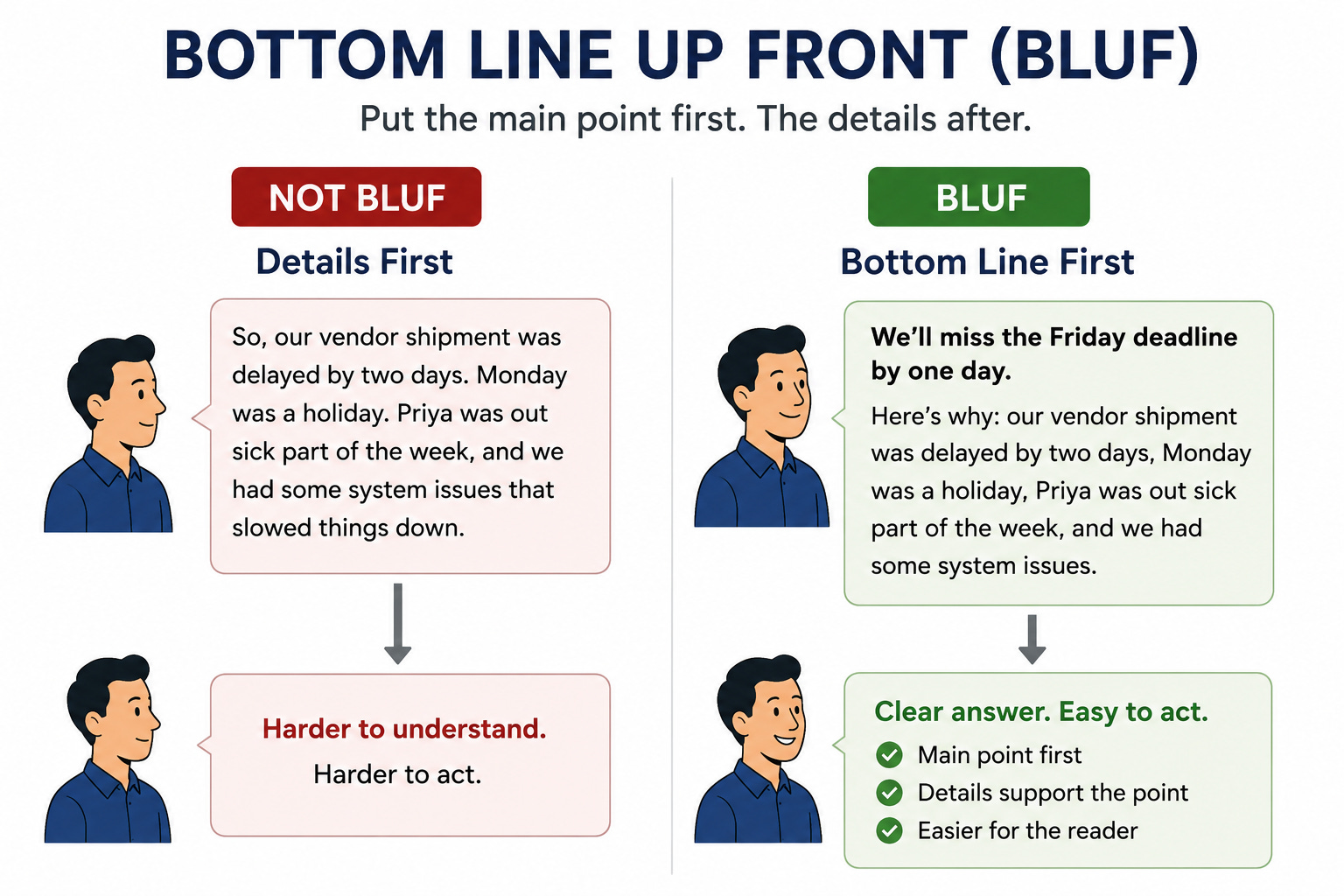
This style even has a name: BLUF, short for bottom line up front.
📝 Bottom line up front (BLUF) = a way of communicating that puts the main point first and the details after
If you read our earlier post Don’t Make Your English Too Polite, this will sound familiar. That lesson was about not hiding your point behind too many softening words (such as maybe and I think).
This lesson is about not hiding your point behind too much backstory.
📝 Backstory = the background information or explanation that comes before the main point
👉 Different habit, same fix: Say the important thing first. Then support it.
❌ Harder to understand:
This week has been tough. Our vendor shipment was delayed by two days. Monday was a holiday. And Priya was out sick for part of the week, so the team lost some time.
What does Jim have to do? He has to figure out the answer himself.
Now compare it with this:
✅ Clearer:
We’re going to miss Friday by one day. The vendor shipment was late, we lost a day to the holiday, and Priya was out sick.
The second version is clearer. Farid gives Jim the information he asked for first. This way, Jim can get the information he’s looking for immediately.
Imagine Farid talking to his coworker Marcus before he replies to Jim.
Farid: I don’t know how to say this without sounding like I’m making excuses.
Marcus: What happened?
Farid: There were some real issues this week. The vendor was late, we lost a day to the holiday, and Priya was out sick.
Marcus: Okay, but give me the headline. Are we hitting Friday or not?
Farid: Probably not.
Marcus: Okay. That’s what I needed to know!
Farid gives Marcus all the background before giving him the one thing he really needs: the answer. Marcus has to ask another question to get it.
Farid: We’re going to miss Friday by one day.
Marcus: Okay. What happened?
Farid: The vendor shipment was late, we lost a day to the holiday, and Priya was out sick. We can finish by Monday instead.
Marcus: Got it. I’ll let the team know.
One sentence gives Marcus the answer. Everything that follows explains it. He doesn’t have to search for the point because Farid puts it first.
Farid still wants that promotion. And a few weeks later, he has to tell Jim something even harder than “We’ll be a day late.”
What does he say? How does Jim respond? And what happens to Farid’s promotion by the end of the year?
Upgrade to keep reading.
For $8 a month, you’ll get:
🔎 The research behind why putting your main point first works
💬 Five workplace situations where answer-first communication can make you sound more confident
🧰 Sentence starters you can use in your next email or meeting
✏️ Practice exercises, quizzes, vocabulary review, and full answer keys
📚 Full access to the entire archive of past lessons
One better communication habit can change your career.
👉 Upgrade now for $8 a month to keep reading
Comments
Nothing yet. Say the first thing.
Sign in to join the conversation.