

Maria, one of my adult learners, forwarded me a draft email to her boss. She wanted my feedback on her workplace communication.
She hopes to be promoted soon and wants to make sure she’s sounds confident and professional.
Maria was managing a complex project with a tight deadline. She believed the team needed one more week, but she did not want to sound disrespectful.
Here’s what she drafted to her boss:
Sam,
I wanted to give you a quick update on the project. Testing is taking longer than expected, and I think maybe we could consider pushing the deadline back by one week, if that’s okay.
Her message included several phrases that made her recommendation sound less clear:
I think
maybe
could
if that’s okay
Maria thought these phrases would make her sound polite. Instead, they made it hard to tell what she really wanted.
Did she believe the deadline should change? Or was she only presenting it as one idea?
Yes, but the problem is not politeness itself. There’s a role for politeness, helping diffuse tension when you disagree with someone, make requests and work with others productively. But when we add too many “careful” words, our main message can become hard to understand.
Confident American professionals use phrases like:
I think…
My sense is…
It looks like…
From what I can see…
I may be missing something, but…
These phrases, also called “softeners,” show that the speaker is giving an opinion rather than stating a fact. One softener can help you sound thoughtful and professional. Just be careful not to overdo it on the softeners.
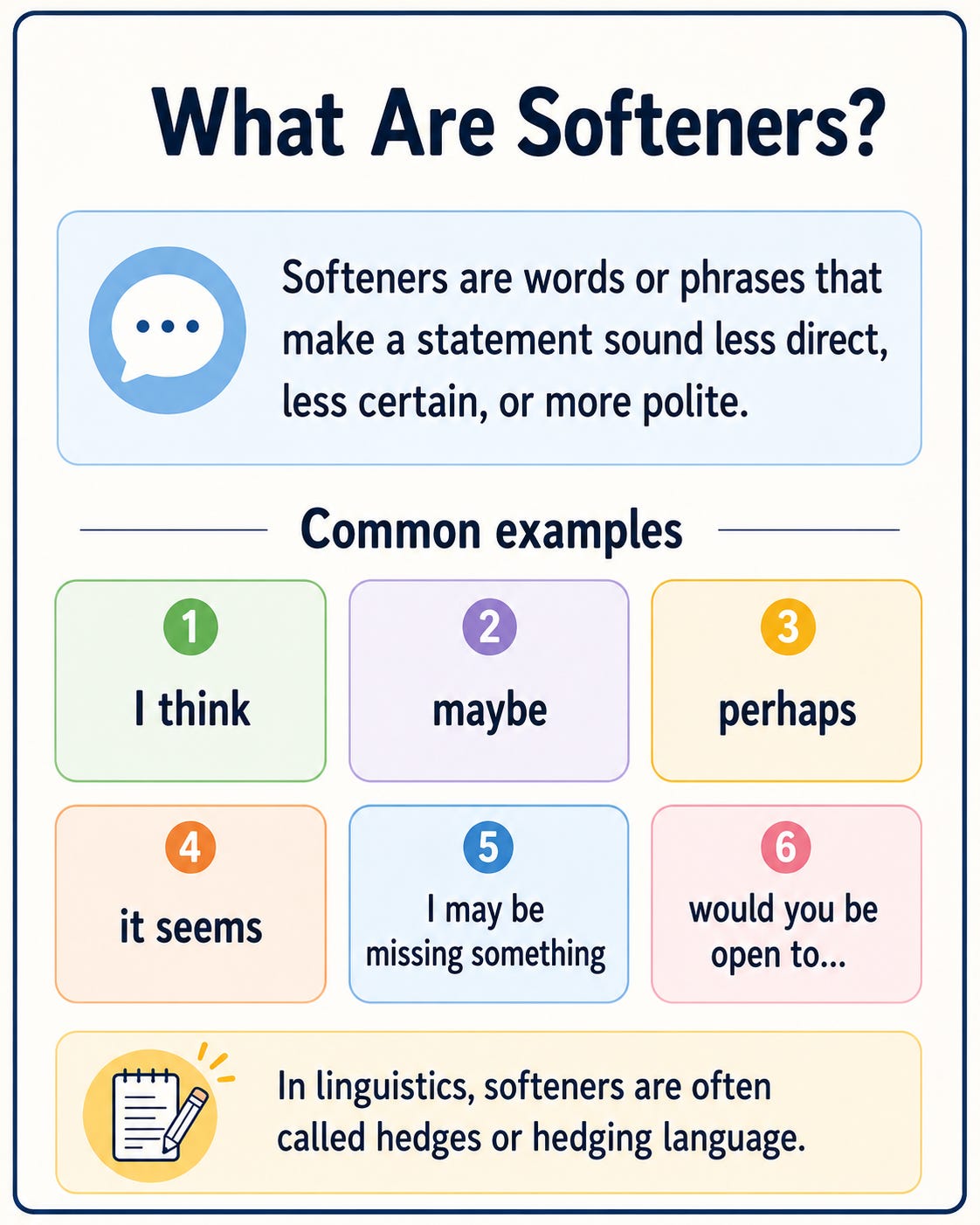
❌ I wanted to give you a quick update on the project. Testing is taking longer than expected, and I think maybe we could consider pushing the deadline back by one week, if that’s okay.
✅ I wanted to give you a quick update on the project. Testing is taking longer than expected, and I think we need one more week. Can we move the deadline to September 22?
The second version is still polite, but the main point is easier to understand.
I think shows that Maria is giving her professional opinion. She also explains the reason:
Testing is taking longer than expected.
Then she makes a clear, specific request:
Can we move the deadline to September 22?
Maria isn’t pretending to be certain. She is just making it easier for her boss to understand her recommendation.
Imagine Maria talking with a colleague before she emails her director.
Maria: I was wondering if maybe we should ask for another week.
Colleague: Do you think we really need it?
Maria: I think we might, but maybe the team can still finish on time.
Colleague: So what are you recommending?
Maria sees a problem, but she is sending mixed signals.
📝 To send mixed signals means to communicate two different or conflicting messages.
She says the team may need more time, then suggests that everything may still be fine. Her colleague cannot tell what she really thinks they should do.
Now listen to a clearer version.
Maria: I think we need another week.
Colleague: What makes you think that?
Maria: Testing is three days behind, and we still have two major issues to fix. I’m going to recommend moving the deadline.
Colleague: I agree. We should ask for the extra week.
Maria uses one phrase to show that she is giving her opinion:
I think…
Then she gives the facts and clearly says what she recommends. She still sounds polite, but no one has to guess what she means.
Next, let’s look at what the research says and learn one simple rule for making your message clear without sounding rude.
✨ Want to sound more confident at work without sounding rude?
Upgrade to continue reading.
For just $8 a month, you’ll get:
The simple rule that fixes most over-hedging
A realistic manager dialogue you can use as a model
Better phrases for emails, meetings, and difficult conversations
A quick editing test to make your English sound clearer
Practice questions with answers
Full access to the entire archive of past posts 📚
That means dozens of practical lessons designed to help you speak more naturally, sound more professional, and move ahead in your career.
One useful phrase can change a conversation. One better conversation can change how people see you.
👉 Upgrade now for $8 a month and keep reading.
Comments
Nothing yet. Say the first thing.
Sign in to join the conversation.