
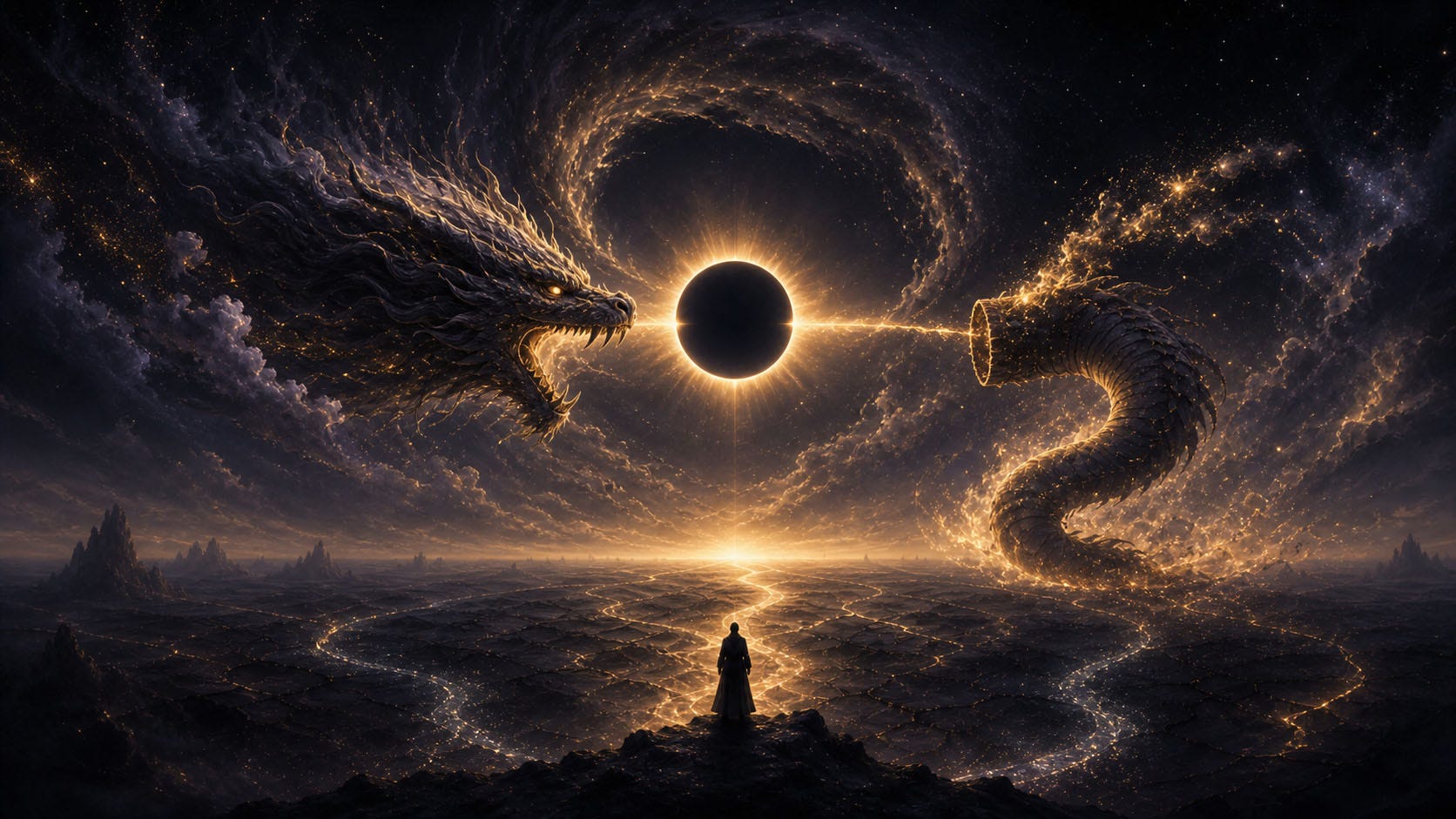
To read an eclipse accurately, you must look at its specific mandate. In order to do this, we must know whether it’s either Solar or Lunar, and whether it’s a North Node or South Node event.
A Solar Eclipse always occurs at a New Moon. Under normal conditions, the Moon is invisible, overpowered by the brilliance of the Sun. At a Solar Eclipse, the Moon unexpectedly steps into the foreground and darkens the Sun—a fundamental role reversal.
So whilst Solar Eclipses can seed new beginnings just as New Moons do, they are new beginnings with a twist of fate born through disruption. Something that was previously overlooked, dismissed, or left out of the plan suddenly becomes the deciding factor. An unexpected event, person, desire, or circumstance enters the picture, shifting the entire trajectory.
Lunar Eclipses occur at a Full Moon, inheriting the classic symbolism of culmination and outcome. But here, too, there is a twist: the Earth’s shadow interrupts the standard Full Moon process, forcing what has been gathering beneath the surface to break into consciousness all at once. This is why Lunar Eclipses trigger sudden revelations or awareness of what was previously out of view. Months of unspoken tension or subterranean development can crystallise in a single moment.
The Lunar Nodes dictate how these dynamics unfold:
A South Node Eclipse works exclusively on what has already been lived, built, or set in motion. Because the South Node is the tail of the dragon, it cannot take in fresh input; its function is to digest, release, or transform accumulated history. This makes South Node Eclipses heavily outcome-oriented—something comes out.
If you have spent years building a digital footprint, for instance, this could manifest as sudden recognition or being headhunted for a major documentary. If an intimate relationship has been deteriorating for years, it might bring a definitive closing of the door. What looks like a sudden shock on the surface is almost always the final sentence of a very long chapter.
North Node Eclipses operate in the opposite direction. The North Node is the head of the dragon: it possesses the eyes and mouth to see, ingest, and explore. These eclipses bring an inflow of unfamiliar energy—a new opportunity, invitation, person, or direction that requires us to step outside our established baseline.
When you put these distinctions together, simply stating “there’s an eclipse in your 6th house” is nowhere near enough information.
We need to dive much deeper.
Is it Solar or Lunar? North Node or South Node? Is something entering or leaving your field?
Is accumulated momentum coming to fruition, or is it dissolving through your fingers like sand? Is this an initiation, a consequence, a revelation, or a release?
Tip: Pay attention to what is genuinely clearing out, resolving, or asking for honest alignment in your chart right now—and don’t let the surface-level noise distract you from the deeper work unfolding.
❤️ Enjoying this post? Please take a moment to tap the heart and share. This small gesture helps more people discover Energy Therapy! Thank you!
Locate 20° Leo: Find the house containing approximately 20° Leo in your natal chart. This marks the primary arena where this eclipse story will unfold.
Check for Hard Contacts: Look for natal planets or angles around 17°–23° of the Fixed signs:
Leo: Conjunction
Aquarius: Opposition
Taurus or Scorpio: Square
Orb Considerations: Start with a tight orb of approximately 3 degrees. Widen that orb up to 8–10 degrees when the eclipse directly activates your Sun, Moon, Ascendant, or Midheaven. You can also note if the eclipse triggers aspect patterns in your chart, which add another potent layer to the story.
Want to understand how this Solar Eclipse—or the Lunar Eclipse that follows—activates your natal chart?
Even if these particular transits do not make exact contact with your key placements, future eclipse cycles will. In our work together, we can explore your natal nodal placements and the broader karmic story they describe.
I currently have two client spaces available before I leave for Oxford, plus booking slots open for my return in September:
Option 1: Pre-Oxford Sessions (20th or 21st August)
Payment Deadline: Wednesday, 12th August (to allow sufficient time for chart preparation).
Option 2: Post-Oxford Sessions (From 15th September onwards)
Payment Deadline: Thursday, 20th August.
In a Karmic Destiny & Archetypal Mapping session, we explore the Lunar Nodes in your birth chart, the active houses and planets, and the overarching patterns of growth, culmination, and release unfolding for you—both now and across the broader arc of your life.
👉 Book your Session Here
(Please note: date, exact time, and place of birth are required. Chart rectification is not offered at this time.)
Most manifestation advice fails around eclipses because it treats a Solar Eclipse like a regular New Moon.
People light candles, write intention lists, and try to “manifest” new outcomes—completely unaware that the rules of intention-setting are fundamentally inverted during an eclipse.
If you try to initiate a standard manifestation protocol under a South Node (Ketu) eclipse, you are essentially trying to plant seeds in soil that cosmic mechanics are actively clearing out. The result? Frustration, stalled momentum, and feeling like the universe is working against you.
To actually work with these transits—rather than getting run over by them—you have to understand how and why the “Role Reversal” happens, the exact spatial geometry that overrides your conscious will, and how to tell whether a transit is forcing an inflow (Rahu) or demanding a purge (Ketu).
In this exclusive paid breakdown, we go deep into the mechanics:
The Quantum Mechanics of Manifestation: Why standard New/Full Moon ritual rules break down during an eclipse, and how the Sun-Moon “Role Reversal” temporarily overrides your egoic intentions.
The Cosmic Spatial Realignment: The precise astronomical geometry that shifts authority from your conscious mind to your subconscious and environmental forces.
North Node (Rahu) vs. South Node (Ketu) Mechanics: How to immediately identify whether an eclipse is forcing an unexpected new trajectory or executing a timeline collapse/structural purge.
The “Stage Light” Fallacy: Why forcing a public debut under a South Node Leo eclipse backfires—and how to align with the true, behind-the-scenes clearing taking place in your chart right now.
Side-by-Side Reference Master Table: A clear breakdown comparing Rahu vs. Ketu mechanics, ego reactions, and real-world outcomes so you never misread an eclipse mandate again.
Upgrade your subscription to unlock the complete guidance and master the art of working with the mechanics of eclipse timing.
Comments
Nothing yet. Say the first thing.
Sign in to join the conversation.