
Investors, policymakers, and system planners model project risk in very different ways, yet all are ultimately chasing the same question: what actually gets built?
For investors, risk is about return volatility and discounted cash flows. For policymakers, it’s about realized socio-economic impact. For system planners, it’s about capacity adequacy, reliability, and the timing of new infrastructure. The first speaks in discounted cash flows and IRRs; the second, in GDP and jobs; the third, in megawatts and grid stability.
All three perspectives share a deep need for data-driven, risk-based analysis of how projects move from paper to construction, which is why the Energy Nation probabilistic model focuses on expected value (EV).[1]
At its core, EV represents success-weighted capital. It turns the abstract notion of risk into measurable outcomes. By multiplying probability by project cost (or capacity, or CO₂ emissions), we can answer a simple but powerful question: for every unit of proposed investment, how much is likely to materialize?[2]
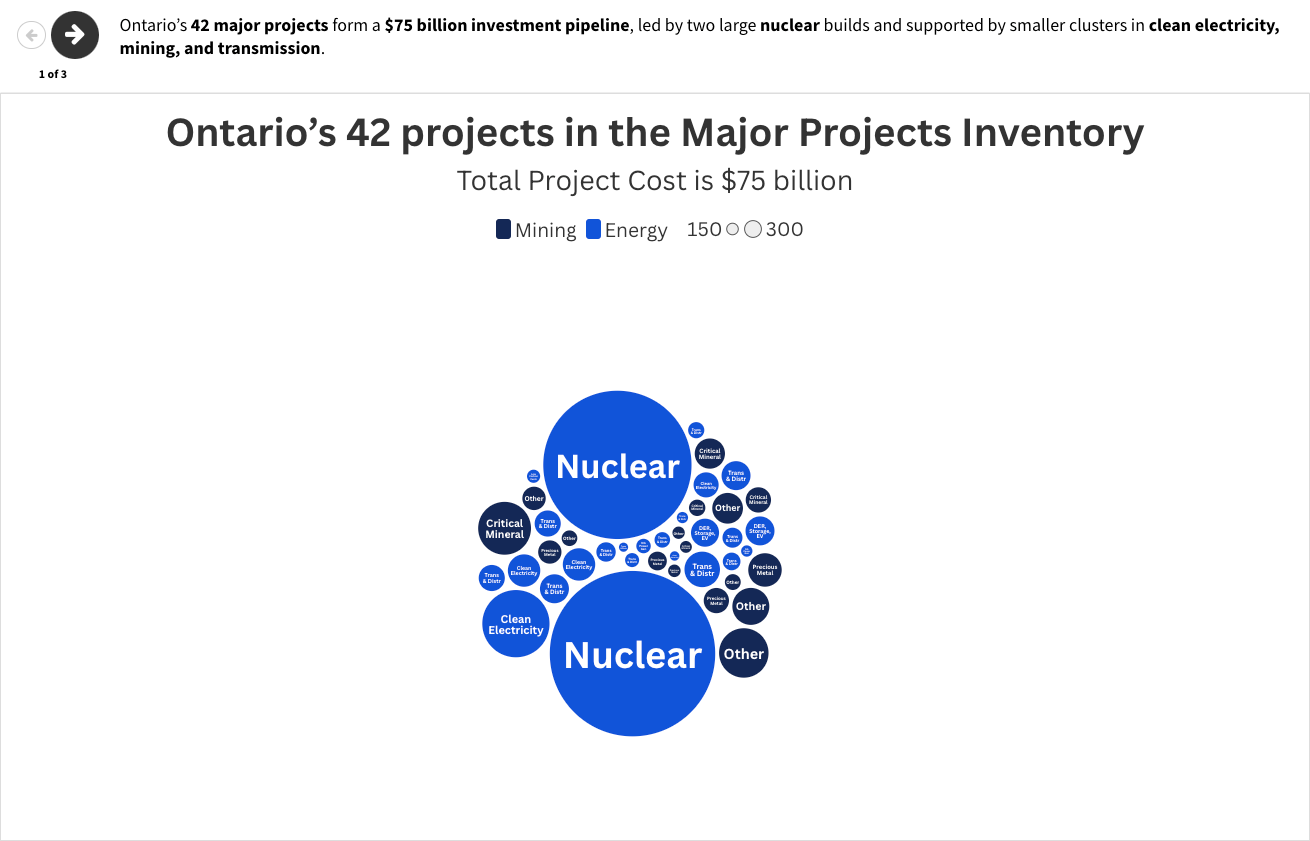
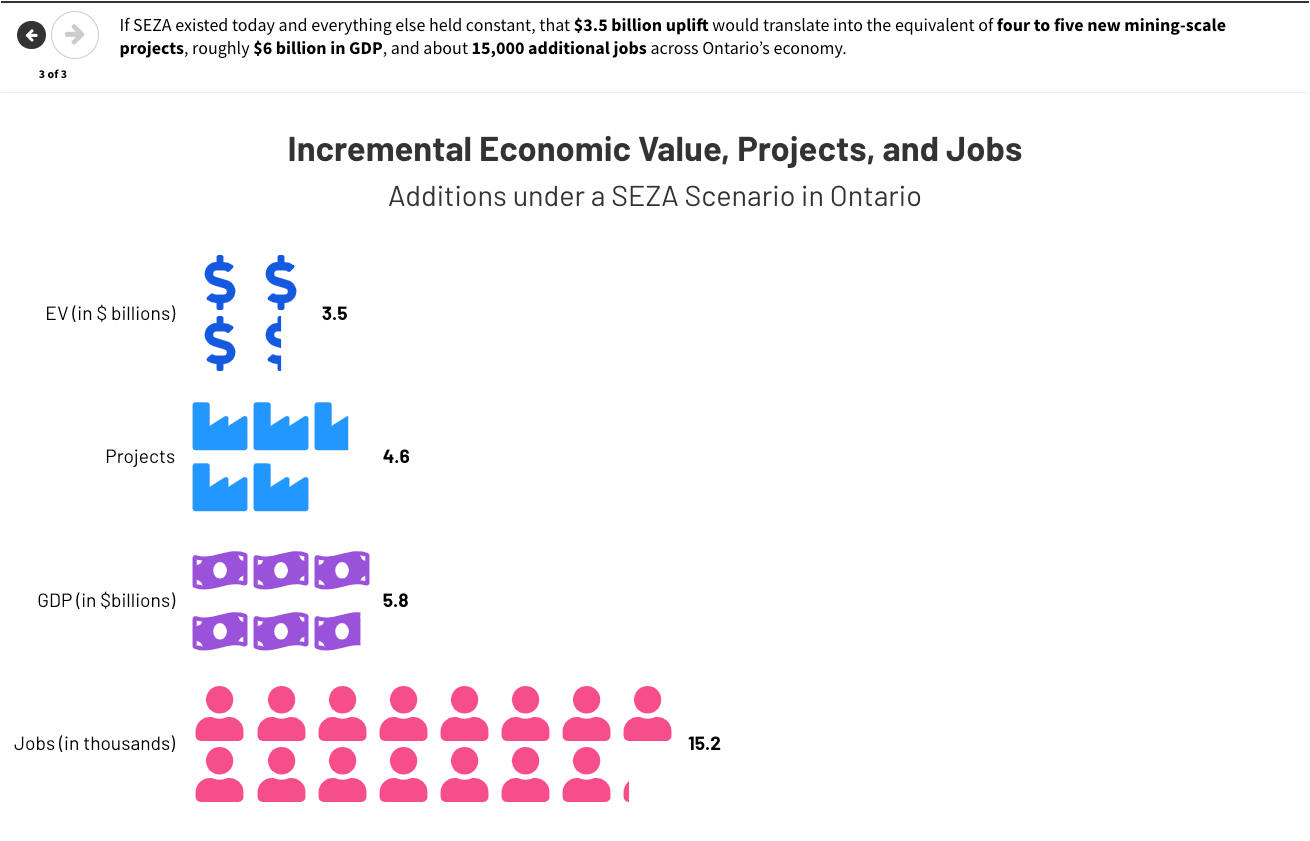
To see how this plays out in practice, we revisit Ontario’s major project portfolio: 42 large-scale developments across energy and mining, together worth roughly $75 billion. Each project carries its own cost and probability of success, allowing us to estimate how much capital is likely to be realized under current conditions. We can then simulate how changes in policies or processes, such as those introduced under the Special Economic Zones Act 2025 (SEZA), would alter those odds and quantify the resulting shifts in financial, system, and socio-economic outcomes.
Explore the full analysis in our interactive data story, created with Flourish Studio.
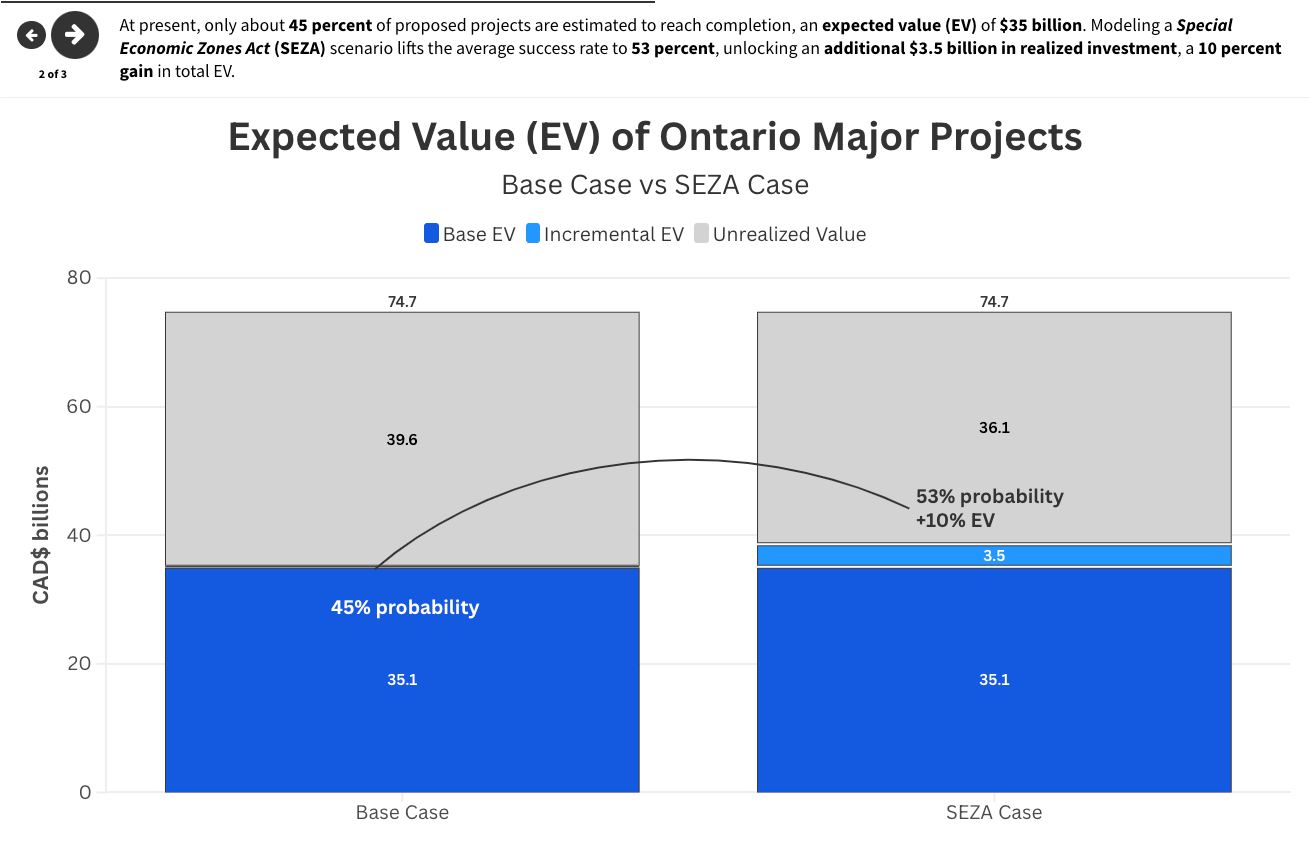
[1] Total EV is the sum of probabilistic share of each project’s total project costs that is expected reach completion under each policy scenario. The Energy Nation model can also discount EV, although I rarely do so, since it adds another layer to an already complex data stack.
[2] Deterministic capacity expansion models (CEMs) can show what, where, and when to build, but they tend to overlook the risks inherent in development and financing. For example, a CEM might tell you that a province needs n GW of new wind energy by 2030, whereas a probabilistic risk engines would tell you that to have n GW of new wind by 2030, you may need 2n GW or 10n GW in the development pipeline by 2025, depending on the odds. Translating probabilities into expected values, expressed in dollars or capacity or emissions, reveals how shifts in risk translate into real outcomes.
Comments
Nothing yet. Say the first thing.
Sign in to join the conversation.