
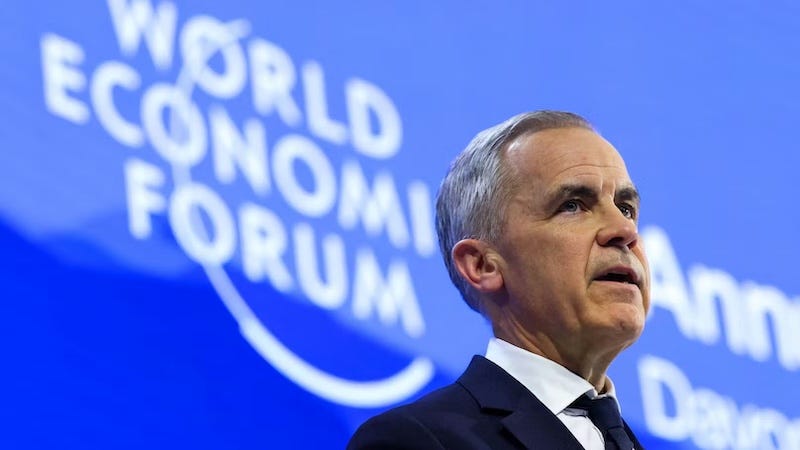
In the year and a few months since he became Prime Minister, one of Mark Carney’s signature themes has been to “actively take on the world as it is, not wait for a world we wish to be.”
He laid it out in as many words in his widely-heralded speech to the World Economic Forum in Davos last January. And in every direction all at once, so often for the better and so often for the worse, he’s been acting on it ever since.
The avalanche of decisions, announcements, and possibly performative memoranda of understanding and “head of agreement” deals has left close observers with whiplash. The pace of activity and the government’s briefly derailed but still strong deregulatory slant has many climate hawks despairing at latest data showing that 80% of Canadians are concerned about climate change, a big gain over the last two years, but only 13% of us list the climate emergency among our top three issues.
We can also take the polling data as an important reality check. Whatever else it tells us—and the immediate news for straight-on, climate-themed action is dire—it shows clear-eyed Canadians recognizing that “the world as it is” is not the world in which we wanted or expected to find ourselves in 2026.
But it’s still the world we’ve got, and it isn’t likely that any of the adjacent or intervening priorities—from pandemics and disease outbreaks, to wars and genocides, to a crushing affordability crisis—will ease anytime soon. Certainly not with the White House still occupied by a walking, raving, “sundowning” chaos field doing whatever it takes to make matters worse. (In case you still don’t have your own countdown app, we’re just 141 more sleeps away from U.S. midterm elections…. hopeful news when you consider that we started at 730.)
So an urgent question in that world is how to shift the narrative, build momentum, and deliver results on climate change in the most complicated, volatile surroundings that many of us have seen in our lifetimes.
If you’ve read The Weekender even occasionally over the last year, you’re familiar with this line of thought. I’m convinced that, in his own mind, Carney came to office with the shortest mandate letter on record.
Job 1: Protect Canadian sovereignty—safeguard Canada’s very existence—against Donald Trump’s 51st state fantasies.
I like to say (endlessly and with much redundant redundancy, friends and colleagues will probably tell you) that this imaginary job description comes with an equally imaginary footnote.
Job 2: If in doubt, refer to Job 1. If you’re still in doubt, refer to it again. Then stop reading and get on with it.
None of this justifies slowing down Canada’s already lackadaisical emissions reduction efforts, giving at least rhetorical aid and comfort to a largely U.S.-owned fossil industry, or sweeping away a half-century of impact assessment regulation.
But for anyone trying to shape how those policies develop and how they play out, an important first step is to understand the motivations behind them. Whatever other factors might be at play—and there are plenty of theories going around—there’s no doubt that sovereignty, annexation, and trade negotiations with the U.S. are at the top of the federal government’s agenda.
All of which led one of my oldest friends and colleagues to ask a provocative question a couple of weeks ago:
So you’re saying that keeping Canada whole is more important than fighting climate change?
No, not quite.
It’s more that, in “the world as it is” as I’m sure Carney defines it, and as most of us experience it, we have to be able to do more than one thing at a time. Fortunately for anyone who does still see climate change as a top priority, the available toolbox of climate solutions has something for pretty much everyone. As veteran climate scientist and communicator Katharine Hayhoe told The Energy Mix in a feature interview earlier this year:
The more worried and paralyzed people get, the more desperately they seek silver bullets, [and] the more they aren’t willing to do the slow and patient work of adding up all the silver buckshot into a truly sustainable solution. They want to just leap right over and find a fix…
[And yet] we have so many pieces of silver buckshot that it means there’s a way for everybody to be engaged in climate solutions. And there are climate solutions that address so many other issues at the same time.
But we dare not forget that, for Canada in 2026, there’s an added dimension. Whatever else we’re doing, wherever we are and whenever it is, all of us everywhere are called to fight fascism when it threatens to rise, fight it with all we’ve got, and keep fighting until we shut it down…alongside whatever else we’re doing.
And Trump has brought us to that moment.
Getting this right is about our basic humanity. It’s also about having the scope and manouevring room to get the job done on climate change or whatever else we’re engaged with. If you doubt that for even a second, think about a Canadian mother and daughter held for weeks in an ICE detention prison, another Canadian detainee just left to die, or an American at risk of deportation by their own malign government after taking a wrong turn and accidentally trying to cross the border.
Or talk to Americans in towns of 10,000, not just the big cities, who live in terror after seeing neighbours carted away in the dead of night.
It’s happening right now, before our eyes, in the country with which we share the longest (we used to say undefended) land border in the world.
Now imagine how much harder it would be to get anything done on emissions reductions, local resilience, or the energy transition if we suddenly woke up one morning in an occupied 51st state.
None of this is an argument for delaying action on a climate emergency that is accelerating, and won’t have the courtesy to pause until we’re ready to pay attention. But we’re already seeing a number of climate advocacy and research shops assembling the data and laying out the arguments that will create bridges between two side-by-side realities.
On one hand:
• Parts of India sweltered late last month under temperatures above 45°C, killing 3,400 people in a day and nearly 30,000 over a five-day span. With the heat lingering long past sunset, “it feels as if mornings and nights no longer exist,” one meteorologist told BBC.
• A much-anticipated El Niño is now upon us, with sharply higher sea surface temperatures in the Pacific Ocean set to disrupt weather, food supplies, and economies and drive hotter conditions—possibly including a record-hot year in 2027. In tandem with higher fuel and fertilizer prices brought on by the American/Israeli war on Iran, the extreme weather could lead to a food crisis for up to 125 million people, according to the U.S. State Department.
• Record temperatures above 15°C in Antarctica this month—20°C above normal—led to widespread melting in a region that normally sees 20 centimetres of ice at this time of year. One team of Chilean glaciologists found rain melting a glacier in the middle of winter. “There was a direct impact on the glacier, which should be receiving snow now,” team member Luis Muñoz told the Guardian. “This is obviously not good for the glacier.”
• After an extreme drought in 2023-24, the Amazon rainforest canopy began releasing chemicals—quite possibly as a defence against stress—that had never been seen before, Germany’s Max Planck Institute for Chemistry reported earlier this month. While scientists don’t yet fully understand the implications, “the shift toward more reactive compounds could have significant implications for atmospheric chemistry and the overall resilience of the Amazon rainforest,” EurekAlert writes.
The storyline on the other side of the house explains why those wrenching, everyday realities are sinking below the waves (below the rising seas?) as a public opinion priority.
But it also carries some powerful hints about where climate communicators and advocates can go next if they want to have an impact:
• Rising fossil energy costs have 31% of Canadians sometimes forced to choose between food and fuel, and 38% at least occasionally making trade-offs between utilities and other household essentials, according to an Abacus Data poll this month on behalf of the Canada Green Building Council. “Affordability is no longer just about the cost of getting into a home,” Abacus wrote, reflecting an undercurrent of urban planning research that in one case dates back a dozen years. “It is about the cost of living in one.”
• Abacus may have conducted its research before we saw the full price impact of the virtual closure of the Strait of Hormuz. Oil stands at US85 to $87 barrel today, but analysts say it could approach $150, depending on whether Donald Trump, Iran’s Revolutionary Guards, and the rest of the hardliners in both countries manage to end Trump’s 100+-day “little excursion”.
UPDATE June 15: There’s confirmation this morning that the U.S. and Iran have reached an initial agreement to end the war and reopen the Strait. If the deal holds, $150-per-barrel oil won’t happen and prices will actually fall, since international oil trading is a business that thrives on pain and suffering—the more brutal and senseless, the better they like it. For the rest of us, though, it’ll take weeks for the backlog of tankers in Hormuz to clear, and even if it cleared tomorrow, history tells us that every fossil fuel supply shock—from Vladimir Putin’s invasion of Ukraine, to the OPEC oil embargoes of the 1970s—pushes oil-consuming countries to steadier, more reliable alternatives.
As we were saying, actually…
• Even without another price shock, the massive disruptions in Hormuz are already leading to permanent “demand destruction” for oil and liquefied natural gas—and if you read a little bit between the lines, fossil companies are even beginning to admit it. The energy-importing countries that are home to 74% of the world’s population have got a message that hasn’t yet landed in North America’s petrostate mediascape or wider culture: that the shift off oil and gas will speed up because countries need cheap, reliable energy that isn’t subject to geopolitical shocks, not particularly because fossil fuels account for 75% of the world’s climate pollution. Cutting emissions along the way will just be the grandparent of all “co-benefits”.
• And as long as geopolitical instability keeps landing faster and more visibly than climate impacts, climate hawks—like it or not—will need to find pathways to fold faster emissions reductions and deeper climate resilience into a fracturing, increasingly militarized global scene. With Russia expanding its presence along NATO’s eastern flank, just as Trump reduces U.S. support for the continent, European military planners are scrambling to rearm in anticipation of a possible invasion as early as 2029. Yet again, it isn’t the fight we wanted or expected. But that worry—see previous reference to standing against fascism wherever we encounter it—is already a strong enough current that climate messages won’t successfully push against it. There might be some unexpected wins to be had by swimming alongside.
It’s easy enough to be led wrong if you listen to the constant drumbeat of propaganda from the fossil industry and its enablers: It’s a different world, they’ll say, and the only “right” answer is to let all of those other priorities dominate and leave climate solutions for another day.
There’s clearly no time for that. The climate emergency is deepening, 80% of Canadians know it, and up to 89% in national surveys around the world want governments to do more to solve it—even if we mostly don’t realize we’re in the majority. Nor is there any need to postpone a new climate economy that is taking shape before our eyes.
No one who understands those realities should stop acting on them. No one who really understands them can stop.
The unexpected twist is that in “the world as it is”, it’s no longer a winning strategy to hammer away at climate facts and data and hope against all recent experience that they’ll break through. Not unless we’re satisfied with winning all the arguments (at least in our own minds) and losing all the decisions.
But if we listen more closely to what matters most to people outside the climate “bubble”, then discover together what parts of a climate solutions toolbox can help get those things done, we may actually see some powerful wins start to take shape.
Even if we’re in a strange, perverse moment when we can’t fully signpost them as climate wins.

Mitchell Beer traces his background in renewable energy and energy efficiency back to 1977, in climate change to 1997. Now he and the rest of the Energy Mix team scan 1,200 news headlines a week to pull together The Energy Mix and The Energy Mix Weekender.

O’Leary’s Data Centre Will Be One of Earth’s Largest Heat Sources, Physicist Warns
What a Supercharged El Niño Could Mean for Canada
61% of Albertans Oppose Subsidies for New Pipeline
BYD Eyes 20 Dealership Locations After Canada Greenlights Chinese EV Imports
31% Cutting Back on Groceries as Canadians Embrace Energy Efficiency to Trim Costs
Hundreds of Rural Albertans Line Up to Battle Data Centre Goliath
Global Gas Glut Could Undercut Demand for Ksi Lisims LNG
The FIFA World Cup Is One Wildfire Away From an Air Quality Disaster
Banks Up the Ante on Fossil Fuels—Again

B.C. First Nations voice opposition to potential pipeline routes revealed in Alberta draft maps (Globe and Mail)
Trump’s Alaska Oil and Gas Lease Auction Draws Just Two Bidders (Bloomberg)
The FIFA World Cup is brought to you by Saudi oil. These fans and players want to stop it (CBC What On Earth)
The oilpatch will need 72,000 workers over the next decade (Canadian Broadcasting Corporation)
West Moberly First Nations and RES awarded 210MW wind energy contract in British Columbia (RES media release)
Judge overturns Trump’s cancellation of $82.1M in clean energy grants (Utility Dive)
China’s solar majors charge into batteries as panel sales falter (Reuters)
The Ocean Can Play a Much Larger Role in Fighting Climate Change (World Resources Institute)
Tensions Mount at Greenhouse Gas Protocol as Scientist Resigns in Protest (Heatmap)
Global biofuel demand set to grow by nearly 70% as food prices rise (Transport & Environment)
Four days of extreme rain killed 7% of world’s rarest orangutans, study says (British Broadcasting Corporation)
Lithuania’s grid operators can now disconnect solar plants without cybersecurity measures (PV Magazine)
Comments
Nothing yet. Say the first thing.
Sign in to join the conversation.