
The US is signalling a shift in its Iran strategy, suggesting that an “indefinite” blockade and continuous economic pressure could turn the tables and force Tehran back to the negotiating table.
However, the consequences of this strategy should concern every government: an indefinite blockade strategy portends an era of indefinite energy crisis, undermining policies that so far have only partially addressed the structural components of the ongoing supply shock.
In the last 24 hours, two key figures in the Trump administration took the stage to suggest Washington is preparing a new course of action to regain the initiative in the war with Iran.
First, while visiting Panama, the Secretary of Defense Peter Hegseth gave his view of the ongoing conflict in an interesting press conference. Asked for how long the U.S. could maintain its blockade on Iranian ports, Hegseth replied
“We can hold it as long as we need to. Indefinitely — the United States Navy can maintain a blockade like that because we’ll rotate ships in and out, as we have and we’ll continue to. No other nation on earth, no other navy on earth has the capability to have a wall of steel like the US Navy, and then the willingness to use it as we have. So, Iran knows it can’t get in and out on this blockade and they know that there’s no timeline on it either. We’ll hold it as long as we need to.”
Just a few days ago the U.S. fired two Hellfire missiles into the engine room of the M/V Vela Nova, disabling the Panama-flagged ship that was attempting to force the blockade line and enter an Iranian port. According to the latest update from CENTCOM, the U.S. Navy has “redirected 59 commercial vessels, disabled 3 and boarded 2 of them to ensure full compliance with the blockade.”
However, over the last week, several media outlets reported food shortages, exhaustion, broken plumbing, and other acute and concerning physical and mental health issues among the sailors aboard the USS Abraham Lincoln.
Its deployment, originally expected to end in May, was then extended multiple times, leading to the current situation. Democratic lawmakers in Congress have also raised the issue with the Trump administration, requesting authorisation to visit the ship to “conduct a bipartisan oversight visit” to the aircraft carrier.
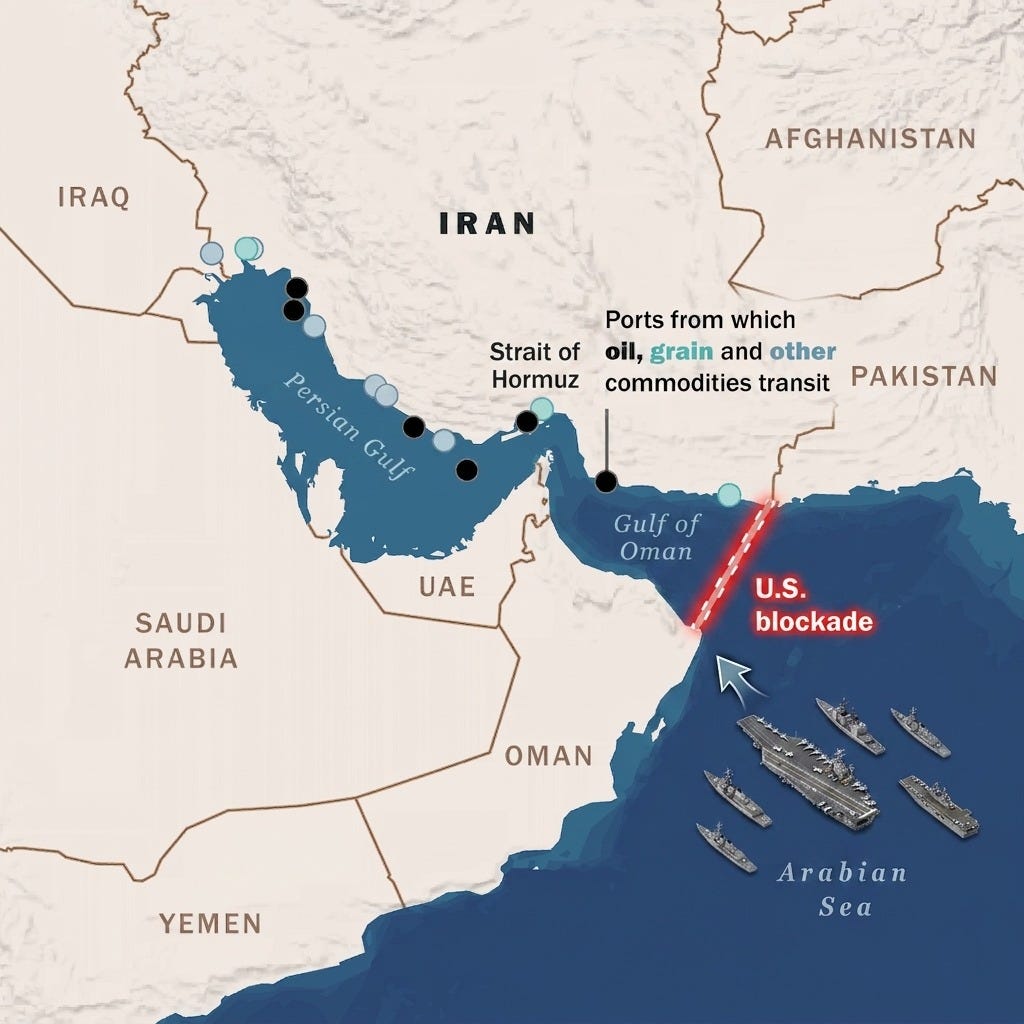
Map: The U.S. Blockade Line and Iranian Ports
CENTCOM has also responded to media reports, denying the claims and wading into the political fray. Implicitly, CENTCOM suggested that the “indefinite” blockade poses no threat to the operational readiness or welfare of US forces deployed in the region.
Another sign of an impending strategic shift in the Gulf comes from Treasury Secretary Scott Bessent, who hinted at upcoming announcements regarding “measures like have never been seen in the history of the economic isolation of a country.”
According to Bessent, this isolation is paired with a “continued blockade in the Strait of Hormuz that will keep anything from going in or out of the Iranian ports.” It is worth noting that the lifting of the blockade is one of the six unilateral requests Tehran has made to Washington in order to halt the war and return to the table.
Bessent also invoked the “maximum pressure” strategy introduced by President Trump a year ago—which ultimately led to the war that began on 28 February—suggesting it is now evolving into an “indefinite maximum pressure” campaign.
President Trump’s strategy effectively de-emphasises both diplomacy and military action, prioritising economic pressure in the hope that time can accomplish what force could not. This strategy requires both patience and time at the implementation level. However, neither is on the U.S. side.
The inconsistent behaviour of the president and policymakers within the administration is well known and has been repeatedly demonstrated over the last seven months of war. How they intend to sustain within an “indefinite” American blockade of Iranian ports amid expected attempts by the IRGC to forcibly unblock the Strait of Hormuz for Iranian tankers remains an open question.
Looking at the situation on the global energy markets, time is equally against the U.S.
The IEA projects that oil demand will increase in 2027 by 2.4 million barrels per day (mb/d). Yet, renewed tensions between Washington and Tehran have undermined supply recovery efforts, reducing projected Q3 2026 supply by 1.7 mb/d compared to the same IEA report from last month. The situation in the refined products market is even more precarious: supplies remain 5 mb/d below year-earlier levels, driven by combined strikes in the Middle East and on Russian oil infrastructure.
With the blockade persisting well into August and potentially extending “indefinitely”, these lost supply will weigh even more on the global oil supply starting from the autumn.
Furthermore, global oil inventories plunged by 69 million barrels in July, despite an initial uptick in shipments through the Strait of Hormuz following a temporary ceasefire under the signed Memorandum of Understanding.
In the gas and LNG market, the situation is even more critical. Without Persian Gulf supplies, refilling storage facilities is proving much more difficult in both Europe and Asia.
While the UAE is planning new investments in the sector—including a possible export plant on its east coast to bypass Iran’s grip on the Strait of Hormuz, as analysed yesterday by EGS—bad news continues to emerge from Qatar.
The world’s largest LNG exporter alongside the U.S. has reportedly shut down Train 5 at its mega Ras Laffan complex. The same facility was the one struck by Iran in the first weeks of the war.
At present, satellite data indicates that only two trains display thermal signatures or show operational activity, despite optimistic statements from Doha regarding a potential agreement to reopen navigation through the Strait of Hormuz.
An “indefinite blockade” strategy—even if operational maintenance proves feasible—will only inject further volatility into already severely disrupted global energy markets.
Don’t forget to read my latest analyses
Comments
Nothing yet. Say the first thing.
Sign in to join the conversation.