
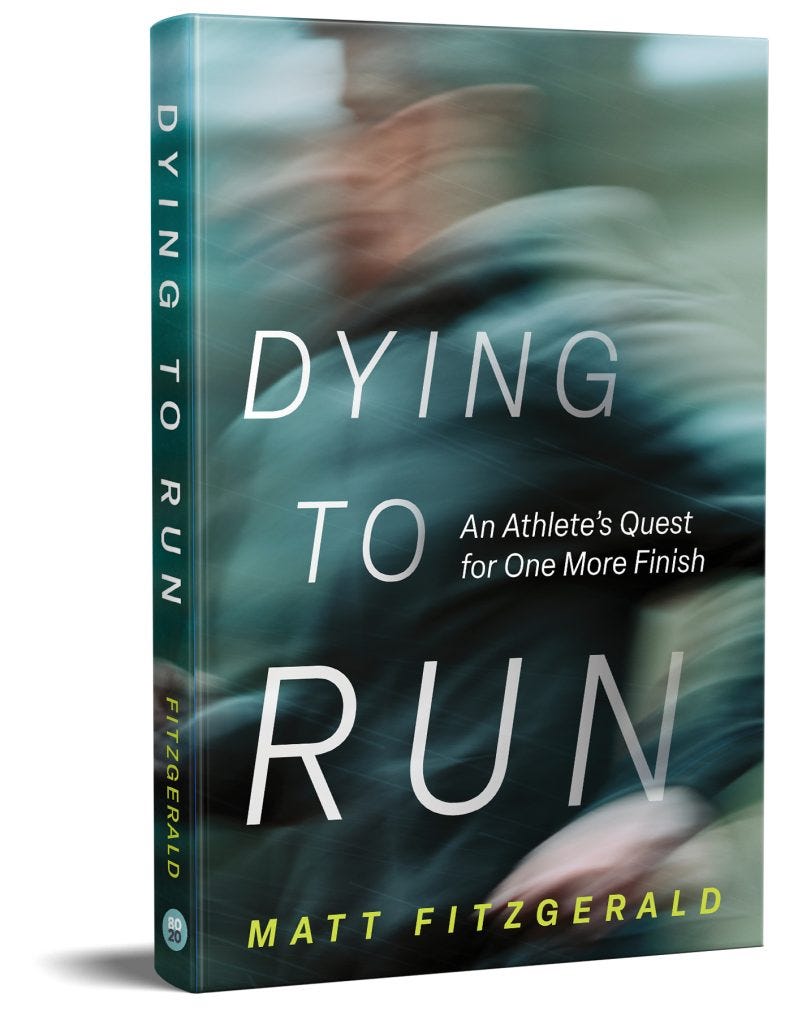
After suffering four years of suffering the crippling effects of long COVID, lifelong runner Matt Fitzgerald is desperate to reclaim his life. Hell-bent on finishing one last race, Matt enters the Javelina Jundred, a 100K ultramarathon in the Sonoran Desert. This race could kill him—or heal his sense of loss. In this excerpt from his epic memoir, Dying to Run, Fitzgerald shares how he tried to “win” a cardiac stress test in the way only a competitive runner would.
The first indication that something was amiss with my ticker came from heart rate data collected during my runs. One day I’d pin the needle at 180 beats per minute while jogging along at my forever pace. The next day I couldn’t get my heart rate above 110 at any speed. Perplexed, I began to monitor my heart around the clock, detecting further anomalies. The simple act of standing up would make my pulse jump 30 beats, and when I paused a morning walk with Nataki to admire a neighbor’s garden, my heart rate spiked instead of settling as it normally did. I know now that these were symptoms of post-viral dysautonomia and had nothing to do with my later-diagnosed heart disease. It’s not uncommon for symptoms of one disease to lead to the discovery of a second one—comorbidities, in doctor-speak—and that’s what happened to me.
It took a while, however, like a badly played game of twenty questions. I went in for bloodwork, which came back normal. I then took a lung test, which also came back normal. Chest X-ray, echocardiogram, EKG: normal, normal, normal.
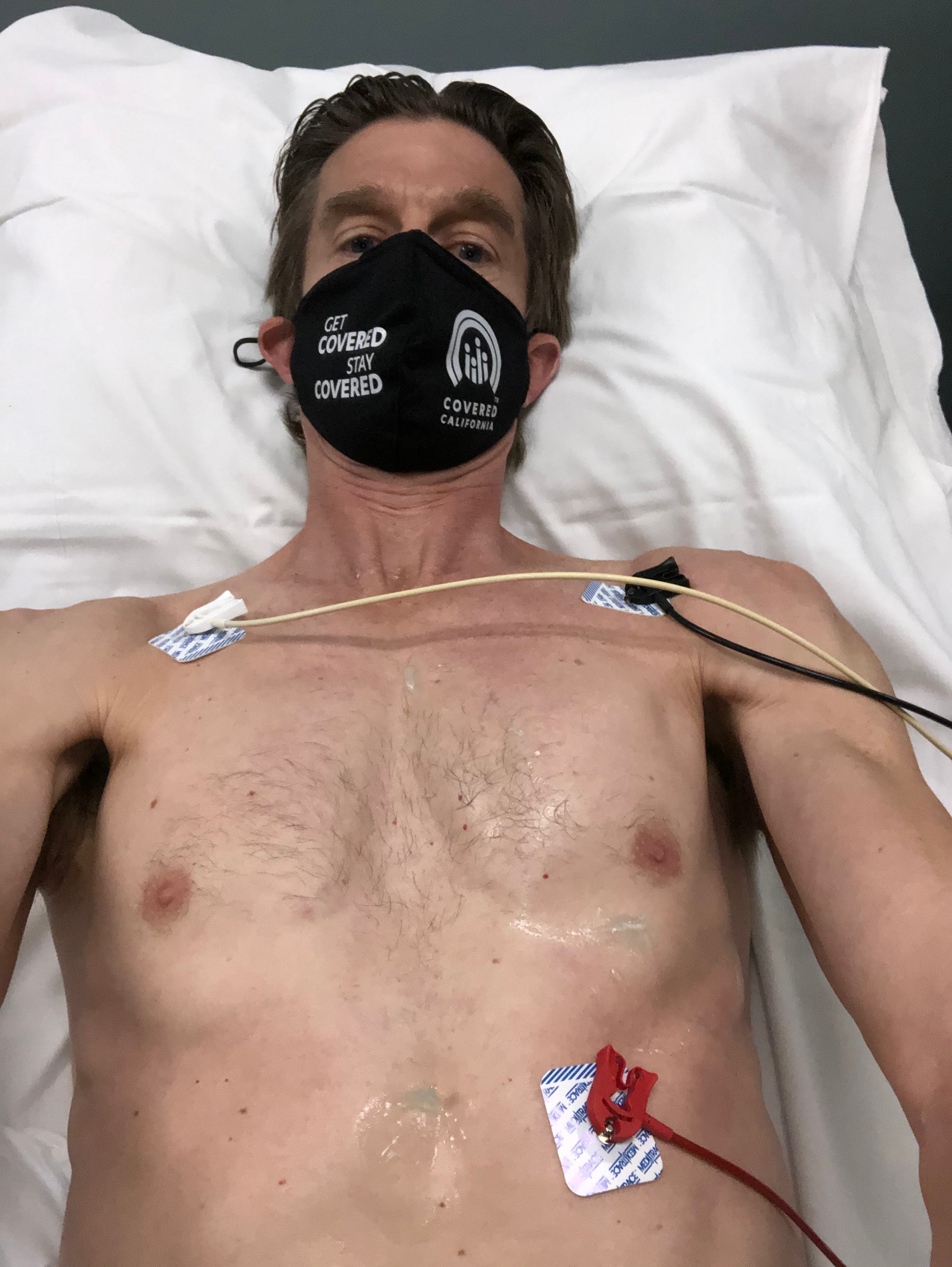
Next up was a cardiac stress test, where the patient walks or runs on a canted treadmill wearing electrodes. I’d been sick for three months at that point, but I hadn’t yet pulled the plug on running, and I approached the test like any other race even though it very much wasn’t. A normal heart patient would have worried about what the test might find, but all I cared about was posting a good score.
I arrived at the hospital clad in color-coordinated Hoka apparel, buzzing on caffeine and carbs. Final instructions were given by a masked technician who might as well have been a megaphone-holding race organizer. Most of what she said went in one ear and out the other, but I caught the part about “continuing to failure.” When the starting pistol cracked (there was no starting pistol), I leapt up onto the treadmill with an eagerness that, judging by the technician’s body language, lacked appropriate solemnity. It was all I could do to suppress the impulse to ask her for the number to beat.
Had it been given, that number would have been neither a time nor a speed nor a distance nor anything else I was used to measuring performance by but a metabolic equivalent, or MET, which is how performance is measured in cardiac stress tests. One MET equals your rate of calorie burning at rest. A slow walk is 2.0 METs, or double your resting energy expenditure, and so on. The average heart patient taps out at 6.0 METs. I was still going strong at 17.2 METs when the machine stopped and I was ordered to step off.
“You said I could go to failure!” I protested.
The technician ignored my outburst and asked if I’d been experiencing chest pains. The answer was yes, but that was beside the point.
“I wasn’t even tired!” I half-shouted. “You didn’t let me finish!”
A flash of pity passed over the technician’s eyes.
“Mr. Fitzgerald,” she said with forced patience, “your test results are . . . abnormal. You need to stop exercising. Immediately. That means no more running. I don’t want you even mowing the lawn.”
“But—”
“You will start taking children’s aspirin. One a day. We’ll schedule you for a cardiac angiograph as soon as possible. In the meantime, if you experience any chest pains, call 911 right away.”
One week later, I lay supine on a padded table with a catheter in my arm, staring up at a large cylindrical contraption called a fluoroscope. A special glow-in-the-dark dye suffused my bloodstream, allowing the scope to capture X-ray images of my arteries. Every few minutes the cardiologist’s piped-in voice commanded me to hold my breath for the next shutter click. Between clicks I practiced my corpse pose, wondering what the doctor was seeing, knowing already it wasn’t good.
Of the many emotions you don’t want to see on the face of your cardiologist after such a procedure, shock has to be number one. But shock is what I saw in the eyes of the masked face of Dr. Singh when he entered the consultation room where I’d been sitting for two days (not really, but it seemed like it), awaiting the specifics. On paper, I was among the healthiest specimens Dr. Singh had seen in nearly thirty years of practice. I had zero risk factors for heart disease, perfect blood lipids, and a stress test result that qualified me to be a fighter pilot. By all measures, I had no business being in his office. Yet my calcium score—which relates to plaque size in the coronary arteries—was 363, placing me at moderate to high risk of suffering a heart attack in the next ten years. Dr. Singh had never seen anything like it. I know this because those exact words—“I’ve never seen anything like it”—came out of his mouth. The poor man was so plainly shaken by my case that I had to suppress an urge to console him.
Like I said, I’ll never know how healthy my heart was or wasn’t before I got sick, but it certainly wasn’t helped by the virus, which is known to inflame the inner lining of the arteries, making them sticky and prone to entrap passing lipids and calcium molecules. The virus also thickens the blood by forming thousands of microclots. In the coronary arteries, these unfavorable changes combine to accelerate plaque growth, a process that could be further hastened by, say, doing large amounts of high-intensity exercise, as I did during the six months between my recovery from COVID-19 and the onset of my present malady.
None of this was documented in my medical records, however, and Dr. Singh found himself at a complete loss as to what to do with me. He couldn’t tell me to start exercising or clean up my diet because I’d exercised my entire life and authored several books on healthy eating. Nor did it make sense for him to prescribe a statin to lower my cholesterol, which was low already. Yet he prescribed one anyway, as the only alternative to doing nothing. I took one pill, maybe two, and tossed the bottle.
What I really needed, I decided, was a second opinion from a doctor who was also a runner, and I knew just the person: Amy Fiedler, a cardiac surgeon at UCSF who competed in triathlons and ultramarathons when she wasn’t stenting the arteries of sedentary sugar addicts. On the pretext of interviewing her for a magazine article about heart risks in endurance athletes, I got Dr. Fiedler on the phone and asked her how I might better assess my own risks in continuing to run. Dr. Google had advised me to request a coronary catheterization, a mildly invasive procedure that would determine the severity of any blockages I might have, and Dr. Fiedler seconded this recommendation.
“Depending on the outcome,” she said, “you’ll come away with either peace of mind or a basis for pursuing further treatments.”
“Let’s say there are no blockages,” I said. “If I’m understanding you, this means it’s safe for me to run now. But if running contributed to my plaques, won’t more running just keep making them worse until I do have a blockage?”
“That’s a good question,” Dr. Fiedler said, “and I don’t know the answer to it. I don’t think anyone does.”
By the time this call took place, I’d already stopped running for reasons that had nothing to do with fear of a heart attack. In the first five months of 2021, my malaise had worsened to the point where I could hardly walk, much less run. The heart stuff could wait. Yet even when I returned to running, I kept putting off the procedure, knowing the result might force me to stop. Just give me six months, I thought.
A lot of runners run for health-related reasons, but I never did. I ran because it made me feel alive, like in the last mile of the 2020 Atlanta Marathon, where I drove myself deep into the pain cave in an unsuccessful effort to chase down the leader of the forty-plus age division. Official race photos show my teeth bared like I’m being dunked in battery acid, but what they don’t show is that on the other side of that silent scream, I was experiencing a kind of euphoria— the sublime torment of being almost there but not quite.
Exercising to total exhaustion as I did in Atlanta is known to suppress the immune system temporarily, enabling opportunistic viruses to gain a foothold. I can’t prove it, but I like to think I got COVID-19—and later long COVID—because I ran that marathon. And if I had the chance, I’d do it again.
At a scientific conference some years ago, I debated the meaning of “health” with some hotshot endocrinologist. His definition was “resilience against threats.” What a sad little view of health! So passive. So timid. My definition of health is feeling alive, and you won’t feel very alive if your top priority is being resilient against threats. To feel what I felt in Atlanta, you must take risks and put yourself in danger. That’s my experience, anyway. The raw intensity of that last mile, where I stretched myself so far that I never recovered: That’s what I call health. And if it’s not health, I prefer it to health.
Republished with permission of 80/20 Publishing from Dying to Run: An Athlete’s Quest for One More Finish by Matt Fitzgerald. See more at 8020books.com.
No posts
Comments
Nothing yet. Say the first thing.
Sign in to join the conversation.