
AI isn’t just accelerating old processes, it’s rewriting the rules of business entirely. The question is no longer whether to act, but how to act responsibly, strategically, and without waiting for permission.
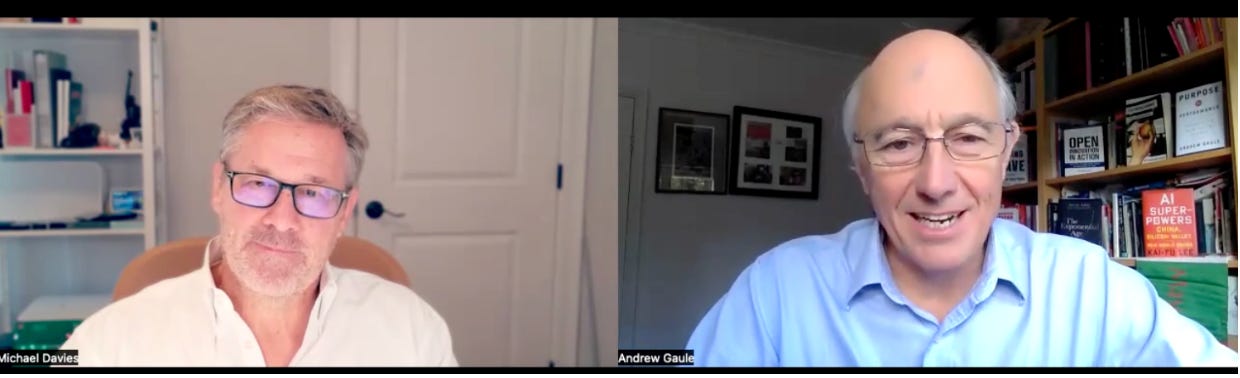
Michael A.M. Davies, strategy consultant, MIT lecturer, and founder of Endeavour Partners, recently sat down with Andrew Gaule on Gaule’s Question Time for a wide-ranging conversation about the seismic shift that AI is driving across industries, and what it demands of the leaders navigating it.
With more than two decades at the intersection of technology and business strategy, Michael has seen hype cycles come and go.
His view on this moment is unambiguous: this is different.
The arrival of generative AI, he argues, represents a historic inflection point, one he puts on par with the advent of the internet. And like that moment, the leaders who thrive won’t simply be those who move fastest. They’ll be those who move most clearly.
Get your hands on it
The single most important thing Michael would tell any executive right now is this: stop delegating your AI education. You cannot lead an AI strategy you don’t understand. That means sitting down with the tools — GPTs, large language models, generative systems — and experimenting directly. Not to become a technologist, but to develop the judgment that strategy requires.
“Hands-on experimentation isn’t optional. It’s where strategic clarity begins.”
Once leaders understand what these tools can and cannot do — including their very real limitations, like hallucination and bias — they can start building a coherent strategy. Until then, Michael warns, they are flying blind.
AI is reshaping business models, not just workflows
One of the most important things Michael wants leaders to internalize is that AI isn’t just a productivity tool. It’s a structural force. He points to how law firms are already using AI to automate document review, a task that previously consumed thousands of billable hours. That’s not a faster process. That’s a fundamentally different business model.
The same pattern is playing out in healthcare triage, financial analysis, knowledge work, and middle management.
The question for every organization, in Michael’s view, is: which core processes are being restructured, and is leadership driving that change or being caught off guard by it?
Humane adoption isn’t a soft concept
When Michael talks about “humane adoption” of AI, he is not speaking in abstractions. He means concrete choices: being transparent with the workforce about what’s changing and why, ensuring that AI decisions in high-stakes domains like healthcare and finance are subject to meaningful human oversight, and treating the workers whose roles are disrupted with candor and care.
Leadership that is both strategic and supportive isn’t a contradiction, he argues. It’s the only kind that builds the organizational trust needed to sustain transformation over the long term.
Don’t wait for regulation
Michael hears it frequently from leaders: “We’re waiting to see how the regulatory landscape settles.” It’s the wrong posture. Regulation will not keep pace with the technology. Organizations that wait for external guardrails before acting responsibly have misunderstood their own duty. The frameworks for principled, ethical AI already exist. What’s often missing, he says, is the will to use them.
Cautious optimism for the long run
Michael is genuinely optimistic about where this technology takes us — over time. AI has an extraordinary capacity to empower people, expand access, and solve problems at scale that were previously intractable.
But he holds that optimism carefully. In the near term, the risks of misuse, rapid change without adequate governance, and the human cost of poorly managed transitions are real. The path to a good outcome, he believes, runs directly through the quality of leadership decisions being made right now.
Six questions from the conversation
What is “humane adoption” of AI? Michael emphasizes responsible AI use that accounts for ethics, transparency, and human impact — especially where AI decisions affect healthcare, finance, and people’s livelihoods.
What should executives be doing right now? They must engage directly with the tools. Michael is clear that hands-on experimentation is non-negotiable for building the strategic clarity needed to act.
Will AI fundamentally change business models? Yes. Michael’s view is that AI isn’t just accelerating old processes — it’s reshaping them entirely. Law, healthcare, and knowledge work are already evidence of this.
How do leaders balance short-term wins with long-term ethics? Be strategic and supportive. Michael argues that leaders must be candid about disruption while ensuring workers are treated with dignity during transitions.
Can we wait for regulation before acting? No. Regulation won’t keep pace. Michael’s position is that organizations must adopt a proactive, principled approach using what’s already known.
Is Michael optimistic about AI’s future? Optimistic long-term — technology has genuine empowering potential. Cautious short-term, given the pace of change and risk of misuse.
▶ Listen to the full conversation with Michael A.M. Davies on Gaule’s Question Time.
No posts
Comments
Nothing yet. Say the first thing.
Sign in to join the conversation.