
…While we are postponing, life speeds by. Nothing, Lucilius, is ours, except time. We were entrusted by nature with the ownership of this single thing, so fleeting and slippery that anyone who will can oust us from possession. What fools these mortals be! They allow the cheapest and most useless things, which can easily be replaced, to be charged in the reckoning, after they have acquired them; but they never regard themselves as in debt when they have received some of that precious commodity,—time! And yet time is the one loan which even a grateful recipient cannot repay. - Epistles of Seneca, 1
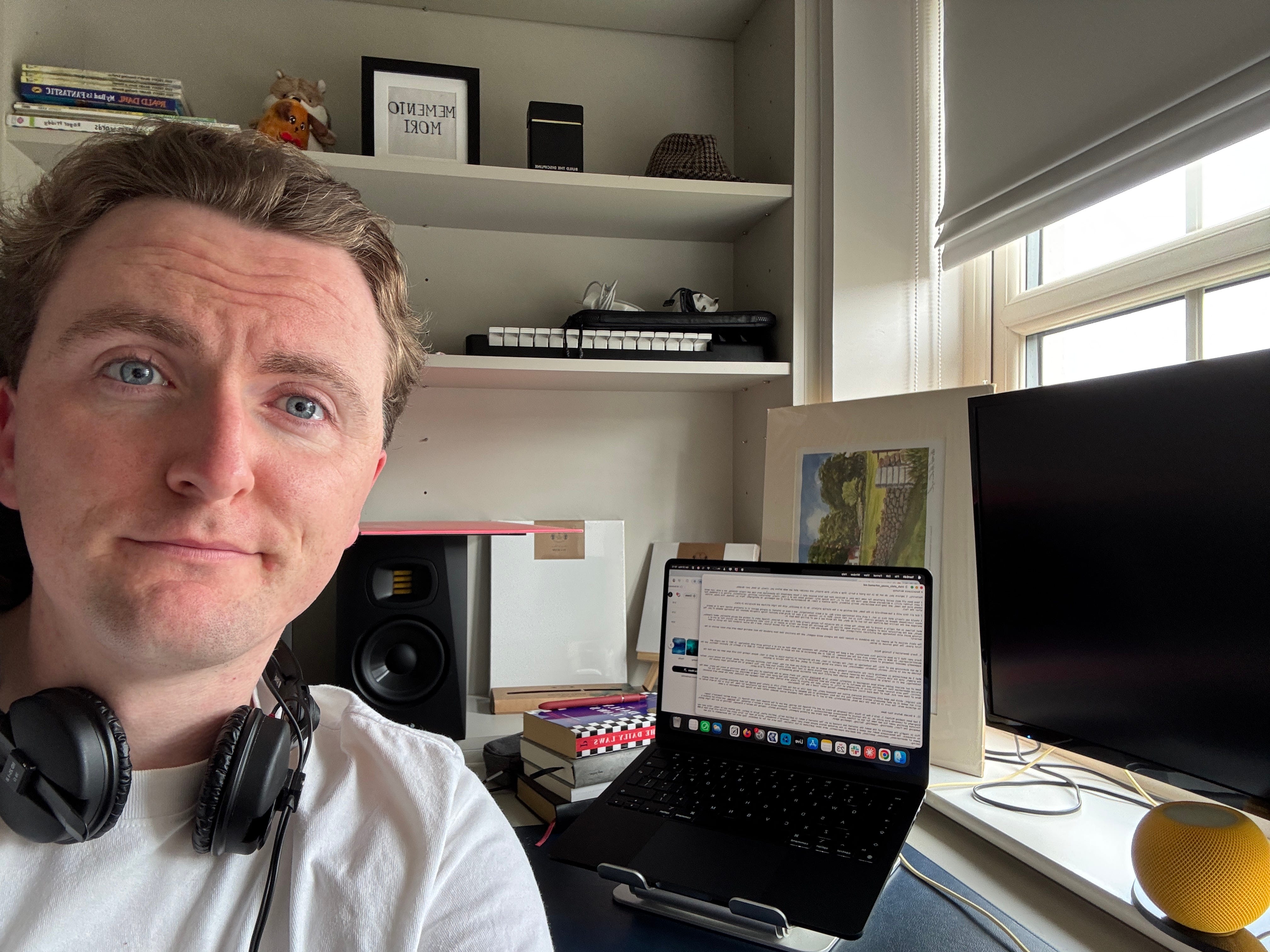
I spend my discretionary time on five things: reading one book slowly (right now all different forms of psychology books), watercolour painting, calisthenics, writing in a notebook nobody else will read, and long-form outdoor meditation without a timer. There is also a two-month-old in the house and ongoing startup work throughout; I mention this not to establish virtue, but because the objection I most often encounter is that deliberate slowing-down belongs to people unburdened by the ordinary pressures of living, and that is not my situation and probably not yours either.
The five practices I have just described are, as it turns out, my own personal renaissance practices — in the sense of belonging to a model of human development that the fifteenth and sixteenth centuries in Italy codified more precisely and more durably than any period before or since. That is not to say, that I don’t watch TV, or socialise, but with a new arrival at home - these have taken a back seat recently in order of what I truly value.
This model for me is finding renewed purchase in a culture characterised by artificial intelligence, manufactured urgency, and the systematic destruction of sustained attention, therefore is not a coincidence.
The consensus for the past decade has been that we are at a turning point with technology, and that the people who do not move quickly enough will find themselves stranded on the wrong side of an epochal change from which there is no recovery. In 2017 it was crypto and decentralisation; in 2020 remote work and the new economy; in 2022 generative AI and the death of the knowledge worker; in 2026 the frame has widened to include agentic systems, physical robotics, and the imminent reshaping of almost every profession that requires thought rather than pure physical labour.
I am not dismissing any of it, the technology developing is genuinely consequential, and anyone engaging with this newsletter already knows that the tools we use to write, search, schedule, and communicate are being rebuilt at a pace that makes last years assumptions unreliable.
What I am internally questioning is the cultural framing that has accumulated around it. The relentless insistence that you must act now, learn fast, position yourself before the window closes, build the second brain and master the prompts, ship the side project, or watch your future erode while others race past you into a prosperity you forfeited through insufficient urgency.
This framing above is produced almost entirely by the people whose business models depend on your feeling permanently behind, and Seneca would have found it entirely familiar. In De Brevitate Vitae (On the Shortness of Life), he describes the wealthy and powerful men of his acquaintance as the most enslaved people he knew, because they had surrendered their time not to pleasure or rest but to ambitions they did not control. Their arrangements always deferred to a slightly later date, to the management of a present that someone else had designed for them and which they mistook for their own life. They were always about to retire to philosophy at fifty or sixty, once the accounts were balanced and the affairs arranged, and none of them, by Seneca’s account, ever did. Most died mid-arrangement, having never spent a real day on what they had told themselves they were saving their time for.
His insight, which has preserved its accuracy across two millennia, was not that life is short but that most people will not spend it on what actually matters, because they are too busy responding to the demands of a time that someone else has structured for them. The cure he offered was not efficiency or optimisation but the deliberate recovery of time from the arrangements that had claimed it.
The extra effort goes into the redeployment of things that compound across decades rather than evaporate in a week.
I have been reading Michael Gelb’s How to Think Like Leonardo da Vinci through the spring — on and off, and one thread running through it, which Walter Isaacson’s longer biography of Leonardo also picks up at considerable length, is the specific texture of Renaissance apprenticeship and what it actually required of the young people who undertook it.
A boy of thirteen or fourteen entering a master’s workshop, the bottega, would not produce a finished work under his own name for ten years. Before that there was grinding pigments, preparing panels, copying the master’s drawings in exact detail, learning to mix gesso to the right consistency, sweeping floors, watching, repeating the same gestures over and over until they were not gestures any more but a form of embodied knowledge that could not have been acquired by any other route.
Leonardo’s own notebooks, kept for the better part of forty years and filled with more than six thousand pages of observations, sketches, dead-end experiments, and unanswered questions, were never published during his lifetime. Instead written for no audience beyond himself — the private record of a mind in permanent conversation with reality, kept across decades before anything made its way to public domain.
This is structurally the opposite of the model the internet has trained most of us on, which is to publish early, publish often, build in public, ship before you feel ready, and treat the performance of learning as equivalent to the learning itself. The Renaissance model was closer to spending a decade in the workshop before anyone outside it hears your name, and using the time to develop a depth that cannot be faked or hurried and that will, eventually, be obvious in everything you produce.
Robert Greene’s Mastery, which examines dozens of practitioners across centuries and disciplines in search of common patterns, arrives at the same conclusion from a different direction. That being, the people who achieved real mastery in any field had spent their formative years in deep apprenticeship to the work itself, not to the presentation of the work. And these two approaches produce fundamentally different human beings with different relationships to time, patience and what consistent effort is actually for.
Reading one book at a time, slowly, without performing the reading for anyone or anywhere is one of the most useful changes I’ve made. This includes the various digital spaces where the performance of reading has become its own well-populated sub trend.
The default mode I had drifted into, which I suspect is recognisable to most of us who read a lot and care about reading, had become something quite different from what I am describing. A book nominally being read, an audiobook in the car, and the habit of screenshotting highlighted passages and putting them somewhere public, half-processed, carrying a borrowed authority from the source while not really belonging to any sustained thought of my own.
There was, somewhere under all of that, actual useful information that I may or may not have fully absorbed.
My rule is one book, finished before the next is opened, usually read in the morning before the day begins and sometimes in the evening with no phone in the room, and no intention of doing anything public with what I read. An example would be Marcus’s Meditations, which I have returned to more times than I can accurately count, is now a different book under these conditions. I am no longer working against the background noise of needing to extract something usable from the encounter. There is just the text and the time I have agreed to give it, and what that results in, is a form of absorption the other way cannot replicate.
Seneca makes this point in his letters to Lucilius with characteristic force, warning against the habit of reading too many authors in succession, skipping from one to the next in the pursuit of novelty, and recommending instead a small number of trusted writers returned to repeatedly and sat with at depth. A metaphor is digestion — a man who eats too fast and too much does not nourish himself regardless of the quality of what he is served, while the man who eats less and more slowly draws genuine sustenance from it.
Ichigo ichie, another favourite concept of mine from Japanese society, which translates roughly as “one time, one meeting.” Emerged from the tea ceremony tradition, where each gathering is treated as singular and unrepeatable, demanding full presence from everyone in the room. A book read with that quality of attention becomes, in some sense, its own personal ceremony. You will not pass through it again in quite the same state of mind.
The Renaissance scholars who produced the intellectual revolution of the quattrocento were working from a small number of rediscovered classical texts, returned to obsessively, annotated heavily, argued about across decades. Their productivity was an output of depth, not a substitute for it.
I also came to start watercolour painting largely through the Gelb book and through a long-standing curiosity about what the Renaissance masters actually meant by saper vedere — knowing how to see.
I am not a painter by any stretch of the imagination. Art was my worst subject in school, I have no formal training in any visual discipline, and the watercolours I produce are the work of an absolute beginner. I have shown them to nobody and intend to continue showing them to nobody, which is part of the point, and I will come back to it.
The specific reason for choosing watercolour rather than a more forgiving medium is that it does not permit the revision that allows you to escape the consequences of inattention. You put pigment on wet paper and the water carries it where it wants to go, and if you have misjudged the dilution, or if your eye has misread the tonal value of a shadow by even a small margin, the paper shows you exactly and immediately that you have done so, without softening the feedback or offering an undo option.
What I found, after a few weeks of genuinely novice effort, is that the practice of painting is secondary to the practice of seeing that it enforces. To render a flower in watercolour requires that you actually look at the flower, for far longer and with far more attention than you have ever looked at it before in the ordinary course of living.
And in that looking, you discover that the colour you believed you were seeing is not a colour at all, but a range of four or five related colours shifting across the surface. That the shadow you assumed was simply dark is a quite specific cool violet, the boundary between the petal and the air is not a line but a soft gradient your eye had been simplifying for the practical convenience of recognition.
Ruskin, the art critic argued this point more persistently than anyone in the Victorian period, the purpose of drawing is not to produce a picture but to compel genuine looking with the picture as merely a byproduct of the real work, which is the transformation of perception.
The Renaissance masters understood drawing as a discipline of seeing first and a productive activity second, which is why Leonardo spent years studying the fall of light across a human face before he put a face in a painting, and why those studies are, in themselves, some of the most extraordinary things he ever made.
My physical practice consists of calisthenics — push-ups, pull-ups, leg raises, squat variations, and mobility work. Requiring nothing beyond a bar and a floor, with no gym membership, no wearable technology, and no application logging my sessions. Alongside this is gardening, which is resistance work conducted in the presence of earth and is one of the oldest forms of physical education available. Finally, walking on familiar ground — not just scenic routes chosen for their visual interest but simply the long way round, taken for its own sake and nothing more.
The contemporary fitness environment has become extraordinarily instrumented over the past decade for everyday people, but the body, in the absence of instrumentation, is sufficient and in many ways, a more accurate feedback system for most of what physical practice requires. You know when a set is genuinely hard and when it is not, you know with reasonable accuracy when you have recovered and when you have not, and the removal of devices from practice tends to restore a quality of attention to what is actually happening in the body.
Epictetus, who spent much of his life enslaved and had a damaged leg from an injury sustained in that period, treated the body and its difficulties not as problems to be optimised around but as the primary training ground on which character was either formed or failed. The point of returning to physical practice was not the routine itself but the relationship it cultivated with discomfort, limitation, and the regular decision to return despite having no particular desire to. This is precisely the quality some of the Stoics understood as the foundation of everything else worth developing.
There are two kinds of writing, the first is the writing you do for other people; shaped, edited, argued, structured to move through a sequence of ideas, and carry a reader from one end to the other, requiring that you know where you are going before you begin and that you spend the whole time earning the destination. There is nothing wrong with this kind of writing, and it is the kind I am doing now.
The second has a different logic entirely — exploratory, often broken, contradictory in ways you do not notice until you read it back weeks later, sometimes embarrassing in the precision, and sometimes the first rough formulation of an idea that will not become fully clear for another year or another decade.
Marcus Aurelius’s Meditations belong to this category. The Greek title Ta eis heauton (“the things to himself”), makes plain that they were never intended for anyone else, and they are the private training journal of a Roman man trying, across twenty years of ruling an empire under very difficult conditions, to hold himself to a standard of decency and reason that the circumstances of his life were constantly working to undermine.
Pierre Hadot, whose scholarship on ancient philosophy has shaped how a generation of readers understands Stoic practice, argued that this kind of writing is not a record of thought but the means by which thought is shaped. Writing for no audience is a different cognitive operation from writing for one, and that the first changes you while the second primarily packages you. Trying to understand this distinction with a clarity is something we have largely lost in the age of public performance.
I now again, write most mornings by hand, in a plain notebook bought for the purpose, about whatever is present rather than whatever I intended to publish, and found, as I had half-expected but half-forgotten, that the thinking on those pages was a different kind of thinking from what appears here.
Long-form outdoor contemplation is the hardest of the five practices to describe without sounding either mystical or impractical. By long-form I mean up to two hours spent primarily outdoors and primarily without agenda.
There is a walk I took most evenings throughout the month of May, usually after the baby had settled, forty-five minutes, sometimes longer, with no phone, and no final destination beyond the familiar back lanes. By the time I reached the highest point where the landscape opens and the sky becomes the largest thing in view, something that had felt urgent an hour earlier had, without my working at it, arranged itself into a different proportion.
The Zen tradition has a practice called kinhin — walking meditation performed between periods of sitting, each step a complete act rather than a means of getting somewhere. What the monasteries understood, and what the productivity culture has inverted entirely, is that walking is not merely just exercise. It is equally the real practice at hand. The distinction sounds minor and turns out to be everything.
Long periods of outdoor time produce something closely analogous to this naturally, without requiring any particular mental technique. After forty minutes on a hillside with wind and the ordinary natural rhythm of an outdoor hum, sees the urgent matters of the day arranging themselves into a perspective that a ten-minute guided session on an app sitting at your desk cannot quite replicate. It is the physical scale of the outdoor world, more than any technique, that does the heavy work.
Nietzsche wrote that all truly great thoughts are conceived while walking, a claim he intended with some precision. The body in motion loosens something that the seated, indoor, screen-oriented body tightens, and that ideas which have been stuck in one posture have a way of shifting in another. Recovering this kind of long, unbroken, unstimulated time is something you have to take back deliberately and with discipline, because no platform will hand it to you and no application will protect it for you.
What I noticed, returning from those walks, was that the cultural noise I had absorbed during the day had been correctly resized. From my trail it looked like what it was, a story told at volume by people with a clear interest in your believing it.
The question this leads to is whether the cultural urgency of this moment reflects the real stakes for people living real lives, or whether it reflects primarily the business interests of the people generating it. My view is largely the latter. The urgency is not the technology itself — it is the story told about the technology by people whose revenue depends on your experiencing it as an emergency.
And the fact that a generation raised entirely inside that system is now actively dismantling it by choosing analog cameras, dumb phones, physical notebooks, and unlogged movement suggests that the story is becoming harder to sustain.
I am not dismissing this new wave of tech, or the disruption, which is real — I work in music technology and engage with these tools every day. What I am questioning is the specific shape that it takes in public discourse, because the urgency is not the technology itself; it is the story told about the technology by people who benefit from your believing it.
The fifteenth and sixteenth centuries in Italy were a period of dislocation not entirely unlike our own, the printing press was upending the economics and authority structures of knowledge, the rediscovery of classical texts was reorganising intellectual life from the ground up, new navigational instruments were rendering old certainties about the physical world inaccurate, and the church’s authority was fraying at the edges in ways that would shortly become catastrophic.
The people who emerged from that period as its lasting contributors were not, as a rule, the ones who moved fastest through the disruption. Michelangelo, who worked through an extraordinary span of that upheaval and was still designing St. Peter’s Basilica at eighty-seven, replied to a question about what he was still doing with ancora imparo — “I am still learning” — a phrase that represents precisely the opposite of the current injunction in place. The Renaissance master’s relationship to time was not that of the sprinter but of the craftsman, this produced a different type of output, the kind that endures precisely because it could only have been made slowly, at a depth the sprint model cannot reach.
I am not announcing a new philosophy or recommending a programme. I saw this past month simply as a form of recalibration. Many of you who know me, are aware that I complete challenges like this regularly.
What I want from the internet now is considerably less than I had been taking from it.
What I want from reading is fewer books, returned to more deeply, in the way Seneca recommended.
From physical training I want less data, aesthetic concern and more direct primal contact with the feedback the body provides when you pay close attention to it.
From writing I want the two kinds kept genuinely separate — the public kind, which is this format, and the private kind, which serves a different function and degrades if it is allowed to become public.
From time outdoors I want more of it, with fewer interruptions, because the quality of attention it restores is not available from any other source I have found.
And from the broader cultural conversation about technology and the future of work, I want to participate when I have something to contribute and to largely ignore it the rest of the time, because most of what is generated by that conversation is produced by people who need you inside it in order for their businesses to function.
There is nothing new in my approaches or in this conclusion. It is what the Stoics arrived at over the course of several centuries, and what the Renaissance masters demonstrated through the texture of their working lives, and indeed what the contemplatives of every tradition that has produced anything worth keeping have been saying since before most of them were writing it down.
The good life is built slowly, in private, on practices that compound over decades and do not produce much that is visible in the short term. The race being sold to you in the business press and the AI urgency newsletters is not the race you are actually in.
A month is enough to feel the difference between the two tempos — not enough to have settled into the better one, which is the work of a much longer timeframe, and enough to remember that the workshop is still open, and that ancora imparo is not a modest disclaimer but the most ambitious sentence a person can say.
The Romans had a word I love, “otium”. Think of this as purposeful rest. This would be time spent working through thoughts, and things that don’t have a deliverable attached. A time for us where nothing is produced except clarity and relief.
So if you are to spring into action, do so with your own purpose and intention for the enjoyment of living.
At last I have what I wanted. Am I happy? Not really. But what’s missing? My soul no longer has that piquant activity conferred by desire… Oh, we shouldn’t delude ourselves — pleasure isn’t in the fulfilment, but in the pursuit. — Pierre Augustin Caron de Beaumarchais
Serius est quam cogitas (it is later than you think),
Enda (The Irish Stoic)
On the polymath model and mastery;
Michael J. Gelb, How to Think Like Leonardo Da Vinci
Walter Isaacson, Leonardo Da Vinci
Robert Greene, Mastery
On the Stoics;
Seneca, On the Shortness of Life
Marcus Aurelius, Meditations
Pierre Hadot, Philosophy as a Way of Life and The Inner Citadel
On seeing and drawing;
John Ruskin, Elements of Drawing
Shari Tishman, Slow Looking: The Art and Practice of Learning Through Observation
On attention and the case for slowness;
Cal Newport, Deep Work and Digital Minimalism.
Jenny Odell, How to Do Nothing.
Johann Hari, Stolen Focus.
Hector Garcia, Francesc Miralles: The Book of Ichigo Ichie.
On walking and thinking
Nietzsche, Twilight of the Idols and Thus Spoke Zarathustra
Frederic Gros, The Philosophy of Walking
Stoic Practices for the Modern Mind
·
Apr 17

The Stoics were not interested in philosophy as spectacle. They wanted tools: techniques that could be picked up, used daily, and tested against the friction of daily life.
Comments
Nothing yet. Say the first thing.
Sign in to join the conversation.