
Listen. This is an old story. It was old when the bards first wrote it down, and they only wrote it down because they were afraid of forgetting it, which is the only reason anyone writes anything down.
It begins with a king who was afraid of everything else.
Gwrtheyrn was High King of Britain, and history would remember him by another name, Vortigern, and it would not remember him kindly. He had invited the Saxons in. This had seemed clever at the time. Hire one enemy to fight another. Pay them in land. What could go wrong?
Everything. Everything went wrong.
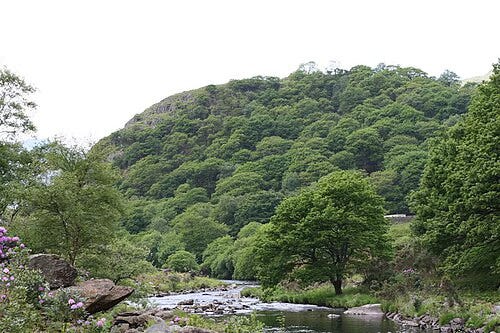
The Saxons took the land and then took more land, and the king who had invited them found that an invitation is a door, and a door opens both ways. So Gwrtheyrn fled west. He fled the way guilty men flee, blaming his advisers as he went. He came at last into Eryri, the place of eagles, where the mountains stand close together like witnesses. There, on a wooded hill above the Glaslyn, he stopped.
“Here,” he said. “Build me a fortress here. Stone walls. A tower. Something that will last.”
His men built all day. In the morning the walls lay scattered on the grass like a child’s game abandoned in the rain. Not fallen. Scattered. There is a difference, and everyone felt it.
They built again. Again the morning found the stones thrown down.
Three times they built. Three times the hill refused.
So the king called his wise men, as kings do when things fall down. Twelve druids came, and they consulted, and they conferred, and after a suitably impressive delay they delivered their finding.
“You must find a boy with no father,” they said. “Kill him. Sprinkle his blood on the foundations. Then the walls will stand.”
It has been noted, by wiser heads than the king’s, that this is the sort of answer wise men give when they have absolutely no idea. Blood is always the answer of the man who has run out of answers. But Gwrtheyrn was desperate, and desperate kings do not audit their consultants.
Messengers went out across Wales, looking for a boy with no father, which is a strange thing to look for and a worse thing to find.
They found him at Caerfyrddin. Two boys were quarrelling in the street, and one threw at the other the oldest insult there is. “You have no father. You never had a father.”
The messengers looked at each other. That was quick, they thought. That was suspiciously quick.
They asked the boy’s mother. She was a nun of noble blood, and she told them, calmly and without shame, that no man of this earth had fathered her son. Something had come to her in the night. Something that spoke fair and left quietly. The boy’s name was Emrys.
They took him to the king. They did not tell him why. Children being led to their own funerals are rarely given the itinerary.
But the boy knew. That was the first strange thing about him. He stood before the High King of Britain, a child before a crowned man, and he did not look like the one in danger.
“You mean to kill me,” he said. “Your wise men told you my blood would hold your walls up.”
The king said nothing, which was an answer.
“Ask them,” said Emrys, “what lies beneath the foundations. If they are wise, they will know.”
The druids did not know. This was awkward.
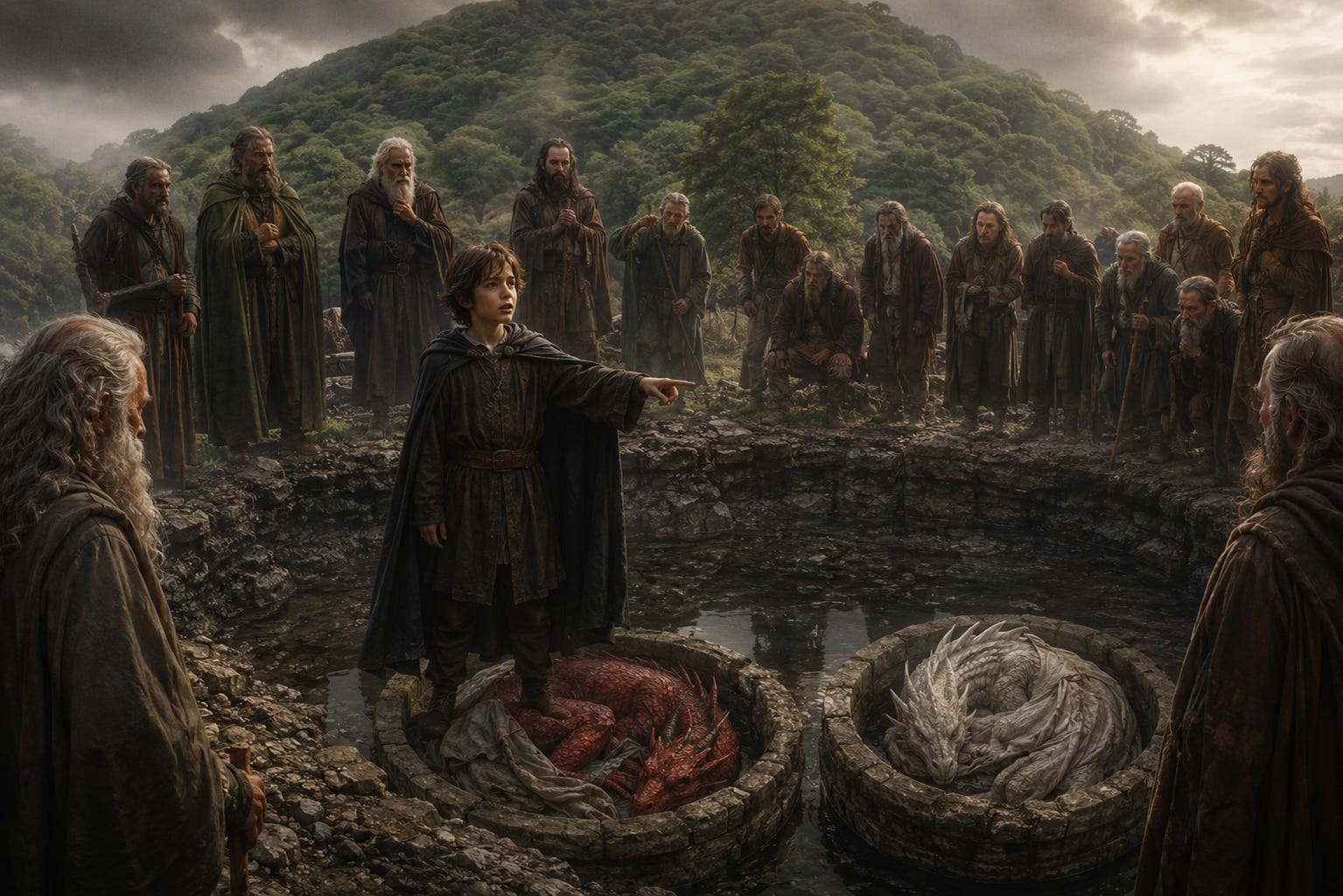
“Dig,” said the boy.
They dug, and beneath the foundations they found a pool of dark water, wide and still. The druids had not known it was there. Every man present did the arithmetic on that.
“Drain it,” said the boy.
They drained it. At the bottom lay two stone vats, and within them, wrapped in a cloth, two sleeping dragons. One red. One white.
And here, the bards say, the boy paused. Because there was an older story buried under this one, the way the pool was buried under the fort, and Emrys knew it. Long before Gwrtheyrn, before the Romans even, King Lludd of the silver hand had ruled Britain, and his island suffered a scream that came every May Eve. A scream that turned the land barren and drove men out of their wits. It was the sound of two dragons fighting, his brother Llefelys told him. So Lludd trapped them, drunk on mead, at the exact centre of the island, and buried them in a stone chest, here, on this hill, and told nobody. Problems buried and untold do not die. They wait. That is the whole of history, told briefly.
The dragons woke. They rose from the vats and fought above the water, red against white, claw and fire, and every man who watched felt the fight was somehow about him. The white dragon drove the red one back. The red rallied. It threw the white from the hollow and the white fled, and the red returned quietly to its rest, as if nothing worth mentioning had happened.
“Explain,” said the king, in the voice of a man who no longer trusts his payroll.
“The pool is the world,” said Emrys. “The red dragon is your people, the Britons. The white is the Saxon you invited to dinner. The white will win, and keep winning, for a long age. The red will suffer and retreat into the mountains and the corners of the land. But it will not die. It will endure. And one day it will drive the white back across the water it came from.”
He looked at the twelve druids, who had recommended sprinkling him on the masonry.
“Your walls fell,” he said, “because you built on top of a fight you did not know was happening. No blood fixes that. Not even mine.”
Gwrtheyrn did not kill the boy. Even he could see the shape of things now. He gave Emrys the hill itself and everything on it, and he took his fear elsewhere, west again, to another fortress. He was pursued to the end. Fire took him, or grief, or the earth itself. The accounts differ. The accounts always differ about men like Gwrtheyrn. Nobody cared enough to agree.
The hill kept the boy’s name. Dinas Emrys. The fort of Emrys. It keeps it still.
The boy grew, and became someone. The bards of Wales called him Myrddin Emrys, and the wider world, softening the name for tongues that could not manage it, called him Merlin. The child a king tried to mortar into a wall became the counsellor of kings, the prophet of the island, the wizard at Arthur’s shoulder. Whether all that is one man or several men stitched together by storytellers is a question scholars enjoy and the hill ignores.
There is a treasure there, the old people said. Myrddin hid his gold in a cave on Dinas Emrys before he left Wales, in a golden cauldron, and the cave is sealed, and it will open only for one particular youth, golden haired and blue eyed, and when that one stands on the right stone a bell will ring, and the hill will open of its own accord. Many have dug. The hill has opinions about digging, and expresses them in thunder and bad luck, and the diggers have always gone home early.
And the red dragon of the pool flies on the flag of Wales to this day. Ask the next person who calls it a national symbol whether they know it is also a survivor. It slept under a mountain of failed walls, in the dark, under water, for centuries. It lost, and lost, and did not die.
That is the tale. But leave the last word to the hill.
Every one of us builds towers. Careers, reputations, marriages, kingdoms. And some of them fall down every night, and we hire wise men, and the wise men tell us the fault lies anywhere but the foundations, and someone usually gets sacrificed, and the walls fall down anyway.
The boy’s question is the only question. Not how do I make it stand, but what is underneath it, still fighting, that I have never once looked at?
Drain the pool. See what wakes.
Dinas Emrys stands above the Glaslyn valley near Beddgelert, in the care of the National Trust. The walls on its summit are ruins. The story is not.
Emrys /|\
Thanks for reading Emrys Y Dewin! This post is public so feel free to share it.
No posts
Comments
Nothing yet. Say the first thing.
Sign in to join the conversation.