
Like all good Americans, I need constant airflow. Temperature is not so important but stagnant unmoving air is death. What I need is a ceiling fan in every room on earth that stays on lazily swinging for twenty-five years straight until the blades slump down like spent boners. I also need a never-ending supply of ice water, in giant containers.
This has been an issue with me and the Northern Europeans. Their buildings are built for endless winter and trap heat for efficiency, so they become saunas during the summer. I am baffled by their esoteric ideas about “ventilation”, which involve drilling little holes in the apartment that let in cold air in the winter but don’t do anything in the summer.
I spend $70 on a fan, I come inside and open every window in the house to create a breeze, but it’s never enough, the Swedes look at me quizzically, with eyes of a thousand grey lakes, they don’t use fans, they don’t mind the still hot air.
I get the feeling Europeans don’t think air-conditioning is “healthy.” There are insane political debates about whether it’s “climate-friendly'“ conveniently ignoring that thousands of elderly Europeans drop dead every year in their apartments—this love of central planning, this stubborn refusal to engage with reality.
I also get the feeling they view air-conditioning as another vector of Yankee imperialism. Or Asiatic barbarism. Amazon, Uber, NATO, Netflix, gig work, now you want us to embrace air-conditioning? What next, bottled water?
“We didn’t used to have summers like this,” they all say, casting side-eye in my direction, as if Trump was personally responsible for the climate.
I think the real reason Europeans don’t have air conditioning is not that they’re too poor or any of the array of excuses — “our buildings are too historic” “we’re all renters, not owners” — NYC, New Orleans, Latin America, Asia, are all historic places filled with renters with window AC units—the real reason is because they feel like they shouldn’t have to. That’s for them, not us. It’s so American, this need for constant comfort.
We arrived in Munich during the heatwave and took the commuter train into town. The anonymous Eurozone scenery flies by out the window, there is no AC or open window, the air is hot and stagnant but all the Germans are unphased. Not a drop of visible sweat on any forehead or armpit. I spot a 30-something American woman across the train car in agony, mouthing I’m dyingggggg to her German companion who looks completely fine. She’s got a portable fan in her hand and is sipping from one of those large adult sippy-cups.
A curious little German girl sits across from me and stares at me for half an hour. She’s sweet she’s cute and I’m smiling back, but in my head I’m saying, Didn’t your parents teach you any manners, you little Kraut?
I have a kind of stressful phone call in the otherwise silent train car, sweat starts pouring down my forehead and neck, I feel lightheaded and claustrophobic. starting to panic a little, I splash warm water from my water bottle onto my face.
The girl just keeps staring at me as I’m falling apart, probably thinking, “Why are Auslander so strange?” I feel ashamed for being so weird, disintegrating before her eyes.
I, who was raised in the heat-bowl of Columbia, South Carolina where in the summer we used to literally fry eggs on the sidewalk; I, who once drove across Texas in June with no AC in a van full of punks; I, who lived in NYC tenement rooms for a decade with a box fan in the window; have now become so old and wimpy and reduced and unable to temperature-regulate that an hour in the central European heat completely destroys me, a blathering pulp on the ground, that’s how soft I’ve become.
We get to our hotel. It’s an amazing little place, a true budget Eurohotel of the 90s. The kind of place Linda stayed as a kid on 90s summer holiday. The kind of place you can imagine a gang of kids in 1999 checking into blasting “Sandstorm” and counting their pills and lagers before heading off to the rave at the abandoned quarry. There’s a courtyard set back from the road, hidden in the trees, middle-aged European couples sit around there in silence drinking their lagers and smoking their cigarettes, looking satisfied being Continental.
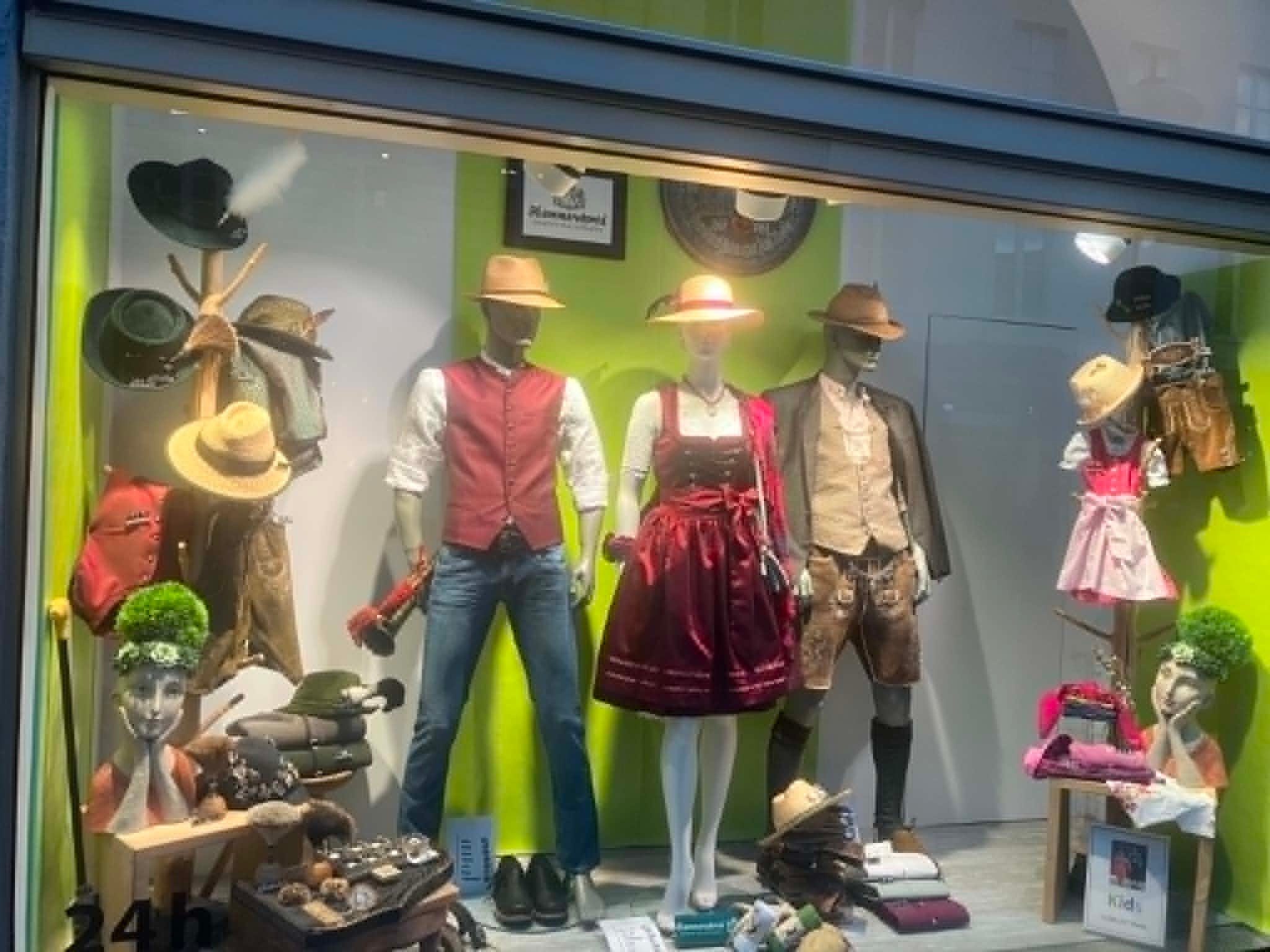
Inside, it’s quirky and filled with books and framed art prints, and the room is nice but it’s a sweltering inferno. We take cold showers and lay down for a siesta. As usual, Linda falls asleep immediately and I toss around looking at my phone. Then we get up and go out to the city just to get out of the room and when dusk finally comes we’re in a beer garden packed with young German men and women celebrating something, the women in the traditional cleavage-dirndl and the guys in worn-in, passed-down pair of package-accentuating lederhosen, probably grandpa’s lederhosen, high-quality clothing as family heirlooms. Someone tells me that a good pair of custom-made lederhosen can run $500 but will last you a lifetime.
I had a lot of ideas about Germany and Germans before we came. Linda studied in Munich and the first place you go off to leaving your hometown when you’re young to live alone is always romantic and holds a special place in your heart. Its always nice to give a place another chance and see it through someone else’s eyes so I said great, let’s go.
I’ve been to Germany maybe three or four times and never thought much of it: weird, unstylish, technocratic. I never saw what the fuss was all about with Berlin. When I was in my 20s, we hitchhiked from Spain to Germany and I remember feeling progressively more disheartened with each border we crossed. We ended up in some random German border village that for some reason felt like the bleakest place on earth.
So I’m surprised to find that Munich is a great town with lots of soul and interesting places and a lovely river. I had assumed that, being the cradle of Nazism, it would have been leveled during the war and rebuilt as a simulacrum, but the historical center looks fairly intact.
Everyone’s attractive and seems happy in Munich. As far as attractiveness goes I would rank it alongside Stockholm and New York. Unlike Stockholm and New York, where people are physically attractive but often seem vaguely anxious or unhappy, it seems like everyone is foremost happy in Munich and the attractiveness is a byproduct of their happiness, a more healthy form of attractiveness. It’s good to be in places with attractive people. I believe it makes you more attractive.
We took the train down to the Alps, to the town we would be living in for a week, near the border of Austria, in the shadow of a cinematically-intense evil German mountain. The town looked like where Walt Disney got his inspiration for Pinocchio or Snow White. But it was real, not a simulation town.
All the houses in this town were painted. The paintings portrayed biblical scenes and medieval scenes and looked very old. They were painted not on the outside of the houses, chatGPT informed us, but into the lime itself, in the 1700s, when the town had become rich and prosperous as Europe’s violin-making center.
The village was tucked into a bucolic valley, and we walked directly out of town up into the mountains and thick alpine forest. This is like the forest Hansel & Gretel walked into and found witches, I said. I wished I brought one of my books about witches in the middle ages or the Holy Roman Empire or Barbara Tuchman or something, but the only book I brought with me was Middlemarch.
On our first day walking out of town into the mountains, we passed the most German man alive. He was sitting on the porch of his medieval thatched-roof house covered in antlers and skulls in his lederhosen and a shepherd’s cane and a pointed hat. “Guten Abend” he called out to us smiling and we said good evening back. We walked off stunned, “That is the most German man I’ve ever seen” “Is the tourist bureau paying him to sit there?” and we hiked up into the mountains to swim in the crystal clear alpine lake, discussing the whole time. We came to the conclusion he was just being who he was. Which was something he believed in, some lineage, some tradition. This ancestral-boundedness to his land and people and language.
Over the years, I have often found myself thinking about something this scary Russian mercenary guy I hung out with said. We were in this breakaway Eastern Ukraine dive bar, I guess it was Donetsk. I was there reporting. This was before the Ukraine war started in earnest (I’m always too early to things, and get bored of them by the time they become big things.)
Somehow we got onto the subject of globalism and he pounded the table, “When I’m in England, I want to be with Englishman. King Arthur, Cornwall, tea, little hedge-lanes. When I’m in France, I want it to be the most French shit you’ve ever seen—berets, escargot. America should be American—money money fast talk business progress. And Russia should be Russia.”
I found myself thinking of him again after we met The Most German Man Alive, and thinking, man, that guy would really love to be here, in this Bavarian village in capital-G Germany, church bells, lederhosen, it’s not just a put-on, this is how they do things around here, but that guy is probably dead. And I found myself agreeing with him, that it’s nice when places still have a little bit of these old world ideas about them.
I don’t like the standardized universal world, the one world order, the unicontext, The Universal Room as Agnes Callard has helpfully called it, I want there to be regional difference and stubborn breakaway regions and hidden places untouched by progress and modernity.
Back in town on our way to the grocery store, there was this multigenerational gang of German hikers and their dog sitting on a park bench. I couldn’t tell if they were a family or a group of multigenerational friends. They were passing around a glass quart of buttermilk. It must have been ninety degrees and humid. They looked so happy, even the dog looked happy, lapping his buttermilk too.
That is so extremely very German, we laughed.
We sat on our wooden balcony in the evenings having a wine or a beer and looked out into the valley and the mountains. Our balcony didn’t face the big evil German mountain, it faced a smaller range of mountains, where a kind of bird chorus lived and were constantly happy in the evening and morning. We looked out and watched the sun rise and set over the mountains, and listened to the constant church bells. That’s Friendly Mountain, I named one nurturing mountain, and that’s Friendly Mountain’s... son, or nephew, I said, pointing to the smaller mountain that was being protected by Friendly Mountain.
Grandson or granddaughter, Linda corrected me. You could clearly see it was Friendly Mountain’s grandchild, not son or nephew.
I love it here, I love Bavaria, all these church bells and bloody Jesus crosses everwhere I said. Solid grocery store, easy to hike and bike out of town by walking, plenty of swimming spots, I bet it’s lovely in the winter.
I’m going to move here and become a violin-maker, I told Linda. If you can’t stomach Bavarian small-town life you can live in Munich and come down on the weekends.
OK, she said. It was a plan.
Comments
Nothing yet. Say the first thing.
Sign in to join the conversation.