
Text within this block will maintain its original spacing when published
What we want is not simply to win in a moment of stormy upheaval something that we can’t hold onto. We want something lasting.
          —Hjalmar Branting, founding father of Swedish Social Democracy, May Day, 1917.
Håll ihop—så går det bra (Stick together—then things will go well)
        —Hjalmar Branting. Final speech to the Swedish Social Democratic Party (SAP) in the Riksdag.
I.
They say it’s the darkest November in twenty years—ten hours of sunlight the entire month on the drizzly west coast, one of the lowest and darkest, even by Swedish standards. “But have you seen poor Vaxjö only got three hours of sun?”—my friend laughs bitterly as we walk down the slick cobblestones of Andra Långgatan, on our way to the next jaunty little dive, where we’ll drink coppery-tasting $3 drafts surrounded by friendly, attractive, interesting people. The dream of the 90s is still alive in Sweden.
I look it up later, Vaxjö is an inland oubliette, one of the numberless, characterless provincial cities that pock the vast forests between Stockholm and Gothenburg.
My mind ranges out to the moss-dampened trails I explored during summer. The suburbs turned to primeval forest just twenty kilometers outside of town—I plowed up and down the hills re-listening to Jung’s Memories, Dreams, Reflections, the chapter about the conflict between his two selves, who he called Number One and Number Two, one that belonged to God’s World—the world of animals and sunlight and grass—and one that belonged to Man’s World—Jung’s intellect and career ambitions—admiring the delicate, fairy-quality of boreal landscape, but most of all, the total silence, even in the summer.
I think of those trails and how for six months they are so gray and wet and misty and impenetrable—there will be no winter hikes, maybe they will be accessible again in April.
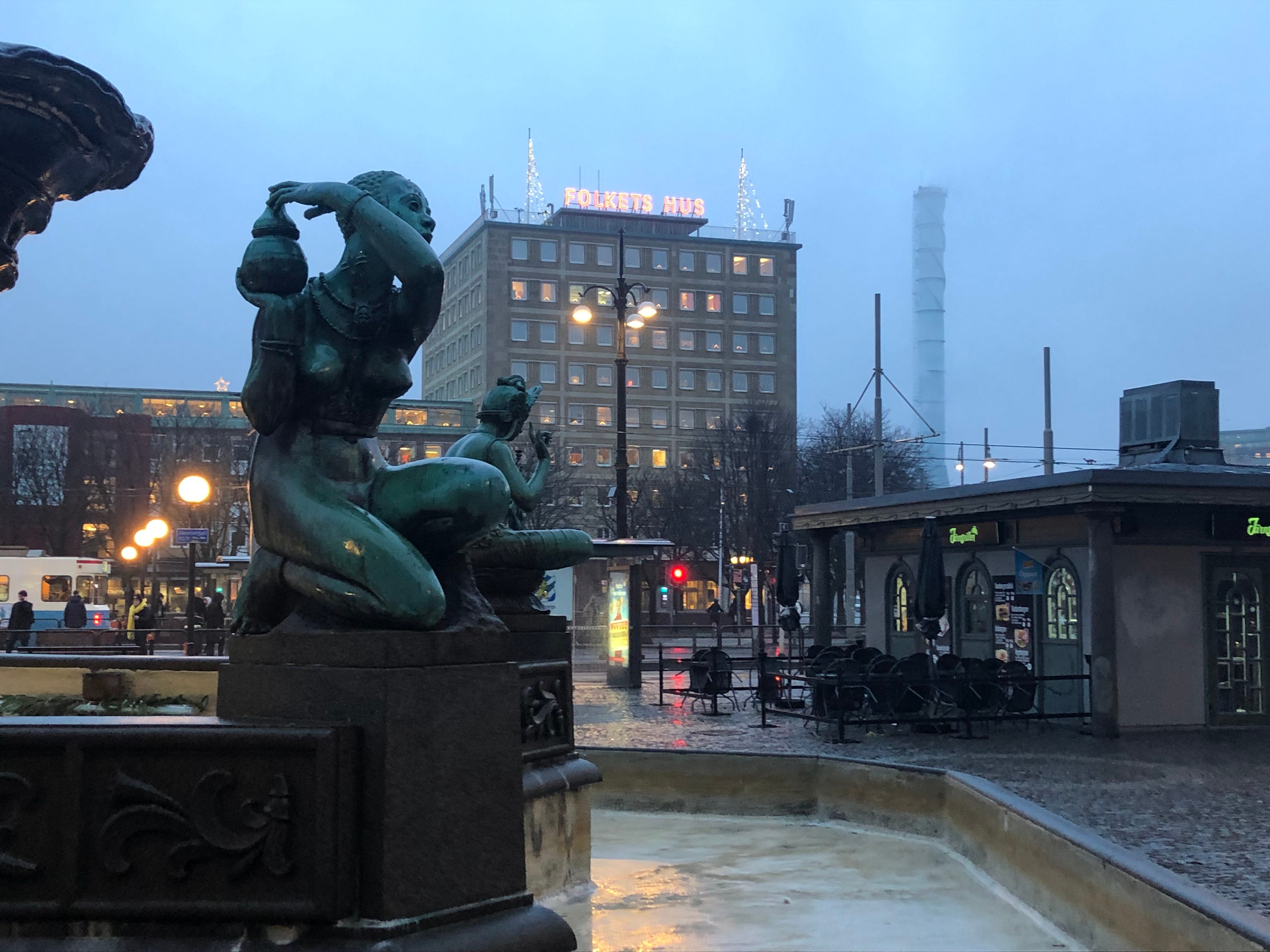
From my office desk by the harbor in Gothenburg, as the sun sets at 3:30, I stare out the window at the wet cobblestones, the wet leaves, the dead trees, the Soviet-bloc public apartments across the way with the terracotta roofs built in the 1960s “Million Homes” campaign, the streetlights suspended across the road on a tightrope wire, and the twinkling golden crown of the Skansen Kronan up on the hill, a 14th century defensive bastion.
Outside my little window, the endless silence of Nordland.
All hail Nordland, a land so northerly and pagan that the Romans considered it beyond the land of the dead, a land of great sleep that for centuries Christians only had the barest successes in converting.
A land of moss-covered stone, dead trees, clouds.
A rocky, windswept, largely birdless land, aside from the blue-black snipes and the seagulls, so vast and gray-blue and godless/birdless that its enough to make you cry because you’re far from all that used to trouble you (especially god, who troubled you so much).
Total darkness by four, like the lights went out. Moon usually hidden behind cloud.
Anything to push back the endless darkness! I go up the street to the supermarket past all the little shops with the inviting kerosene-torch-candles outside the door, get the anchovies and dijon and Hellmann’s mayo, get some low-alcohol-percentage People’s beer and come home and make the Chicken Caesar Salad, putting on a song from Bathory’s masterpiece, Nordland I “Winterblot”:
Text within this block will maintain its original spacing when published
All male, nine by nine, hanging gently, swaying in the wind
The bark of ash absorbing the splattered heaps of blood
For the return of the sun, a winter sacrifice
Ox, dog, horse, sheep and slave, all offered to the gods
A blot was a sacrifice of people or animals that took place once every nine years. And old one-eyed Odin—sometimes beguilingly referred to in the sagas as “The Evil-doer”—famously spent nine nights hanging and swaying from the tree sacrificing himself.
Text within this block will maintain its original spacing when published
Life-giving disc shall fill the sky once more in all its span
The vinterblot, a reawakening, hail Nordland
But the Swedish black metal, which stiffens the resolve and tightens one for the approaching winter, has to be balanced out with some kind of longing tenderness, spare acoustic songs of yearning (why? for what? to open all the pores to pain and memory and longing?)
I put on Fred Åkerströms 1972 “Berceuse” from Två Tungor:
Text within this block will maintain its original spacing when published
Sov, sov, lilleman (Sleep, sleep, little man)
Livet är en dröm (Life is a dream…)
Natten är så lång, så lång… (night is so long, so long)
If the drizzle lets up for more than thirty minutes, I will walk down to the harbor to look at the insect-like dock machinery, the freighter boats, the massive cruise ships, the Casino Cosmopol, the elegant little bars with names like Lilla London, Irish Embassy, and Golden Days—Denmark is out there across the bay somewhere, and beyond, across the North Sea, Scotland.
I will take the tram into town where all is shining safely. The world is so wonderful, on the tram into town. I will think about everything and nothing.
Trundling around the curves past the little rivers and the Fryshuset, the Ölhusets, the old factories repurposed as gyms and city bureaucracy offices, the housing estates abutted by the gray scrapey mountains, the tangle of electric lines over the train tracks.
The pale blonde people in black pea coats shuffling home, all looking remarkably the same, all beautiful, in the sideways freezing rain.
And in the spring when the sun finally comes out, the people in town by the quay will stop as they’re doing their afternoon errands and stand still, eyes closed, basking in the sun like lizards or believers caught in the gamma ray of the Rapture.
They are pale like vampires. They love the sun but they do not know the sun, it never quite reaches them, it doesn’t darken their skin.
I love it, I love them, these heathens, while worshipping nothing and being totally secular but syncretic somehow, worshipping their old gods—the preciousness of the sun, the bonfires and coming of spring, the wooden goat of Christmas, the movement of the seasons, the salt air of the cold and grinding rocky sea.
I love them and their little society struggling to not be so homogenous, struggling to make itself truly multicultural, their love of sports, their naivety, their lack of shame about their nakedness in dressing rooms, the way they don’t complain about how the summer cold Archipelago water makes the skin sting and the breath gasp, the genuine helpfulness and friendliness of the people working at every convenience store.
Wet soccer pitches. Cobblestone. Smiling stone lions. Excellent Syrian and Afghan food, the pita so fluffy and fresh it’s like artisanal blown glass.
Everybody sensitive and responsible and lovingly attentive to the children.
The grandest, most extensive playgrounds I have ever seen.
No cash accepted, anywhere. No physical money of any kind.
Shoes and coats off when you come in the door.
Long candlelit dinner parties that start in the dark and end in the dark and where after the first two bottles of wine, the land-o-lakes-eyed Northerners start to speak openly and frankly about their lives and worries. Depression. Anxiety. Love problems.
Lit candles, everywhere, at all times, in public, at home. Candles at the gym. Candles at the bar.
Twenty candles on the floor during the yoga class. Once, out my window, I saw a torchlit procession for some long-deceased Swedish king, I think it was Gustav Adolf.
But surprisingly few fires. Car accident fatalities hovering around zero.
Tiny flicker of light in the endless darkness. They have to counteract the weight of the endless forests in every direction, the Foreverdark Woods, as Bathory calls them.
A place that makes you both hard and soft at the same time.
II.
But also. And—
So far from the din and hum of our imperial center. That famous American energy, the slim possibility that you might actually win, win in the imperial center, our urge to win and succeed at any cost.
Sleepy here. Land of Nod. The people lack intensity and spleen. Easy to sleep. Easy to work. No noise. The trams are quiet, the library is quiet, the night is so quiet.
No birdsong, no green things—aside from the tiny little green shoots my friend is growing in his kitchen window.
Never wait more than seven minutes for a bus or tram. Never go to bed after two AM. Never wake up crushed by doubts, envies, ambitions.
F. Scott Fitzgerald, from Tender Is the Night:
“After lunch they were both overwhelmed by the sudden flatness that comes over American travelers in quiet foreign places. No stimuli worked upon them, no voices called them from without, no fragments of their own thoughts came suddenly from the minds of others, and missing the clamour of Empire, they felt that life was not continuing here.”
That’s how it is.
III.
I first came to Sweden in the summer of 2004, to visit the two queer girls who lived below me in Barcelona—Saga and Sandra. It was through them and a few others like the tall, somber Rogier, that I fell in with the Swedes. They were much easier to get to know than the socially-impenetrable Catalans—as rich, sarcasm-and-irony-inclined countries, we shared cultural reference points.
Saga was an Amazonian indie babe with cat-eye glasses and Sandra came off a bit more as a hard antifascist, with facial piercings and a Chelsea cut. With their perfect fringes, their love of twee pop and radical politics, and three-quarter-cut parachute pants, they seemed to me like people from the future.
I had a crush on Saga but she was about a foot and a half taller than me and she wasn’t interested—Sandra made some flirty overtures towards me, but I wasn’t interested. So we were friends.
There was also Lisa, an indie girl who worked at an up-market chocolate bar shop and lived in a kind of mini-Danish log cabin in a huge hipster loft; Emmanuel, a tall, gangly, lovable Bowie-vampire; Helena, elegant and beautiful and whimsical as Audrey Hepburn in Roman Holiday; Gro, who was in love with a Catalan indie guy; and Dee, my short, Swedish-Jewish doppelganger—who I loved instantly like a brother from another mother—like Frodo and Sam, we were both hobbits, short men from different worlds who still instinctively liked and empathized with one another.
We became a kind of gang.
I loved them and I think they loved me. But nearly every big night out we had, any attempt to go out to a club or some squatted warehouse to dance until dawn usually ended abruptly—Saga and Sandra in tears shouting and yelling because of something some dirty Spanish man said to them, all of us walking home down to the Raval in the sodden Barcelona drizzle.
Back at the apartment we’d cuddle up in a pile and make tea and they would take turns reading me Valerie Solanas’s S.C.U.M Manifesto. I still remember the words: “Life in this society being, at best, an utter bore.” That’s right, they read to me from the Society for Cutting up Men as a bedtime story.
The same thing would repeat the next night and a few nights later, on and on and on.
While many of the individual nights were abortive and sad, somehow taken as a whole I found myself happy in Barcelona—maybe the happiest I’ve ever been, probably because I was on a great adventure and felt my whole life was ahead of me, a way I can only dream of feeling now.
I watched no movies and read no books. I was riddled with guilt because I was fucking around in Europe while my dad was dying back home.
I woke every morning at 6:30 AM to the sunrise over Montjuic and walked up the Ramblas past the flower sellers and staggering drunks. After my courses, I took aimless, hours-long walks across Barcelona until it became dark.
I got very skinny from the walking and living only on avocados and baguettes and espresso and red wine, but when I looked in the mirror, I was still chubby.
That summer, I visited the girls in Malmo. Even at the height of summer, the weather was windy and soggy, the temperature never breaking 65 degrees.
In the blustery drizzle, we wandered the rocky shoreline huddled in hoodies. The cold and wind and empty cobblestones somehow made the food taste better; the houses and apartments seemed to enclose and protected human beings, nurture them in cozy terrarium interiors with tea, candles, and blankets, the dull drizzle pounding at the windows.
We took a sauna in Saga’s apartment-building basement. The basement was utilitarian and had pale green tiles, like an old mental hospital.
I got so overheated and dizzy in the sauna that I had to rush out and vomit and shit at the same time.
After that, the drizzle felt more manageable. I felt that the weather and the sauna and the interiors enclosed the human, embraced, warded off chill and sickness unto death.
In Barcelona, the rain had been sloppy, drunk-sad, and nihilistic.
In North Carolina, it is always torrential and awe-inspiring, a storm followed by rainbows and sunlight and frogs.
In Sweden, it is a never-ending drizzle, like melancholic tears.
I didn’t like Sweden in the way you like a place and fantasize about how great it is and wanting to move there afterwards. But something about it got stuck in my gullet. Strange memories like piercing sunlight refracting in shards of broken mirror.
I guess it made an impression on me. I’m not sure what the impression was. Not a better impression than anywhere else. I didn’t think much of it at the time or in the decade that followed. But something about the cold rain and the sauna-heat, and human-scaled things.
Something deliciously Soviet-simple in it, like a blank canvas, like North Carolina, where nature and civilization blend seamlessly into each other, in a kind of symbiosis.
A place that tamed the passions rather than inflaming them.
IV.
Sweden is not thought to be such an interesting place. Especially by the people from here. “It’s so boring here,” they say. “We suck,” they say; “We are such a small, unimportant country.”
But life is good and easy here, so they don’t leave. Sure, they go on vacation to exotic places, and maybe do a year or two in New York or Berlin that they will talk about for the rest of their lives, but they will always return to their cozy Hobbiton Shire.
Very few stray away forever.
They love their Knackebrod crackers and rent-controlled apartments and Sunday P1 hour-long radio programs too much.
Can you blame them?
Swedes always think that Swedes know best, that their society is at bottom the best, most safe and non-violent society in history; that however modest it might be, by certain metrics they are superior to all other cultures and countries, even America.
They’re so smug, they’re self-satisfied and soft, my friend in New York says of them.
It’s hard for them to remember that people struggled to get here. Because once they’re here, they disappear into the ever-gray mist of the big apartment complexes.
Sweden really is like Rick’s in Casablanca for the immigrants.
And everyone at Rick’s has a story.
Everyone was someone, on their way somewhere, but ended up stuck in Casablanca, where all the Flotsam and jetsam of the universe washes up.
There are always reasons.
You meet lots of immigrants who are wanted by the authorities in their home countries for having been part of outlawed opposition parties and opposition movements. Or who faced war and persecution. Persians, Kurds, Afghans out of sync with Afghanistan, Russians out of sync with Russia, old Allende commies from Chile, South American guerillas, a few old beatific Black Panthers.
You ask them, “So do you like Sweden?” and they shrug and say the people are nice and complain a little bit and then get a kind of misty look in their eye for the home they can’t or don’t want to go back to, for whatever reason.
It’s kind of like the Afterlife in that way—the place after the storms and chaos and action.
Like Assata Shakur in Cuba—what happens after the big action in life ends? She lived out the remaining decades in an upscale suburb of Havana. I went to her house there and knocked on the gate and tried to visit her. But her bodyguard shooed me away.
As Edward Said put it in “Reflections on Exile”: “The achievements of exile are permanently undermined by the loss of something left behind forever.”
Purgatory is a kind of waiting room for lost souls.
In the Norse sagas, Hel [sic, with one L] was not a bad place, the place of Christian torment but a kind of shimmery gray otherworld—it was a real place, geographically located North and Down, according to Snorri Sturluson.
In Casablanca, Bogart is living in a kind of hazy netherworld after Paris and his passionate gun-running anti-fascist days in the Spanish Civil War. He is running Rick’s, where all the lost souls waiting for their visas to come through are milling around—“Everybody comes to Rick’s!” they say. “Everybody knows Rick!”
But Rick doesn’t even know Rick anymore. He has become bitter. He doesn’t believe in anything anymore. Especially love or politics. He tolerates the Nazis, he serves the partisans, he deals with the refugees, but he’s over it—he’s just out for himself.
Casablanca is probably my favorite movie, mostly for the ambiance, but also because I can relate to Rick. Sometimes I feel like I am living a life-after-life myself. A kind of retirement from the world. I don’t care about anything anymore. I just want to mind my own business and keep my nose clean.
I had been longing to make myself cold and frozen and unassailable inside and I found it in Sweden, where even when the feelings thaw they never flow down in gushing cataracts.
After everything is over, there is just snow and the silence of Scandinavia, the futuristic swish of the futuristic trams and Arcade Fire blaring in my headphones: Afterlife, oh my god, what an awful word. After all the fires have burnt / in the dead light of the afterglow.
So far from all the things that made me feel love and joy and nostalgia and hate.
The good is only so good and the bad is only so bad, there are bumpers, socially, emotionally, class-wise.
An all-encompassing Bethesda, a blankness, a blanket of light melancholia. Bethesda, Bethesda, is it a suburb of Washington, DC, or is it the shimmery other place, the place of forgetfulness—that’s what Baudrillard called it in his book America.
I will go up to the mossy old graveyard in Redbergsplatsen. At the entrance, engraved in stone, it says: Think of the dead.
Comments
Nothing yet. Say the first thing.
Sign in to join the conversation.