
The New York Times has a pretty good editorial about why crime is falling. These two sentences, though, struck me as worth investigating a little:
Data has long made clear that murders spike in the summer, when school is out. As the old saying goes, “Idle hands are the devil’s playthings.”
It’s definitely true that murders spike in the summer, and that school is out in the summer. But how much of the additional violence is driven by school-age youths going nuts because they have nothing to do, as opposed to just heat?
At least some findings suggest school is no violence-reducer. As this study notes (emphases mine):
In the foundational paper, Jacob and Lefgren (2003) use teacher in-service days to estimate a causal relationship between school attendance and crime in urban settings. They find that juvenile property crime declines by 14% on days when school is in session but violent crime for this same group increases by 28% on school days.
In a follow-on study, Luallen (2006) exploits school attendance variation caused by teacher strikes that resulted in canceled school days. He finds that juvenile property crimes increase on days with strikes but violent crimes decline, and that the results are solely driven by urban areas. …
Using data on reported crimes and aggregating to the law enforcement agency-year level, we show that on average crimes in treated agencies increase as a result of the policy [of a four-day school week].3 In particular, property crimes increase substantially when four-day school weeks are adopted. Alternatively, we find no evidence that juvenile violent crime is affected.
Further, this survey finds that “Self-reported crime among middle and high school students decreased substantially between spring 2020 and spring 2021. Non-lethal violent crime dropped by 24% and property crime declined by 23%, large reductions compared to changes observed over similar time frames during the preceding three decades.”
It seems intuitively plausible that school could have an incapacitating or placating effect thanks to the consistent schedule and supervision. However, school is also a place where personal conflicts can flare up, as kids are forced to be around each other whether they like it or not. I never really got into fights as a teen, but I definitely thought about punching people more on school days.
To investigate further, I grabbed Jacob Kaplan’s cleaned-up version of the FBI’s Supplementary Homicide Report,1 where departments provide a lot of details about each individual homicide (though participation in this reporting is not universal). Since homicide trends have been crazy this decade and even school attendance wasn’t consistent, I opted to combine the data for 2010 to 2019. My question: Is the homicide surge in the summer particularly concentrated among those of high-school age?
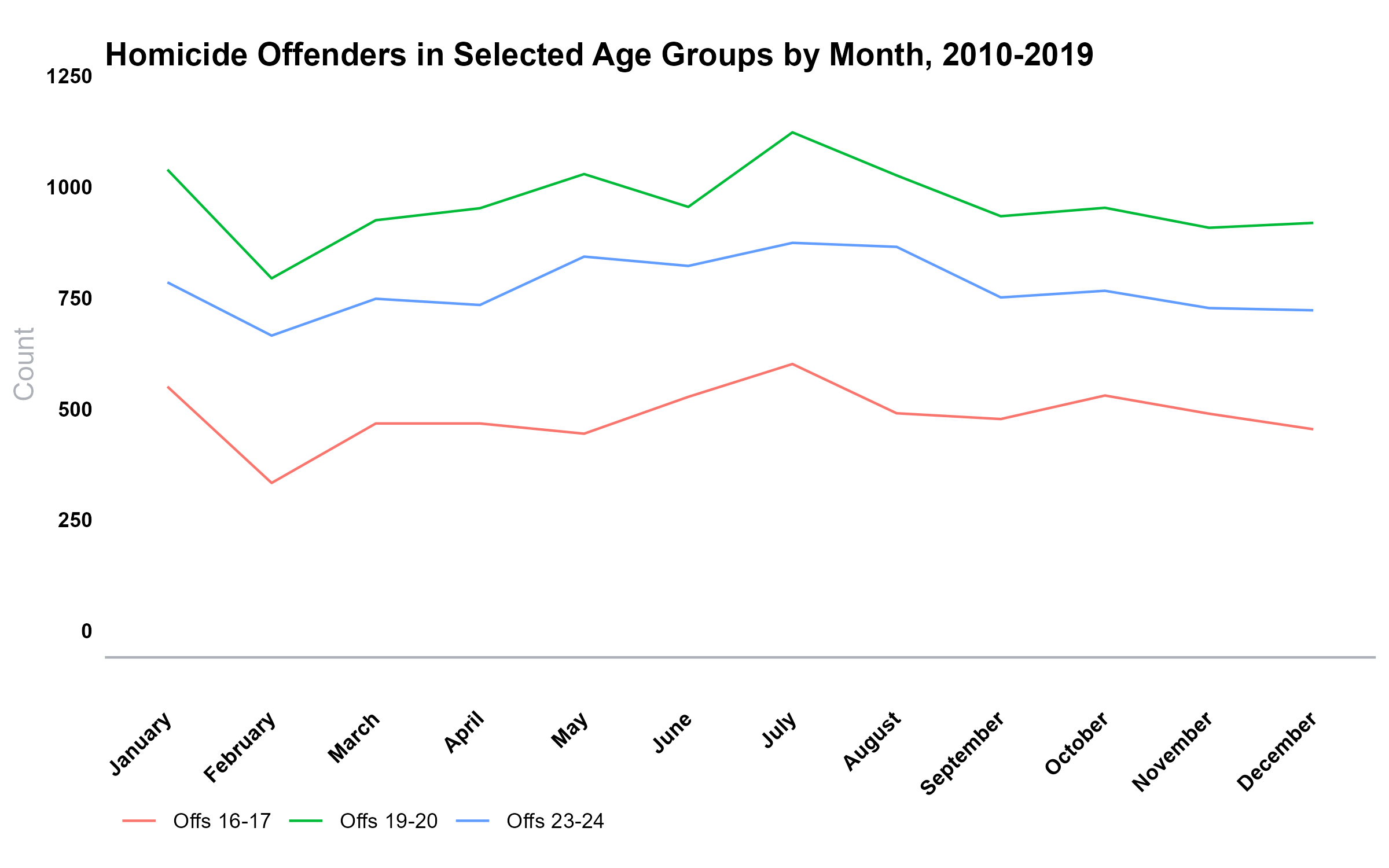
I tallied up how many homicide offenders and victims had been recorded in the age groups 16-17 (still should be in high school), 19-20 (not in high school but might be in some postsecondary education), and 23-24 (finished even with a four-year degree) during this period, broken out by month. Note that if an incident had multiple victims or offenders, I tallied up all the relevant fields to capture everyone involved.
Here’s the result for offenders. The downtick in May for the 16-17 group is interesting, but in general it seems that homicide offending rises for all young adults, to a reasonably similar degree, in the summer.
And here it is for victims:
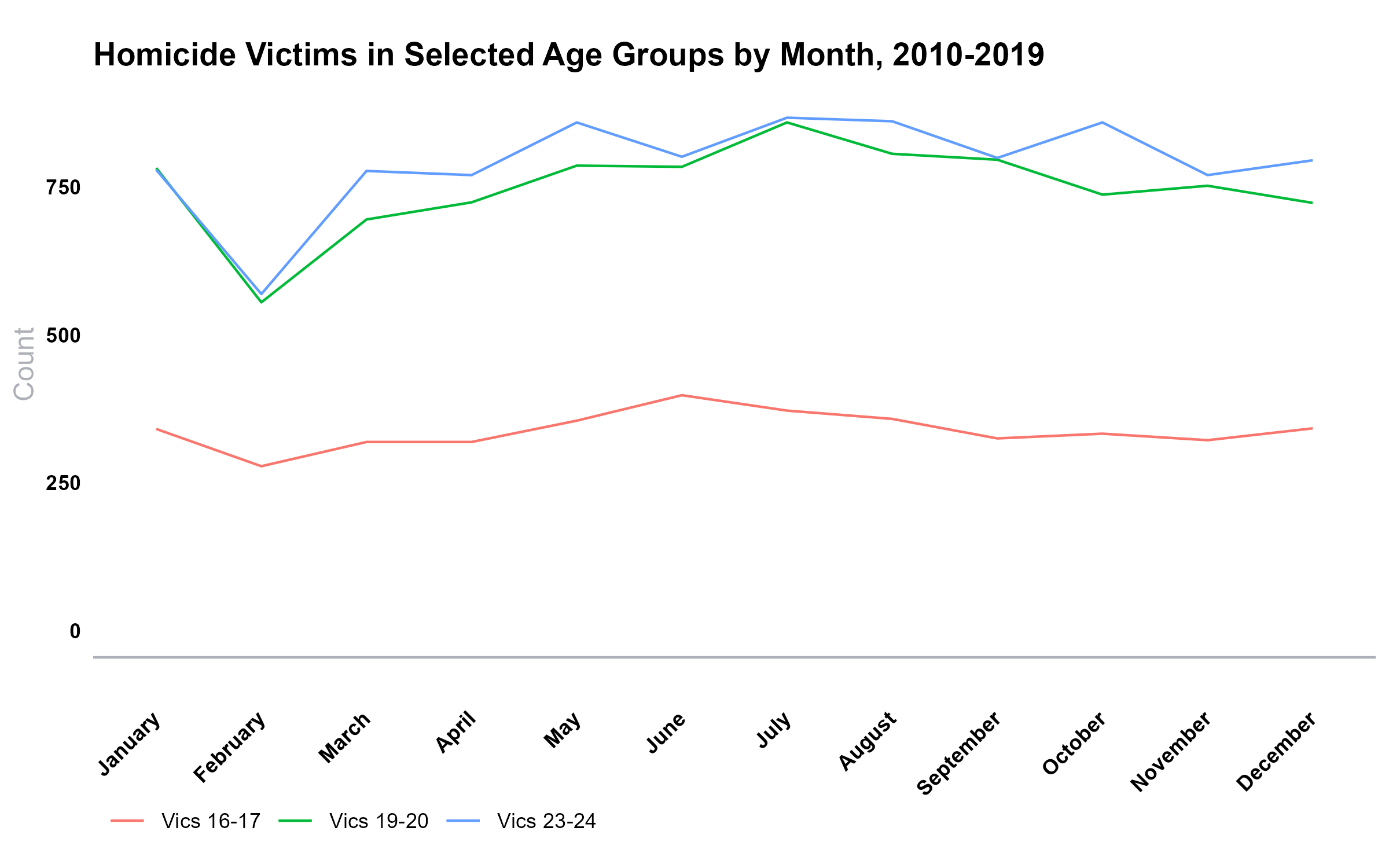
As someone who really hated school closures—I’d still be living in Northern Virginia otherwise!—I kinda like the idea of blaming a murder spike on them. So far, though, I haven’t seen great evidence for it.
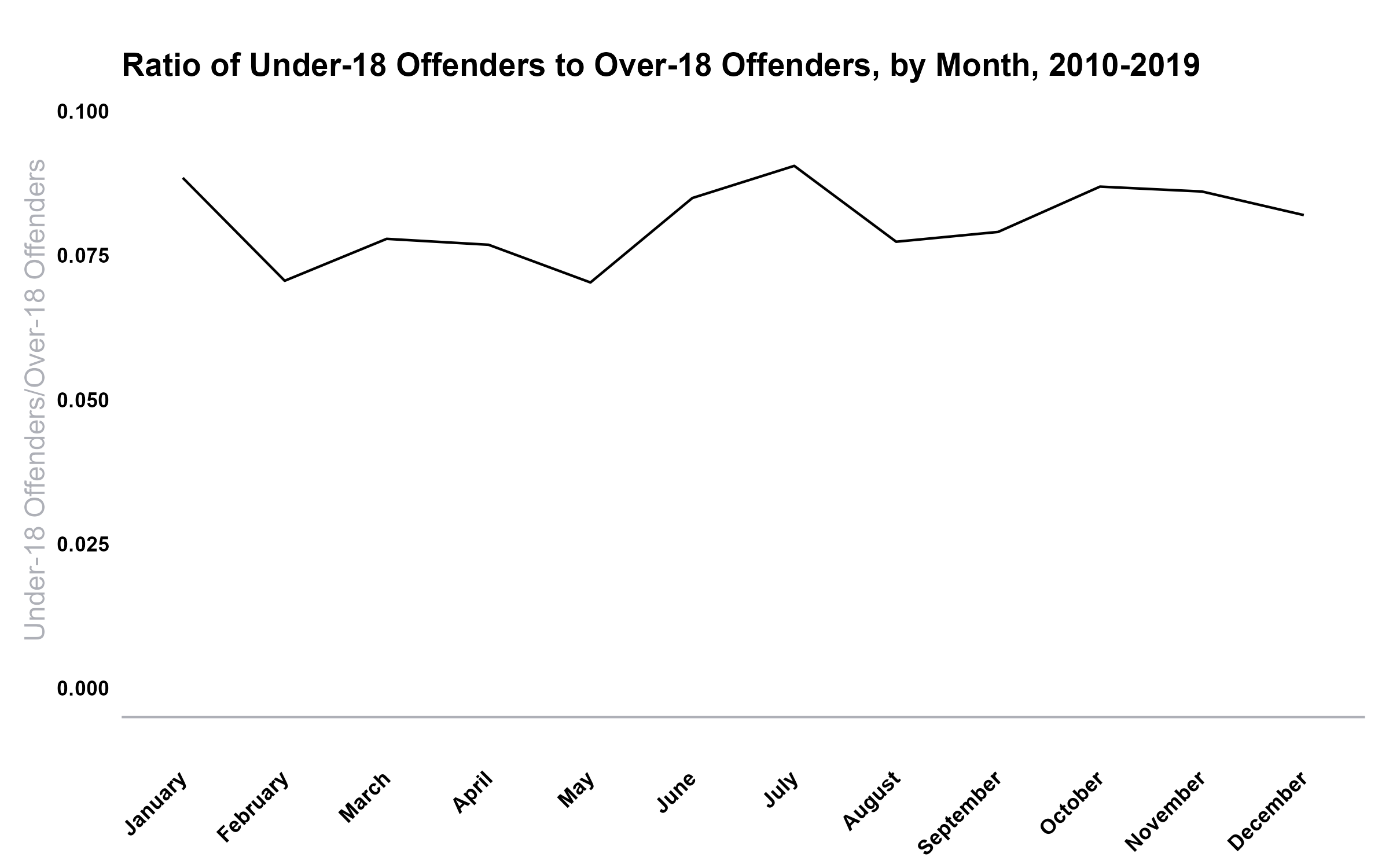
UPDATE: I feel dumb for not thinking of this earlier, but this is the ratio of under-18 to over-18 murder offenders by month of the year (excluding those exactly 18), for 2010-2019. Clearly, the vast majority of offenders are adults and this ratio is always below 1:10 (or 0.1), but in this way of looking at it, minors do become slightly more common among offenders when school lets out:
No posts
Comments
Nothing yet. Say the first thing.
Sign in to join the conversation.