
There is a place in my local neighbourhood that borders on the holy for me. It is not trendy or romantic or technically spiritual. It is in a clean but extremely dated building across from a 7-11. It smells lightly of bleach and is brightly lit.
It is the public bathhouse, or sento in Japanese.
Like most public bathhouses, there is a vending machine out front and a jumble of bikes parked close by the entrance. There is a stand for umbrellas by the front door, one where you lock your umbrella in place and take out a tiny key (because the only things that are ever stolen in Tokyo, apparently, are umbrellas and underwear). Of course, as always, there is a laundromat attached so you can take a bath while you wait for your clothes to dry.
The sento is run by a couple so elderly, they occasionally fall asleep at the front desk. However it is usually not for long, as they are doing a roaring trade, with customers constantly rolling in and out, leaving a tidy pile of coins on the counter, for the entrance fee or a cold bottle of milk post bath.
For the last two years, once or sometimes twice a week I walk up to the sento and spend an hour or so there. When I return home, I always feel cleansed far beyond the physical body alone.
It is said that sento culture dates back to the Heian period of 794–1185 (Japan’s golden age, one of my favourite historical periods to read about) and boomed in popularity after the war. Public bathhouses existed not only because there were no baths in regular homes, but also as a place for gossip, socialising and community connection.
Despite even the tiniest modern Japanese apartment being fitted with a bath these days, my local sento is still a hot spot, teeming with women (mostly over eighty) exchanging quiet nods, stories and cackles every night of the week.
In my first months of living in Tokyo, where everything was a blur and I was existing almost completely on my own, it was the sento that became my sacred place. I could be with people separately, but intimately. I could be alone, relaxed and safe in a room full of women, without the distraction of a phone.
It was in the sento I helped keep the tentacles of anxiety at bay. It was the place where I remembered that everything, eventually would be okay.

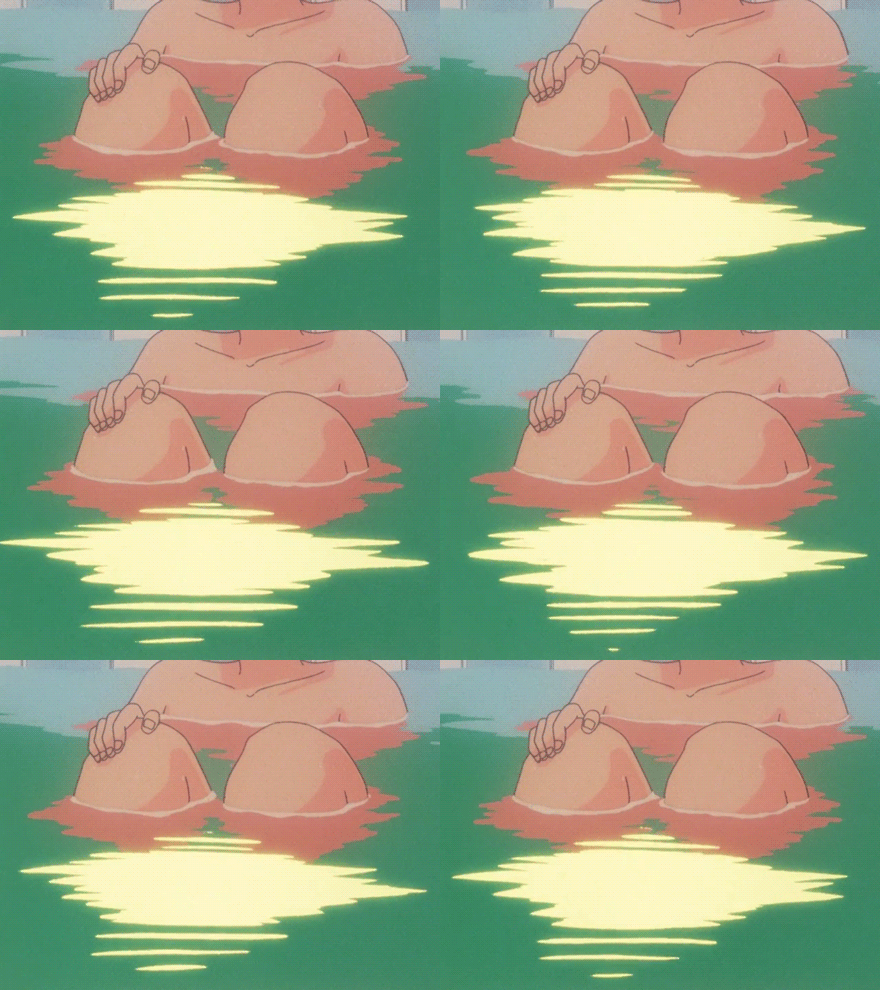
If you’ve spent time in Japan, you may have experienced onsen. Onsen are hot spring baths, filled with naturally occurring, mineral rich water, heated by the earth. Most of the time, onsen baths are found in onsen towns and the best way to enjoy them is by staying in a traditional ryokan or inn, but day trips (even from Tokyo) are possible (and highly encouraged).
While both sento and onsen involve public bathing (although you can also have private onsen baths at ryokans) they are fundamentally different. Onsen are a luxury, even medicinal experience, sento is the everyday. They are both, in my opinion, deeply spiritual experiences, but in wildly different ways.
While onsen are healing retreats from the real world, there is something about the sento that lodges you further into the local community and the everyday. Taking yourself out of your home to bathe allows you to be more present in the experience. It is here we feel how powerfully restorative and deeply cleansing bathing can actually be.
When I read about wellness influencers rejecting bathing for a more ‘natural’ or ‘traditional’ approach I shudder (and completely disagree). Water has always been a threshold, a holy place, one that is best not ignored.
Below, I share the art and practice of public bathing, sento essentials and some of my favourite public bath spots in Tokyo.
Comments
Nothing yet. Say the first thing.
Sign in to join the conversation.