
In the Golden Age of Twitter, before it was bought up by a white supremacist oligarch and transformed into a wasteland of disinformation and hate, the Canadian politics nerds used to half-joke about how badly Canada needed The Economist Party. As far as I can recall, the idea of The Economist Party was hyped by smart, policy-focused journalists like Andrew Coyne and academics (especially economists (duh), but also political scientists like myself). It was a simple proxy for a simple idea: what if instead of the political parties and politicians we were stuck with, instead we had evidence-based wonks with long-term vision for running the country?
I quit Twitter long before the 2025 election, but I bet a lot of people thought Mark Carney would be the first Economist Party Prime Minister. Boy were they wrong. Carney has proven to be just as short-sighted, politically-minded, and partisan as many as his predecessors.
And so however depressing or outrageous it is, it was not entirely surprising to see Carney partake in some grubby patronage and strategic politicking with Senate appointments today.
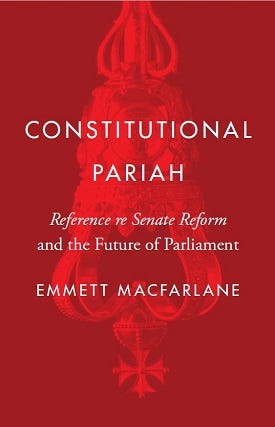
Full disclosure: in 2015 and 2016 I advised the Trudeau PMO on their proposed ‘merit-based, non-partisan’ appointments process to the Senate. The reform successfully limited (nearly eradicated) patronage appointments, making the Senate a more useful and independent policy advisory body. In the years since 2016, the more ‘independent’ Senate has more frequently proposed amendments to government legislation but without falling into the trap of becoming unduly obstructionist. I wrote about the process leading to reforms and the early outcomes in my book, Constitutional Pariah.
The renewed Senate still has its detractors. There are those who will never accept it as an unelected institution (a valid enough viewpoint), those who would prefer it remain a partisan rubber stamp (usually partisans), and those who just really, really hated Justin Trudeau.
But I viewed the reform to the appointments process as particularly useful. It presented something of a modest check on executive power in Canadian governance. The House of Commons, especially in the context of a majority government, is weak and ineffectual, dominated by party discipline so extreme it dwarfs that of other Westminster-based parliaments. Short of the courts, our system lacks institutions that meaningfully condition or mitigate unchecked legislative majoritarianism.
Even as an appointed rather than elected body, the Senate can serve an important ‘sober second thought’ role, taking into account constitutional issues, long-term policy considerations, and evidence in ways the House seems unwilling or incapable of doing. And while an unelected body should not obstruct the overall legislative agenda of the government of the day, it fulfills an invaluable role when it slows things down, proposes legislative changes, and operates as a check - in rare occasions - on the majority’s worst impulses in the context of a broader democratic system.
So when Mark Carney abandons a core premise of the reforms and engages in grubby patronage to appoint a friend and faithful Liberal to the upper house, and uses another appointment to free up a contestable Quebec riding, he should be criticized. It turns the clock back and raises the specter of a Senate that, when filled with government appointees, was often little more than a rubber stamp (and that, on occasion, when a new government takes over, becomes a hostile, obstructionist partisan body). A Senate filled by patronage appointments isn’t worth the money spent on it.
Now, perhaps we shouldn’t wring our hands too much about a single set of appointments. After all, in its press release, the government announced it will re-establish the advisory committee on appointments going forward. But there is something concerning there, too: “The government is also removing the non-partisanship criterion for Senate appointments.”
In other words, the Carney government is opening the door to more partisan appointments in the future. And let’s be clear about the muddy phrasing here. The government misrepresents the reform. A history of partisan service was never meant to be an explicit disqualifier for appointment to the Senate. The non-partisan, merit-based criteria were only designed to ensure that partisanship wasn’t the basis for appointments. Carney has decided to abandon this key principle. The result will be a less useful upper house, and one less check on prime ministerial power.
Carney’s record so far is revealing. He has abandoned climate policy, he is cutting important institutions and programs from mental health and disease prevention to international aid to Library and Archives Canada, and he plays partisan institutional games with the best of them. The 2025 election was framed around Justin Trudeau’s unpopularity. Once Trudeau resigned, voters surged to Carney, not only because of the Trump threat but because they didn’t want Pierre Poilievre. It’s becoming increasingly clear, that in avoiding Poilievre, Canadian voters did not get a Economist Party PM. What they got was basically Oxford-educated Stephen Harper.
No posts
Comments
Nothing yet. Say the first thing.
Sign in to join the conversation.