
Is it just me or is this the time of year where a specific kind of exhaustion hits? Whether it comes from running a business, raising kids, or working a full-time job, the good weather starts to feel like everyone around me is doing it better than I am.
Now I know this is an absolutely made up thing in my head, but I look at the fruit from the seeds of winter and I’m often side-eyeing my harvest. The shoulda, coulda, wouldas start to hit.
I recognize this pattern in myself and others immediately. It’s what operating from anxiety and comparison looks like from the outside, and I say that with no judgment because I have been there too.
Here are the signs that comparison syndrome is going to hold up your paper:
You feel like you’re behind because your competitor’s Instagram looks polished or because they have been in business longer. You’re considering a rebrand.
You avoid looking at your bank account because you’re afraid of what you’ll find, or you are ignoring a problem that needs your attention hoping it just goes away.
If you have a job, everybody is pissing you off and you are getting your resume ready, even though it’s been less than a year.
You refresh your “strategy” with whatever AI tool you’re using, even though you haven’t actually done anything different since you last prompted it.
The hard part about being an adult is that it is never just one thing. You have a long list of responsibilities. You carry everything on your back, so when something feels off, your brain assigns the blame to whatever is most visible. Usually, that’s a competitor who seems to be winning, a coworker who feels like the golden child, the season’s instagram It girl, or worse your loved ones.
So you don’t sleep. You post more. You hire a social media manager and then fire them. You wonder if you need to rebrand, reposition, or start over entirely. The anxiety keeps moving, but the outcome doesn’t. The mental load of that cycle is real, and it is also a choice you no longer have to make.
I manage a multi-million dollar marketing budget at my day job. The environment has gotten genuinely harder with SEO shifting and vibecoding changing how people build and publish. Paid media costs more and converts less and you need a hundred pieces of creative to find your winning set. So what does everyone around me want to do? Obsess over our competitors. “Look what company x did. Company Y just launched this. Have you seen that?” The truth is, I really DGAF, because our competitors have budgets I do not control, teams I do not manage, and a product roadmap I do not influence. The stress starts to weigh on me, but here is what I do instead of spiraling.
I will preface this by saying that my assumption that you, like me, have been working your ass off. So you aren’t dealing with a work ethic or focus issue, it’s likely a mindset issue. Now if you have been slacking, these tips will not apply and you need to go read Atomic Habits and listen to some podcasts. Ok back to the post.
I run the same two audits: an external data review and a cold lead review.
In every area of life, the external data review comes from conversations and reviewing the data available. When I talk to a single mom about dating, or another marketer about attribution, or someone balancing a side hustle and a job, I always find that I’m never alone in my situation or feelings. I need to get my head out of the sand and see if what I’m going through is unique to me or not. Comparison ends when I realize we are all living in some version of the same shxt show.
Now let me get nerdy for my business owners and marketers real quick.
I do a competitor check using SimilarWeb. The data brings people back to reality fast. Most founders and marketing managers are shocked to discover they are neck and neck with the competitor they thought was destroying them. Sometimes they’re ahead. The Instagram account with 50K followers and perfect branding? Their website gets 200 visits a month. Yours gets 1,500.
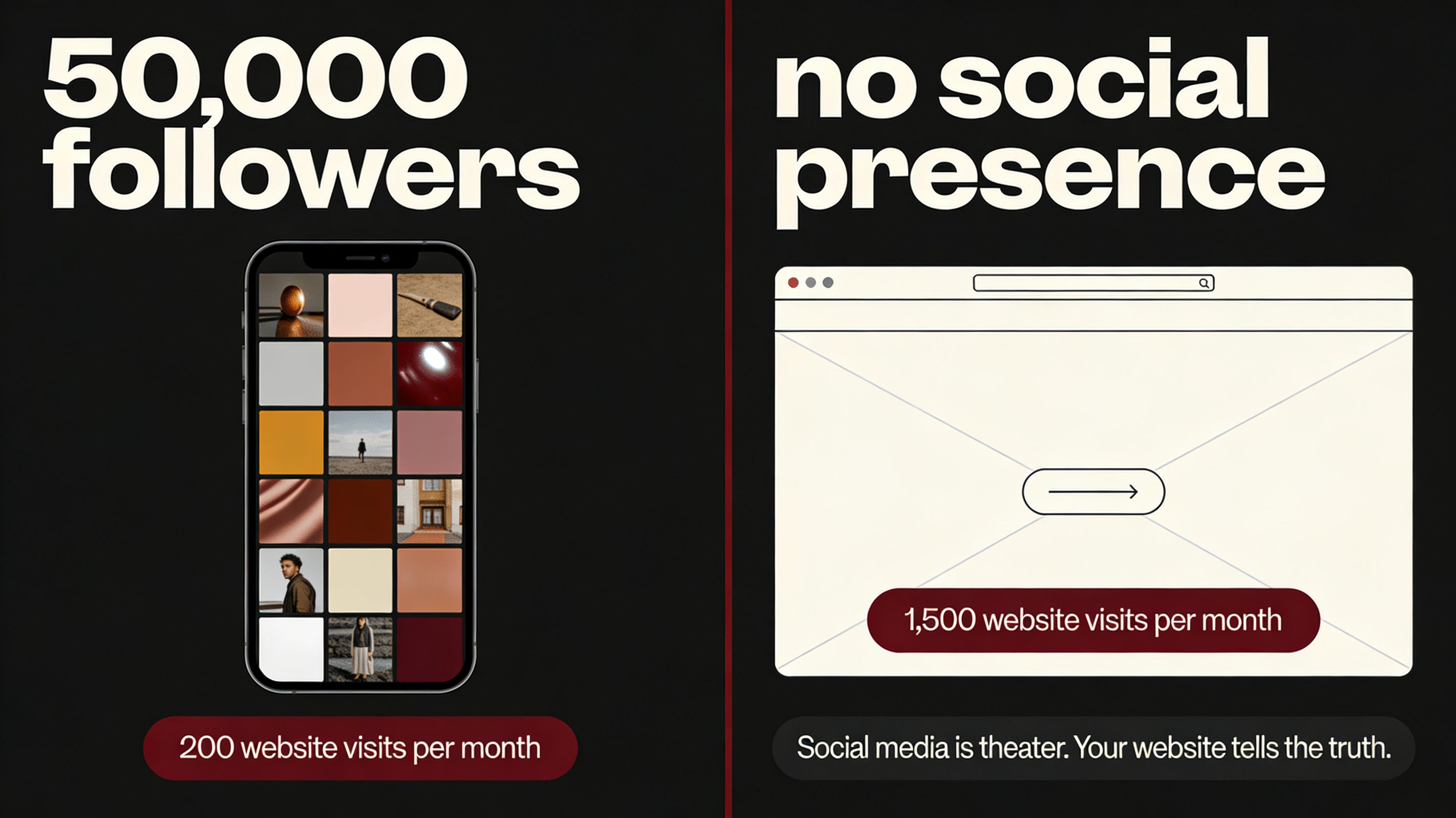
The website usually tells the truth because the website is where conversions happen. Social media is theater. Your website is your actual sales floor, customer service desk, and credibility validator in one place.
SimilarWeb shows you where traffic comes from: organic search, paid ads, social, direct, and referrals. I use this to stop conversations about chasing what competitors are doing on social and redirect the team toward what’s actually driving their growth. Nine times out of ten, the answer is SEO and email, not Instagram. The competitor with the flawless feed and a full-time content studio? Three percent of their traffic comes from social. The rest comes from search and a list they’ve been building for years.
This data also sets realistic expectations based on your actual market. If you’re local or brick-and-mortar, you need to know what normal looks like in your ZIP code, not what influencers in completely different markets are reporting. You find out the average business in your area gets 500 website visits a month, and suddenly your 800 visits don’t feel like failure. You were winning and didn’t know it because you were measuring yourself against the wrong benchmark.
If there is a real gap and you are behind, SimilarWeb shows you exactly where their traffic comes from. You stop guessing where to invest and build your strategy around what works in your specific market.
The second audit is the cold audience check, and I run this one on website copy and campaign messaging.
Before I rebrand for the eleventeenth time, I feed my website page or a campaign brief to Claude and tell it to read the asset as a cold potential customer who has never heard of us. I tell it exactly who we are targeting. I ask it to surface every question, objection, and point of confusion that person would have.
I used this on my agency website and Claude came back with 23 questions a cold lead would have after reading my homepage.
“How do you create content without interviewing me for hours?”
“What if my brand voice isn’t defined yet?”
“Do I need to provide the strategy, or do you?”
“How fast is the turnaround?”
I thought my copy was clear. It turned out I was answering questions no one was asking and ignoring the objections that were stopping people from booking calls.
I answered every single question in plain language, the same way I would explain it to someone over coffee. I asked Claude to review my answers and tell me where my messaging needed to change. It told me to add a process page, build in the economic argument for why hiring me beats a full-time content hire, and create a FAQ section to address friction before someone even considered booking a call.
I made the updates in one afternoon. The following week, the sales calls changed completely. People showed up already understanding how we work, already clear on pricing, and already sold on the model. The lead-to-client conversion time dropped from two weeks to three days.
I do not control that my competitors have more budget to spend on acquisition. I do control what happens when someone lands on our page. I control whether the copy closes objections or creates new ones. I control whether the experience wastes the traffic we earn or turns it into revenue.
In every other context, the outcome is the same. When you’re in it, you often lose sight of how your audience is perceiving you. So take a step back and consider 2 things: what are the gaps that are impacting you getting the results you want, and what you can control in this situation. Whether it’s dating, a promotion, coparenting, we have to become aware of how the other side is receiving us, in order to build the bridge. ( I know Kevin Samuels is somewhere feeling hella justified right now.) That is the shift. From anxiety about what you cannot control and ignorance around where you stand to building a strategy around what you can change.
The sanity part of this newsletter is real. Comparison anxiety is not a mindset problem you fix by thinking more positively. It is an information problem. You are making up a story about where you stand because you do not have the data to tell you the truth.
Benchmarking calms the anxiety because evidence replaces assumption. You stop feeling behind because you know where you actually are. You stop throwing energy at things that look like they matter and start putting it into things that move the needle in your life and career.
Your obsession with comparison is not keeping you sharp. It is keeping you tired.
Get the data. Run the audit. Then work on what you actually control.
Comments
Nothing yet. Say the first thing.
Sign in to join the conversation.