
When my sons were small, they loved to play a game we dubbed “I’m better than you”. Who was better at football, maths, cards, eating Weetabix? Or even baking after the Great British Bake-off turned making scones and whipping eggs into a competition. All siblings have rivalries of one kind or another, but the fierce one-upmanship between my boys knows no bounds, although it has lessened somewhat as my younger son has caught up in size to his brother and now stands a better chance of beating him at arm wrestling.
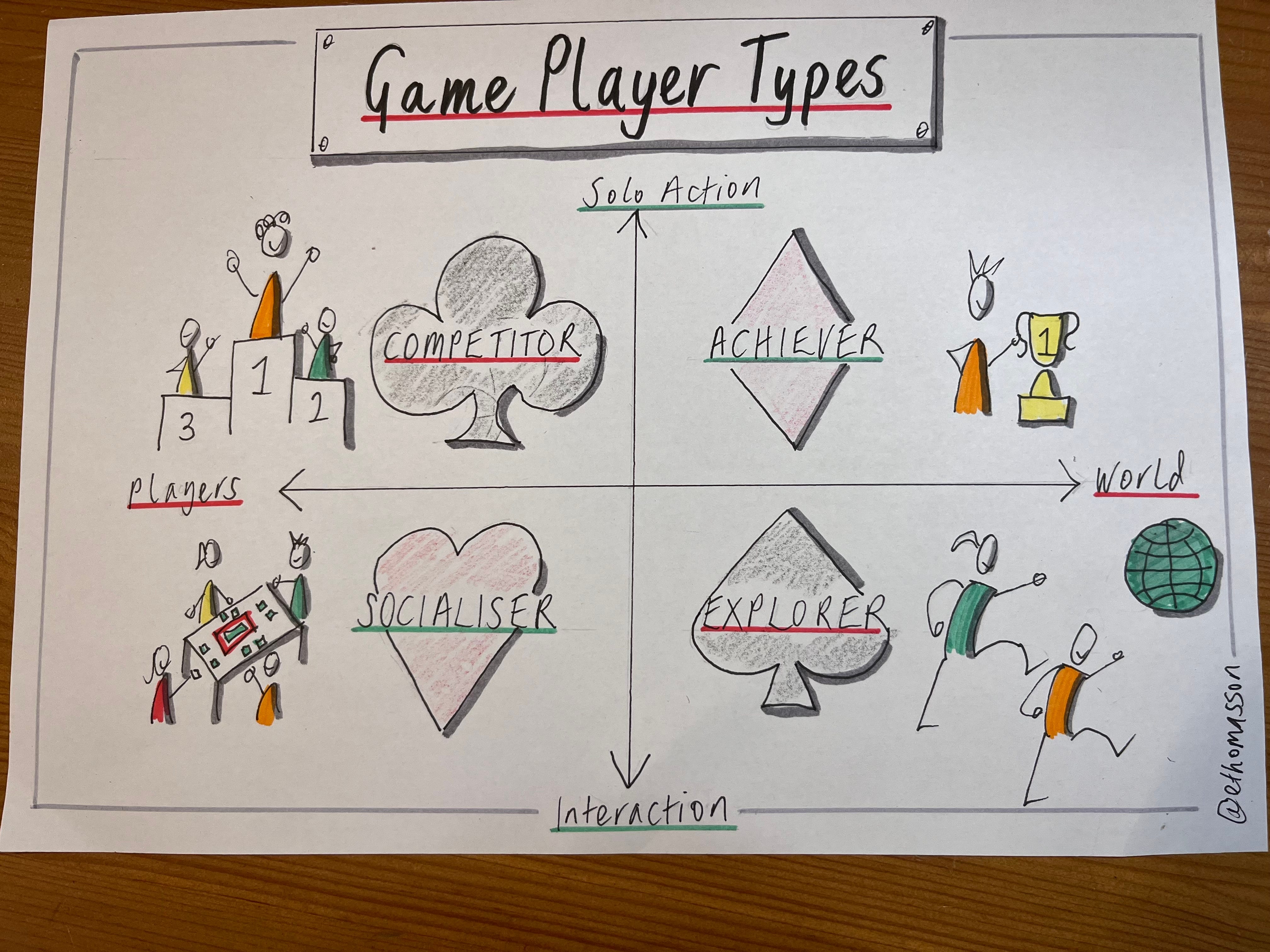
The rivalry might have been easier to manage if I had known about a framework which describes different types of game players: Achievers, Competitors, Explorers and Socialisers. Achievers are motivated by their individual mastery of a game and like to amass points and accomplish something for themselves. Competitors (known as Killers in the original theory) are motivated by beating others and climbing up rankings. I’m pretty sure I have one of each in my sons, which makes for a fiery combination: we had to ban chess for a while as it so often ended in a fist fight.
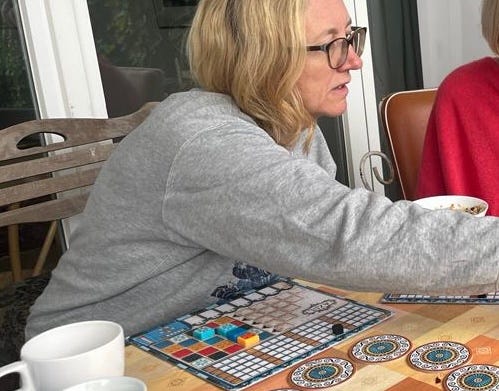
The other two categories are more peaceable: the Socialisers like me who don’t have the killer instinct but enjoy a low-stakes game like Dixit or Azul as long as it is accompanied by gossip and a glass of wine. That probably explains why I mostly stayed in defence in the school hockey team, spending most matches chatting to the goalie. Then there are the Explorers, players who like discovering places, knowledge or hidden treasure, immersing themselves in fantasy worlds like Dungeons & Dragons.
Playing games can be a very serious business, as psychologist Maria Konnikova discovered when she set out to teach herself poker to learn more about the importance of skill versus luck. One of her key lessons was this:
“It’s the hands you don’t play that win you the title… The art of letting go can be the truly strong one. Acknowledging when you’re behind rather than continuing to put good money after bad,” she writes in The Biggest Bluff. “Sometimes, the most difficult thing of all is to stop playing.”
You many be asking yourself why this is relevant for this newsletter, especially as I’m not much of a gamer myself. Well it turns out that gaming psychology can be applied in many areas: leadership, education, event facilitation and even journalism.
The framework can help leaders to discover how to reward and motivate different people in a team. So an achiever might prefer a promotion or a weighty metal desk ornament like the one Reuters sends staff for long service, but a competitor is more likely to enjoy wining a prize like “journalist of the year”. A socialiser like me would like to be rewarded with an invitation to a team dinner, while an explorer might enjoy the opportunity to go on a trip or learn a new skill.

Gamification is also key for teaching and facilitation, especially given our diminishing attention spans. Neuroscience shows that our brains are more likely to process a multisensory, concrete experience than a dry abstract concept. Think Duolingo for language learning, or fitness apps with their badges and streaks. I was inspired by a conference hosted by civil society organisation Better Politics Foundation, which featured a dynamic lightening debate involving judges and audience voting instead of the usual staid panel discussion. I use this kind approach in the workshops and events I run: even introducing an element of competition into an exercise on the stages of burnout, for example, or a competitive challenge to explore team dynamics.
I first heard about this model at an innovation event hosted by media development organisation DW Akademie at the International Journalism Festival. The presenters told us that gamification can help spark dialogue. We learned to apply insights from classic games like Monopoly, Risk and the Rubix Cube to efforts to counter polarisation in society.
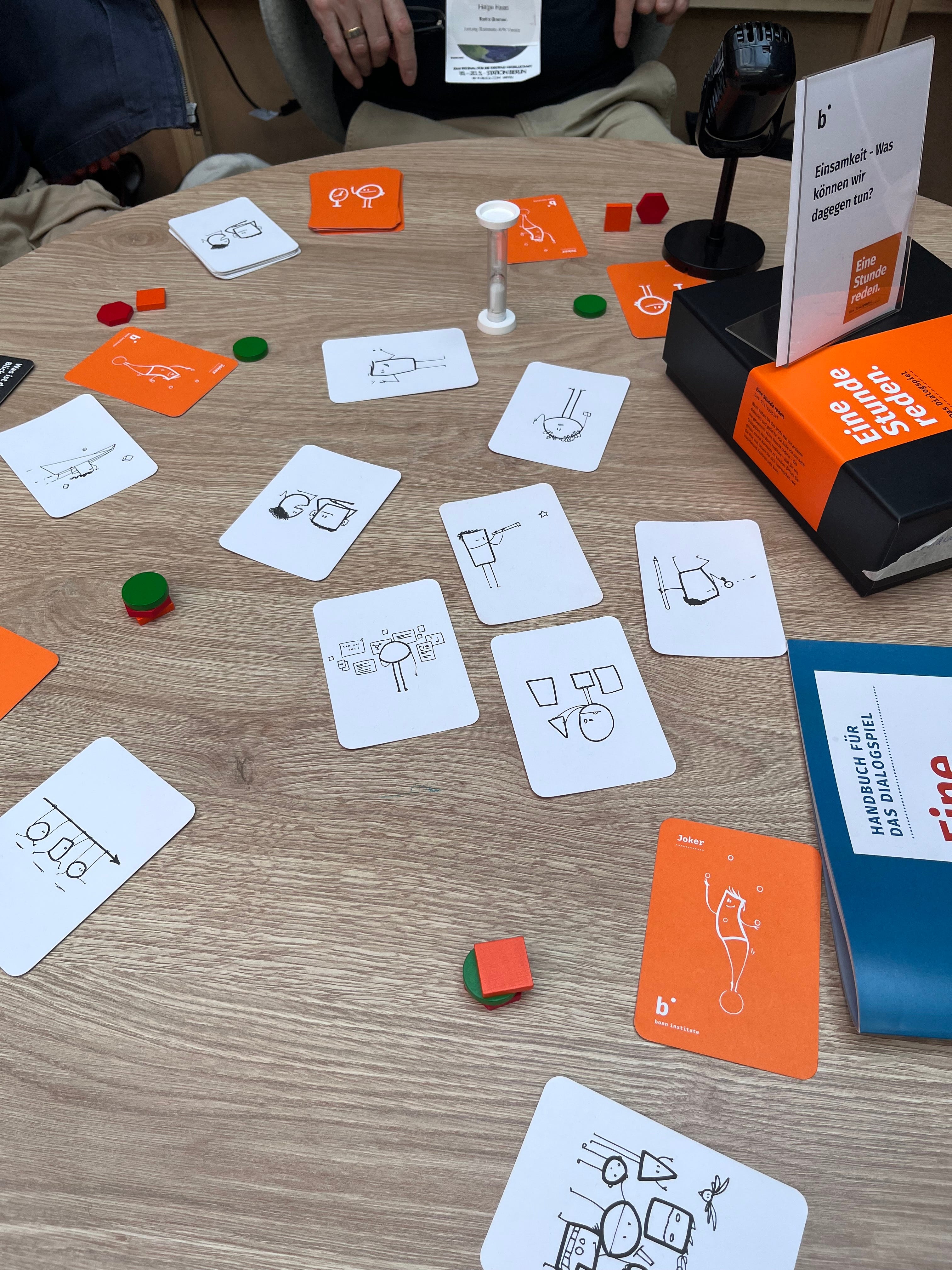
The Bonn Institute, which promotes constructive journalism, has taken this further: designing a cooperative board game to facilitate discussion on topics such as the loneliness pandemic. The game is structured to give everybody a turn to speak, with cards to express gratitude to each other, so it probably mostly appeals to socialisers like me. This kind of game is typical for the world-leading board game industry which developed after World War Two in Germany when the country consciously sought to promote games that foster cooperation with games like Catan instead of ones that stoke conflict developed in the US and UK, like Risk.
Gamification has arrived in journalism too with projects like The Waiting Game, a video game that tells stories of people seeking asylum in the US, or We Grew Up in War, which follows children in conflict zones like Bosnia and Herzegovina and Ukraine.
Thinking about conflict, I assume “competitors” and “achievers” are disproportionately represented in politics. After all, you need to have some kind of killer instinct to fight and win elections. Given what I know about the enduring intensity of sibling rivalry, I wonder how well that equips elected officials to play a more collaborative role once in power?
What I am reading:
Flesh - David Szalay - Told in very sparse language, this book follows the twists and turns of the life of a teenage boy after he has an affair with a married neighbour in Hungary, eventually moving to London and finding his way into the elite. An intriguing journey of desire, money and loneliness.
What About Men? - Caitlin Moran - This is a pretty lighthearted take on the maze of modern masculinity that makes many sweeping generalisations, but still made me laugh out loud at points. The best chapters on body image and the impact of pornography on teenage boys were handled with Moran’s characteristic dry humour, or the bantz (banter) that she says men hide their feelings behind.
Comments
Nothing yet. Say the first thing.
Sign in to join the conversation.