Linda Hoopes · The Journals of Emma Troutman Boylan
I love sailing, so when my great-grandmother’s journal mentioned the family’s August 1947 sail on the Black Duck, a schooner owned by their neighbor Stephen Forbes, my curiosity was piqued.
I’ve pulled together this account from a variety of sources, including a story Emma wrote, newspaper articles, and other online material.
The Black Duck was a 65-foot gaff-rigged schooner, designed by Crowninshield and built in 1909 by Rice Brothers in East Boothbay, Maine. She weighed 22 tons and was 46 feet at the waterline, with a 15-foot beam, a 6-foot draft, and an average speed of about 10 knots.
Frank, William, and Henry Rice began building boats in East Boothbay in 1892. The company ceased operations in 1956. Here’s a 1919 picture of their yard.
When Emma sailed on the yacht in 1947, it was owned by her neighbor Stephen Forbes, a physicist in the Philadelphia area. His father, who (according to Emma’s story) was involved in designing the boat in 1909, was Waldo Emerson Forbes, one of four sons of William Hathaway Forbes and Edith Emerson (daughter of Ralph Waldo Emerson). A 1911 record shows the boat’s owners as Waldo E. Forbes and his brother Alexander, a neurophysiologist and scientific explorer. Waldo E., who briefly worked in the family financial business but left to follow “literary pursuits,” died in 1917 at age 38.
In 1918, Black Duck was loaned to the Tabor Academy by Alexander and William Cameron Forbes, another of Waldo’s brothers. Cameron was an investment banker and diplomat, and was Governor General of the Philippines from 1909-1913.
The Tabor Academy, founded in 1876, is a boarding and day school in Marion, MA that incorporates maritime activities as an integral part of their programs. Black Duck was the first of a series of schooners operated by the school. In 1924 the school bought their own ship, an 88-foot schooner they named Tabor Boy. Here’s a photo of Tabor Academy students aboard the Black Duck.
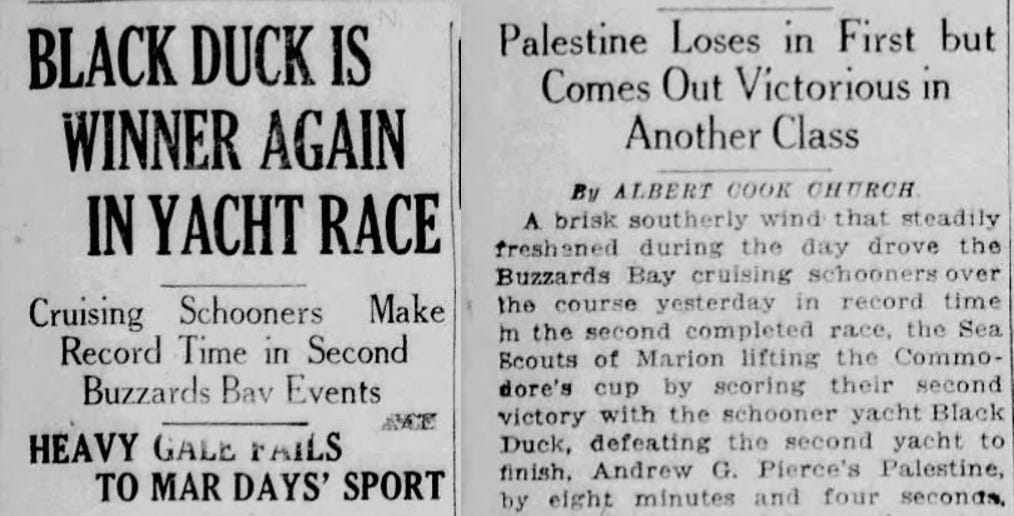
It looks like the Sea Scouts also made good use of her. I found this 1921 article from New Bedford, MA in which the Marion Sea Scouts sailed her to victory in a two-race series.
And in 1922 the Sea Scouts held a summer camp & training program at Tabor Academy that included activities on the Black Duck. Here’s a brochure describing the program. In 1923 a crew of Sea Scouts from East Boston sailed her to Portland, ME. I also found a story of their return trip to Boston, which involved a seamanship competition for nine pieces of pie.
Alexander Forbes apparently took possession of the boat again in 1924, and he competed in the New London to Bermuda race that year, taking 4th in her fleet.
The biennial race to Bermuda, now run from Newport and jointly sponsored by the Cruising Club of America and the Royal Bermuda Yacht Club, began in 1906.
I didn’t find much about the Black Duck in the years that followed; here’s the story Emma wrote as part of a late-1940s correspondence course that fills in some of the blanks. She interviewed Stephen Forbes’s wife (also named Emma). [Her writing instructor gave her a B+ on the assignment, commenting that it would have been better to place the current actions of the boat earlier in the piece and then move to the history.]
Text within this block will maintain its original spacing when published
Lesson 7, 7/28/47
     Safely anchored in the Sassafras river off Chesapeake Bay rides a graceful, two-masted schooner bearing the name “The Black Duck.” The yacht is owned by the Forbes family. Mr. Stephen Forbes of Moylan with a crew of eight men recently sailed her from Woods Hole, Mass. to her present location. Mr. Forbes plans to keep her for at least two years.
     Mr. Forbes’ father helped design the boat. He named her “The Black Duck” when he had her built 37 years ago. So Stephen grew up with the Duck. He boarded the yacht first (with some help) when only nine months old. He learned early how to manage the sails and the rigging. He has a real seaman’s scorn for the lazy motor type of navigation.
     The yacht measures 65 feet in length and draws 6 ft. of water with the center board up and 10 ft. with it down. Although a crew of 8 besides the skipper are required for cruising, her log book records the amazing fact that on one occasion Mr. Forbes’ father sailed The Black Duck all alone. Ten people can be accommodated in the bunks.
     The trip from Woods Hole occurred during Mr. Forbes’ vacation. The crew did not see land for four days.
     When Mr. Forbes decided to bring the Duck to Chesapeake Bay he bought a large lot with a water front on the Bay. Here he keeps two dinghies and an American kayak which take them back and forth from the shore to the yacht.
     Skimming over the water in full sail, the Black Duck makes a most attractive target for Kodaks. Mrs. Forbes says “she is the most photographed lady on the bay.”
     In her long career the Black Duck has sailed twice to Bermuda, once to Labrador, many times to Maine, besides numerous shorter trips up and down the coast. In 1942, she became a training boat for some of the navy giving them experience in sailing.
     For some time after this she stood idle. She needed reconditioning. To sell her seemed the best way out. But something happened. A man from Philadelphia saw her. He offered to put her in good condition if in return he could borrow her awhile. This transaction kept the Black Duck from being sold. She spent the years 1945 and 1946 at Long Island.
     Mr. and Mrs. Forbes are most generous with their yacht. Every week end finds a group of friends happy to go cruising with them. In their beautiful new log book of gold and black with the Black Duck’s name on the cover, the many guests write their names.
     Mrs. George Allen from Panama, a sister of Mrs. Forbes, is spending the summer in Moylan and enjoys these delightful trips with them.
     Mr. Forbes is a physicist, being employed by the Bartol Foundation in Swarthmore.
I couldn’t find any information to corroborate Emma’s story about the Black Duck being used for naval training in World War II, or her rescue and restoration in 1945-46. Stephen moved her to the Chesapeake in 1947, and Emma wrote this journal entry in August of that year:
Sat 2. This is the day we sailed on the “Black Duck.” We got started about 1:10 P.M. Drove to Chesapeake bay where the Forbes had their boat anchored on the Sassafras River. I had baked cookies in the morning & Mrs. Forbes served cocoa-cola etc. Then we sailed around a little finally landing in the mud. We ate supper on the boat. It was 8 P.M. before we got started for home. It was after 10:40 when we got home. We had a swim before we went sailing. It was a quiet time but interesting because it was our first time in a yacht. There were 8 of us—4 in Bob’s family, Gerald & K, Dad & I.
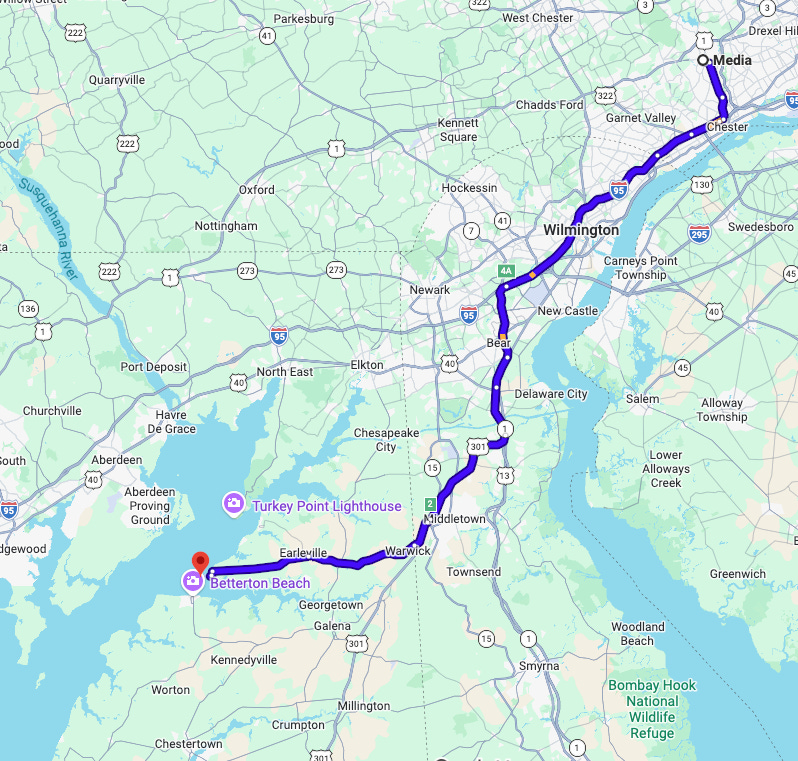
Here’s a map of the trip from Emma’s home in Media to the Sassafras River—about 65 miles.
Unfortunately, another piece of Emma’s writing reveals a sad end to the Black Duck’s story.
Text within this block will maintain its original spacing when published
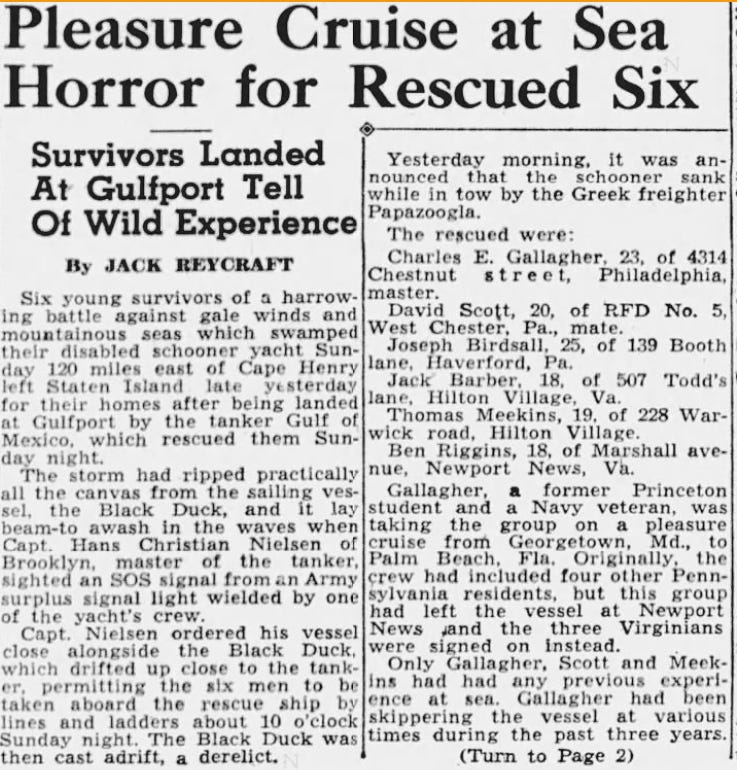
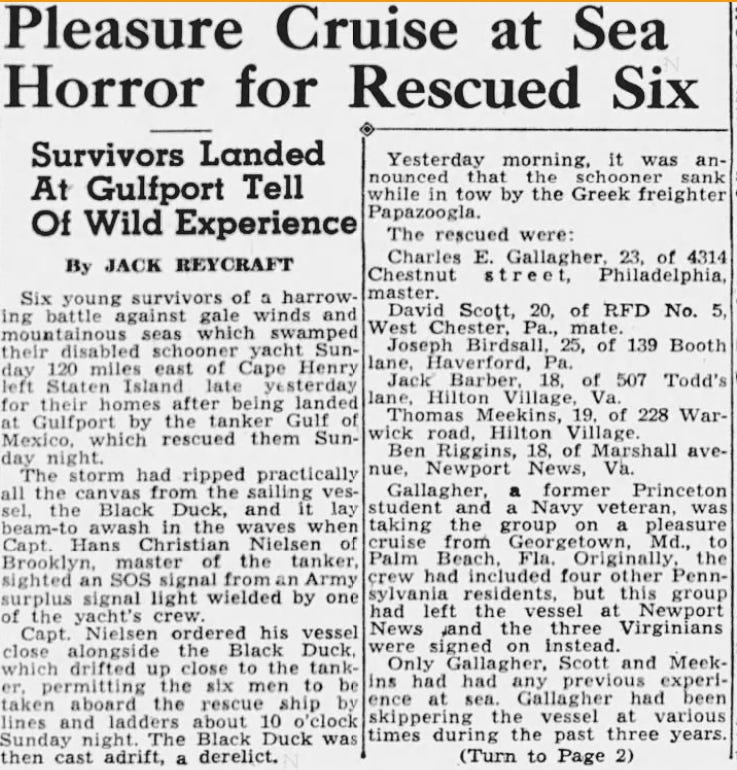
     “The Black Duck is no more,” said Stephen Forbes. “She went down in the terrible storm which ranged on last week about 100 miles off the coast from Cape Hatteras."
     The schooner, which had been owned by the family for years, was like a member of the family. On it Mr. Forbes had played as a boy—he had helped sail her many times. It was the scene of some of his dearest memories when courting his sweetheart. When word came this last week of the boat’s tragic end, it was almost like losing a member of the family, and friends and neighbors were all sympathetic.
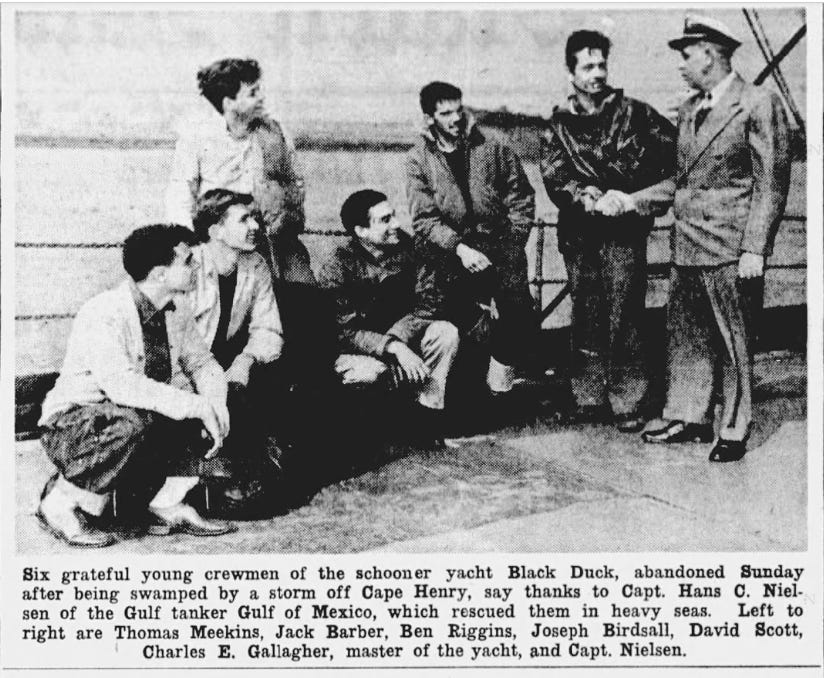
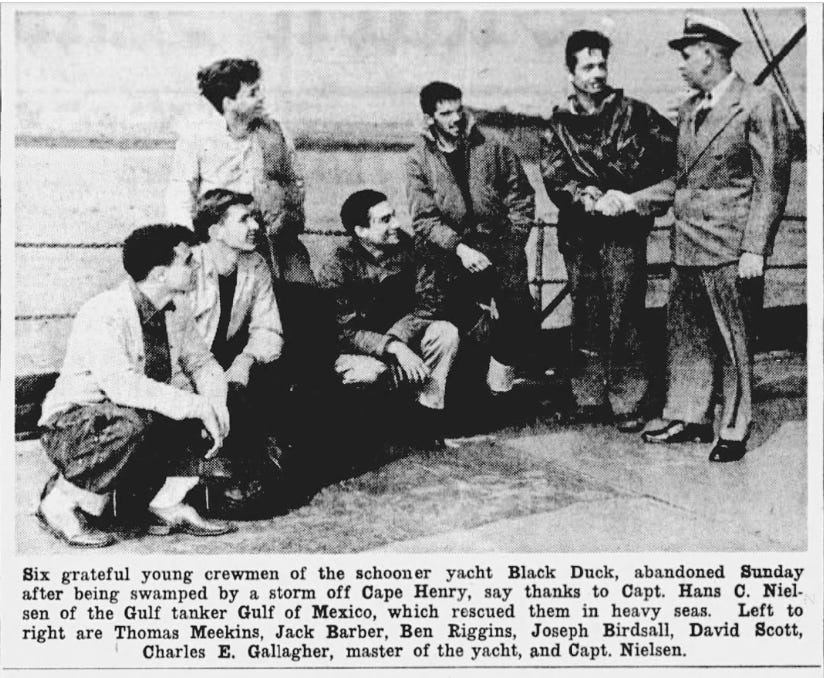
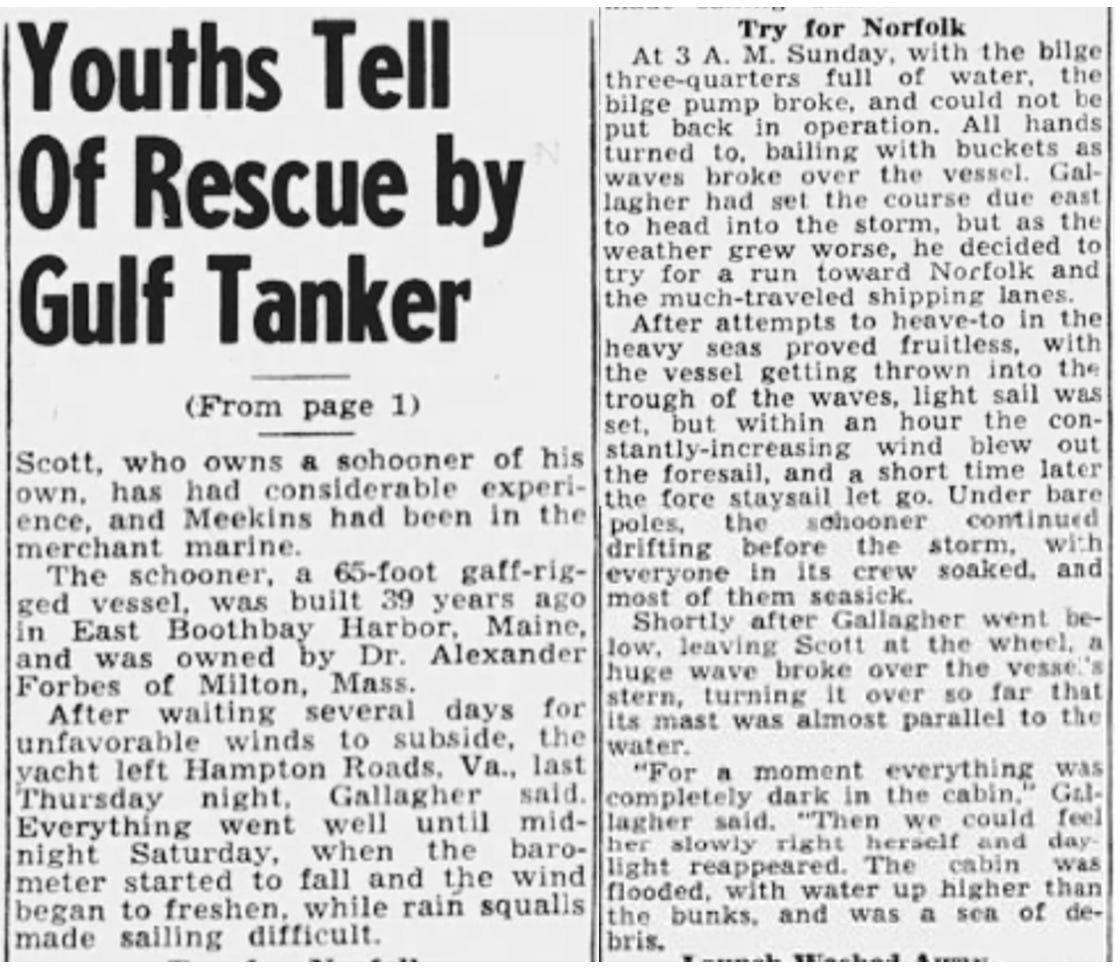
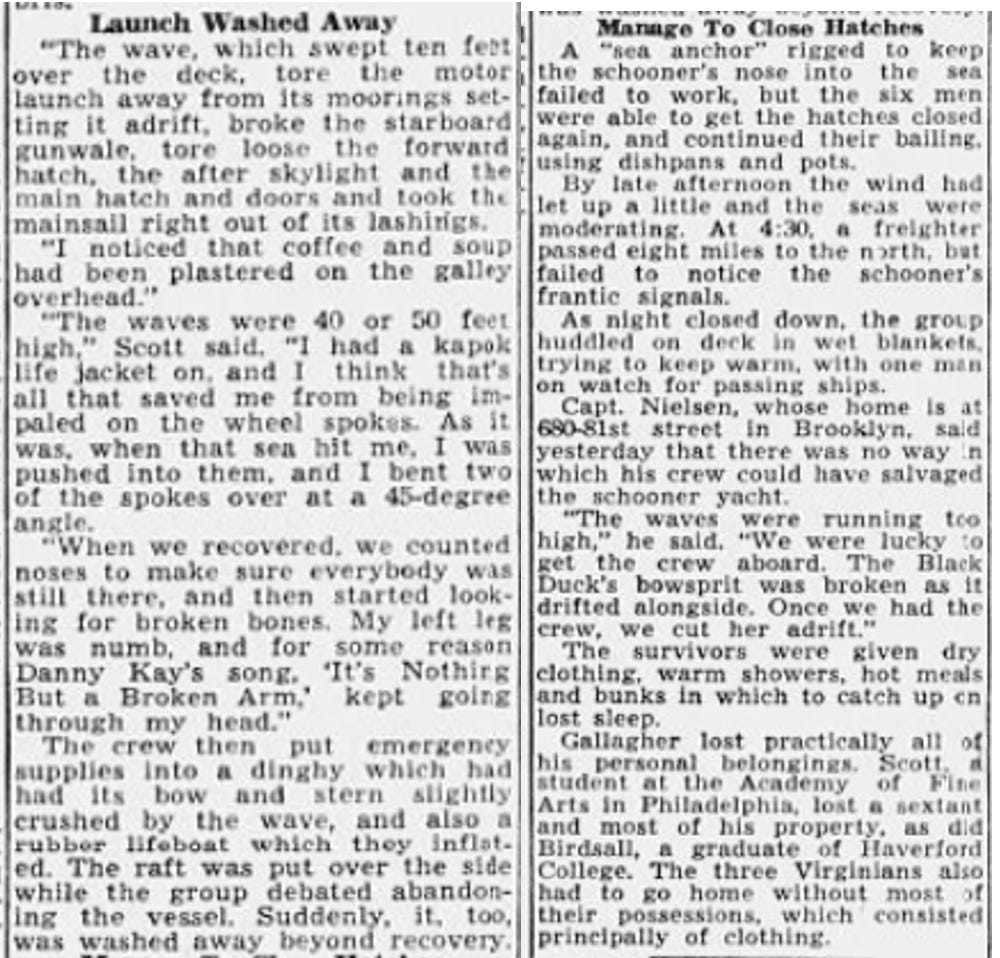
     Though the young captain who had borrowed her who was to sail her to Florida with all the crew was rescued from the sinking ship, he tells a thrilling story of the high waves they encountered. Waves 40 to 50 feet high swept over the ship, sweeping everything off deck. The crew battled the storm for four long, hard hours.
I found several newspaper stories about the storm and the rescue. Here’s one of the most detailed, from the Mar. 10, 1948 Staten Island Advance:
Thus endeth the tale of S/V Black Duck.
I hope you’ve enjoyed this special feature! Please feel free to share it.



Comments
Nothing yet. Say the first thing.
Sign in to join the conversation.