
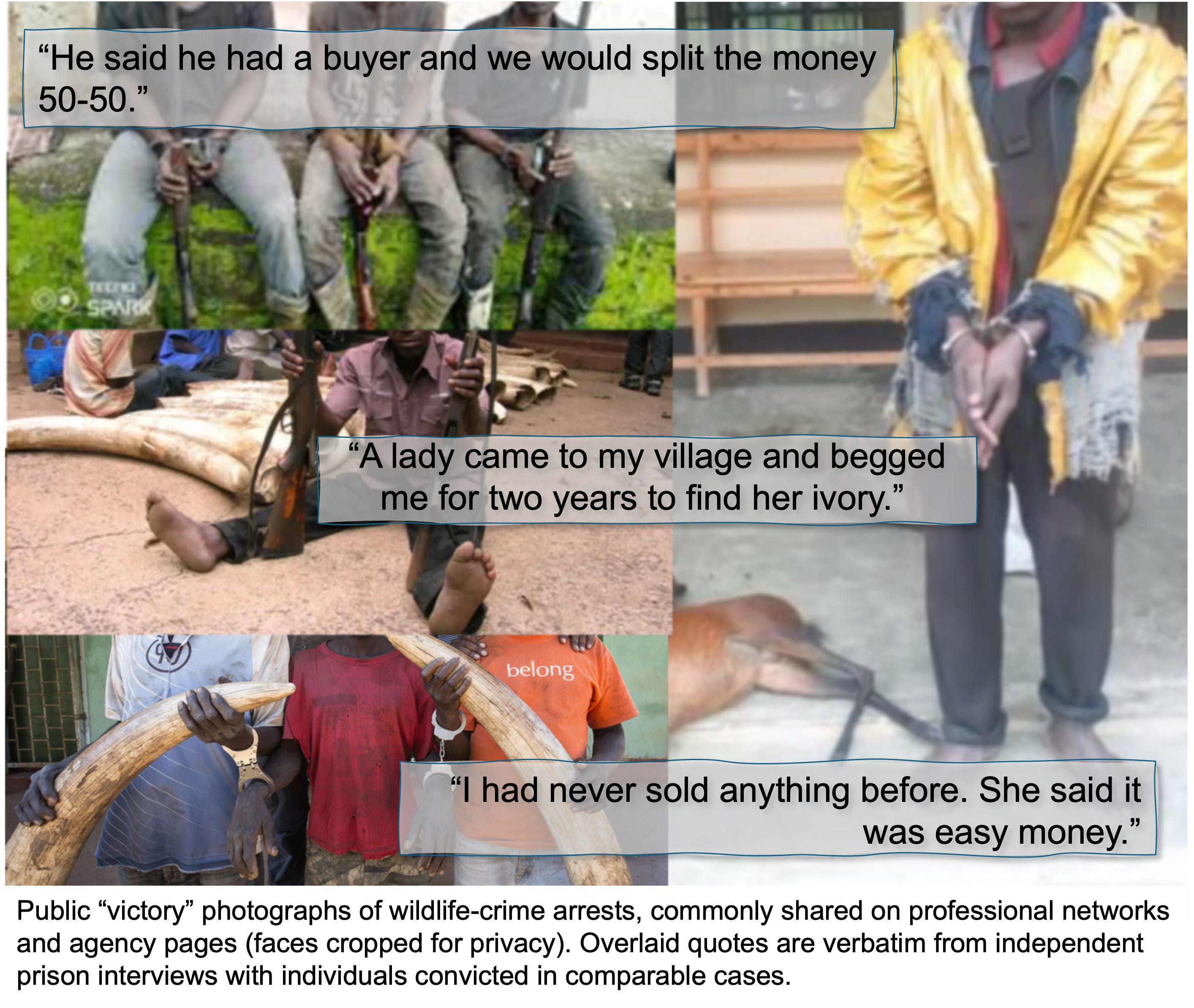
Across the hundreds of offender interviews I transcribed and analysed that I mentioned in my last article (and subsequent interviews added since), a distinct pattern kept resurfacing. A subset of testimonies described individuals with no prior involvement in the wildlife trade being approached, sometimes by a stranger, sometimes by an acquaintance, occasionally by a long-standing friend, and being told that a buyer was available for an illegal product. The individual would source the item, arrange a meeting, and be arrested almost immediately.
For example:
“A woman known as [….] came to my farm and stated that she was buying gold and ivory or pangolins.”
“It was a planned thing. Somebody an informer arranged for me. He asked me to escort me that he had certain items which he wants to sell and that we would share the money.”
“There was a lady working for [agency'] who asked me to look for a pangolin that she wanted to buy. It took a year for her to convince me and I engaged [someone] to help me source a pangolin.”
These accounts concern me for several reasons. They do not generally meet the legal threshold for entrapment - respondents were free to act or not - but the issue here is not the individual case. It is the system that selects people for targeting in the first place. I cannot independently verify any testimony, so I am not asserting these accounts as fact. What I am saying is that their frequency, relative to international benchmarks, is difficult to dismiss as noise.
This leaves several uncomfortable questions.
First: would the offence have occurred at all had the opportunity not been presented?
Second: what intelligence value is generated by these arrests? Do they illuminate wider networks and associations, or simply remove first-time, opportunistic actors while leaving higher-tier participants untouched?
And, centrally: what does “predisposition” mean in a context where opportunistic engagement is culturally and economically normal?
Closely linked to that is a practical question for enforcement strategy: how effective is this approach for preventing and reducing wildlife crime, rather than just generating arrest events?
Before going any further, it’s necessary to be precise about terminology. “Entrapment” is a narrow legal concept, and in most of the cases in my dataset the formal threshold is not met. The deeper issue, though, is the distinction between providing an opportunity to someone already willing to offend and creating an offence that would not otherwise have occurred. In most legal systems the boundary is expressed through two questions:
Did the criminal intent originate with the suspect or with the state?
Was the suspect already predisposed to commit the offence before law enforcement intervened?
Sectors that rely heavily on covert methods (e.g. counter-narcotics, anti-corruption, countering organised crime) monitor enticement risks closely because informant incentives, financial rewards, or poorly supervised operations can shift activity from detecting genuine offenders to manufacturing offences [1].
Wildlife crime enforcement has increasingly adopted the same proactive tactics, and not without reason. In an environment where wildlife crime is covert and detection is supremely difficult, the only practical way to generate cases is often for the state to simulate demand. The main argument of these tactics is that removing low-level opportunists chokes the recruitment pipeline that feeds larger syndicates. These are not frivolous points. However, wildlife enforcement typically operates without the rigorous oversight frameworks that have evolved in those other sectors. That gap matters.
When the overwhelming majority of these cases are visibly “one-and-done”: an external actor approaches, the target sources an item for the first (and apparently only) time, an arrest follows within hours or days, and there is no evidence—either in the file or in the offender’s subsequent account—of any deeper network being touched. And when a not insubstantial minority of cases follow this exact sequence, state-simulated demand can no longer be treated as a marginal phenomenon. It becomes a material fraction of the entire observed market.
Even if we assume heavy self-serving bias and cut that respondent figure in half or by two-thirds, the residual proportion remains far higher than the background rate of inducement claims tolerated in narcotics, corruption, or organised-crime policing, where recurring patterns at this level routinely trigger oversight reviews.
In other words, directionally consistent minority patterns of this size are precisely how systemic risk first announces itself in any covert environment.
The deeper discomfort is this: if the state is the only plausible buyer in a non-trivial share of all detected transactions, we fundamentally do not know what the underlying market looks like in the absence of enforcement activity. We may be arresting symptoms while simultaneously teaching survivors to recognise and avoid future stings. Worse, by reliably providing lucrative, low-risk demand to people who had never previously entered the commercial trade, these operations risk manufacturing the very entry-level offences they then celebrate as success—while experienced, syndicate-connected traders simply wait them out or route around them.
In short, the cure may be incubating the disease.
In covert or informant-driven policing—drug enforcement, anti-corruption work, organised crime investigations—it is normal practice to pay attention to how often suspects raise concerns about inducement or offence creation [2]. Oversight bodies do not treat these accounts as proof of misconduct, but they do treat them as signals about how well the system is controlling risk. In these sectors, inducement claims are expected to be uncommon. When they appear repeatedly, they prompt questions about source management, incentives, and operational authorisation [3].
There is no single numerical threshold used across policing, and outside terrorism there are no large datasets that quantify how often inducement indicators appear. What does exist from inspectorate reports, integrity-testing guidance, and reviews of undercover practice—is a consistent expectation that recurring inducement patterns matter, even when they appear in a minority of cases [4]. Organisational-risk research makes the same point: vulnerabilities in complex systems show up first as small but repeated anomalies, not as majority behaviour [5].
Seen through that lens, the pattern in my dataset stands out. Across more than several hundred interviews, as already mentioned, a substantial minority described the opportunity as having originated with someone else. These testimonies are unverified and should not be taken as factual findings about individual cases. But what matters is their frequency and consistency. In any covert environment with mature oversight, a recurring minority pattern of this size would be treated as an early-warning signal [6]—evidence that certain operational pathways, incentives, or decision processes may be shaping how offences begin.
Wildlife enforcement has never measured this. But the prevalence alone suggests the sector should start.
Back to my dataset; I coded each of the interviews meaning I read each interview and identified patterns that emerged naturally from the respondents’ words. When the same type of description appeared repeatedly across independent interviews, it was grouped as a theme.
A significant subset of interviews included a pattern whereby the opportunity to offend did not originate with the respondent but was introduced to them. Respondents described being approached, being asked to find something, being told a buyer was available, or being encouraged to source an item they had not previously been looking for. In some of these cases, the person who initiated the opportunity later turned out to be connected to a government agency or acting as an informant. In many narratives, the sequence was linear:
external approach → opportunity presented → item sourced → immediate arrest
As previously mentioned, these testimonies are unverified, and I am not presenting them as factual pronouncements about any individual case. What matters, and what the coding made visible, is their consistency as a narrative structure. In content analysis, patterns that recur independently across multiple interviews warrant analytical attention, even when each account individually remains uncertain.
It is worth noting that I did not apply the detailed entrapment-indicator frameworks used in some terrorism studies, which rely on a 15–20 item coding scheme. Those tools were designed for long-term federal stings with extensive documentation and do not map cleanly onto rural wildlife contexts, where the social and economic dynamics of opportunity differ markedly. However, the presence of a clear thematic pattern in my own dataset suggests that developing a tailored set of indicators appropriate for conservation settings may be both possible and useful. Such a framework could help enforcement agencies distinguish between genuine intelligence-led opportunities and operational pathways that risk unintentionally generating offences. NB: If you are a practitioner or SME I would love to hear from you on how such indicators might best be designed.
The key point here is not to cast aspersions or blame. It is that a non-trivial minority of respondents describe offences beginning in ways that indicate external initiation rather than offender-driven intent. This might function as a diagnostic signal and tell us something about how certain cases come into being, and therefore something important about the operational landscape in which proactive wildlife enforcement is taking place.
These patterns also raise an important difficulty for interpreting the formal record.
Even when an offence may have originated through an externally introduced opportunity, the case file rarely reflects that sequence, and the court process almost never examines it. Once a suspect is found in possession, the pathway that led to that moment tends to disappear from view. This is especially true where cases are resolved through early guilty pleas. This means that formal records may not give an accurate indication of the level or location of crime if this holds true in multiple areas.
On paper, a guilty plea can look like a clear admission: the accused accepts responsibility, the facts appear uncontested, and the case seems straightforward. However, in practice, guilty pleas in wildlife cases often tell us more about the pressures surrounding the legal process than about the origins of the offence.
Access to legal advice is often limited, and most defendants face strong practical incentives to plead early. The cost of contesting a case, the fear of a harsher sentence, the impact of prolonged detention on family income, and the desire to “get it over with” all create rational pressure toward plea bargaining. These pressures can obscure disputes about how the offence began and who initiated the opportunity. Once a plea is entered, any questions about inducement, intent, or the broader circumstances effectively fall away.
There is also the structure of the law itself. Many wildlife offences are drafted as possession-based or strict-liability offences for necessary reasons: proving nuance, intention, or the sequence of events that led to possession is often complex or impossible. Legally, the person was in possession and the law is designed to treat that as the decisive element, irrespective of the pathway that brought them there.
But, this means that plea statistics alone cannot be treated as evidence of predisposition or voluntary criminality. A clean case file does not tell us whether the offence would have occurred without the specific opportunity presented, nor whether the accused had any prior involvement in wildlife crime at all. Pleas streamline the legal process, but they also erase exactly the kinds of contextual details that matter for understanding operational risk and offence creation.
Predisposition in US jurisprudence is defined narrowly: it refers to a person’s existing criminal inclination before law enforcement intervenes. The test assumes that people who accept an illicit opportunity do so because they were already inclined toward wrongdoing. This logic underpins most entrapment doctrine and many internal oversight thresholds in narcotics and anti-corruption operations.
However, my view is that this framework does not translate cleanly into rural wildlife contexts, where opportunistic engagement is common, economically rational, and often viewed as morally neutral. My interview data makes this divergence clear. The majority of respondents believed they would be received positively by their community on release because, in their view, they had not done anything fundamentally wrong. Likewise, a smaller majority said they understood, at least to some degree, that their action was illegal but proceeded anyway because the opportunity aligned with immediate financial pressures, existing social networks, or routine local practices.
In these environments, “predisposition” does not look like latent criminality. It looks like:
financial need,
familiarity with hunters or local resource users,
routine exposure to informal wildlife use,
taking a one-off chance when someone presents an opportunity.
If these patterns are treated as evidence of inherent criminal inclination, the resulting analysis is both distorted and misleading. It mistakes situational opportunism for pre-existing criminality, and it collapses culturally ordinary behaviour into a legal category designed for entirely different social settings.
This is why importing US-style predisposition thresholds into conservation enforcement may be analytically unsound and might be worth a rethink. This is because it risks categorising normal, situational decision-making as criminal predisposition, while ignoring the structures and incentives that actually shape participation in wildlife crime. And it blurs the distinction between discovering genuine offenders and creating offences by presenting opportunities to people whose only pre-existing “predisposition” was the need to solve a short-term problem.
In practice the sequence often looks like this:
An informant (or undercover officer) is given a financial or leniency incentive tied to producing a case.
The easiest, safest way to deliver is to approach someone who has never sold wildlife products before but who has plausible access (a villager near a park, a scout with a rifle, a butcher who knows hunters).
The target is offered easy money for what is presented as a low-risk transaction.
If the target hesitates, the pressure is repeated—sometimes for months—until they agree.
An animal that would still be alive is killed to fulfil the new, state-created demand.
Arrest follows immediately, the case is celebrated, the informant is paid, and no higher-tier trafficker is ever identified.
Four brief examples from the dataset (all details altered to protect identities):
“I kept it for 2 days before it died” A farmer was offered 10,000 for a live pangolin. He caught one, kept it hidden, but it died before the handover. He still informed the “buyer” who offered 5,000 for the skin. He was arrested when the authorities arrived.
“They said they would get inside to be given money” A villager was asked to find a pangolin for 10,000. After weeks of searching he located one. The “buyers” told him to bring it to a car; they said they would get inside to pay him. Officers arrested him on the spot.
“A lady continued pushing” A shopkeeper was repeatedly asked by a woman (later revealed to be linked to law enforcement) to supply ivory or pangolin. He eventually found a piece of ivory with a friend within the village. When he delivered it, officers emerged from a nearby vehicle.
“A friend is the one who approached me” An unemployed man was told there was 90,000–150,000 for a pangolin. He didn’t know how to hunt one, so he paid village boys. When the pangolin was brought, the “friend” called the police. Arrested in his home at 20h00.
All four were recorded as first-time offenders. Given gaps in detection and record-keeping, some may have had prior low-level involvement, but every respondent insisted this was their first (or first in years) commercial sale and the specimen was sourced only after the external approach. These are not kingpins. They are ordinary people turned into suppliers because someone with a quota and a reward was willing to wait.
Conservation harm: Every case above added at least one dead protected animal that did not need to die. In parts of the dataset the majority of seized specimens were killed only after the operation began. The sting becomes the proximate cause of the very loss it claims to prevent.
Social harm: The defendants are almost always working-age men—fathers and breadwinners. A five- to seven-year mandatory sentence tears families apart. School fees go unpaid, children drop out, wives and young children are scattered to relatives across the country. Poverty deepens.
Operational harm: Each publicised “success” that began with a state-linked buyer breeds distrust. Villagers learn that the friendly stranger offering quick cash may be a trap. Genuine community intelligence, the lifeblood of wildlife protection, dries up. Experienced traffickers, who already screen buyers carefully, simply adapt and wait, while the space for honest cooperation shrinks.
In short: more dead animals, fractured families, and a harder environment for real investigations.
This is not a criticism of field officers or scouts, most of whom are following the incentives and training given to them. It is a criticism of a system that still treats every arrest as an unalloyed good, no matter whether the crime would have happened without state involvement.
None of the problems described are inevitable. Other covert-policing sectors (narcotics, anti-corruption, organised crime) faced exactly the same risks decades ago and built simple, low-cost safeguards that dramatically reduced offence-creation without lowering their ability to target genuine criminals.
Four changes could make the biggest difference tomorrow and cost almost nothing to implement:
Higher thresholds for proactive operations: No sting or informant-led approach against a new target is authorised unless an intelligence analyst can point to corroborated prior evidence (reports, phone data, previous seizures, credible community nominations) that the person has already tried to sell or is actively seeking buyers. A single uncorroborated informant is no longer enough to green-light simulated demand.
Scrutiny and capping of informant rewards: Payments or sentence reductions are scaled to the intelligence yield and the level of the target, not simply to the fact of an arrest. This removes the perverse incentive to manufacture easy low-level cases.
Mandatory independent analytical review: Before any proactive operation is launched, a short “target justification package” (one page, three questions—see example below) is completed by an analyst who is not part of the operational team and is signed off by a senior officer. This is already standard in FBI and many European undercover units.
What specific prior evidence shows this person has sought or offered wildlife products?
What intelligence suggests an offence is being planned without law-enforcement involvement?
What higher-tier intelligence is expected from this operation?
Routine monitoring of inducement signals: Every case file records (in one sentence) who first raised the idea of a sale. Allegations or patterns of external initiation are tracked as a standard integrity metric, the same way corruption or excessive-force complaints are tracked in regular policing. A recurring 5–8% signal triggers automatic review, exactly as it does in other covert sectors.
These would hopefully not be radical reforms; but rather the basic hygiene that any mature covert-policing system eventually adopts. For agencies and officers they are protective, not punitive:
they reduce the risk of wrongful-conviction or entrapment appeals,
they shield officers and departments from future reputational blowback,
they prevent needless community anger and the loss of cooperation that follows.
Most importantly, they ensure that the next pangolin, elephant, or lion that dies actually advances conservation rather than becoming a preventable casualty of the cure. And even in area where current practice feels clean and intelligence-led, these measures cost almost nothing and act as institutional seatbelts (there when you need them, invisible when you don’t). They will either confirm that everything is already running correctly, giving the agency robust, evidence-based reassurance for courts, communities, and donors, or they will surface a vulnerability that can be corrected long before it ever becomes a crisis.
Wildlife-law-enforcement agencies are some of the most dedicated and courageous in the world. They operate with tiny budgets against sophisticated transnational syndicates. The last thing they need is to waste time, money, and credibility creating offences that would never have happened without their own intervention.
In my humble opinion, transparency about enticement risk is not a sign of weakness; it is the hallmark of a profession that has moved past counting arrests and started measuring genuine prevention.
My data clearly needs further research and triangulation to verify this as an issue - however, I hope this can be a start to the conversation so that we in wildlife crime law enforcement can be confident we are discovering crime, rather than accidentally generating it.
[1] https://oig.justice.gov/sites/default/files/archive/special/0509/chapter4.htm
[2] UNODC. (2013). Anti-Corruption Toolkit, Ch. 5 (“Integrity Testing and Risks of Inducement”).
[3] HMICFRS (UK). (2012). A Review of Undercover Policing.
[4] U4 Anti-Corruption Resource Centre. (2021). Integrity Testing and Entrapment Debate.
[5] Reason, J. (1997). Managing the Risks of Organizational Accidents.
Vaughan, D. (1996). The Challenger Launch Decision.
Perrow, C. (1999). Normal Accidents.
[6] UNODC. (2013). Anti-Corruption Toolkit, Ch. 5 (“Integrity Testing and Risks of Inducement”).
No posts
Comments
Nothing yet. Say the first thing.
Sign in to join the conversation.