
The topic of intelligence can be a tricky one. Often associated with espionage and military operations, the word carries a loaded, shadowy connotation. It doesn’t help that the term itself has multiple meanings: depending on context, it can refer to an organisation, a process, a product, or an activity, which can make things unnecessarily confusing.
For clarity, I’m using Bang’s (2018) definition of intelligence as “knowledge or foreknowledge designed to support decision-making.” In this sense, intelligence is purposeful and action-oriented. Unlike research, which is often exploratory and open-ended, intelligence is generated for immediate application: to inform decisions, guide actions, or anticipate threats. But, framing intelligence as a type of research as we might with ecology or economics could help normalise its role in conservation. In other words, intelligence should not be viewed as a shadowy offshoot of military doctrine, but as a vital form of action-research that we ignore at our peril.
This article will explore what intelligence is (and isn’t), how it functions across different levels, and how it could be better integrated to support conservation law enforcement. Sorry - it’s not going to be a how-to guide for developing James Bond skills.
Early policing was structured on military models (Horns, 2014), which influences today’s conservation enforcement and parallels continue to be drawn between anti-poaching efforts and counterinsurgency. This can often take the form of criticisms of militarisation of conservation (Duffy, 2014). However, while some valid points are raised regarding taking an overly aggressive approach to policing these criticisms can also lack understanding of military theory in this area and be simplistic - tarring anything that may have an association with the military as bad or aggressive. This ignores the possibility that tactics like community engagement or patrols based on intelligence are just policing by another name and others - although military in style - are simply appropriate adaptations to rugged, rural contexts.
Military and policing definitions of intelligence share proactivity and a decision-making focus, but differ in tools and management frameworks.
The table below compares definitions, purposes, tools, and analytical models, highlighting overlaps between Intelligence-led Policing and military intelligence.
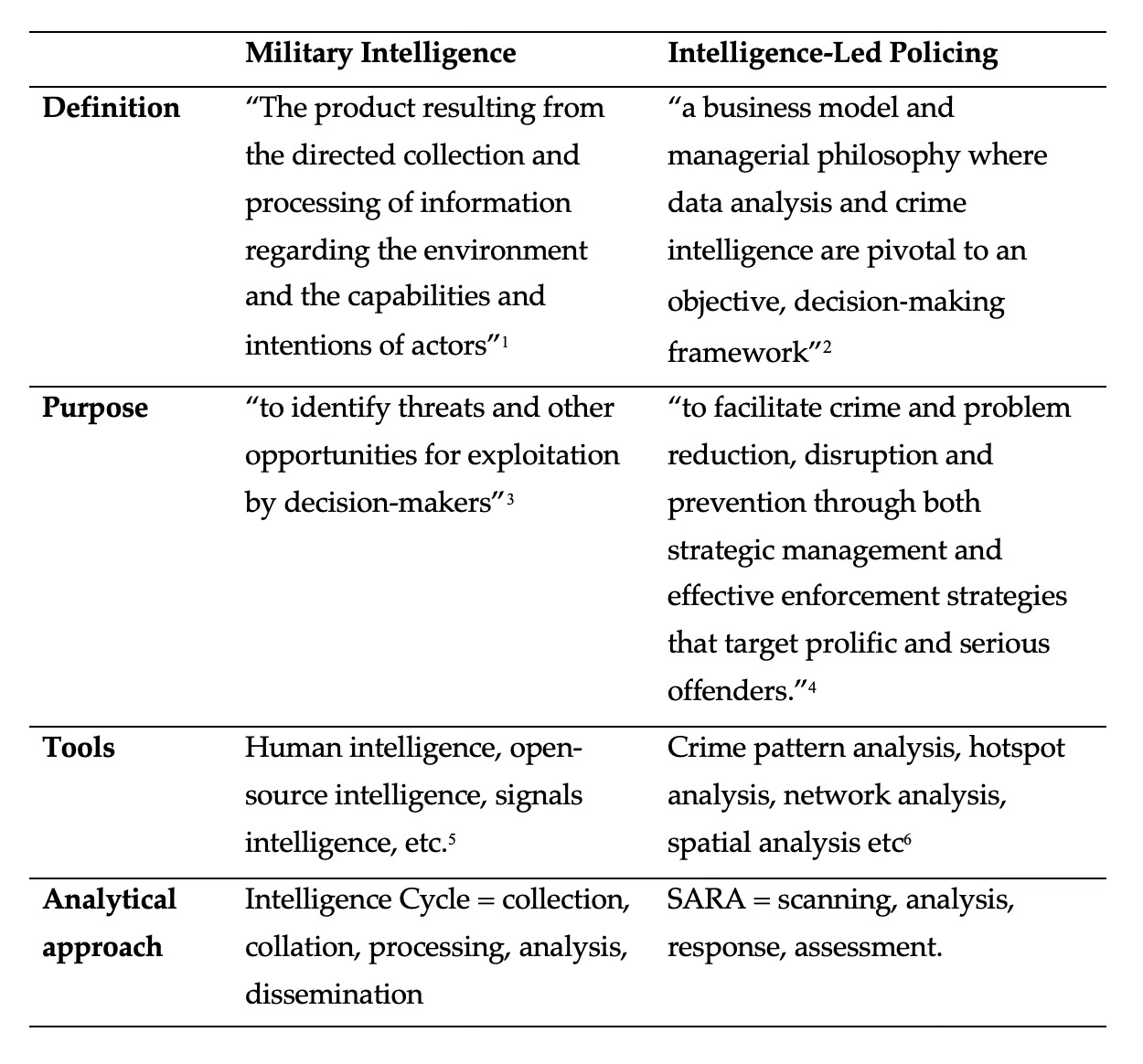
In summary; intelligence-led policing may be best thought of as more of a managerial approach, whereas military intelligence focuses on discrete outputs and threats.
In wildlife conservation, intelligence is increasingly recognised as a useful tool—but in practice, I’ve observed a range of inconsistent and often reactive approaches. This is especially true in contexts where enforcement strategies are arrest-driven. Several NGOs I’ve worked with describe their approach as “intelligence-led,” but in reality, this often centres around the use of covert informants (HUMINT) to support arrests, rather than to guide crime prevention or proactive patrolling. A more accurate term in these cases might be human intelligence-pushed reactive patrolling. This narrow interpretation of intelligence suggests a limited understanding of its full potential as a systematic and proactive discipline within wildlife protection.
Take HUMINT as a case in point: while covert informants can be a valuable source of insight, over-reliance on this channel risks ignoring other rich, underused sources of information—such as social science research, open interviews, or post-arrest debriefs. These sources may offer more sustainable and ethically robust intelligence over time.
Moreover, covert informant management carries significant ethical and operational risks. For example, if an informant approaches someone with no known involvement in wildlife crime and offers to buy ivory, the resulting offence may be viewed as having been artificially created—raising serious questions about entrapment, legitimacy, and the role of conservation organisations in potentially initiating the very crimes they aim to prevent.
This also leads to practical concerns about value for effort. If intelligence efforts focus on individuals who are not linked to broader criminal networks, what strategic benefit does that offer? Intelligence should ideally illuminate patterns, routes, or networks—not just lead to isolated arrests with little upstream impact on illegal trade systems.
Finally, we might consider the cautionary lessons from the war on drugs, where heavy reliance on informants led not only to questionable outcomes but also to increased violence. In some cases, entire communities became more insular and suspicious, with informant-driven policing fuelling distrust and retaliation. If conservation organisations pursue similar tactics without reflection, we risk not only reducing the flow of actionable intelligence over time but also contributing to an escalation of hostility or even violence in areas that may already be fraught with tension.
So what else can we do? As mentioned above - intelligence can be thought of in several ways but also exists on different levels: strategic (policy), operational (campaigns), and tactical (field decisions). On top of that, additional classifications (e.g., basic, applied, all-source, activity-based) describe different methods and scope of intelligence production.
For example, Activity-Based Intelligence (ABI) is a military term referring to the integration of data from multiple sources to uncover relationships and patterns but aligns closely with intelligence-led policing in that both focus on integrating data sources to produce actionable insight.
From a wildlife conservation perspective, SMART patrol data offers strategic-level intelligence (Kavhu & Mpakairi, 2021; Kuiper et al., 2023; Critchlow et al., 2015), and lends itself to adaptive management in practice. However, and again from personal observation, this information is often underused with respect to crime prevention - being typically only used for reporting, not predictive action. Nonetheless, the fact that data is collected, collated analysed (even if lightly) means that even if the term is frowned upon because of its associations - the fact remains that intelligence is already firmly in use and a more systematic analytical approach could make SMART data more actionable for wildlife crime law enforcement, supporting prevention rather than just documentation of crime events.
So what sources of information can we use in addition to SMART and HUMINT? To understand how this can work in practice, it’s useful to explore the kinds of information already being collected in conservation contexts, and how these align with well-established intelligence categories from military and policing fields. In fact, the overlap is striking.
Military and policing organisations draw from similar types of data, albeit often labelled differently. For example, what the military terms Signals Intelligence (SIGINT), interceptions of electromagnetic signals, can be seen in conservation through acoustic sensors, camera traps, or retrieved phone data from apprehended suspects. Geospatial Intelligence (GEOINT), widely used in both fields, finds its conservation equivalent in remote sensing, drone imagery, terrain analysis, and even combat tracking techniques.
The table below maps these relationships across the three domains: military intelligence, law enforcement, and wildlife conservation. It shows not only that conservation organisations are already engaging in parallel activities, but also that structuring and analysing this data with intelligence principles in mind could unlock much greater value.
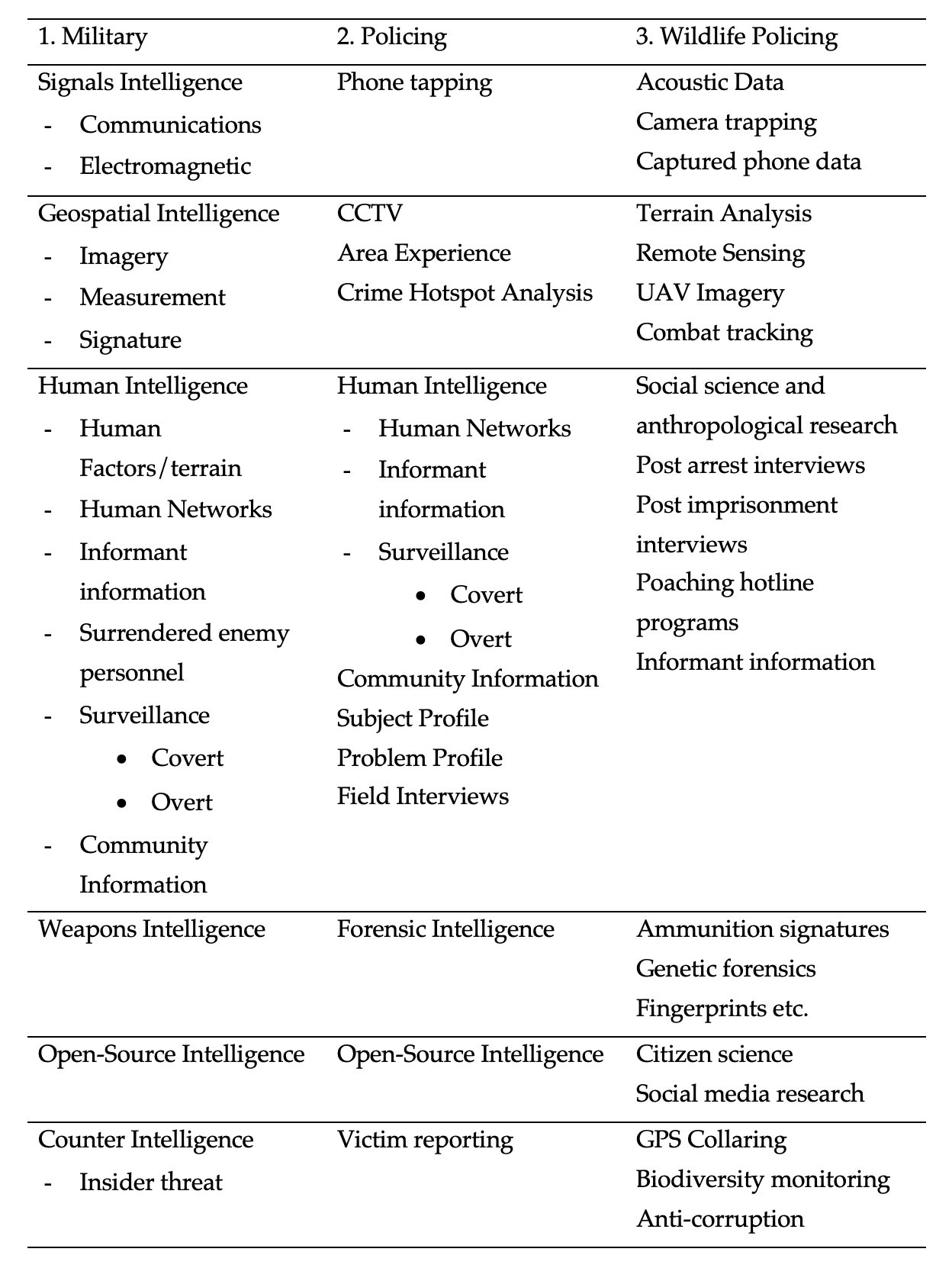
This table underscores a key point: much of what conservation agencies and NGOs already do is intelligence work. What’s often missing is the structure and synthesis—connecting these data streams, analysing them collectively, and translating them into insights that support proactive, risk-based law enforcement strategies.
For example, multiple patrol reports noting snares in one area, coupled with drone images of new paths being cleared, could point to an emergent hotspot. A series of interview debriefs from apprehended poachers might highlight a specific market route or community facilitator. But unless these sources are integrated and subjected to regular, intentional analysis they remain just fragments of a puzzle.
Recognising and formalising this process doesn’t require embracing military jargon or compromising ethical standards. It simply means treating conservation information streams as intelligence - or in other words, as data with the purpose of guiding action.
So coming back to one of my favourite topics, environmental criminology, offers a valuable set of tools for improving how intelligence is gathered, interpreted, and applied in wildlife conservation. Core theories such as Rational Choice Perspective (RCP), Routine Activity Theory (RAT), and Crime Pattern Theory (CPT) as discussed in previous articles, are particularly helpful here because they shift the focus from who is committing the crime to how, where, when, and why crimes occur in specific contexts.
By applying an environmental criminology lens, we can become far more deliberate about what kinds of data are collected. For example:
RCP encourages us to collect information on the perceived risks, rewards, and effort required to offend which might include patrol frequency, visibility, arrest records, market prices, or known entry routes.
RAT draws attention to the convergence of offenders, suitable targets (e.g., high-value wildlife), and absence of capable guardians suggesting we monitor things like animal movements, fence conditions, or times of low ranger coverage.
CPT emphasises the spatial and temporal patterns of crime highlighting the importance of mapping incidents over time, analysing repeat locations, and examining routine human and wildlife movements.
In this way, theory can guide intelligence not just in how we interpret data, but in what we prioritise collecting in the first place.
When intelligence is grounded in criminological understanding, it can be used more strategically, helping us to anticipate risk, shape patrol routes, allocate resources more efficiently, and ultimately prevent crime rather than only respond to it.
Better intelligence leads to smarter patrol planning: resources can be directed toward likely poaching hotspots at times when crime is most probable, based on routine patterns and recent indicators.
It enables more efficient enforcement: rather than spreading effort thinly across large areas, patrols can be concentrated in locations that offer the highest return on effort.
And critically, it allows for more meaningful use of limited resources: time, money, and personnel are often in short supply and good intelligence helps ensure every unit of effort counts.
Wildlife law enforcement has the laws and the tools, but application can be uneven, and the approach is often reactive. Without a common framework, results vary wildly, and lasting impact can be limited.
Intelligence is already in play, yet it’s too often misunderstood or underused. Patrol logs, field reports, and community tips sit in files when they could be driving strategy. In many cases, “intelligence” is mistaken for surveillance alone, missing its real value as a guide for prevention.
Environmental criminology offers a way forward. It helps explain where and why crimes occur and how to spot patterns before they become problems. It’s a proven scaffold that can turn data into foresight and foresight into action.
By adopting structured intelligence models conservation enforcement can shift from chasing incidents to preventing them. That shift isn’t just about tools; it’s about building the skills and mindset to use them well.
P.S. If you’d like to learn how to apply these models in your own work, I’ve developed a hands-on training course that walks through the process step-by-step. You can find the details here.
Bang, M. (2018). Institutional influence on assessments: The institutional analysis and development framework applied to military intelligence. The International Journal of Intelligence, Security, and Public Affairs, 20(1), 47–70. https://doi.org/10.1080/23800992.2018.1436391
Critchlow, R., Plumptre, A. J., Driciru, M., Rwetsiba, A., Stokes, E. J., Tumwesigye, C., Wanyama, F., & Beale, C. M. (2015). Spatiotemporal trends of illegal activities from ranger-collected data in a Ugandan national park. Conservation Biology, 29(5), 1458–1470. https://doi.org/10.1111/cobi.12538
Duffy, R. (2014). Waging a war to save biodiversity: The rise of militarized conservation. International Affairs, 90(4), 819–834. https://doi.org/10.1111/1468-2346.12142
Hiorns, B. (2014). Analysis of C3 counterinsurgency inspired policing, and the flip side of the COIN. Homeland Security Affairs. https://www.hsaj.org/articles/489
Kavhu, B., & Mpakairi, K. S. (2021). Spatial Monitoring and Reporting Tool (SMART) in Mid-Zambezi Valley, Zimbabwe: Implementation challenges and practices. Conservation Science and Practice, 3(9), e492. https://doi.org/10.1111/csp2.492
Kuiper, T., Ngwenya, N., Kavhu, B., Mandisodza-Chikerema, R., & Milner-Gulland, E. J. (2023). Making adaptive management more user friendly to encourage manager buy-in. People and Nature, 5(2), 684–698. https://doi.org/10.1002/pan3.10440
No posts
Comments
Nothing yet. Say the first thing.
Sign in to join the conversation.