
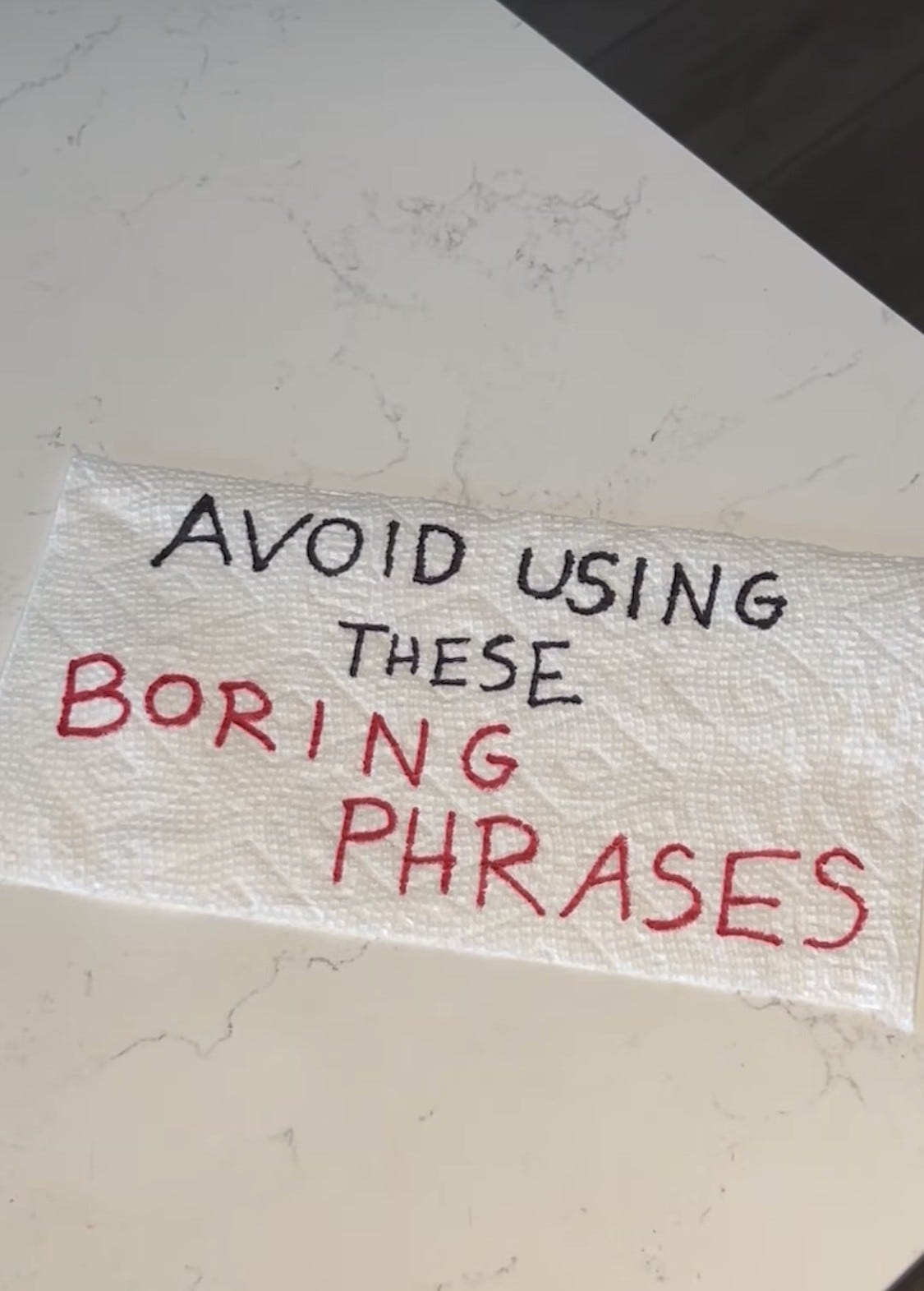
Anyone else seen this on Instagram recently? It pops up on my feed so much that in the most meta way, I’ve become utterly bored of it. The only upside is that it got me thinking about cliché. And the more I thought about that (combined with a recent book I’d read that was full of them) the more I thought about writing down how I feel about what Jake Epping calls ‘linguistic shortcuts’ in Stephen Kings’ 11.22.63 (I should add that this is not the book full of clichés, I adore this book!)
Cliché-laden novel aside, I wondered about my own writing. How often do I allow clichés to live rent-free in my narrative? And are they really all that bad?
Well, yes … because they are boring. And we don’t want to write boring.
Poor old clichés, they really are victims of their own success. Phrases that were once innovative or clever, perfect in a specific situation, but which have subsequently become overused and overfamiliar. As writers, we can slip into using them too easily, too subconsciously. As Renni Browne and Dave King put it in Self-editing for Fiction Writers:
Virtually all cliches … begin their life as original, effective expressions - so effective, in fact, that they got used until all the life went out of them
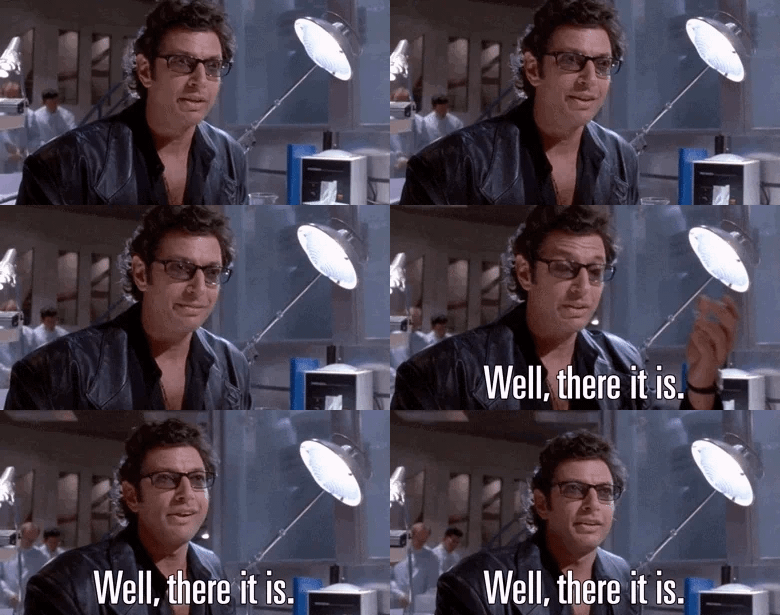
Is that so terrible though? OK, so a phrase has become overused … doesn’t that suggest it’s the right thing at the right time? Or is relying on an overused expression simply laziness? That’s not a criticism, by any means - it’s human nature to follow the path of least resistance, to take the easy option. What would Ian Malcom say?
You read what others had done and you took the next step. You didn't earn the knowledge for yourselves, so you don't take any responsibility for it
In other words, it doesn’t require any effort to write it, and so it doesn’t require any effort to read it either. The reader simply skims over the surface of the phrase like a flat stone on water. The exact opposite of what you, as a writer, want … especially in the opening chapters of a book (I DNFd that book after about chapter three. Eek).
And that’s at best. Somewhere along the line, the cliché becomes meaningless until (at worst) it’s just downright annoying. If you don’t believe me, see how far into this video you get before you want to scream, tear your hair out, and never hear “Is that what I think it is?” ever again. (Thanks to Janice Hardy’s Fiction University for introducing me to Super Cut Videos!)
So what can we do about it? Is all hope lost?
Well, for starters I’m going to come in with a big ‘ol caveat: in a first draft, honestly, who cares? Take all the shortcuts you need, skim right across the lake until you type The End. Plenty of writers leave sentences unfinished or write vague things like then something dramatic happens or, insert Scooby-Doo ending here. Anything goes in a first draft. Use them as placeholders (linguistic shortcuts), but when you come to edit, consider them again - what do you actually want to say, in YOUR words, rather than someone else’s? If you’ve used a clichéd metaphor is there something more original you could say? Could you ditch it and be direct instead? Or tweak it to suit your style or theme.
Often, the challenge lies in spotting them in the first place. As with a lot of writing craft, practice makes perfect; the more you look for them, the more you will see. Aim to be more aware at the first draft stage and use them intentionally. I flag mine as I write so I know to address them during edits; self-editing is tough enough without having to be super vigilant for phrases hiding in plain sight. Get in the habit of noticing them in general usage. Try to avoid** them in emails, in birthday cards, in arguments.
Dealing with them is easy. My advice is to take that errant cliché apart and analyse it for purpose. For example, I’ve used in a nutshell in the sub header - a phrase so commonly used and yet at the same time, WTF?? I mean, maybe it works in a piece about trees or seeds or the natural world, but in an everyday context … In. A. Nutshell. If nothing else, when did you last hear anyone say nutshell? Say the phrase a few more times and it sounds ridiculous. Nutshell might be a cute character name (I’m thinking bookish BFF in a cosy academia romantasy) but what do you really mean? That you’ve summarised a more complex issue? Then say that.
Writers Digest suggests one way to avoid cliches is to write with more sincerity. This is a fabulous amazing brilliant helpful piece on avoiding the clichés that come with melodrama or sensational writing (I have this idea that in the future superlatives will be eschewed by the cool kids and the use of the word awesome will be met with ridicule. Oh I can dream).
Clichés often come attached to other things - books, movies, TV personalities. That might be why it’s slipped into your work - because it conjures up that connection for you … but will it for your reader? (This might be especially relevant for writers of children’s literature, fiction and non-fiction). And if it does, once again, is that a lazy shortcut to character or theme? Rather than use old connections, try to make your own, and in doing so, develop your character’s voice.
At the end of the day*** the odd cliché isn’t going to make or break your book but, if you can banish them, you’ll elevate your writing and be left with a more sophisticated and professional-sounding narrative.

*Comment below with the number of cliches you spotted in this Substack!
**the simple act of typing avoid makes the connection to like the plague in my brain. It’s almost impossible to … well, avoid like the … (falls into cliché death spiral)
***at the end of the day … the sun goes down. (This is number one on my list of most hated clichés)
And, if you’ve read this far and you’d like to support this author/editor, you can buy my books anywhere books are sold; here’s a handy link to my Bookshop UK page:https://uk.bookshop.org/shop/emmaread . Leaving a review on Amazon is always super helpful to your favourite authors too, even if you haven’t bought the book there. It does magical things to the visibility algorithm and puts our books in front of fresh eyes. And, if you didn’t know, borrowing the book from your local library helps authors too, via the Public Lending Right scheme - yep we get paid per book borrowed, so go ahead and take out all your fave authors’ books!
See you all soon, with more news, and editing/writing tips, bye!
Comments
Nothing yet. Say the first thing.
Sign in to join the conversation.