
On 1 August, twenty-two European governments signed a letter calling for the Union’s external borders to be reinforced and, in the same document, declared themselves ready to reintroduce controls at Europe’s internal ones. One signatory had not waited. Italy had announced the day before that it was reimposing checks on arrivals from Spain.
The trigger was Ceuta. At the end of July, tens of thousands of people crossed from Morocco into a Spanish city of 84,000 inhabitants, most of them swimming around the breakwaters. Spain’s interior ministry put the number at around 72,000 over two days. Ceuta’s mayor-president has since said that more than a hundred people died. The response was familiar: emergency talks, more money for enforcement, faster returns, and a call to give Frontex command authority over a member state’s own border.
Before Europe buys more of this, it is worth asking what two decades of it have already bought. Frontex ran on €6 million in 2005; its budget for 2025 was €1.12 billion. On three counts, that spending has failed. It has not protected free movement inside Europe. Its price has kept rising, because the governments Europe pays are free to raise it. And it has left untouched what actually draws people, which is the demand for undeclared work inside Europe itself.
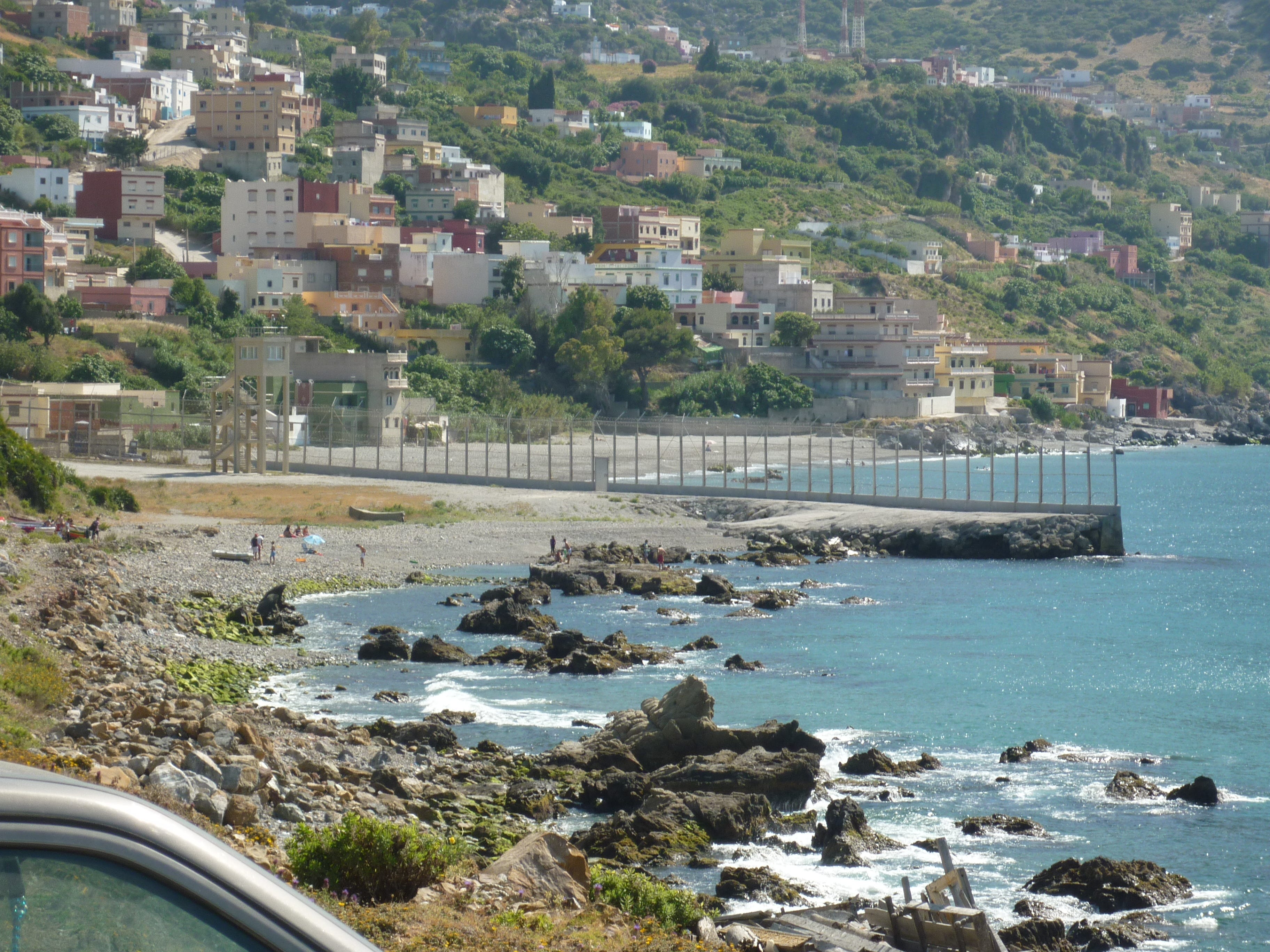
The border fence at Benzú, Ceuta, running down into the sea, with Beliones in Morocco beyond. Photo: Mario Sánchez Bueno, via Wikimedia Commons, licensed CC BY-SA 2.0.
Ceuta is Spanish territory under a special Schengen regime: Spain checks identities on every ferry and flight to the mainland. Controls between Italy and Spain, or at any other internal European frontier, could do nothing to prevent those crossings. The twenty-two governments concede as much in their own letter, which records that no unauthorised onward movements towards the rest of Europe have been detected; their interior ministers confirmed it on 4 August.
The controls went up regardless. Italy reimposed checks on air and sea arrivals from Spain from 1 August. Spain has answered with identity and visa checks on arrivals from Italy. France quintupled its police presence at the Spanish border, to 334 officers, and Portugal reinforced its southern borders. Two countries that share no border are now inspecting each other’s travellers.
This has happened before, though in earlier cases the frontline government had itself facilitated movement towards the rest of the Schengen area. In April 2011, after Italy issued temporary permits to some 25,000 Tunisians who had arrived during the Arab uprisings, France stopped the trains at Ventimiglia. The dispute led to the Schengen governance package of 2013, which made it easier to reintroduce internal controls whenever a state is deemed to have neglected its external border. The instrument built to reassure Europeans about openness became the instrument for suspending it.
The two halves of the European regime have never behaved alike. As my research on the history of the European migration regime shows, internal openness and external closure developed along separate tracks: closure was never, in practice, the condition of openness — however insistently rhetoric claimed otherwise. Internal openness has faced sharper crises and better outcomes: the surges that followed the 2004 enlargement were absorbed within a decade or so as labour markets adjusted, and the one lasting rupture, Brexit, was influenced by a variety of considerations, including timing and trade globalisation.
Consider what Europe has already purchased in Morocco. The Union provided more than €234 million between 2015 and 2021, a further €150 million in 2022, and €152 million in 2023 inside a wider €624 million package. That is over half a billion euros in a decade, a large share of it for border management and returns.
What the money buys is a service, and services can be withdrawn. The template was the EU–Turkey statement of 18 March 2016, which offered up to €6 billion, a revival of accession talks and an accelerated visa-liberalisation roadmap in exchange for taking back irregular arrivals. Four years later, dissatisfied with European support, Turkish authorities let people gather at the Greek land border at Evros. Nor is the price always paid in euros: in March 2022 Spain abandoned nearly half a century of neutrality on Western Sahara and endorsed Morocco’s autonomy plan.
This is not an accident of bad bargaining. The interdependence that restrictive migration policies create is asymmetric, and it runs in favour of the states that sit astride the route. A transit country converts its position into a standing claim on European money and European diplomacy, and each renewal costs more than the last. Europe’s hold lies in remittances from European employment, which were already worth more than a third of Morocco’s export earnings by the late 1980s. That is the lever, and it is one Europe hardly uses.
Meanwhile, enforcement at one crossing raises the price at the next and hands the difference to smugglers. The International Organization for Migration has recorded more than 33,000 deaths and disappearances in the Mediterranean since 2014, a toll that has gone on mounting through the years of heaviest enforcement.
The proposal now on the table is more of the same. Manfred Weber, who chairs the largest group in the European Parliament, said on 1 August that Frontex should be given real enforcement powers and, where a national government will not secure the external border, command authority over it. Spain had officers and fencing in quantity, and neither made any difference. What moved tens of thousands of people in forty-eight hours was a mixture of rumour on social media and, in all likelihood, forbearance on the Moroccan side. Command authority over a Spanish beach reaches neither.
The signatories do offer an account of what drew people to Ceuta. They name Spain’s regularisation scheme, which they treat as a pull factor, and a Spanish Supreme Court ruling of 29 June, made public on 8 July, which barred the summary return of people intercepted at sea while swimming to the enclaves.
The regularisation explanation does not survive the calendar. The scheme was open only to people already living in Spain before 1 January 2026, and it closed to applications on 30 June, a month before anyone swam. Admittedly, pairing hard entry rules with periodic amnesties is a self-renewing cycle: the front door stays narrow, demand goes round it, and the amnesty that follows confirms that going round it works. Italy, which is now among those lecturing Madrid, regularised roughly 1.7 million people between 1986 and 2009. But even allowing for that, it cannot explain a sudden and concentrated inflow at the end of July.
The ruling matters more, but not as the letter suggests. It removed an enforcement shortcut; it did not create the demand, and it cannot explain why tens of thousands of people moved within forty-eight hours three weeks after it was published. What can explain that is the campaign that circulated online in late July presenting the judgment as an open door, which Spain’s interior ministry attributed to smuggling networks.
There is, however, another pull factor for irregular migration, and the letter does not mention it. Agriculture, care, hospitality and other sectors across Europe cannot fill posts at declared wages, while the same economies host large irregular populations doing precisely that work undeclared. Labour ministries treat the first as an economic problem and interior ministries treat the second as a security problem. They are the same problem, and it is the one European governments can legislate about without asking anyone’s permission.
Legal channels here fail on price and on paperwork. So cut the tax and social-contribution wedge on low-paid and seasonal jobs, so that a declared worker no longer costs an employer far more than an undeclared one. Let residence rest on work rather than welfare: open employment early, keep entitlements for new arrivals contributory, and let legal status follow participation in the labour market — a principle EU law already applies to mobile EU citizens, whose right to reside beyond three months depends on supporting themselves.
Then reserve enforcement for people who present a genuine security risk, instead of dispersing it across an irregular population it has never succeeded in removing. And simplify hiring, with standardised documents, faster authorisation and shorter consular queues. Greece and Egypt agreed in 2022 to admit up to 5,000 seasonal agricultural workers a year. Fewer than two hundred came. Christos Giannakakis, vice-president of the Greek agricultural cooperatives’ confederation ETHEAS, told me in an interview that the candidate lists reached the Greek system “without essential details — no passport numbers, resumes, or photos”, so employers could neither assess nor contact the workers, and hired informally in the meantime. Matching workers to jobs is often done better by private recruitment agencies than by public bodies.
None of this is expensive. All of it costs less than what Europe already sends to Rabat, and unlike that money it cannot be withdrawn by anybody else, while effectively solving the problem of irregular migration. The question the twenty-two governments have not asked is whether the borders they are buying are worth the price. On the evidence of the last two decades, they are not. A border that Europe rents can be opened from the other end. Rules that Europe writes for itself cannot.
No posts
Comments
Nothing yet. Say the first thing.
Sign in to join the conversation.