
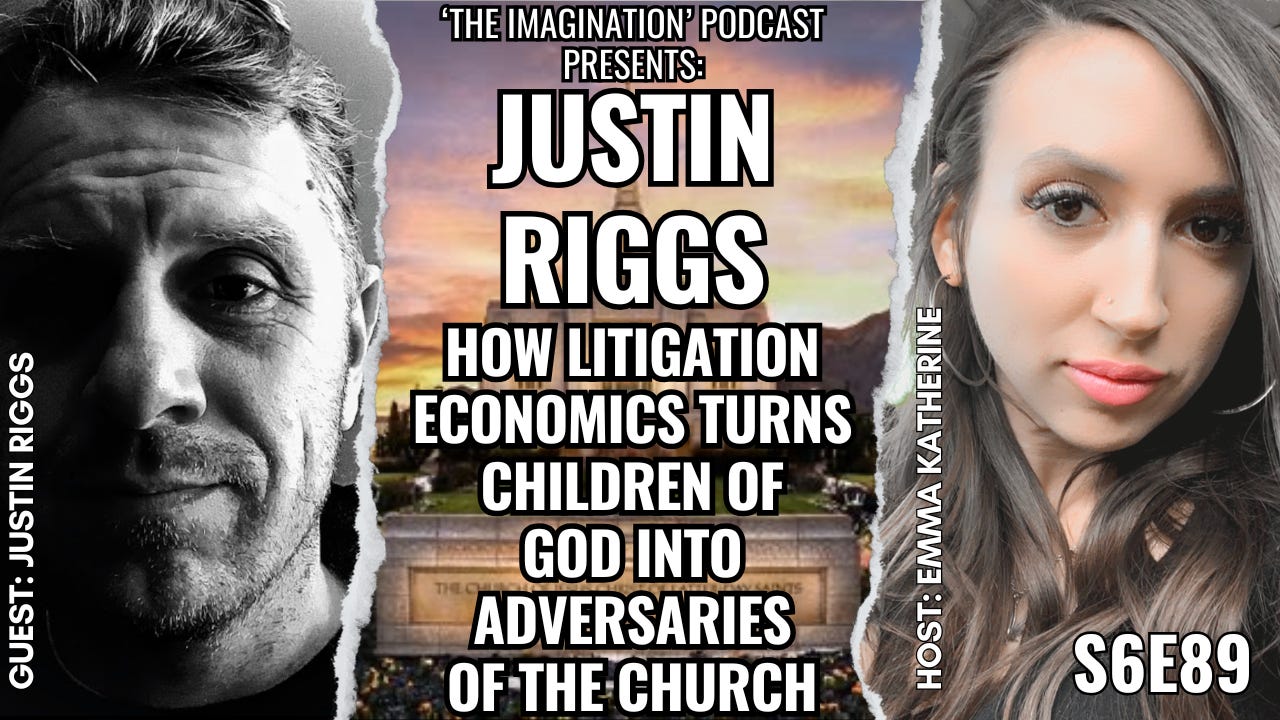
TEASER OF JUSTIN’S INTERVIEW:
WATCH ON YOUTUBE:
WATCH ON RUMBLE: CLICK HERE
GUEST INTRODUCTION AND HOW TO CONNECT / SUPPORT:
Today I’m honored to have back on the show, LDS abuse whistleblower, survivor, investigative researcher, journalist and reporter, creator of LDS Abuse, excommunicated lifelong member of the Church of Jesus Christ of Latter-day Saints, loving father, nature lover, and a man on a mission to help members of the spiritual body known as The Church of Jesus Christ of Latter-day Saints know what to expect from their church if they become victims of abuse: Justin Riggs aka LDS Abuse In our last two episodes, Justin took us on a deep dive into the heart of institutional failure and the hidden structures that protect it. We first examined the case of Gordon Bowen - a world-famous advertising executive whose alleged patterns of abuse, financial misconduct, and decades-long ties to top LDS church leaders revealed a system prioritizing brand protection over victims. Through court documents, journals, and public records, we traced how an abuser remained connected to apostles and prophets even after excommunication, while survivors were left without recourse. We then expanded that conversation into the deeper roots: the quasi-religious secret societies, fraternities like Sigma Chi and Pi Kappa Alpha, Skull and Bones chapters, and patronage networks that have infiltrated Utah’s elite and church leadership for over a century. From humiliation rituals and death oaths to the Black Supper and the pipeline of power, influence, and gain, we explored how these systems condition compromise, enable cover-ups, and make justice for survivors so elusive. These themes - ritual abuse allegations, historical infiltration, and the prioritization of secrecy over the vulnerable - have been the foundation of Justin’s recent work. Today, we build on that conversation even more, continuing to connect the dots with the same relentless, evidence-based courage that has defined this journey. At the center of it all stands Justin, also known online as ‘LDS Abuse’ - a singular voice for truth whose life story is both a profound personal odyssey and a beacon of hope for every survivor still searching for light in the darkness. Justin’s path began in the quiet corridors of personal curiosity. A lifelong member of the Church of Jesus Christ of Latter-day Saints, he once sought simply to understand how good people could fail victims of abuse. That curiosity quickly evolved into a rigorous, evidence-based mission and his research extends far beyond individual cases. Justin built a public archive of evidence that empowers others to see the patterns for themselves. This relentless pursuit came at great personal cost: his work led to his excommunication from the church he had known his entire life. Yet he continues, driven by the unshakable conviction that sunlight is the best disinfectant and that secrets only allow abuse to metastasize. Justin’s work has connected the dots between ritual abuse allegations, historical infiltration efforts, and the LDS corporation’s prioritization of brand protection. He has revealed a system where victims are funneled into therapy modalities that undermine legal recourse, and where even prophets and apostles have been implicated in shielding perpetrators. Through painstaking documentation, he has transformed private pain into public knowledge, given voice to the voiceless, and offered a roadmap for accountability. What makes Justin truly awe-inspiring is not only the depth of his research or the courage to expose even his own family’s pain - it is the profound humanity that burns beneath the fire. He speaks of chain-breakers and he believes in a God of both justice and mercy. He weeps with survivors, fights alongside them, and extends grace even when it costs him personally. Justin stands as a model of intellectual courage and moral clarity. A survivor who refused to stay silent. A researcher who turned personal cost into collective light. A warrior whose unwavering stand continues to remind us that one dedicated soul, armed with evidence and fierce love for the vulnerable, can help break the chains for generations yet to come. His courage continues to shift what is possible. His humanity continues to heal. And his story continues to inspire every one of us to stand a little taller, speak a little louder, and refuse to look away.
🔗JUSTIN’S PLAYLIST:
https://www.youtube.com/playlist?list=PLoojlrL9wVROlw0jmqs1oIVjpP8uJx9JW🔗GORDON BOWEN COURT DOCUMENTS WEBSITE: https://gordonbowencourtdocuments.com/
🔗CONNECT WITH JUSTIN:
X: @ldsabuse - https://x.com/ldsabuse
TikTok: https://www.tiktok.com/@ldsabuse_on_x
EPISODE SUMMARY:
In this episode of The Imagination, host Emma welcomes back LDS abuse whistleblower, survivor, investigative researcher, journalist, and reporter Justin Riggs (known online as LDS Abuse). An excommunicated lifelong member of the Church of Jesus Christ of Latter-day Saints, loving father, nature lover, and advocate, Justin continues his evidence-based examination of institutional failures surrounding abuse within the church. Building on prior discussions of Gordon Bowen’s alleged patterns of abuse and financial misconduct tied to top leaders, as well as quasi-religious secret societies, fraternities (such as Sigma Chi and Pi Kappa Alpha), Skull and Bones chapters, humiliation rituals, death oaths, the Black Supper, and patronage networks that condition compromise and enable cover-ups, Justin focuses on the bureaucratic layer beneath occult-influenced leadership.
He titles the discussion “The Slaughterhouse of Israel: How Litigation Economics Turns Children of God into Adversaries of the Church.” Drawing from a 2007 deposition of Randy Austin (a longtime attorney at the church’s primary law firm, Kirton McConkie—formerly Kirton McConkie & Poelman until Poelman’s name was removed after a prostitution solicitation incident), Justin details how the firm handles adult abuse claims. The firm, an “iron fortress” for decades, prioritizes protecting the corporation’s image and assets over victims, viewing claimants as adversaries under “litigation economics.”
The core cases involve Michelle Nielsen and Gina Petton (Johnson), two women from Bluffdale, Utah—a unique community where mainstream “Brighamite” Latter-day Saints intermingle with Apostolic United Brethren (AUB) fundamentalist polygamists living more integrated lives. In September 2001, the church settled a major lawsuit (Jeremiah Scott v. church, involving Franklin Curtis) for $3 million (from a $1.5 billion claim) citing litigation economics alone after a judge ordered release of internal sex-abuse files and disciplinary records. Michelle, a traumatized single mother of four struggling after flashbacks, divorce, and lack of support—despite prior reports to bishops (some supportive, others silencing her via the Strengthening Church Members Committee, red-tagging, and temple recommend issues)—contacted Kirton McConkie in December 2001 seeking help from “someone who represents the church.” She referenced the settlement and sought a comparable resolution without initially wanting to sue.
Randy Austin, involved in the 1995 launch of the LDS abuse hotline and a public defender of it (e.g., at FAIR conferences alongside apologists and Deseret News reporter Tad Walch), met her in person (unusual, given the high potential claim of $5 million). He brought a colleague (Erin Carlile) for independent notes, obtained consent to contact only problematic local leaders (not supportive ones), recorded and notarized her account, extracted a “demand” figure, and framed everything as protecting the client’s interests. He promised an “investigation” and claimed the church “likes to help,” while carefully separating his lawyer role from priesthood duties. Local leaders were warned of a potential suit, “poisoning the well.” A committee of corporate figures (including Von Keetch, Boyd Black, Paul Rytting, Fred Riley, Lance Wickman, and assistants—no apostles or First Presidency) reviewed findings focused solely on liability, not truth or pastoral care. On September 24, 2002, Wickman (writing on behalf of the First Presidency) denied a monetary settlement, offered limited counseling coordinated through local leaders, and suggested police involvement while claiming the claims could not be substantiated.
One week later (October 1, 2002), Gina—unacquainted with Michelle, roughly 10 years apart in age—contacted the abuse hotline (staffed with Kirton McConkie attorneys listening in) and reported strikingly similar ritual abuse involving the same Bluffdale locations, figures (Bishop John Turner, a Utah State Prison warden; Ron Jones and the Lions Club), candles, robes, animal blood, and related elements. Gina’s case was rapidly escalated to Wickman. Despite exact corroboration on key details, the firm segregated the women, withheld the mutual evidence, and never informed either. Gina experienced false hope of high-level meetings (including one scheduled post-Thanksgiving that Wickman denied knowledge of upon her arrival at the Church Office Building), leading to a suicide attempt with 17 Vicodin. Both women later attempted suicide amid the handling. A subsequent offer via Area Authority Tad Callister involved payment contingent on an NDA, which Gina and her sisters rejected; they sought accountability (e.g., removing their father, known to the hotline since 1993 yet later called as a bishop) rather than money.
Therapy support for Michelle was capped (around $11,000–$15,000 total via fast offerings, forced through LDS Family Services therapist Dr. Liz Hale with recorded sessions shared to local leaders via waivers, ending by Halloween 2005). Austin continued parallel communications without linking the cases. Justin emphasizes that attorney-client privilege is claimed to trump priest-penitent privilege, so disclosures to bishops can reach church lawyers; work product shields the firm’s investigation from victims; and bishops/stake presidents are treated as clients/employees for privilege purposes despite being unpaid lay leaders. The abuse hotline is framed publicly as protecting children but functions to manage liability risks to image and assets. Justin draws parallels to his own hotline experiences (e.g., with Matt Ballard) and leaked internal spreadsheets dismissing claims as “more drama.”
Key takeaways: Never disclose abuse details to bishops first (information flows to potential adversaries); never speak to Kirton McConkie without independent counsel; the firm and related systems view victims as adversaries, not clients needing pastoral care; actions (segregation, limited aid, liability focus) reveal priorities far from Christ’s example. Survivors Michelle and Gina later connected via We Are the People Utah, corroborated tunnels (denied by authorities but supported by cadaver dogs, ground-penetrating radar, and additional witnesses), and shared stories publicly. Justin invites others with documentation or experiences to reach out to reduce isolation and build corroboration. The episode underscores how litigation economics, corporate structures conflating the spiritual church with the legal entity, and layered protections turn vulnerable “children of God” into managed threats, producing profound real-world harm including suicide attempts, while survivors continue seeking justice and community outside institutional channels.
DETAILED EPISODE OUTLINE & EPISODE TIME STAMPS:
Opening Welcome and Guest Introduction (0:00–5:24)
Host Emma greets listeners and honors returning guest Justin Riggs.
Describes Justin as LDS abuse whistleblower, survivor, investigative researcher, journalist, reporter, creator of LDS Abuse, excommunicated lifelong member, loving father, nature lover, and mission-driven advocate.
Recaps prior episodes: Gordon Bowen case (advertising executive, alleged abuse/financial misconduct, ties to apostles/prophets post-excommunication, brand protection over victims via court documents/journals/records); expansion to quasi-religious secret societies, fraternities (Sigma Chi, Pi Kappa Alpha), Skull and Bones, humiliation rituals, death oaths, Black Supper, patronage networks enabling cover-ups and elusiveness of justice.
Frames themes of ritual abuse allegations, historical infiltration, secrecy prioritization.
Details Justin’s journey: curiosity about good people failing victims → evidence-based archive → personal cost of excommunication → “sunlight is the best disinfectant”; connections between ritual abuse, infiltration, brand protection, therapy modalities undermining legal recourse, prophets/apostles shielding perpetrators.
Praises Justin’s humanity, chain-breaking, belief in a God of justice and mercy, weeping/fighting with survivors, intellectual courage, moral clarity.
Formal welcome and Justin’s response: Appreciation; episode will be difficult yet eye-opening on how the system works; plans to cover extensive information efficiently.
Episode Title and Framing: Bureaucratic Layer and Law Firm Role (5:24–8:57)
Justin titles the show “The Slaughterhouse of Israel: How Litigation Economics Turns Children of God into Adversaries of the Church.”
Recaps prior identification of leadership layers in quasi-religious secret societies involving humiliation, shame bonding, and abuse.
Notes occultists require bureaucratic layers of sincere believers who view them as literal prophets and protect them believing they do the Lord’s work.
Emphasizes these are not wicked conspirators in smoke-filled rooms but occultists using well-intentioned bureaucrats; will show they are not representatives of Jesus Christ “in their own words.”
Introduces Kirton McConkie (formerly Kirton McConkie & Poelman; Poelman removed after downtown Salt Lake prostitution solicitation).
Decades-long “iron fortress” as the church’s primary law firm.
Victim who sued the firm provided deposition of Randy Austin, offering an insider view of abuse-case handling versus public claims.
Setting the Stage: Bluffdale Context and 2001 Settlement (8:57–12:12)
Focus on Bluffdale, Utah: Unique mingling of mainstream “Brighamite” Latter-day Saints and AUB fundamentalist polygamists who live more integrated lives within municipal boundaries (unlike isolated groups).
September 2001 lawsuit context: Church faced ~$1.5 billion claim (Jeremiah Scott, abused by church member Franklin Curtis); settled for $3 million.
Attorney Jeffrey Anderson noted serious liability concerns.
Church denied liability, settled solely on “litigation economics.”
Explains litigation economics: Cost-based decisions common for large organizations, odd for a truth-focused church; will show its dominant role in abuse decisions.
Michelle Nielsen (former Bluffdale resident; featured on We Are the People Utah with Jason and Alexia Preston) sees the settlement, compares her worse abuse experiences, and decides to contact church representatives.
Michelle Nielsen’s Background, Trauma, and Initial Outreach (12:12–18:48)
Emphasizes deep trauma of abuse victims: Decades of failed local leadership reports; some bishops supportive (one gave a prophetic blessing without details, cried with her, studied the issue), others apathetic/silencing.
After reading Glenn Pace memo (validation of ritual abuse), she shared it; was released from callings, red-tagged by Strengthening Church Members Committee, temple recommend temporarily held; leaders later apologized, saying they followed orders.
Deposition excerpt: Austin first contacted mid-December 2001 via secretary; Michelle referenced Oregon settlement, named plaintiff lawyers, wanted to talk to “somebody who represented the church.”
Critical distinction: Lay leaders represent Christ; Austin represents the church narrowly as a lawyer protecting corporate interests, turning the victim into an adversary from the outset.
Austin’s profile: Present at 1995 abuse hotline creation; public speaker defending it (e.g., FAIR conference with therapist, calling it “as valuable a tool as exists in the world to protect children”); appears with FAIR apologists and Deseret News’ Tad Walch (criticized for incomplete Brenda Miles coverage).
“Trifecta” willing to “lie for the Lord.”
Initial Meeting Setup, Lawyer Checklist, and Adversarial Framing (18:48–34:44)
Michelle insists on in-person meeting; Austin agrees to “investigate” and report responses.
Victim views him as “Brother Randy Austin” offering church help/financial consideration via committee.
Justin parallels his own experience requesting help from Matt Ballard (grandson of M. Russell Ballard): Immediate response that Ballard represents only the church/leaders, not rank-and-file members.
Austin’s first statements: Identifies as Kirton McConkie attorney representing the church; clarifies he cannot represent her.
Explicitly states he protects the client’s (church’s) interests “as best they possibly can be.”
Cannot simultaneously represent victim and client when liability is possible.
“Slaughterhouse” metaphor: Draws in “lambs of God,” processes them spiritually/emotionally/mentally (sometimes leading to suicide) while they believe they deal with Christ-representatives.
Austin understood from the start she had a potential claim against his client.
Michelle was not angry/demanding/threatening suit; reluctant to hire lawyers; sought scriptural/reasonable resolution matching the Scott settlement (which was pure economics, not remorse).
She entered a “shark tank” thinking it a “warm barn.”
Members try to resolve via scriptures while the institution uses worldly methods focused on image/assets.
In-Person Meeting, Notes, Consent, and Story Lock-In (34:44–52:36)
Late January 2002 meeting (unusual; Austin normally avoids in-person; high potential claim of $5 million after $3 million settlement opened the gate).
Brought Erin Carlile for independent notes (to create dual evidence sets for court; outnumber victim).
Reason: Uncomfortable with phone conversation; wanted a witness.
Lawyer checklist items:
Obtained consent to contact named leaders (only those she had problems with, not supportive ones) framed as “corroboration” for financial help, but actually to assess liability (slander/defamation risks). Consent not fully informed; her “Spidey senses” activated.
Told her the church “likes to help in cases like this” (true in narrow sense).
Denied mixing priesthood and lawyer roles (Justin leans toward believing Michelle’s claim he invoked priesthood duty based on hotline experiences; questions whether roles can truly separate).
Asked her to type/write/record account (locks story for evidence; deviations later used against her); eventually notarized.
Extracted the figure (“what is it you would like?”); later characterized as “demand” (her lawyer notes she never demanded; she would hire a lawyer only if church unfair).
Austin agreed only “to take her claim to the church,” not “help her” (avoids strengthening her case).
Disputed statements (e.g., hole-in-building analogy for settlements) promptly denied.
“Investigation”: Not true investigation; selective weighting (discounted Edward Lyall’s letter about Lions Club robes/candles/Satanic stigma under Ron Jones in 1959–60s Bluffdale ward basement when memory weak, but accepted when it attributed knowledge to Michelle).
Privilege Issues, Law Enforcement Coordination, and Committee Decision (52:36–1:09:48)
Critical warning: No true privacy with bishops/stake presidents; attorney-client privilege claimed to outweigh priest-penitent privilege—abuse disclosures can go to church lawyers.
Austin accesses membership numbers via general counsel’s office.
Coordinated with law enforcement (letter to Detective Lopez, August 2002) despite public claims otherwise; police and firm work behind victim’s back.
Core takeaways so far: Nothing told to ecclesiastical leaders is private; church/Kirton McConkie not there to help victims (purpose is limiting liability); everything from first contact is protected work product.
Local leaders treated as clients/employees for privilege (tenuous claim; no formal employment/pay/training); Austin warned them of potential suit and need for caution (“poisoning the well”).
Committee (corporate only: Von Keetch, Austin, legal assistant, Boyd Black, Paul Rytting [Hamblin case ties], Fred Riley, Lance Wickman + assistant—no quorum/First Presidency): Focused solely on liability evidence for settlement threshold; authorized to speak for “the church” (conflating spiritual body and corporation).
Process: Present findings, possible written report/proposed resolution, escalate only if disagreement.
Decision: No monetary settlement (could not “corroborate”); sympathetic to counseling needs, coordinated via local leaders.
September 24, 2002 Wickman letter (on First Presidency’s behalf): Sorry for difficulties; local leaders offered help; Austin thoroughly investigated (Justin disputes); unable to substantiate; report to police; pray for healing; work with locals.
Gina Petton’s Corroborating Report and Segregation (1:09:48–1:24:46)
October 1, 2002: Gina (unacquainted with Michelle) contacts abuse hotline; reports near-identical story.
Hotline: Bishops directed to call; Kirton McConkie attorneys often on the line protecting church.
Gina’s email details: Reached ritual abuse investigation (Ken Theven); promised no tolerance, removal even on limited testimony; church views ritual abuse as growing threat; some cases take 10+ years to prove but true; victims to be believed.
Side-by-side corroboration: Same figures (Bishop John Turner/prison warden; Ron Jones/Lions Club); candles, robes, animal/goat blood, basement/ritual elements.
Firm segregated them despite identical details one week apart; built firewall so neither knew of the other or the strengthened joint claim.
Legal but not moral/ethical; any decent person would reconnect and investigate jointly.
Rapid escalation of Gina’s case to Wickman (she saw as “miracle”; actually liability management).
Parallel communications: Wickman still writing Michelle denial while handling Gina; no information shared.
Further meetings promised (Ken Theven mediation with father/family post-Thanksgiving); Gina drives from California; Wickman claims never heard of her and sends her away.
Result: Devastation; Gina’s suicide attempt (17 Vicodin); later letter still gives Wickman benefit of doubt.
Real harm: Bodies at risk; both women attempted suicide; healing opportunity lost by withholding mutual corroboration.
Post-Attempt Handling, Limited Therapy, and Parallel Communications (1:24:46–1:49:05)
Church eventually meets via Area Authority Tad Callister (agenda on sexual abuse policy); essentially offers money for NDA/silence (rejected; they wanted systemic fixes and father removed from child access—hotline knew since 1993 yet he was later called bishop).
Austin handles both cases into 2004 without linking (therapy payment issues for Gina; letter to Michelle reiterating inability to confirm, sincerity, counseling offer via bishop).
October 2004 letter from Michelle’s stake president (James C. Overson) and bishop (Ralph Hatton): Love/pray; $11,137 already spent; force LDS Family Services liaison (Dr. Liz Hale); recorded sessions shared to local leaders via waivers; not open-ended funding; final 6-month extension ending October 31, 2005 (Halloween).
Justin’s anger: $350 billion corporation caps lifelong trauma aid at ~$15,000; forces preferred therapists; local untrained leaders decide healing; enables further liability monitoring.
Emotional impact: Such letters spiral survivors toward possible death; leaders shielded by top lawyers.
Broader Critiques, Privileges Colliding, and Key Warnings (1:49:05–2:09:20)
Questions: When did “judges in Israel” (prophets) need general counsel to speak for them and avoid liability? Parallel to CIA recruiting young, returned missionaries rather than prophets.
Final takeaways for members:
Never tell bishops about abuse first—privilege hierarchy sends info to potential adversaries; go to proper authorities.
Never speak to Kirton McConkie without own legal counsel—they are paid adversaries protecting image/assets, not empathetic priesthood holders or siblings in the gospel.
They view victims as adversaries and apply evidentiary standards for liability/lowball settlements.
Public claim “abuse cannot be tolerated in any form” is a lie (tolerated daily when low risk to assets; Justin’s domestic violence experience: “we don’t handle that type”).
Never take responsibility; punt to unpaid/untrained local leaders (who face subtle pressure on advancement/funds use via plausible deniability).
Consent vs. coercion: Austin obtained “voluntary” names without full informed consent on true purpose (liability assessment, not help); legal ≠ moral/ethical (parallels Arizona reporting case).
Church as corporation: Conflates spiritual body and legal entity; Austin was not “the church” Michelle sought.
Colliding privileges: Attorney-client claimed superior to priest-penitent; any confession/spiritual experience potentially available to corporate lawyers—never informed consent for that.
Austin does not represent the spiritual church or Jesus Christ; actions (segregation, limited aid, liability focus) prove otherwise. Jesus would provide pastoral care, healing, and needed compensation—not this treatment.
Host/Guest Reflections, Community Value, and Closing (2:09:20–end)
Emma: Shock at behind-the-scenes separation of corroborating victims; survivors fear this system more than being labeled attention-seeking; trauma vulnerability meets masked opposition.
Justin: Insidious because hotline is taught as protective; traumatized people (losing everything) trust the “family” facade while firm knows the adversarial reality; game of attrition/lawfare; document dumps to dismiss cases.
Healing potential of survivor connection (Michelle/Gina later friends via podcast; established tunnels via dogs/radar/additional witnesses despite official denials/closures; community building outside institutions).
Invitation: Survivors with similar experiences/documents reach out; storytelling reduces isolation, shows not crazy, enables corroboration.
Emma thanks Justin for courage, evidence presentation, and giving voice; lists contact info and prior episodes; encourages support and sharing; closes with blessing.
Thank you all for your never-ending support! Please SUBSBSCRIBE on YouTube, Rumble, iTunes and Spotify to keep up with new episodes!
All links here: CLICK HERE TO SUBSCRIBE AND SUPPORT
Thanks for reading Emma’s Substack! This post is public so feel free to share it.
No posts
Comments
Nothing yet. Say the first thing.
Sign in to join the conversation.