
This new Book Post section of This Itch of Writing celebrates books, from very old to very new, that I’ve enjoyed and hope writers will not only enjoy but find useful for their own writing. Click the link or the tab at the top of the page to explore the growing list. All the books are available at the Itch of Writing Bookshop at bookshop.org, which supports independent bookshops; the Itch also benefits directly from a small commission.
With a nature as wild as the moors she loves to roam, Catherine Earnshaw grows up alongside Heathcliff, a foundling her father rescued from the streets of Liverpool. Their fierce, untamed bond deepens as they grow – until Mr Earnshaw’s death leaves Hindley, Catherine’s brutal brother, in control and Heathcliff reduced to servitude.
Desperate to protect him, Catherine turns to Edgar Linton, the handsome heir to Thrushcross Grange. She believes his wealth might free Heathcliff from cruelty – but her choice is fatally misunderstood, and their lives spiral into a storm of passion, jealousy and revenge.
Now, eighteen years later, Catherine rises from her grave to tell her story – and seek redemption.
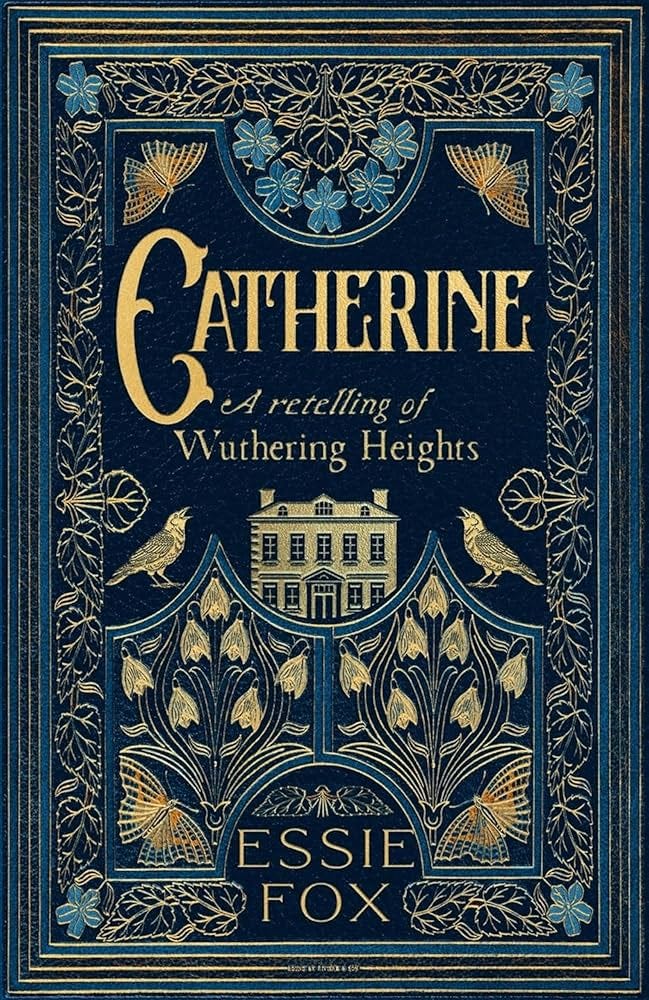
The strapline on my proof copy is ‘Nelly Dean told only half the story’: Wuthering Heights, with its chinese-box-like structure of narrators (so different from Jane Eyre telling her own story!) is just asking for another writer to step in. Essie Fox’s seventh novel does just that - and quite apart from more literary considerations, it’s hard not to like a book which looks so gorgeous, spredges and all.
As far as I can tell (full disclosure: it’s decades since I read WH) Fox follows the original faithfully - this is no spin-off or riff - but with a crucial new lens: what if we look at Catherine’s human drives and disastrous choices with an understanding how limited her options were, as a young woman of her time, class, circumstances and personality? And what if her ghost doesn’t just haunt Lockwood, but gets to tell her own story, and simultaneously see into the mind of the daughter she didn’t live to see grow up? It’s a project which chimes beautifully with our own, twenty-first century desires to tell history “from below”: to give voice to the voiceless and the victims of circumstance.
One of the most important joys of historical fiction is how the imagined and invented intertwines with what we know as real, making the real come imaginatively alive, and the imagined feel more rootedly real. Of course WH is itself fiction, but classic fictional stories occupy a similar place in our cultural memories as the classic stories we are taught as real history. When they’re used as the basis for new fiction, either can open up similar pleasures: the strange being made familiar and the familiar strange. Catherine works so well with the same kind of pleasures: here are the people and voices we feel we know - Fox isn’t afraid to quote Brontë directly - and the heightened, Gothic world we can sink back into, the intense sense of tragedy-in-waiting - but always with the sting of the new and vivid.
If you’re drawn to the haunted halls of gothic in historical fiction - as reader, writer or both - Essie Fox really knows her Gothic. Her background is in design and illustration, and for many years her blog Virtual Victorian was a go-to for lovers of material culture. Here on substack, her new podcast Essie Fox: TALKING THE GOTHIC is full of delights - and that pedigree shows in Catherine.
As a project, Catherine must have been challenging, because following the plotting of Wuthering Heights would, I imagine, have left relatively little room for manouevre - but Fox’s attention to her source feels precise and well-judged. Her previous novel, Dangerous, imagined the disgraced and exiled Lord Byron as turning detective to clear his own name. It’s a fascinatingly different take on the same central writerly conundrum: how imagine outwards from a story the reader already knows, and still make a coherent, self-standing narrative out of it. Well worth studying.
One of the challenges for any story which is as much about ‘then’ as ‘now’ is how to handle the moves between different pasts and presents, making sure the reader never feels unmoore, or reads some thought or action as belong to the wrong time. Essentially it’s all in the switches and the tenses - and Fox’s experience shows in this, handling it all very deftly; for more about non-linear narratives, click here.
Thanks for reading This Itch of Writing with Emma Darwin! This post is public so feel free to share it.
Comments
Nothing yet. Say the first thing.
Sign in to join the conversation.