
0:00
-5:07
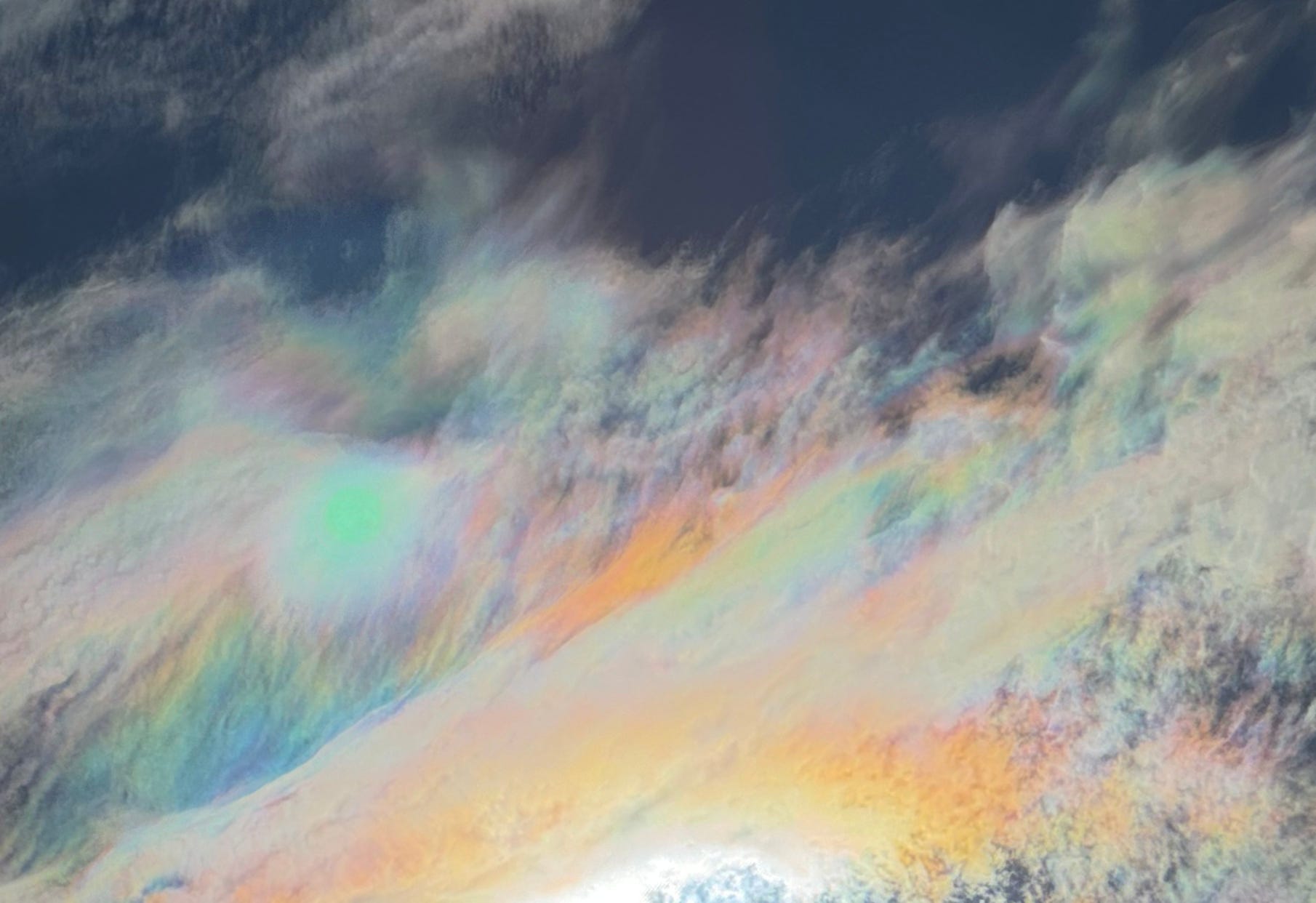
Have you ever seen a cloud shimmering with colors?
If the colors are messy and chaotic, it’s an iridescent cloud.
The colors in iridescent clouds go beyond traditional rainbow colors, tending toward turquoise, lavender, magenta, and amber. The colors form unique, unpredictable patterns.
Iridescent clouds are created by sunlight interacting with tiny water droplets. The more uniform the size of the droplets, the better the chance of iridescence.
Look for them on a partly cloudy day as clouds move in front of and around the sun. It may be necessary to block the sun to see adjacent clouds, or shade your eyes with the darkest possible sunglasses.
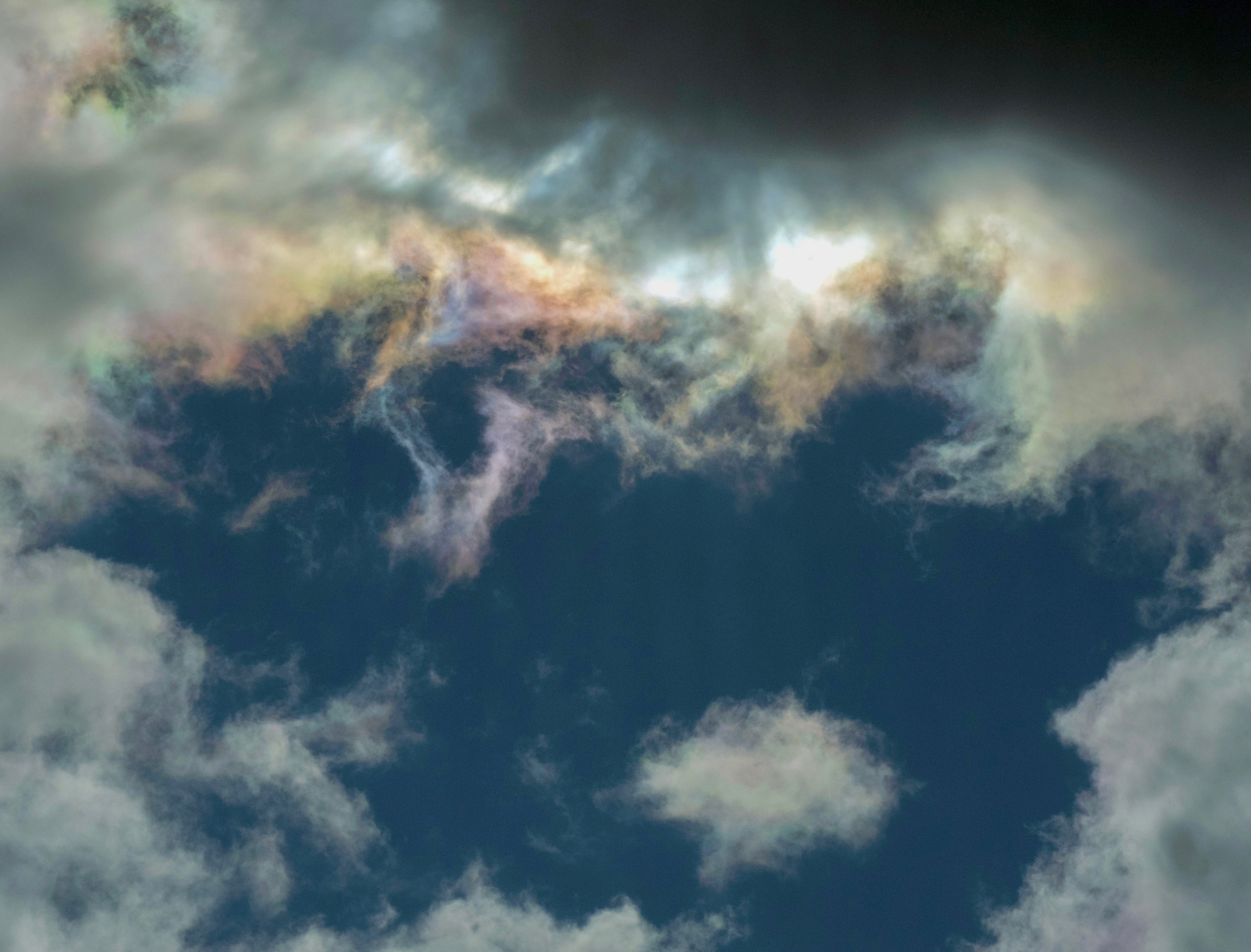
Why aren’t iridescent clouds as well-known as a traditional rainbow?
One reason is that daylight hours are often spent indoors, and when outdoors, clouds may not attract close attention. Another reason is that iridescent clouds often happen too close to the sun to see spontaneously. Yet another reason is that iridescence often occurs within a small area of sky, and at unpredictable times.
Finally, the lack of a mental picture and a name is a major factor: without an inner icon, even when people do see colors in a cloud, the experience may be quickly forgotten.
It was on an annual Thanksgiving bus trip that I learned how common cloud iridescence is. Four years ago, I first noticed that I could almost always see color in clouds from the window of the coach that runs between the Boston airport and Vermont’s Upper Valley.
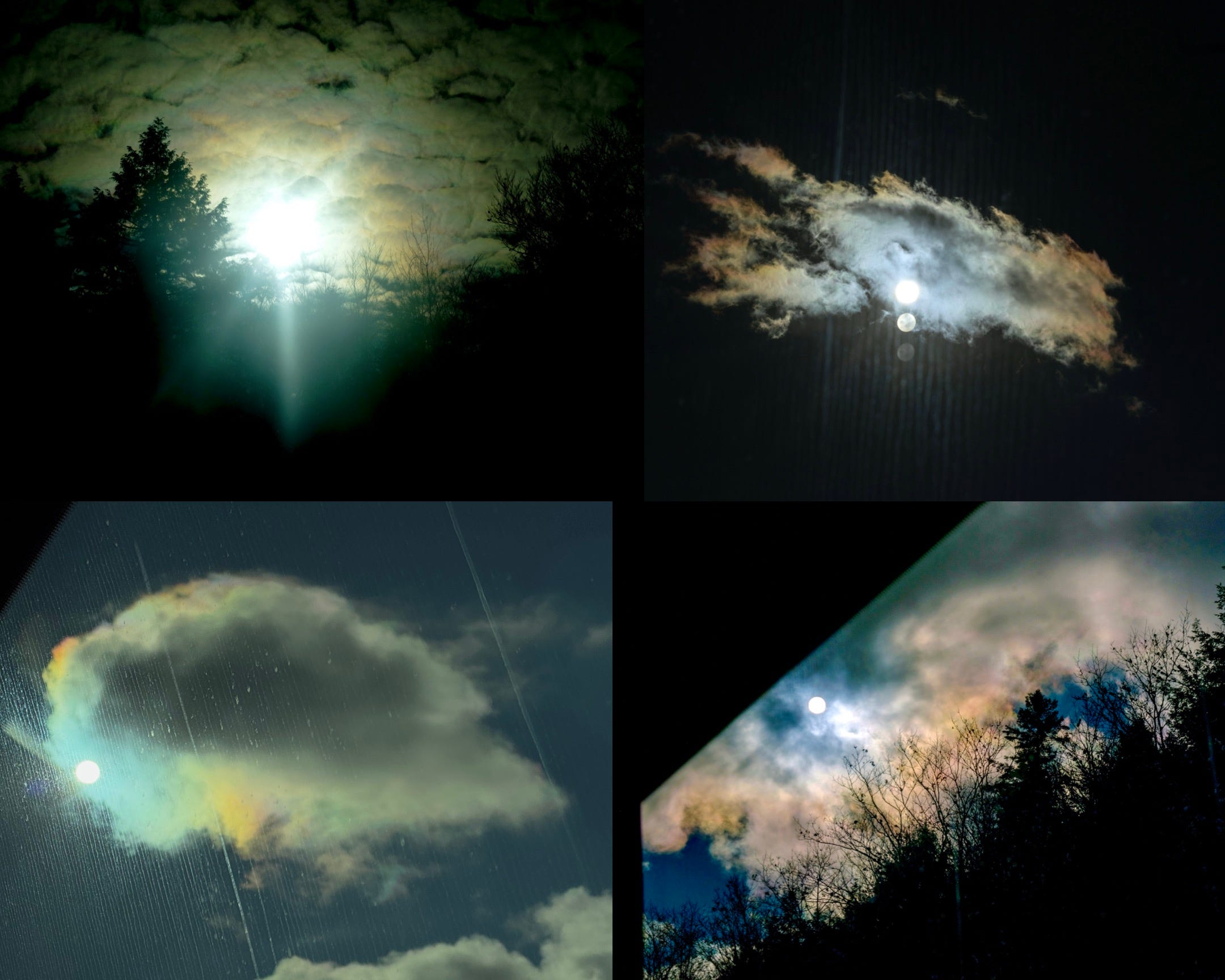
Why has this happened so reliably? The tinted windows of the bus make it possible to look almost directly at the sun, and at nearby clouds, without excessive glare. The ride is several hours long, and the sun and clouds are in constant motion, making it more likely that they will align to create colorful clouds at some point in the journey.
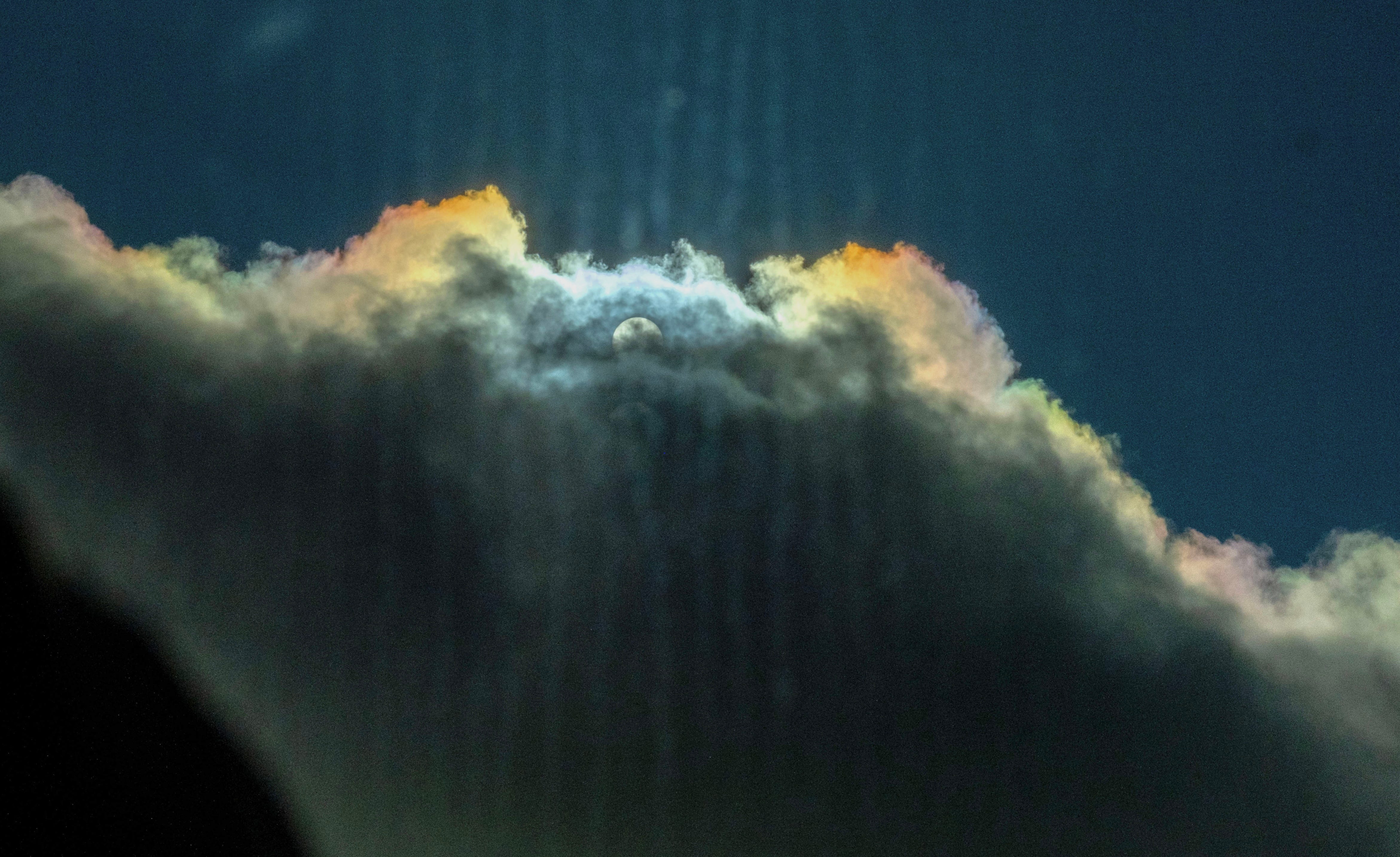
Colors in clouds are not always true cloud iridescence: a predictable, concentric corona of blue and gold tints, or other halo effects, often surround the sun. Genuine cloud iridescence is identifiable by its unpredictable colors in a pattern that could never be anticipated or repeated exactly.
The effects frequently occur together. If you see this blue and gold around the sun, look carefully at nearby clouds: multicolored cloud iridescence may be present in close proximity.
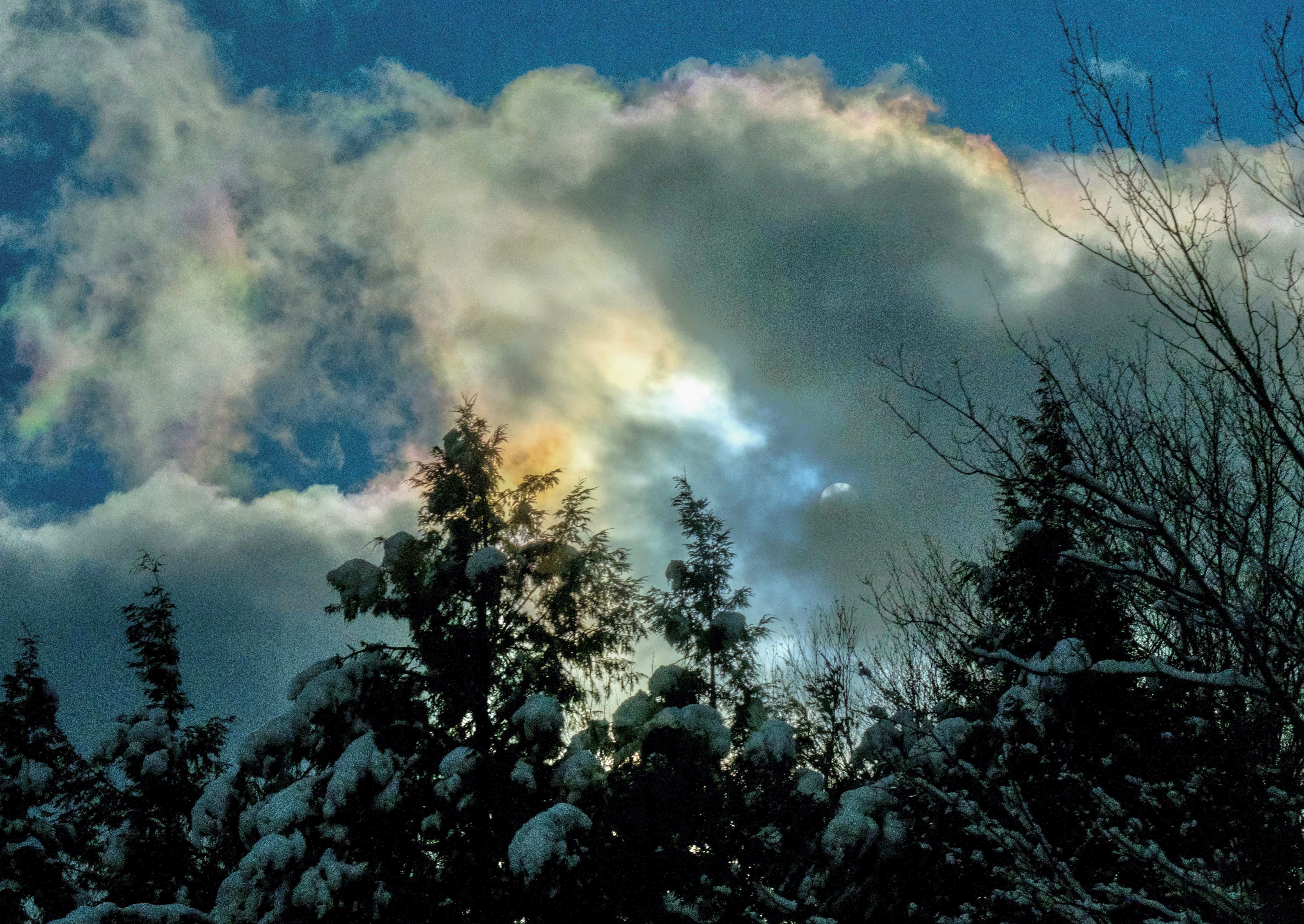
Since I began noticing iridescent clouds, I’ve been inspired to look for them every chance I get.
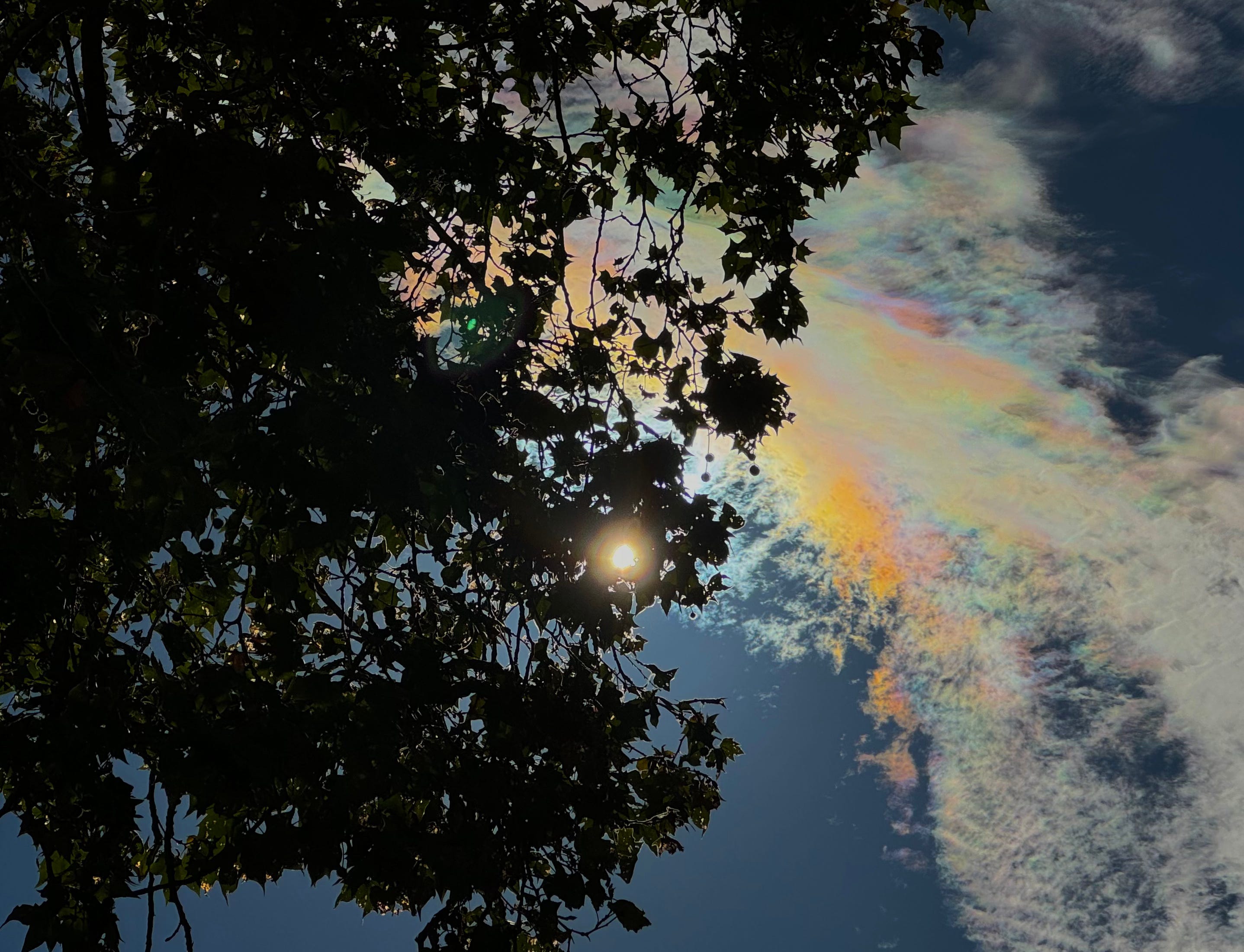
I am surprised at how often I see them.
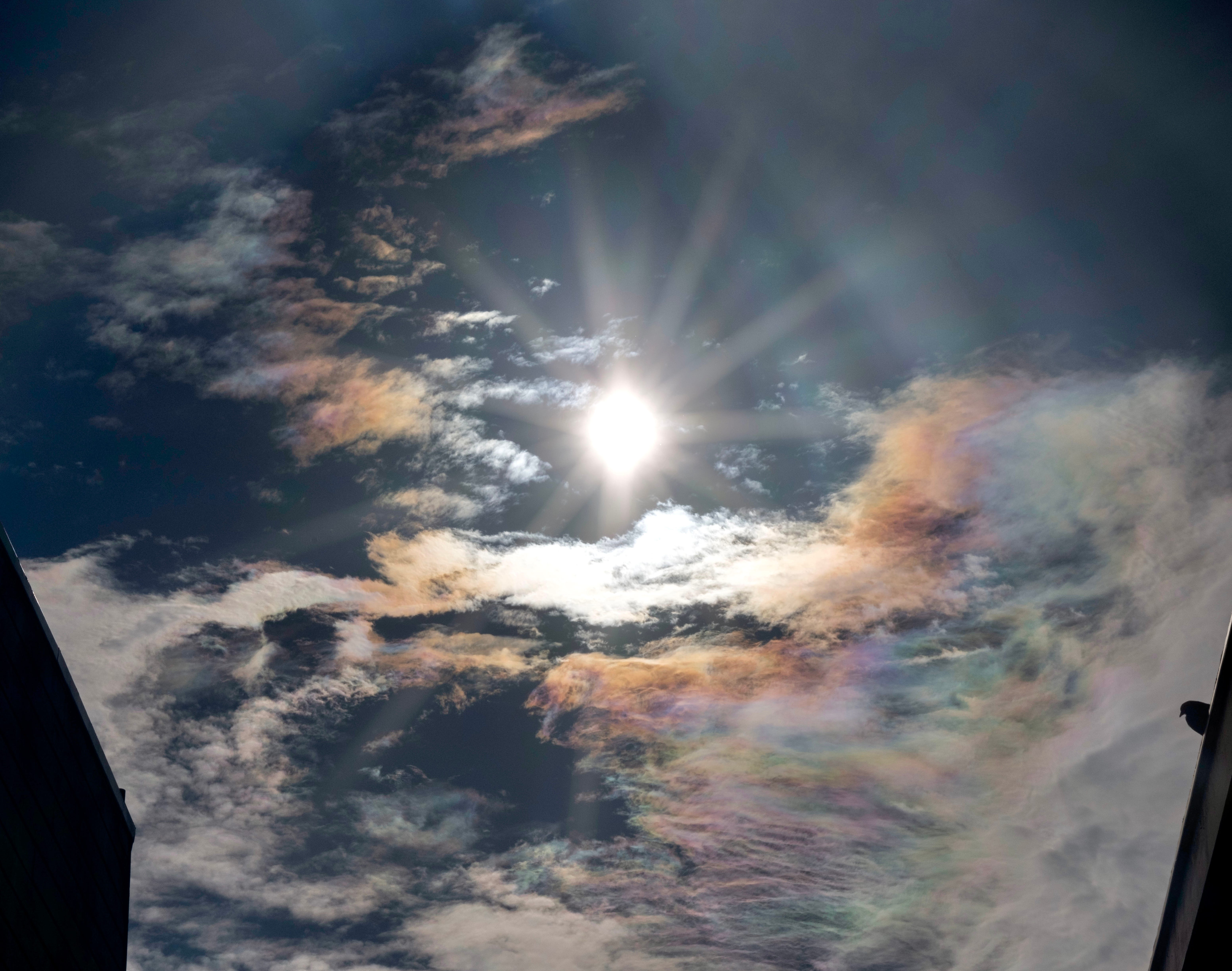
In Marcel Minnaert’s 1954 book The Nature of Light and Color in the Open Air, he writes that “tints in the clouds can practically always be seen if the clouding of the sky is fragmentary (p. 227)”.
He explains that iridescent clouds are caused by “drops of very uniform size in each definite part of the cloud, but different in different parts of it”
(p. 228), and describes the experience as follows:
“Those not accustomed to studying the heavens will be surprised to learn that clouds can often show the most glorious and the purest colors, such as green, purple-red, blue… These colors are in no way related to twilight phenomena and appear both when the sun is low and when it is high.
Iridescent clouds like these…appear close to the sun…if one uses a piece of dark glass they can be seen [close to the sun], and with the eye unprotected [at a greater distance from the sun], growing paler as distance increases” (p. 226).
“[T]he intensity of the light”, he goes on to say, “is often so fierce as to be almost intolerable for many observers” (p. 226). He suggests standing in the shade of a building to block the sun’s glare.
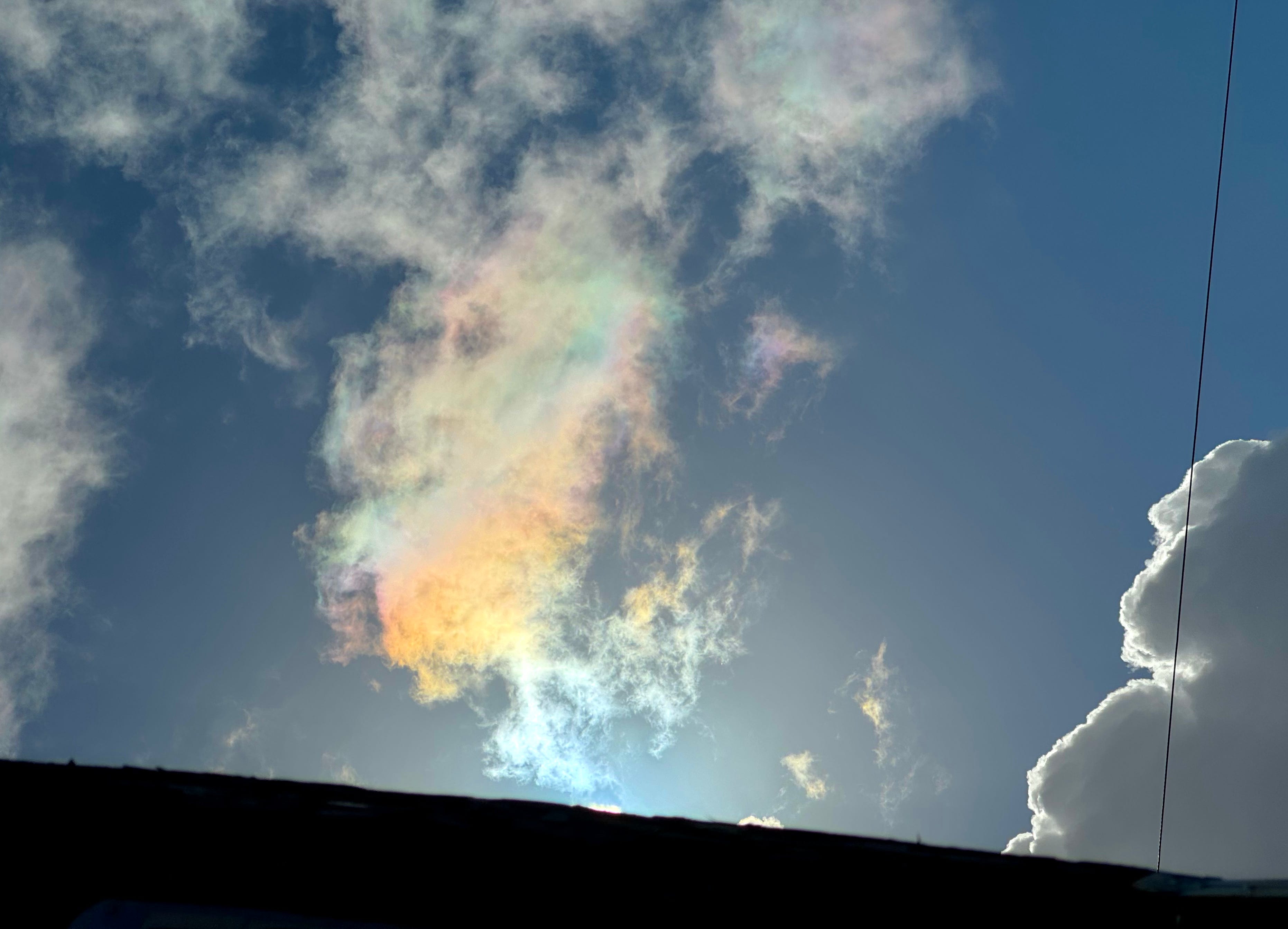
The sun’s reflection in windows or water can be used as a black mirror, making viewing much easier.
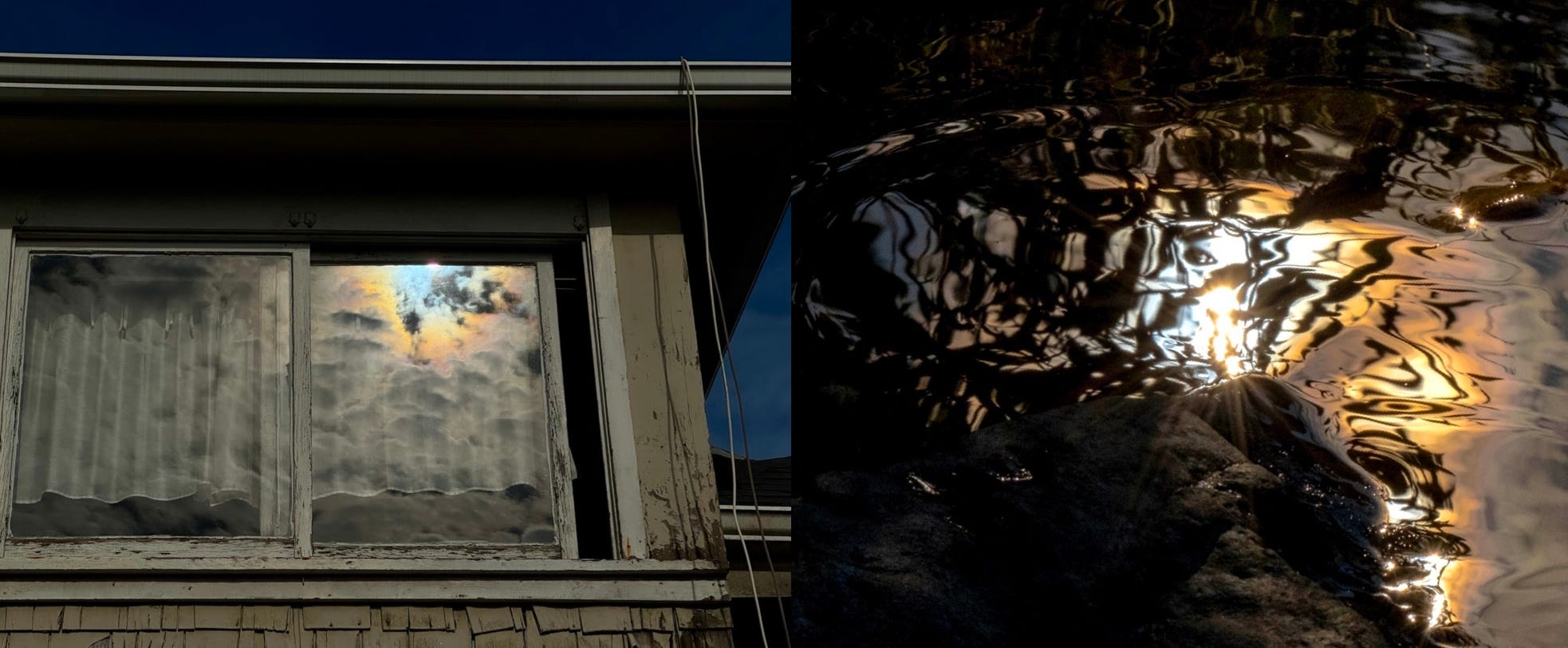
Minnaert describes a dramatic type of iridescent cloud called “mother-of-pearl” that occurs at sunset on high clouds (p229), and is common in polar regions. But cloud iridescence can happen anywhere. The most astounding iridescent cloud I know of (a variation called a pileus or “scarf” cloud) occurred in southern China in August of 2022. Its image is often oversaturated or otherwise altered (as in the left photo below), but the phenomenon was real.
Because most people now carry cameras everywhere, exceptional clouds like this live on beyond the brief period that they are visible in real life. My social media algorithm has learned to show me iridescent clouds. Seeing pictures online forms a consistent mental picture, training my attention to look for them in real life.
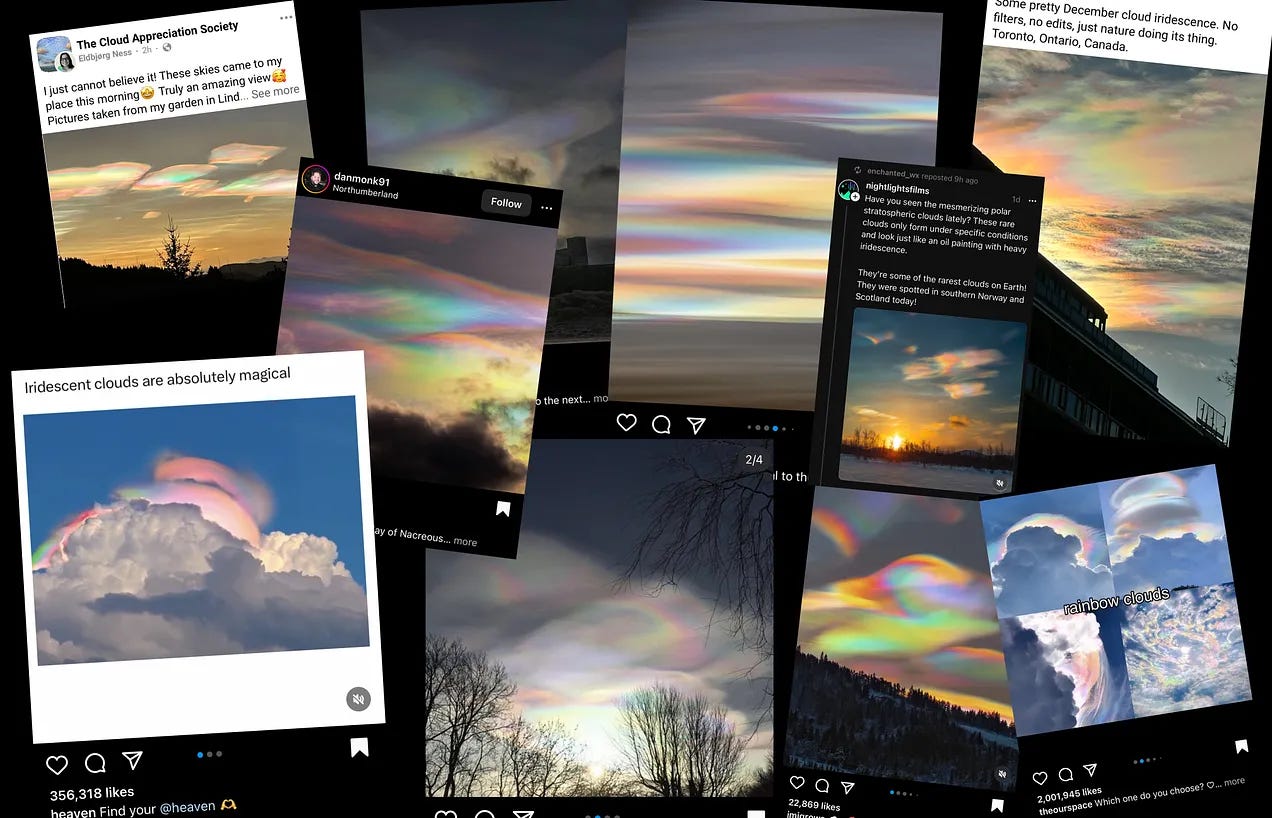
The traditional rainbow is a timeless icon. Sun and rain at the same time is a well-known cue to go outside and look for a rainbow. It is my wish that a partly sunny day will prompt you to take a close look at the clouds. I hope that more and more people will go beyond drawing an orderly rainbow. I hope they will draw a colorful mess within the cloud itself, then look for it in the sky.
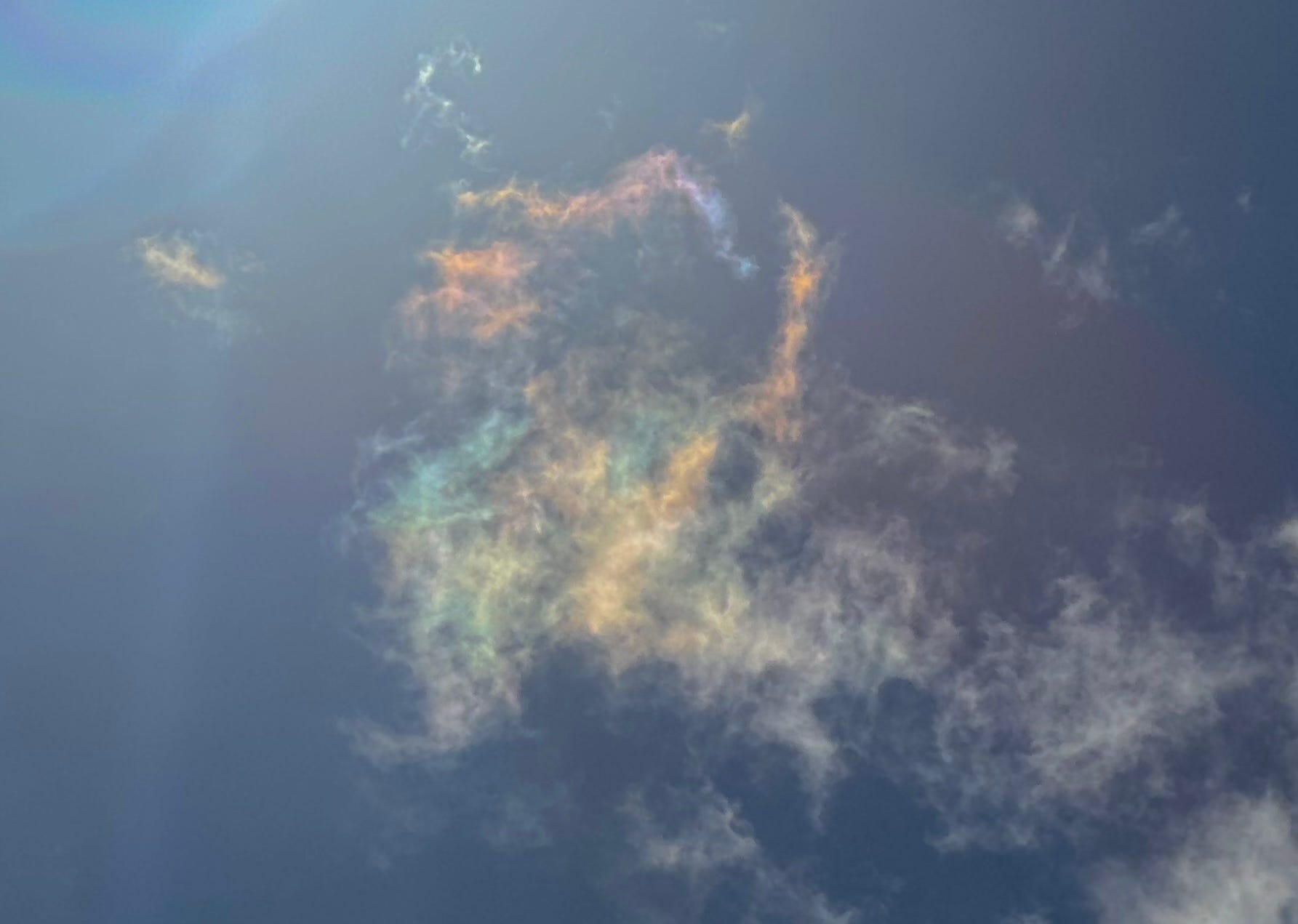
Have you seen this phenomenon? Let me know in the comments.
All photos by Emily Wick unless otherwise noted.
Comments
Nothing yet. Say the first thing.
Sign in to join the conversation.