
The US Centers for Disease Control and Prevention program in Zimbabwe will completely close down by the end of the year as a result of actions taken by the Department of State. In a major step in this process, 27 locally employed staff received “intention to terminate” notices on July 27, according to members of a network of former CDC global staff, and multiple sources based in countries elsewhere in the Africa region.1 Some roles are reportedly scheduled to end in October; others by the end of the calendar year.
CDC Zimbabwe is the first CDC global health program to be fully closed as a result of the Trump Administration’s approach to transferring funds from State to CDC. While State did not explicitly order the closure, it had the power to provide resources for continued activities or for a time-bound transition and closeout of a program that had a relatively small US$66 million budget in FY2025.2 Instead, State exploited a 26-year old budgetary arrangement to make the shutdown inevitable, without any public assessment of the resulting risks to national, global and US health security.
I’ve reviewed the positions and activities to be terminated, as well as CDC Zimbabwe reports, plans and presentations, and believe that this closure jeopardizes public health and health security in Zimbabwe, the region and worldwide.
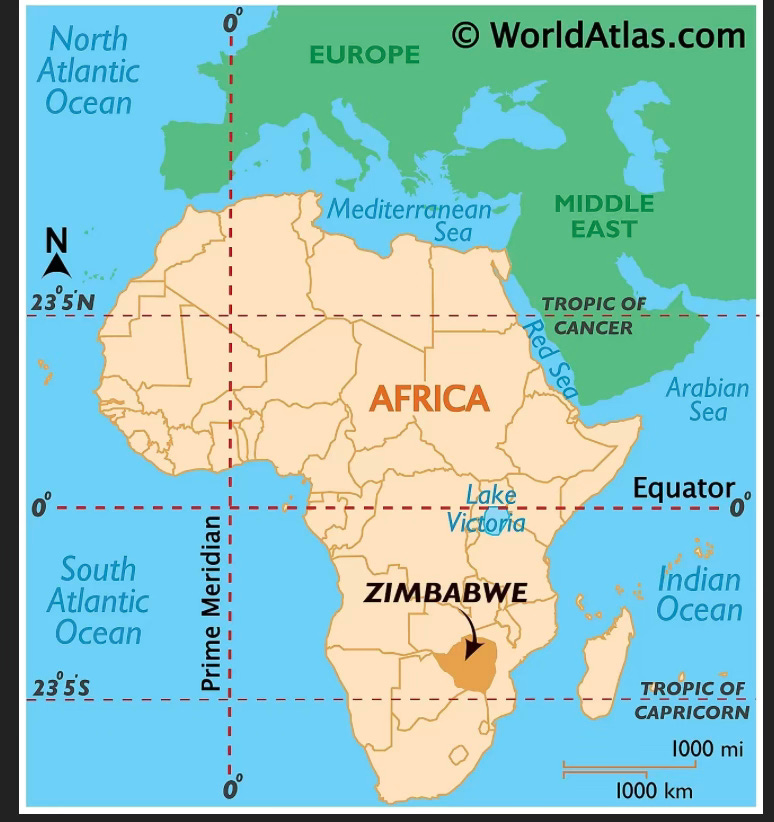
Alt text: A screenshot of a map from WorldAtlas.com that shows the continent of Africa and a lot of country borders drawn on a beige field. Zimbabwe is written in black, with an arrow pointing to a country in the southern portion of the continent. That’s where Zimbabwe is. But wait—holy subscriber pitch, Batman—if this map feels too, you know, accurate, please consider becoming a paid subscriber and grabbing a “Wish You Were Here: July 26 2026 US State Department Map of Africa Commemorative Fridge Magnet. There’s even a bulk order option coming, by special request. Though it is a wee bit wonky. And if you’ve ordered, I see you. It’s coming. Seriously folks, every one of you who is able to pay makes an enormous difference.
The US started down this ill-advised path after the government of Zimbabwe halted negotiations with the US government for US$367 million of US State Department-administered funding under the America First Global Health Strategy (AFGHS) in December 2025. News of Zimbabwe’s exit from AFGHS negotiation broke in early 2026,3 around the same time that The Atlantic’s Hana Kiros reported an internal State Department email that listed Zimbabwe as one of the countries that would lose all of its humanitarian aid in the coming year, as part of a “responsible exit.”4
Even with all this, CDC Zimbabwe didn’t need to close down. Appearances and ambitions to the contrary, the State Department does not have a mandate to manage the US CDC global health program, which operates in countries all over the world. A signed Memorandum of Understanding with the State Department is not a prerequisite for CDC funding. Nor, for that matter, are formal diplomatic relations between the US and a given country. The United States government does not have formal ties with Bhutan,5 but in 2025, CDC made a US$ 800,000 award to the Bhutan Ministry of Health for activities related to influenza viruses and global health security.6
The CDC global health program needs autonomy from US foreign policy activities. Viruses and bacteria do not observe geopolitical borders. Global health security investments are selfishly altruistic. US investments in labs and health systems in other countries make people in America safer, too. This is not pure humanitarian aid—if such a thing exists at all.
CDC no longer has this autonomy, because the State Department, which controls roughly three-quarters of the CDC global health budget, has shifted how it dispenses these funds. (CDC directly controls roughly $700 million for global health work tuberculosis, immunization, parasitic diseases and malaria, and global health protection that is appropriated by Congress via the “LHHS” bill.7)
For years, State received money appropriated by Congress for the President’s Emergency Plan for AIDS Relief in its Global Health Programs (GHP) account. It then transferred a lot of that money on to the agencies, including CDC, USAID and the Department of Defense, that actually did the work.
PEPFAR’s architects gave State control over the GHP account back in 2003 because State did not run programs itself. Back then, State had no conflicts of interest. Its senior leadership had not helped destroy USAID, and then nom-nom’ed a handful of USAID’s grants and former staff.
The Department’s leaders had not opted for no-bid awards and closed-door decisions about funding for technical activities under the purview of other agencies.8 Back then, State was a diplomatic outfit that understood that pandemics destabilize societies, and political will is required for effective health responses.
That was then. This is now.

Alt text: A blue furry puppet with two googlie eyes and a big open mouth holding a couple of giant chocolate chip cookies with lots of crumbs flying around. That’s Cookie Monster, who might be saying, or thinking, Nom nom nom. When I was much, much younger I told my father that I thought the puppeteer who made Cookie Monster move was very lucky because they got to eat all the cookies. My dad said that no one ate the cookies. He told me to look closely and see how all the cookies got broken into pieces and thrown around, and went into the puppet’s mouth at all. I thought I understood artifice and I didn’t. I thought someone was getting the treat and they weren’t. What on earth are we breaking here? Is anyone enjoying anything? It all seemed (seems) like an enormous shame.
Now, the State Department is intent on running all of US foreign assistance and, instead (or in spite) of clocking that it is understaffed, overwhelmed and behind schedule in implementing America First Global Health Strategy agreements, it’s continuing to dismantle systems and programs that could, you know, help. CDC has a host of ongoing “mechanisms” (awards to implementing partners to do work) that have provided lifesaving continuity of care—and could continue to do so as the timelines veer off schedule. But State is, by many accounts, intent on taking control of as many of these mechanisms as possible, and is actively seeking bids for work that the CDC used to do.
Beyond that—and most relevant for the Zimbabwe situation—State leadership has decided that CDC won’t get a substantial interagency transfer from GHP anymore. Instead, CDC will get its funding when AFGHS-funded countries buy its services from a “fee schedule” menu.9
As of now, if there’s no AFGHS agreement, there’s no money for CDC services from the GHP account. Zimbabwe doesn’t have an agreement with the US State Department for continued health funding under the America First Global Health Strategy. CDC can only get GHP funds when a country has an AFGHS agreement. The entire CDC Zimbabwe budget came GHP. Zimbabwe CDC is closing down.
There is absolutely a conversation to be had about why CDC Zimbabwe or any other program was wholly dependent on PEPFAR funding if, as I’ll explain later on, this program is important to national, regional and global health security.
There’s also a conversation about the size of the CDC global health program budget overall, and about where this money comes from. the allocation of funding at the country and headquarters level.
But State isn’t having these conversations publicly (or privately, to the best of my pretty good knowledge). It isn’t looking at the risks of exploiting its mandate to control GHP transfers in ways that result in the closure of CDC global programs. And it isn’t exploring alternatives like planned off-ramps or—what was that phrase again?—responsible exit.
And if State isn’t having these talks, then, for this post, neither am I. The devil is trying to distract us with details about conversations that only make sense if they happen before you start to crumble the cookie. Not today, Lucifer. This is the bottom line:
The State Department should no more control the fate of CDC global programs than the Department of Health and Human Services should determine when to open and close US embassies.
The closure of the Zimbabwe CDC program is the result of a blatant overreach of one agency into another agency’s core functions. It’s happening at a time when neither CDC nor its parent institution, the Department of Health and Human Services, has strong, credible, qualified leadership. Even after Hanta and cyclowhatever and with ongoing Ebola, most people who pay taxes in America do not understand how the CDC’s work thousands of miles away makes them safer. But it does. And State is exploiting a vacuum and taking actions that may well take that safety away.
In Zimbabwe, this means shutting down a 26-year-old endeavor that has been instrumental in supporting national progress toward ending HIV as a public health threat in a country that was once decimated by the disease. In 2001, prior to the availability of antiretroviral treatment, HIV had driven Zimbabwean life expectancy down to 44 years. At the point that the Trump Administration undertook ‘creative destruction’ of foreign aid, life expectancy exceeded 60 years, and the country had moved close to control of HIV as a public health threat.10
I could write an entire post about the consequences of closing the CDC Zimbabwe program focused solely on the risks to babies, young people and adults of diverse identities who are living with and at risk of HIV. It is morally repugnant, enormously wasteful and epidemiologically unsound for the US to abruptly walk away from its HIV program partnerships in Zimbabwe without a sensible transition.
But it is also ultimately the Zimbabwean government’s responsibility to steward and fund these programs, including finding new or different resources to fill urgent gaps identified by people most impacted by inequities. Some of the local coverage of the Zimbabwean decision to walk away from the negotiation table has focused on the need for independence from donor aid, and increasing national sovereignty. How a transition happens, and how high-income countries whose wealth derives from generations of extractive colonialism and ongoing exploitative capitalism play a responsible role in this transition is yet another conversation for another time.11
But there is a conversation to have here and now the true danger of State using a budgetary loophole to destroy investments in US and global health security. That’s the self interest part. And State is doing that by creating the conditions in which CDC Zimbabwe will close.
The US CDC Zimbabwe program has, over the years, supported the establishment of a national network of laboratories that have the capacity to diagnose and determine the genetic sequence of disease-causing agents that are known, like HIV and tuberculosis, and ones that are not. It has helped set up wastewater surveillance initiatives that supported rapid, simple detection of public health threats at the population level, trained local epidemiologists and mobilized frontline responses to cholera and tetanus outbreaks. This program, that the State Department has allowed to shut down, is part of a global network of defenses against outbreaks of known or wholly novel pathogens.12
All of these activities are good for the Zimbabwean health system and the people who access it. They are also good for regional and global health security. Functioning labs, trained staff, and sufficient supplies of reagents (the consumable stuff needed to run lab tests and diagnostics) are all foundational to being able to detect and respond to new diseases that can start anywhere and spread everywhere.
When the CDC Zimbabwe program ends, the hardware and infrastructure may endure: machines, equipment, buildings. Some government-supported staff supporting labs and surveillance probably will, too. But the technical expertise, training, maintenance contracts and reagents could all vanish.
If labs run out of reagents, or personnel do not keep up to date with their training, or the wastewater surveillance system falls into disrepair or the rapid response to the next local outbreak doesn’t happen—that hurts everyone, everywhere.
And if this capacity is maintained, US health security can still suffer. When the US withdraws, other partners can fill the vacuum. Other countries, including those with which the US is in direct geopolitical competition, can step in with support for surveillance that leads to access to valuable genetic information and a head start on the vaccines or tests needed to respond to the new outbreak which will, I promise you, come.
It did these things with PEPFAR money, because health systems that work are good for HIV. You can’t actually have an effective HIV response without sufficient high-quality labs supporting genomic surveillance and timely, accurate viral load, CD4 and HIV testing; nor can you have one if the community doesn’t trust you—which they will not if you ignore their kids who are dying from cholera and say, hey, we’ll be here for you if your baby survives and ends up getting HIV. Who does that? No one. No one does that. Not even once.
State is at its most harmful and hypocritical when it comes to the planned termination of the local staff. As I’ve said in the footnotes, and will say again: I haven’t spoken to CDC Zimbabwe staff for this piece. They’ve just gotten retrenchment letters. They’re processing what’s just happened and, perhaps, looking at finding new roles after years and years of work with the same team. No one in those circumstances should be talking to a journalist.
But there’s enough information out there in the public domain to get a sense of the accomplishments of the program team. I found a 2019 CDC Zimbabwe annual report with an organization chart with staff and roles13, and then did some spelunking around current LinkedIn profiles. Based on this, I believe the staff that received termination letters include the Laboratory Branch Chief, a Zimbabwean citizen who describes accomplishments including “the integration of genomic surveillance into public health responses, notably enhancing COVID-19 detection and containment efforts” and “implementation of the Zimbabwe National Laboratory System Strengthening program, achieving ISO 15189 accreditation for 15 laboratories.”
In plain language, this means the US just gave a notice of termination letter to a Zimbabwean scientist who helped build national systems for quickly decoding the genetic structure of circulating viruses—so that new strains or entirely new diseases could be readily identified. This person also helped make sure that 15 laboratories around the country met international standards for accuracy, timeliness, and reliability
I don’t know the Zimbabwean local CDC staff, but over two decades of reporting on US foreign aid and HIV funding in East Africa, I’ve met their counterparts in Uganda and Kenya. These are some of the smartest, savviest public health professionals in the world. They speak fluent “US government” and “national government.” They explain one to the other. They manage priorities and practicalities. They have the trust and respect of government counterparts because they went to school together, know each other’s families, remember what the country was like before HIV treatment came—when everyone around them was dying. They are brilliant public health experts with deep knowledge of local conditions who are often also incredibly funny. Though none of the staff I’ve known would support me using this phrase: they just get shit done.14
They’ve now been told their jobs are ending. If that is not waste, fraud and abuse resulting directly from decisions made by an administration that scoffs at international partners and claims to value local expertise, then I do not know what is.
CDC Zimbabwe is the first program to be shut down by State; it will not be the last. South Africa is expected to follow on its heels, again as the result of a unilateral decision made by President Trump and Secretary of State Rubio to end all foreign aid to South Africa that flies in the face of every single crumb of evidence for the enormous benefits to the United States of the partnerships and programs that CDC and other US government agencies built there.
Want to fix this?
Let’s go.
Give more money directly to CDC. Recognize that State control of GHP is now a conflict of interest that undermines US national security. Require State to keep all global CDC programs open that would otherwise close due to withholding of GHP funds until a transparent assessment of risks to national, regional and global health security is conducted. Develop transition plans for shutting down programs when that is warranted. Assess the vulnerabilities that America will face when it slashes its CDC presence in southern Africa after both the CDC programs in both South Africa and Zimbabwe shut down.
Do this all with leadership from the local staff. They know what to do.
But also: get good leadership into HHS and CDC, and rotten political leadership out. And do not wait for this transition to re-establish the lanes for US government work related to foreign policy and global health. Tell the State Department that it can open and close embassies, not laboratories. Tell them that if the insanity stops, they can all have some cookies.
I did not speak to anyone working for CDC Zimbabwe for this story. Im gonna repeat this a few times, because it really matters and because I am fresh back from AIDS2026 where, “Hey who are your sources?” was a surprisingly common conversational gambit. While I won’t tell you who they are, I will tell you who they’re not.
This is the “Planning Level Letter” that includes the PEPFAR program budget in Zimbabwe, including the notional amount for FY2025—the last year this level of basic government transparency existed. https://www.state.gov/wp-content/uploads/2023/02/Zimbabwe-COP-ROP23-PLL-02_15_2023.pdf
https://www.theatlantic.com/health/2026/02/trump-state-department-ending-aid-seven-african-countries/686106/
https://2021-2025.state.gov/countries-areas/bhutan/?safe=1
https://www.federalregister.gov/documents/2026/08/05/2026-15903/notice-of-award-of-a-sole-source-cooperative-agreement-to-fund-ministry-of-health-bhutan-national?utm
LHHS stands for “Labor, Health and Human Services, Education, and Related Agencies Appropriations Bill.” This document shows the breakdown of LHHS-appropriated fund for CDC global health work; there are other funding sources from CDC domestic programs, but it’s a good general idea.. https://www.cdc.gov/budget/documents/fy2026/FY-2026-CDC-Operating-Plan.pdf?utm
No Bids, Big Risks: State’s New Slew of Sole-Source Global Health Awards
·
Jul 22

The State Department is swiftly moving many organizations through a no-bid process for America First Global Health awards that will use a tricky, sometimes downright risky, funding approach called ‘fixed amount awards.’ Like so many things that State has gotten up to in its global health activities this year, the rationale is fairly solid; the process s…
America First Global Health Guidance Launches Fee-for-Service Coup Against CDC
·
May 7

The Department of State is turning the US Centers for Disease Control and Prevention’s global HIV program into a disempowered, McKinsey consulting firm-esque entity that will receive resources at the whim of politically appointed Department of State leadership. Released to government staff yesterday, the new “Guidance for U.S. Government Operations Unde…
This talk by a former director of CDC Zimbabwe has the life expectancy statistic I mentioned and it is an excellent, instructive example of a post-2025 narrative structure I’m trapped in and still trying to figure out (you can say that again, groan the people who bother to read the footnotes): explaining what the US investment in global HIV was so that people might actually care that it is being systematically destroyed while there is still time.
For a really jaw-droopingly, heartbreakingly good conversation on coloniality (the Brits say that, ferreal), its afterlives, and attendant geopolitical obligations, please check this out:
hhttps://www.cdc.gov/global-health/countries/zimbabwe.html
https://archive.cdc.gov/#/details?url=https://www.cdc.gov/globalhealth/countries/zimbabwe/annual-report/index.html
And yes, this stack’s song is for you.
You do such a good job. Not gonna clap you out til I have to because who knows who’s reading. And yes, kids, I do know what cookies mean.
No posts
Comments
Nothing yet. Say the first thing.
Sign in to join the conversation.