
The Department of State's June 5 funding announcement for Nigeria is the clearest sign yet that State is taking over activities that, for years, have been led by the U.S. Centers for Disease Control and Prevention. Addendum D: Health Foreign Assistance Memorandum of Understanding (MOU) Implementation in Nigeria invites applicants to submit proposals for functions identical to those that the US CDC has directly funded and implemented for years.1
The State Department’s US global health security strategy already includes the bold gambit of having foreign countries determine the budget and footprint of CDC offices around the world. According to State’s published answers to questions from prospective applicants for its Rapid Outbreak Response funding opportunity, and to the America First Global Health Strategy, the State Department prefers not to specify:2
priority geographies
priority pathogens
an official definition of “outbreak”
preferences for the operationalization of “rapid outbreak response”
preferences for approaches that build on existing country capacity
preference for innovation
preference for pre-positioned in-country response capacity versus global surge capacity
Having established that it can do what it wants, the Department of State reveals, in the Nigeria Addendum, that it wants to fund many of the same functions that CDC has long supported through the partnership with Nigeria Centre for Disease Control and Prevention that also helped avert an Ebola catastrophe in 2014.3
Twelve years ago next month, a man with Ebola got off a plane in Lagos, Nigeria and made his way into the city. The outbreak was well underway at this point, but no one carrying the easily-transmissible, highly lethal virus had been diagnosed in Nigeria. At this pivotal moment, US CDC-trained Nigerian epidemiologists and Nigerian labs supported with US CDC resources swung into action with speed and expertise that stopped spread in its tracks. The US CDC supported half of the units in the Lagos State’s Emergency Operations Center.
That was then, this is now.
As the excerpt below shows, State is looking for groups to help with Public Health Emergency Operations Centers. The Government of Nigeria has a national network of PHEOCs that CDC helped set up.4 State also wants to find groups who can build workforce capacity and specimen transport systems. The US CDC has, to date, helped train more than 2000 epidemiologists and frontline responders.5
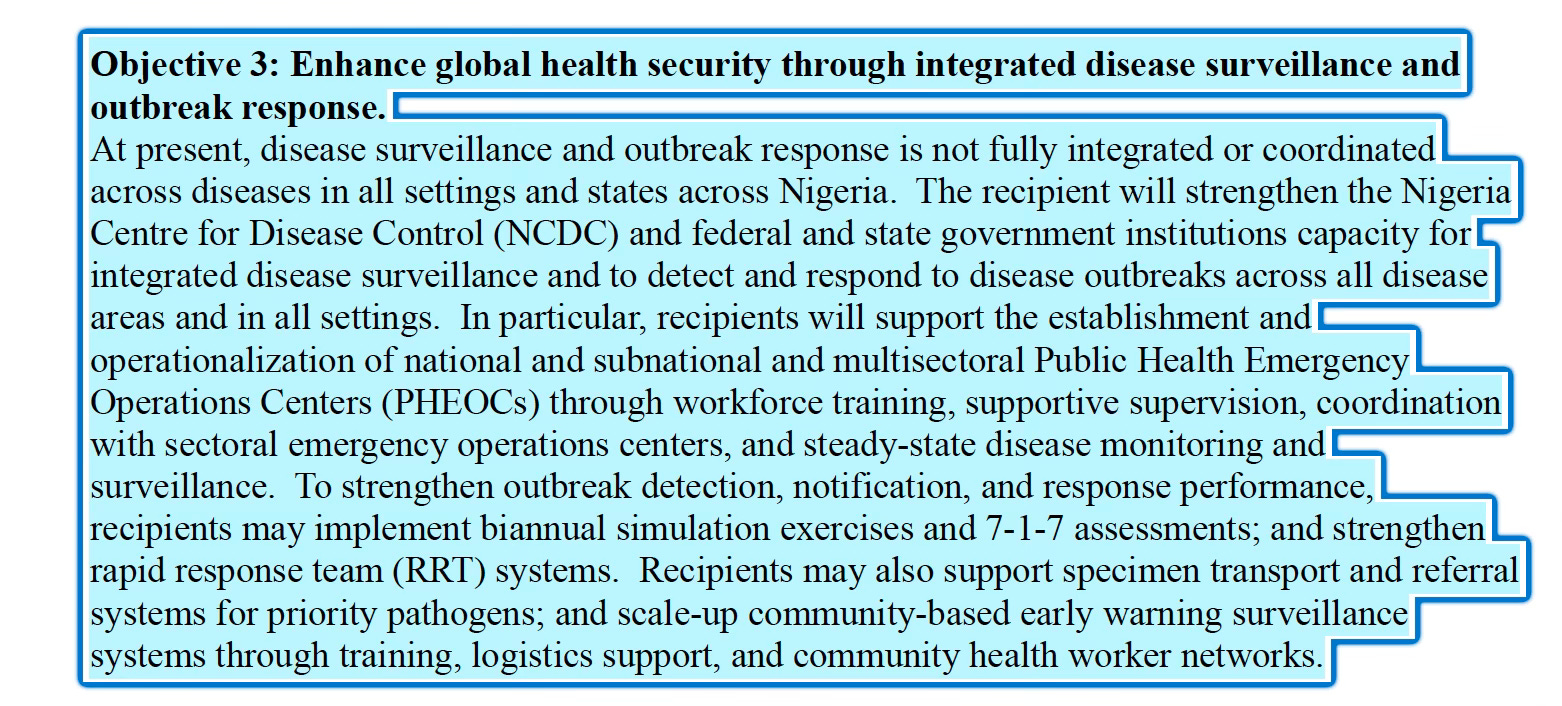
Alt text: A screen show of the Nigeria Addendum (full text in pdf at the bottom of this post) highlighted in blue. Why blue? Because it is raining and cloudy where I am, otherwise on vacation, getting this post off and out to you. Because there is a melancholy to this subject matter (hello Joni Mitchell), also a sameness (hello Yves Klein), but, we must insist, not a numbness. Never a numbness. Because blue is the dominant color in the Knicks’ away uniforms and they did it in San Antonio, didn’t they? They did it in five. aDid I mention I am on vacation? It is also my birthday in two days. If you’re a fan of alt text captions, footnotes, my melancholy chronicle of the dismantling of America’s health security, my musical taste please subscribe if you have not already. Platform is precious. And if subscribed: please become a paid subscriber if you can. It is a gift, always.
As I’ve previously covered, these SOIs will be evaluated by a State Department-convened Merit Review Panel whose voting members are “representatives from GHSD policy and program teams.” Non-voting subject matter experts and interagency colleagues may also be invited to the MRP.6
GHSD includes several staff with subspecialties and significant expertise in global health security, including in some of the areas listed in the Addendum. But the bulk of the technical expertise and know-how for this work sits in Atlanta and in the countries where foreign service nationals (local employees of the US government) have extensive, invaluable skills and context-specific insights.
Indeed, the US CDC is still planning to make and manage awards to Nigeria for global health security-related work using funds that are directly-appropriated to the agency by Congress, including a currently forecast opportunity for USD$ 25,000,000 to support state and local Nigerian capacities and workforce to respond to health threats.7
But the State Department wants to manage as much global health funding as it possibly can. Its implementation guidelines stipulate that if the State Department can access capabilities through its own funding streams that are presently supported by other agencies, “transition to the Department of State mechanism should be prioritized over utilizing the existing non-Department of State mechanism.”8
Objective 3 in the Nigeria Addendum could well be a way to ensure that State has its own means of accessing CDC-aligned capabilities. But there is no guarantee that CDC will be the selected awardee. Under the AFGHS approach, these capabilities could be parceled out among a range of awardees, including the American private sector solution-providers who’ve been favored to date.
The same week that the Nigeria Addendum was released, Secretary of State Marco Rubio spent two days on Capitol Hill in hearings on the State Department budget. Sadly, Congress did not press the Secretary about the potential risks of the Department of State serving as America’s self-appointed global health security provider. For completely understandable, heart-wrenching reasons, our elected officials focused on the deaths and suffering caused by the destruction of USAID.
But the future is also frightening. Putting the Department of State in charge of awards for Public Health Emergency Operations Centers is like putting the Department of Education, of blessed memory, in charge of awarding contracts for US Army ballpoint pens. Sure, DoE knows (knew) a thing or two about these kinds of supplies, but the military probably knows better.
Having State and CDC run complementary, parallel or plain old duplicative global health security programs in Nigeria, or anywhere else, increases the risk that important things won’t get done, key information won’t be passed on, and frontline first responders will not be where they should be when the next outbreak happens—or when the ongoing Ebola public health emergency shows that travel bans, off-shore quarantines and inflatable hospitals do not a secure America make.9
In addition to Nigeria, State has also published addenda for Malawi and Uganda. Malawi’s addendum is particularly interesting because its MoU is not in the public domain, so the funding opportunity notice is the first look at detailed areas that covered in that agreement. All of the countries’ plans also include requests for applicants to provide faith-based and community-based services, and the awards made in this section will be crucial to watch given the disastrous erosion of community-based services for lifesaving public health activities over the past year.
I’ve put all of these addenda at the bottom of this post because they disappear quickly off the website once the deadline passes, and it will be important to cross-compare if and when awards are made. (Hey, speaking of disappearing documents. Check this out!)10
Today, June 17, is the deadline for submitting questions to the Department of State for country-specific funding opportunities. For folks putting together questions, perhaps consider these queries:
When did funding disease surveillance, emergency operations centers, and outbreak response in Nigeria become a diplomatic function?
And this one:
After two decades of CDC-led investment in disease surveillance and outbreak response including in Public Health Emergency Operations Centers, with planned continued activities, what is the justification for the Department of State also making awards in this arena?
Also:
In 2014, CDC-trained Nigerian epidemiologists helped stop Ebola after an infected passenger arrived in Lagos, tracing hundreds of contacts before the virus could spread. How will the State Department ensure that its selected awardee(s) will match the speed, technical expertise, and public health credibility that made that response possible?
If anyone asks why you put them in, tell them, “Emily asked and it’s her birthday.” Or “Because I care about the health security of my neighbors, my elders, my children and my friends.” Maybe the second one, come to think of it. Or maybe both.

Malawi-Specific Addendum for Funding under America First Global Health Strategy
248KB ∙ PDF file
Nigeria--Specific Addendum for Funding under America First Global Health Strategy
238KB ∙ PDF file
Uganda--Specific Addendum for Funding under America First Global Health Strategy
227KB ∙ PDF file
https://files.simpler.grants.gov/opportunities/6ac54adc-9e94-426c-be86-3719e2ca2f58/attachments/2d3ec13d-8ac9-41cd-aff9-31eb4941069d/DFOP0017890_Advancing_Global_Health_APS_Addendum_D_Nigeria_2.pdf
Q and A are standard fare for funding announcements advertised by the US government. After a notice goes up and before the deadline for applications, interested parties submit queries and the government publishes its answers to all of them. I’ve looked at quite a few and I’ve never seen anything quite like this Q and A doc, which includes questions related to the first Addenda (funding notices) for child-protection related work, rapid outbreak response and the Philippines. Many answers are non-answers referring back to the limited information available in the original addenda. It is not unheard of for the funder to decline to provide more details; it is also precedented for the funder to address technical queries such as definitions, priorities, scoring criteria—all of which State declines to address in this context. Every country with a national health security plan has a list of priority pathogens that it is working on; and the US has a list of countries that it funded as part of the Global Health Security Agenda, through 2025. The Q and A declines to identify priority pathogens on four separate occasions, and priority geographies on two occasions in the rapid outbreak response section.
https://link.springer.com/article/10.1186/s12889-017-4535-x
https://www.epidemic-em.org/static-documents/Nigeria%20Case%20Study%2001.06.2021.pdf?utm
https://www.cdc.gov/global-health/media/pdfs/Nigeria_factsheet.pdf
https://files.simpler.grants.gov/opportunities/3bfffcd2-b0c6-478b-8714-7acd6d4e75c8/attachments/64755b0d-72ce-4f87-bd3f-fe6a03f9c464/DFOP0017890_GHSD_Advancing_Global_Health_APS_Amended_as_Highlighted_6-11-2026.pdf
https://simpler.grants.gov/opportunity/790f847d-65a1-4a11-949a-b239a1b4d4d4
https://edition.cnn.com/2026/06/16/africa/drc-ebola-cdc-intl-latam-afr
Huge, repeat tip of the hat to the eagle-eyed team at Public Citizen for spotting that the Department of State has published several specimen-sharing agreements on its website. PC found the MoUs that appeared for five days or so on the State website and held on to them when they disappeared from there. They’ve done the same with these docs. I am grateful to them and excited about a collab I’ll say more about in a post soon!
https://www.state.gov/2026-tias/
https://www.citizen.org/article/u-s-bilateral-health-agreements-case-act-reporting/
No posts
Comments
Nothing yet. Say the first thing.
Sign in to join the conversation.