
Hello and welcome to a pre-vacation Substack! It’s now or never. My local drug store is selling Halloween decor. So I’m going on a late-Northern-Hemisphere-summer hiatus for two weeks, and I’m leaving the Stack behind. Keep an eye on it, alright? Given that there’s a lot happening, and in order to increase the odds that I stay offline, this is a three-in-one post.
“Parallel Systems 2.0”: How the America First Global Health Strategy is developing the duplicative, disparate reporting systems it claims to hate.
Two More CDC Global Offices To Shut Down by the End of September: Angola and South Sudan join Zimbabwe in closing without consideration of global health security risks due to State Budgetary Control
New Addenda Detail State’s Expansion into USAID’s old Turf of Nutrition, Neglected Tropical Diseases—and What Appears to be CDC Mexico’s Entire Portfolio: I don’t even need a subtitle for this item. #gotitinone!
Groups funded under the America First Global Health Strategy will collect data on metrics different from those in the Memoranda of Understanding and report that data separately from country governments in order to get paid—creating exactly the kind of incoherent, duplicative reporting environment the strategy’s architects say they set out to destroy.
This has been inferable for some time. But an answer buried in the recently-published Advancing Global Health APS, Round 2B Q&A1 brings this reality fully into the light.2 Question 108 contains the exchange in question, which is so delicious I’ve reprinted it in full below:
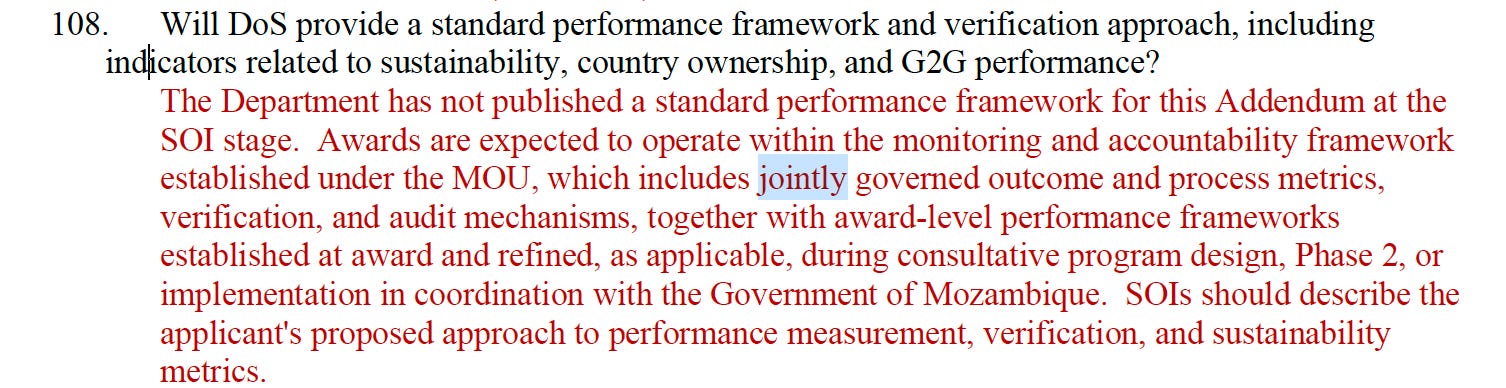
This question relates to the Mozambique “Addenda” (a request for statements of interest related to specific projects that was issued in July.) In plain language, the questioner wants to know: how will my organization’s work be evaluated if we succeed in winning the bid? How will you assess whether we performed well, and how will you make sure that our own reports of performance are true?
In plain language, the State Department says: You’ll do the work in a country that has a Memorandum of Understanding, which has its own metrics and agreements about how progress will be assessed and reports validated. But you’ll also have your own framework for reporting to us. It also says: we will make up the milestones for awards on a case-by-case basis, taking your suggestions about how to measure and verify performance.
In plain language, I say: this is a parallel and fragmented system. Countries with Memoranda of Understanding will make reports on progress toward their process and outcome metrics. Entities receiving awards under the APS Addenda, or via sole-source, no-bid contracts, or via the new faith-based initiative will make reports on progress toward the performance milestones that will, in many cases, be used to trigger payments.
.
There will be two reporting streams and, because every awardee will be able to make up its own evaluation and measurement approach, an array of different milestones and approaches to verification.
We3 know that the performance milestones will be adapted per award because the AFGHS “Milestone Library” says so. It literally says, “this is meant to be a reference tool, not a menu that must be selected from.”4
So, for example, an awardee might take the exemplar milestone, “number of individuals newly-initiated on PrEP” and refine it to be “number of adolescent girls and young women newly-initiated on PrEP” or “number of people living in towns and trading centers on or near borders newly-initiated on PrEP.” You’d propose a target—say 3000 people in six months or sooner—and ask to get paid when you attain that goal.
Your target will contribute towards the country’s overall PrEP target—which will be somewhere in the implementation plan, since PrEP initiations are not included in the process and outcomes metrics in the MoUs.
But you, the awardee, will not get paid on the basis of country reports because the US government has expressly stated that countries should not report results by partner or sub-national geography. This is supposed to make things easier and simpler for countries, and perhaps it does. But it also means that virtually every awardee—including local government entities that compete successfully for awards under the APS, as they are eligible to do— will make its own separate reports using whatever bespoke milestones are checked out from the Milestone Library.
If you’re operating in six districts or 12 clinics, you’ll develop a system for showing clearly that you did the needful in those places or at those sites. In some instances, you might be able to report on your milestone using government data; in many other instances, you will not. You’ll have your own collection tools, databases and monitoring and evaluation staff that operate in parallel to government systems, staff, tools and databases.
This level of complexity isn’t readily apparent in the ways that Bureau of Global Health Security and Diplomacy (GHSD) leadership describe the America First Global Health Strategy approach. At the GHSD pre conference at AIDS20206, Acting Assistant Secretary of State for Global Health Security and Diplomacy Jeff Graham said, “So we asked our partner governments […] in each MoU, where do you want to be in 2030 in terms of national data systems? And those answers are elucidated by the partners themselves, we didn’t write them.”5
It’s not that this commitment isn’t real or genuine. It’s that, even as GHSD is working to support country-owned data systems, it is also creating a parallel reporting system for entities receiving awards via the APS Addenda, sole-source, no-bid awards to USAID greenlisted awardees, and new initiatives like the faith-based mechanism.
It has to be this way.
By definition, a performance-based milestone is completely within the awardee’s control. By definition, national health systems are not in the control of World Vision, FHI360 or any of the other entities receiving major awards. AFGHS has pivoted hard to performance-based payments and so it has to create a parallel system for receiving reports that will trigger payment. It’s decided that these milestones shouldn’t be based on common indicators—even though they used to be. It’s a new, fragmented parallel system and the author of the answer to APS Q&A 2b, question 108 confirms this.
Well, Emily, we had a parallel system before, and we have one again. Now at least countries are in charge of one of the systems—the one that’s supposed to take over in the end. Can’t you give this a rest and find another funny map?6
Sorry, but no.
Because the old parallel system–the one that existed under PEPFAR–did two things that the new parallel system does not. First: it supported a real, thoughtful analysis of national, regional and global progress in the fight to reduce preventable deaths, new infections and avoidable suffering associated with HIV/AIDS. Second, and highly related to the first: the old parallel system supported reporting to Congress about what the billions of dollars appropriated for global health foreign assistance were actually doing. And this reporting was so successful that Congress appropriated money over and over again.
In other words: not all parallel systems are created equal. And the one that State has made won’t be as useful for tracking public health progress and, it won’t be convincing to any Congress that is interested in tracking this progress or, more generally, in accountability.
Let’s7 call the President’s Emergency Plan for AIDS Relief “Parallel System 1.0,” or 1.0 Parallel, for short.
The 1.0 Parallel was based on something called Monitoring, Evaluation and Reporting (MER) indicators.

Alt text: A parade float with a big sculpture of a mermaid whose hair looks like the ocean but also has pearls in it, or maybe that’s sea foam, with a couple of tattoos on her arm. There are humans behind the statue dressed like, I think, pirates. And an elevated subway train on the right side. This is a picture from the Coney Island Mermaid Day Parade. In the past year of trying to explain why I am freaking the eff out about the new approach to data collection and use, I have noticed that the phrase “MER indicator” is a complete buzz kill. People who otherwise seem to want to get on the elevated subway train of urgency and consternation that I ride from one end of the line to the other start to look anxious to get off at the next station. What if, I have thought in my desperation, MER indicators had a rebrand before it’s too late. What if we make it about merfolk? What if we had a parade? Mermaid, merman, merindicator? Please don’t pull the emergency brake.
MER indicators were the same everywhere. Every country reporting on the indicator for people with HIV starting on treatment (Tx_New) defined the indicator in the same way. PEPFAR Country Operational Plans included targets measured in terms of these same indicators: a goal of starting 1000 people onto antiretroviral treatment would be expressed as 1000 Tx_New. PEPFAR country programs shared their MER data on a quarterly basis. Annually, MER data were also used as the basis for the program’s legally mandated report to Congress.
MER data were gathered in parallel to national country data–but often MER data, which came from a subset of the provinces or districts in a given country, were fed into national systems, and the people that were paid to gather, enter, clean and analyze the data were also doing the same thing for the national system. 1.0 Parallel was separate but closely intertwined.
Under Parallel 1.0, PEPFAR went through an annual internal and collaborative process to understand how MER data aligned with the data that the country was collecting through its own system. UNAIDS participated in this harmonization exercise that identified areas of discordance needing follow up, and ultimately strengthened confidence in the numbers used to track the country’s overall progress toward public health milestones. UNAIDS also used the numbers generated by Parallel 1.0 to power its models for epidemic and pandemic trajectories.
So, under Parallel 1.0, one category of indicators was used to:
Track progress and identify challenges in addressing major public health threats;
Assess program and partner performance
Demonstrate the impact of American taxpayer dollars to the lawmakers with the power to authorize and appropriate funding for the program year after year, and
Support more accurate national analysis and global modeling.

Alt text: A pair of images, one of which is a person with dark curly hair wearing a black suit on his hands and knees on the beach, squinting into the sun. The other is of a blonde person with a lot of floaty hair and a fancy necklace underwater giving off strong mermaid vibes. These are both images from the movie Splash. IMDB summarizes the movie’s plot as: A young man is reunited with a mermaid he briefly encountered as a boy and falls in love with her without knowing her secret. I really love how much is happening in this sentence. What if Darryl Hannah (the necklace-wearing mermaid) was the new spokesperson for good data collection?
Under Parallel 2.0, the country government will report on the achievement or failure to meet annual process and outcome metrics. These reports will be national and aggregated. The metrics themselves are poorly formulated, and many countries’ metrics tables are very close to nonsense.8 Nevertheless, this information will be used to meet all four of the needs I just described: track progress; evaluate performance; persuade lawmakers to maintain funding; and power accurate analysis.
Meanwhile, every other group with an award from the US government will make its own reports, primarily in order to substantiate their request for payment. These reports will not be against the annual process and outcome metrics–because these metrics involve conditions that the awardee cannot control.
These independently-collected data will be very much like the implementing partner level data collected under Parallel 1.0–except that this information will only be used for evaluating an awardee’s performance, and not for tracking public health goals, persuading lawmakers or contributing to a more accurate analysis of national and global trends.
This is what happens when business professionals build parallel systems instead of public health experts.
Business pros build systems in which the ability to assess whether a payment is warranted is paramount. Systems in which the most important thing is to generate a paper trail proving that the recipient of funds did what they said they were going to do. The ability to conduct and pass an audit is of the utmost importance in these systems. The public health validity of the metrics and milestones is of secondary importance. The value of the data collected to support other activities such as harmonization across different data streams, modeling and projections doesn’t matter.
Or it doesn’t matter–until it does. Until Congress says, hey, how exactly are you measuring a 0.2 percent change in the number of people living with HIV who are virologically suppressed, when the confidence intervals around every point estimate are miles wide? Or: this report looks great but I just read a Times article about how the wards are filled with people with advanced HIV disease. Or: why is the infant mortality rate higher in this country than it was three years ago, even though the country has hit its infant diagnoses targets year after year?
Because yes, even with the login credentials and access rights that the US government has demanded9, it is still possible that the data obtained from national systems and the actual lived realities of health and disease in a given population will be different.Eventually that difference will appear: first in babies and children, who die faster of HIV, malaria, vaccine-preventable diseases, and then in adults. And while some countries will succeed, others will not. And the ones that do not will want to get paid as much as the ones that do–so their reports will, I wager, look just fine.
I am not saying that it is time to go back to the MER system. I steadfastly refuse the premise that you can only point out a huge-ass problem that is also, let’s face it, an instance of hypocrisy, if you have a fix.
If we can live without US investment in global health going forward, and with a real uncertainty about the state of the HIV pandemic and its potential to return as a destabilizing force in many societies, then Parallel 2.0 is just fine. But if we can’t, we need to fix it. Maybe you can figure that out while I’m on vacation.
The US Centers for Disease Control and Prevention offices in Angola and South Sudan will close at the end of September, leaving both countries without a US CDC presence for the first time in 20 years. The four locally employed staff at CDC Angola reportedly received notices of planned termination in late July.
With the closure of Zimbabwe, which I covered last week, this makes three CDC programs closing in less than eight weeks without any public or transparent assessment of the risks to the local population, or to US global health security, associated with these abrupt exits. These closures are all a result of the Department of State’s decisions about how the CDC global health program receives funds from the Global Health Programs account that the Department of State controls.10
Both countries are places with a documented history of disease outbreaks that threaten local and global health security. In the past decade, Angola has had Marburg, Zika, Dengue, cholera, mpox, and yellow fever. The US CDC program, which was established in 2002, has helped with the responses to all of these outbreaks—sometimes via support from headquarters, but with the benefit of an office supported by locally employed staff.11
The CDC South Sudan office was founded in 2006. According to the WHO, “South Sudan is endemic to several zoonotic diseases and public health threats including rabies, anthrax, brucellosis, bovine tuberculosis, Rift Valley Fever, yellow fever, and Sudan ebolavirus species.”12 It borders the Democratic Republic of the Congo, the epicenter of a catastrophic ongoing Ebola outbreak. CDC is, for as long as it exists in country, the only US support for laboratories in the country. The CDC office worked with WHO, to set up the country’s first and only Public Health Emergency Operations Center.13 Due to the tragic and brutal ongoing conflict, the crucial work of tracking and diagnosing new outbreaks and monitoring communities for instances of animal-to-human transmission is incredibly hard. CDC was helping with that, too.
Both of these offices were funded by resources transferred to CDC by the State Department from the Global Health Programs account that it controls. Both are closing in the context of State’s decision to end the decades-long practice of transferring a portion of GHP to CDC Division of Global HIV and Tuberculosis (DGHT) for autonomous management.
I am not saying that CDC needed to be running PEPFAR programs of the same size, scale and budget in Angola and South Sudan for the foreseeable future. Angola has a large income and substantial revenue from oil that could be spent on health. South Sudan’s context makes operations incredibly challenging. Country ownership is indeed a good thing.
But it is also a strategic benefit to the United States to have CDC offices open and functioning in countries with the outbreak and epidemic profiles of Angola and South Sudan. If you wait until the pathogen is spreading to get into a country with public health assistance, you have waited too long.
The US military knows this. We have bases and outposts in strategic locations. Robert F. Kennedy isn’t allowed to close them. Neither is Marco Rubio.
Question: How on earth is the shuttering of three CDC offices in three countries with unstable public health and/or geopolitical environments where there is a real risk of developments of relevance to US national health security being allowed to happen?
Answer: This is what happens when business professionals get put in charge of public health programs.
Today (August 14), a whole bunch of new Addenda (see footnote 1 for the explanation) washed up on the shores of Simplergrants.gov14, including:
Addendum for Nutrition ($115,000,000, up to 12 awards, 12 countries)
Addendum for Neglected Tropical Diseases ($162,000,000, up to 25 awards, 32 countries across three regions)
Addendum for Mexico ($1,500,000, up to 2 awards)
These Addenda have the usual combination of resurrected USAID-esque programming and shameless expansion into CDC territory that we’ve come to know and love.
Charitably speaking, the Nutrition and Neglected Tropical Diseases Addenda make good on the State Department’s claim that the US isn’t exiting the foreign aid business altogether. Both seek proposals for work that was part of USAID’s core business for many years. Like all Addenda, these are designed to lower the barrier to entry for applicants and to increase statements of interest from private sector and entities that haven’t received foreign assistance awards in the past—all of whom will be selected by the Department of State via ‘Merit Review Panels’ composed by the State Department, with external experts invited at State’s discretion.
A few thoughts on each APS:
Nutrition
For the nutrition awards, it will be crucial to track how this funding flows to and/or complements the work of Operation End Starvation (OES), a relatively new charity and public-private partnership that just received a $ 100 million award from the State Department Bureau of Disaster and Humanitarian Response Assistance.15
A few months ago, Devex reporter Mike Igoe did a profile on one of the forces behind OES, a USAID veteran named Chuck Pope who told Igoe that OES is a solution to the State Department’s quandary of wanting to control all the money that USAID used to have, not having the staff to do so, and not wanting to “hand giant grants to United Nations agencies.”16
Indeed, OES describes itself as a “financing, governance, and coordination platform for procuring and delivering RUTF [ready-to-use therapeutic food] and prenatal vitamins.” If that doesn’t sound UNICEF or World Food Program-adjacent, I don’t know what does.17
To be fair, the US government also recently announced about US$ 1 billion for UNICEF and World Food Program. But this is a fraction of its contributions in 2024. The APS could bring additional partners that, like OES, have limited track records and big aspirations into countries where historically established programs supported by UNICEF and WFP are working with vastly diminished budgets.
Weakening country systems then entering with bilaterally selected partners who have bright ideas about doing the same things differently, who will, in some way, succeed even if they fail because the landscape is so devastated? It’s starting to sound familiar. But maybe it won’t be that way this time. Let’s wait and see.
Neglected Tropical Diseases
So here’s the thing. I was going to do a whole thorough read through of this APS but then I got to the list of targeted countries and saw—wait for it—South Sudan. If that doesn’t land, please go back to the CDC office closure story. If it does, perhaps you’ll understand why the rest of my write-up on this one is in a photo caption.

Alt text: A screenshot from a 2006 entry in a really great local neighborhood blog called Fucked in Park Slope.18 This is before AI. The blog title is “Attack of the Raccoons” and it is about the rascally things that raccoons get up to when they wander out of Prospect Park and into the neighborhood looking for treats. (Neigh, even cookies. Holy multi-post callback, Batman!) The picture shows the head of a raccoon poking out of a silverware drawer in a cramped New York City kitchen. There is a red arrow below the letters OMFG over and over again. I am not calling anyone a raccoon here. South Sudan is not a raccoon. The State Department is not a raccoon. The Addendum is not a raccoon.
THE STATE DEPARTMENT HAS JUST ENGINEERED THE SHUT DOWN OF CDC SOUTH SUDAN AND NOW WANTS TO FUND “STRATEGICALLY TARGETED NTD PROGRAMS THAT BOTH IMPROVE HEALTH OUTCOMES AND REINFORCE BROADER U.S. NATIONAL SECURITY, ECONOMIC, AND FOREIGN POLICY INTERESTS.”
Seeing South Sudan on the country list made me feel the way I did when I saw this raccoon picture. (And when I saw a parade of half a dozen raccoons on the fence outside my window later that year. There were no mermaid floats).
OMFG OMFG OMFG OMFG.
Mexico
At this point, we all know what I’m going to say, right? There is so much overlap between the Mexico Addendum and the 15-year-old CDC Mexico program that I’d say it defies description—except that it doesn’t, I’m just tapped out at laying out the details. Go on over to the Addendum and the CDC Mexico program page (both in footnotes) and you can see for yourself. Virtually every single activity area listed in the APS overlaps with work that CDC Mexico is already doing, with the exception of wastewater surveillance. The last time I checked, the Department of State was not central command for projects that check for the presence of pathogens in wastewater as a way to get early signs of outbreaks, including of asymptomatic infections. Then again, the last time I checked wastewater surveillance was also not supposed to be used to detect the presence of the drugs used in medical abortions by states seeking to control the bodily autonomy of women and other people who get pregnant.19
In this APS, State is looking for independent contractors to do work that the CDC Mexico Office has done, for years, in partnership with CDC's Division of Global Migration Health (DGMH), Southern Border Health and Migration Branch (SBHMB)—and it’s proposing to start wastewater surveillance for the first time. None of the CDC Mexico money was PEPFAR money—or CDC DGHT money. It’s hard to tell exactly where the money is coming from—in terms of the originating accounts. But it should be traceable once the awards are entered into USAspending.gov and the funds start flowing. But it will be crucial to watch this, as well as the ways that these awardees overlap with the Trump Administration’s local militia, ICE, and other enactors of its abhorrent anti-immigration policy.
How’d we do folks? Did we make it through this entire beast of a pre-vacation stack? Are you ready to be released from aspirational inclusion? So be it. I appreciate you so. Thank you for being here. See you in a couple weeks.
For people who’ve found better beach reads than I have, in the Q and A series, the Department of State reprints, verbatim, all of the queries submitted by potential applicants for awards for work in specific countries or on specific topic areas. Each country or topic area’s call for statements of interest is called an Addendum. The Addenda and the Q&A docs are really cathartic to read because, often, the Q&A has a really carefully, diplomatically phrased version of a question that may have come up, plus or minus expletives, during your own reading of the Addenda. Some of the questions are genuinely clarifying; a lot are extremely polite versions of “Can you tell me what is actually going on?” Because State adheres to the requirement to answer these questions with a timeliness that doesn’t happen in other arenas like, say, communications with Congress, the prompt, comparatively loquacious replies are a rarity and, to this info-starved spectator, a pure delight.
Here’s the link to the PDF. I recommend downloading anything you’re interested in there. The documents do not stay live for long. Question 108 appears on page 39 of my pdf reader, but there is no pagination in the document itself. That’s why the word “jointly” is highlighted in the screenshot. I lost the question and had to ‘control F’ on a word I remembered. Q: Could you make this easier for me, please GHSD? A: Where’s the fun in that? (Kidding. There wouldn’t be a reply). https://files.simpler.grants.gov/opportunities/37d48a94-29c7-4325-abb1-9924506444f3/attachments/32ff5682-ad72-4458-ac44-8041c63b1d8a/DFOP0017890_Advancing_Global_Health_APS_Round_2b_QA.pdf
Folks, I hate—hate—the use of “we” in this kind of writing. It presumes some kind of shared identity and agency and ability to influence or care that just doesn’t exist. “You” is also skeevy for the same reasons. And yet this Stack demanded second and third person plural, and I gave in because I realized I wanted company. I think that the GHSD approach to data collection, sharing, target-setting and performance evaluation is hands-down the most dangerous change to the program approach advanced by AFGHS. It imperils lives and Congressional support and the ability to ensure effective stewardship of taxpayer dollars. These things are related but not the same. I’m not sticking the landing on this one yet, or it doesn’t feel like I am, so I’ve resorted to aspirationally inclusive pronouns the way that I might, years ago, have sidled up to the cool kids and said, “Hey what are we doing this weekend?” Because sometimes, guess what, the cool kids turn around and say, “Hey Emily, glad you’re here. We’re gonna be losing sleep over the destruction of approach to tying funding to impact in global health. You wanna come?” I. Am. So. Down.
Emphasis (and decision to end a sentence with a preposition) in the original.
Before you slide into my LinkedIn DMs, let me be clear: I wasn’t at this meeting. I have a recording of the question and answer section, in which Acting Assistant Secretary of State Graham is identified by name prior to answering. The full quote is as follows: “So we asked our partner governments, we said, ‘You know, new data systems, for example, in each MoU, where do you want to be in 2030 in terms of national data systems?’And those answers are elucidated by the partners themselves, we didn’t write them.”
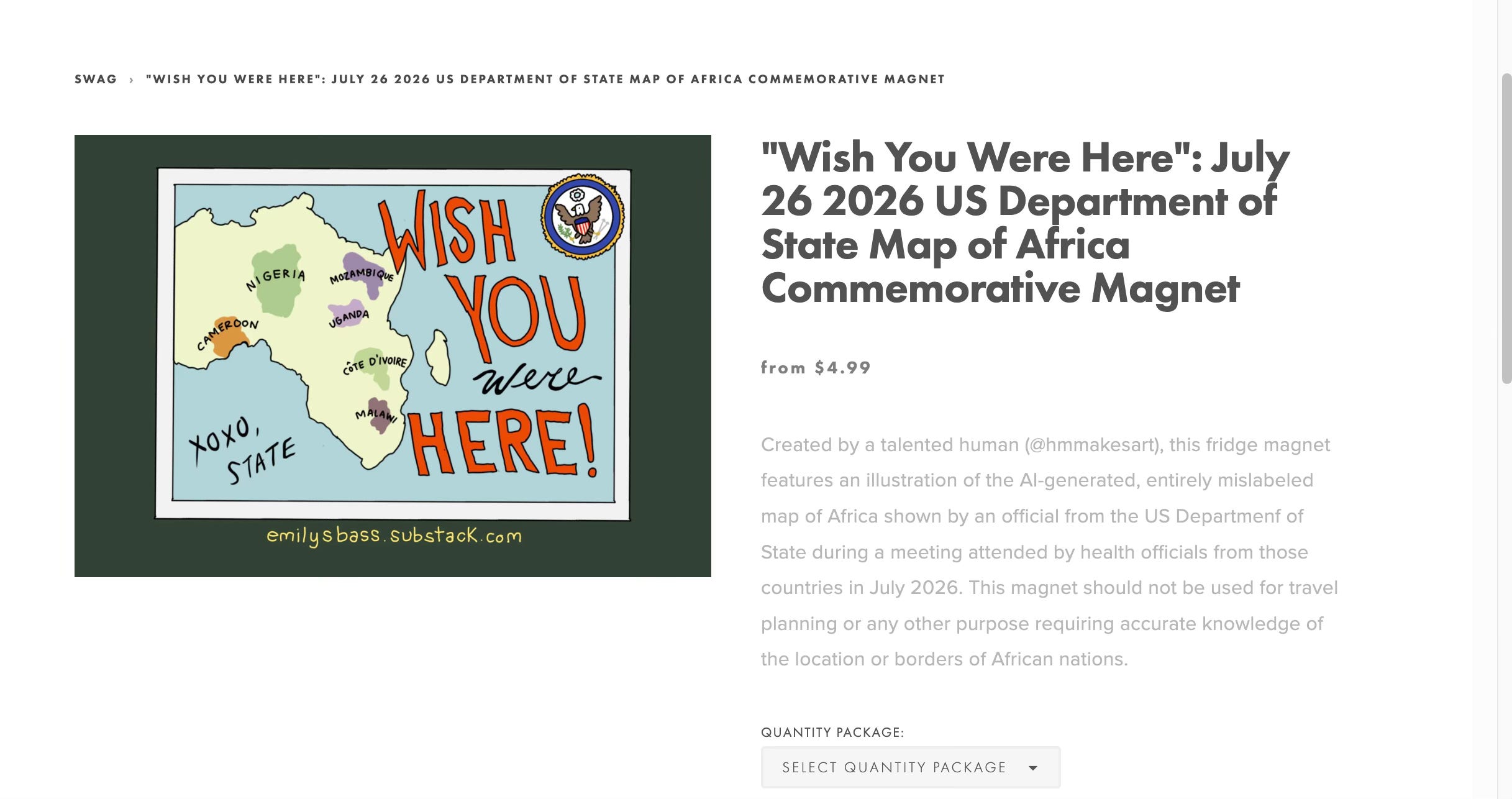
Speaking of funny maps! Some of you (really, not in the fictitious, friend-manufacturing sense) asked for a way to order multiple map magnets. And so I made one! It’s here. You can order packages of up to 20 and I will send them to you. As a reminder, paid subscribers get a magnet free, along with a PEPFAR Data Are Out There bookmark and three Bananapants stickers. Map magnets will ship starting August 31 within the United States. If you need something different in terms of quantity or mailing, please reach out. The message feature on Substack is just dandy.
“Let’s call…” I mean, in for a penny with the “this a group project” vibe, I guess. Let’s say I’ll be back to first person singular when I return from vacay.
Please read this to understand why the metrics are bananapants. https://www.amfar.org/wp-content/uploads/2026/04/Unmeasurable-and-Unaccountable.pdf
(Big, big ups to Senator Warnock and the folks who worked with him to get a pointed letter asking for accountability with regard to the requirements for data sharing under AFGHS earlier this week! I would love to see follow up on the data that should be used—including a demand that the PEPFAR MER system stay online until there’s confidence in the safety, ethics and reliability of the new reporting system.) https://www.warnock.senate.gov/newsroom/press-releases/warnock-leads-inquiry-into-state-department-efforts-to-seek-personal-health-data-in-exchange-for-aid-to-developing-nations/
As I did for the post on CDC Zimbabwe, I’ve confirmed each closure with multiple sources from other countries in the region, but have not spoken to any staff presently involved in shutting things down.
https://www.cdc.gov/global-health/countries/angola.html
https://reliefweb.int/report/south-sudan/joint-risk-assessment-jra-accomplished-effective-control-zoonotic-diseases-south
https://www.cdc.gov/global-health/countries/south-sudan.html
I’m giving you the landing page with the docs on it but let me say it again: they do not stick around for long. Do not bookmark this and plan to go wandering back. Won’t be there. Download that s%&!. If you can’t find something, ping me. I probably have it. https://simpler.grants.gov/opportunity/37d48a94-29c7-4325-abb1-9924506444f3
https://www.state.gov/releases/office-of-the-spokesperson/2026/07/the-united-states-leverages-american-private-sector-to-save-lives-and-treat-global-malnutrition/
https://www.devex.com/news/devex-pro-insider-is-the-future-of-us-aid-already-here-112086
https://www.operationendstarvation.org/about-us
http://fuckedinparkslope.squarespace.com/home/attack-of-the-raccoons.html
https://www.guttmacher.org/2025/12/weaponizing-water-how-campaign-against-medication-abortion-co-opts-environmental-policy
No posts
Comments
Nothing yet. Say the first thing.
Sign in to join the conversation.