
I think I figured it out. The solution to being cross-examined by your abuser. The remedy for the hives, the sweats, the insomnia and anxiety in the days and weeks leading up to trial over child custody with a man who once wrapped his hands around your neck in front of the kids on the toddler’s 3rd birthday.
WebEx.
COVID-era courtroom decorum.
We recently held the long-awaited custody trial involving my second child, the only daughter I share with my ex-husband. There I sat in front of my computer screen, my camera turned off. My newborn baby screamed in the other room in the arms of our nanny while I spent three hours listening to my ex-husband testify that he believed I was a terrible mother. I alternated between handing the baby to the nanny, or nursing him while my camera was turned off.
For the first time in seven years of litigation, I endured a custody trial without having a panic attack.
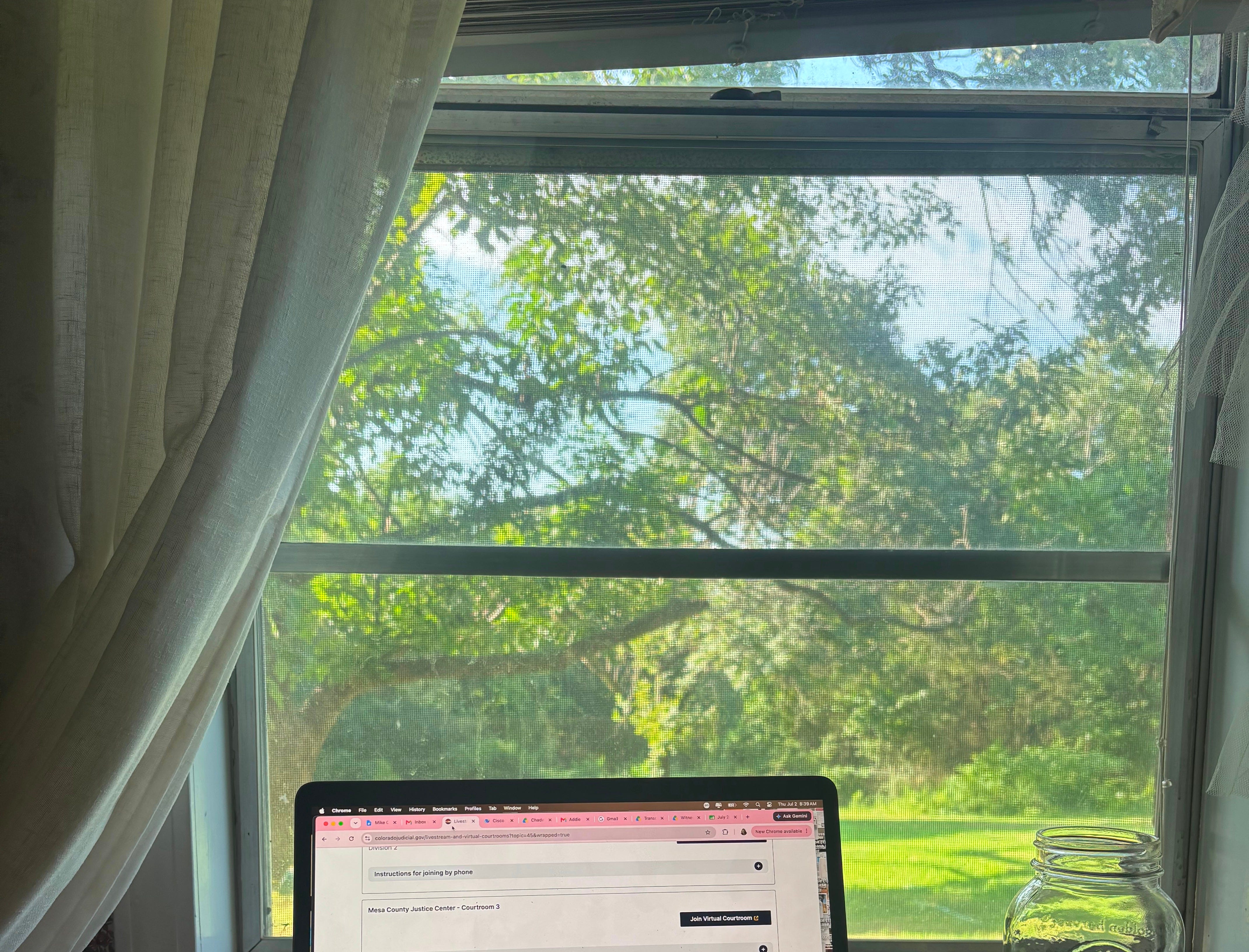
I didn't have to be in the same room as the man who was charged with stalking me in 2021 and who was referred for prosecution for sexually assaulting a child in 2024.
I didn't have to watch him watch me. I didn't have to walk past him in a parking lot, ride an elevator with him, or sit ten feet away while he described, under oath, a version of our life together meant to be heard by a judge but aimed entirely at me. I didn’t have to smell the cigarette smoke coming from his stained jeans while he listed out all the reasons why I’m a terrible mother, despite every court-appointed professional in our case recommending I keep sole custody of our daughter.
When it ended, I closed my laptop. I walked into the living room to find my still-crying baby. I picked him up, put him to the breast, and nursed him.
That's when it hit me: the thing that makes family court unbearable for survivors of domestic violence isn't just the process. It's the room.
Family court cases involving domestic violence rarely play out the way most people might imagine. There’s no dramatic reveal, no moment where the truth becomes undeniable and the abuse becomes crystal clear. Instead, the courtroom becomes a new venue for the same dynamic that brought the parties there in the first place: one person exercising control over another, now with due process as the vehicle.
This is well documented in the literature on post-separation abuse and litigation abuse: filing repeated motions, demanding hearings, insisting on trial dates, and — critically — choosing to self-represent specifically so the abuser can personally cross-examine the person they abused. Family court allows this. Family court enables this. In many ways, family court requires this. You don’t get a free lawyer in family court like you do in criminal court. Unless you can afford a $10,000 retainer, you’re representing yourself in family court.
There’s no prohibition on an unrepresented party directly questioning the person who has accused them of violence, even when that questioning happens face to face, in a room, with the abuser standing or sitting close enough to smell them.
For the victim, this isn’t just uncomfortable. It’s a re-creation of the power dynamic that defined the relationship, except now it’s sanctioned by the state, scheduled months in advance, and it’s impossible to avoid without abandoning your case. You are required to be confronted by your abuser, in front of a microphone, while being recorded.
Legal scholars and advocates have a name for this: using the courtroom as a stage. The performance isn’t really for the judge; it’s for the victim. The message is I still have power over you, and now I get to demonstrate it in front of an audience that’s legally obligated to listen. And there’s nothing you can do to escape.
It should be clear to everyone in the family court world that when these cases span years, it’s not because two people are equally as interested in staying engaged in conflict. But that’s the phrase used to describe them anyway, no matter how inaccurate it is.
High conflict.
They’re probably not high conflict. There’s likely one party who’s moved on with their life. They’ve rebuilt their career or education, they’ve had more kids. They’ve quite literally moved on. And there’s another party terrified of being forgotten. Terrified of accepting that their former partner rejected them. Terrified of losing the power inherent to being a man with a family.
They realize at some point during separation that the only way to force their former partner to engage with them was to litigate them endlessly. The family court process is set up this way: you can quite literally force your victim to see you in court. You can dictate their schedule, where they go, and you can demand access to their financial records and location all under the guise of being an involved parent.
And if you contest this? You’re going to be accused of alienation. God forbid you be accused of alienation.
So he showed up to your new partner’s office unannounced and uninvited? He’s just being a good dad, meeting the man dating his ex-wife. Besides, the kids told him you’re forcing them to call the new guy “Dad,” right? Right?
He sent mail addressed to your home that he’s not even supposed to know about because you’re in the Address Confidentiality Program? He’s just having you served with legal documents. Even though you’re signed up for e-filing, and your attorney of record can accept service of process on your behalf.
He had his sister park outside your new home he claims he has no knowledge of? Purely coincidence. How was she supposed to know you lived there?
He filed deeds and property records of your new husband’s family’s land parcels? It’s public record. So what if he called the clerk and recorder in your town looking for property records?
He called every hotel in a 50-mile radius while you’re on vacation while you have an active restraining order? He’s just looking for his child.
He refused to hand over your child at a custody exchange because he wasn’t sure you were in the state on your own personal time? He’s just concerned about the welfare of his kid.
It’s legally permissible to stalk your former spouse as long as you share a child. And in the family court room, it’s like your own little nonconsensual date. He forces you to attend. You have to answer all of his questions under oath, and your attorney gets to bill you $500/hour to sit there while he breathes on you.
Being in the same room as someone who has hurt you activates a different nervous system response than seeing them on a screen. Proximity, eye contact, body language, the ability to loom, to stare, to occupy space - these are not by accident. They're often the point. A screen doesn't eliminate the psychological weight of facing your abuser, but it does something meaningful: it interrupts the physical aspect of intimidation that so much of coercive control depends on.
Virtual proceedings also mitigate an unlimited amount of other opportunities for harassment that never make it into a transcript - a look held too long in a hallway, a "chance" encounter at the parking garage, a smirk, a comment muttered while passing at a recess. An overt threat in the hallway. These moments are invisible to the court and terrorizing to the person living through them.
There's a particular cruelty in how this plays out. Being in a room with someone who has hurt you is, for many survivors, physiologically activating in ways that have nothing to do with performance and everything to do with a nervous system doing exactly what it's supposed to do around a known threat: nausea, shaking, dissociation, panic. These are very normal trauma responses. They are also, unfortunately, exactly the kind of behavior that gets read by a judge, a court-appointed professional evaluator, or opposing counsel as instability - as proof that this is the unreliable, dysregulated parent in the room.
In other words, the setting produces the symptom, and the symptom then gets used as evidence against the person experiencing it. A survivor who manages to stay composed sacrifices authenticity. She’s accused of being medicated. Numb. She’s cold. She can say (and do) all the right things, but if the judge believes she holds disdain for her abuser, he can deny her request for safety. He can even take her kids away. It happened to me. It happens to women all the time. I lost custody of my daughter not because I had a history of abuse or neglect, but because I violated (and successfully appealed) an order that was unlawful to begin with. Which it was.
None of this is a claim that video hearings are painless. Testifying about abuse is still testifying about abuse, wherever it happens. But virtual proceedings offer several protections that in-person court logistically cannot:
Camera control. A victim can turn their camera off during an abuser’s testimony, removing the performative audience effect entirely. They can cry in the privacy of their own home or office space, and nobody can see or hear them. I listened to my ex-husband describe in detail how our 7 year old daughter has been managing household chores, grocery lists and budgets, and otherwise raising herself with my head in my hands - and nobody could see me.
Physical distance and safety. No shared elevators, hallways, or parking lots. No risk of an unplanned encounter before or after testimony.
Support access. A person can have family and friends in another room while they are under direct or cross examination, or sitting beside them during their abuser’s testimony. In my case, I was able to text friends and family while we all listened to testimony virtually. I had nearly 20 supporters tuned in to observe the trial. An entire community was able to witness this with me in a way an in-person trial would never allow.
Reduced opportunity for nonverbal intimidation. Staring, posturing, and physical proximity - all the little things that don’t show up in a transcript but profoundly shape a witness’s ability to testify - are largely neutralized by virtue of WebEx.
The primary concern with virtual hearings surrounds issues assessing credibility. There’s the argument that in-person testimony carries more weight.
But this can be cut both ways. Virtual court is often very frustrating for those abusers who rely on their proximity to their victims to maintain control. And that frustration can be quite evident on camera. It turns into shouting, talking over opposing counsel, even repeated arguing with the judge. All things that they’d do in-person anyway, but the frustration they exhibit is often exacerbated by virtue of their physical power being taken away. It’s not so easy to intimidate someone through a screen, but it is in a courtroom. The abuser is often unable to conceal his displeasure with the protection virtual distance affords his victim.
In cases involving documented domestic violence, does the potential loss in “in-person credibility assessment” outweigh the very real, well-documented harm of forcing a victim into physical proximity with their abuser as a condition of accessing the legal system?
Do you need to see the sweat beads forming on my hairline to believe that he’s still terrorizing me?
Since 2023, I’ve been the face of The Mama Wilder Foundation, a 501©3 nonprofit organization that allocates cash grants to women navigating their exits from abusive situations, oftentimes in family court proceedings. This work is funded by my social media presence and private donations.
For a list of our resources, visit this page on our website: https://themamawilderfoundation.org/pages/resources.
To donate to our nonprofit: Donate Here
To shop our store, visit our merch line: Click here
No posts
Comments
Nothing yet. Say the first thing.
Sign in to join the conversation.