
If you want a tldr; for this essay it would be: Begin As You Mean to Continue!
As a mother, one of the qualities I most seek to teach my children is that of usefulness. I want to have children who know how to do things. Why do I want this? Because useful children are generally happier, confident, and frankly, more enjoyable to be around. They also tend to grow into happier, more confident adults who use their capabilities well.
Usefulness is an antidote to wastefulness, as well. If you can fix something instead of throwing it away, if you are resourceful enough to coordinate repairs or replacements - well, that’s one less lawnmower by the curb or in the landfill.
I want my kids to know how to make breakfast, fix a cabinet door that’s falling off, properly paint, make clothing repairs, and mow a lawn without scalping the grass too low or missing the edges. They should be able to type, scrub a floor, completely clean up a room, grow vegetables, and care for their leather shoes. These are some of the things I consider useful for adults and children to know.
Usefulness builds confidence, and vice versa. The sure, practiced hand that operates tools became steady over many hours of practice. But one must have the confidence to begin, or the imposed impetus from an adult.
How do we teach children to be useful?
By being useful ourselves, and by allowing them to participate at a young age, probably younger than we would normally be comfortable with.
(If you are useful yourself, but exclude your child from participating in useful activities until they are old enough to not lose the hammer or burn the scrambled eggs, they will likely become useful eventually, once they are adults; but this essay is about raising useful children.)
I look at training children in tasks the same way as teaching a child to ride a bike - something everyone is familiar with. You start with a bicycle suited to the child’s size, attach training wheels, and then remove them once you deem the kid is just about ready to ride solo, maybe even a little before. All throughout, the child is encouraged, comforted, but ultimately pointed towards mastery. Most every parent knows to teach their child to ride a bike. Yet it has been my observation that many parents train their children to do little else; other than, perhaps, to pick up their own toys.
The reason for this, I think, is that teaching kids how to do things can be inconvenient, messy, time-consuming, and frustrating. In short, a total pain in the hinder. But it is in these time-consuming activities that we most empower our children. Children want to be actually useful. They are proud of knowing how to do things, being able to hold their own amongst both older and younger people. If you let your kids help clean the house, things will not be perfect. If you let them chop peppers for chili, the peppers will not all be uniform, and some pepper seeds might end up in the chili - at least at the beginning. Part of teaching children to be useful is allowing for imperfection, while also continually leading them towards improvement and greater skill. When I send my son out to gather certain herbs from the garden for dinner, I see in his face the satisfaction of knowing the difference between lemon thyme, marjoram, rosemary, and purple basil. He has learned over the years to tell one plant from another, and now knows how to properly harvest from the different plants - because of course, one shouldn’t just yank entire stalks off the basil.
When we give children a useful task to complete, it also shows the child that you, as the parent, trust them to complete it. Each time you lovingly delegate a useful task to your child, you are creating a little trust-and-relationship building incidence which benefits both you AND your child.
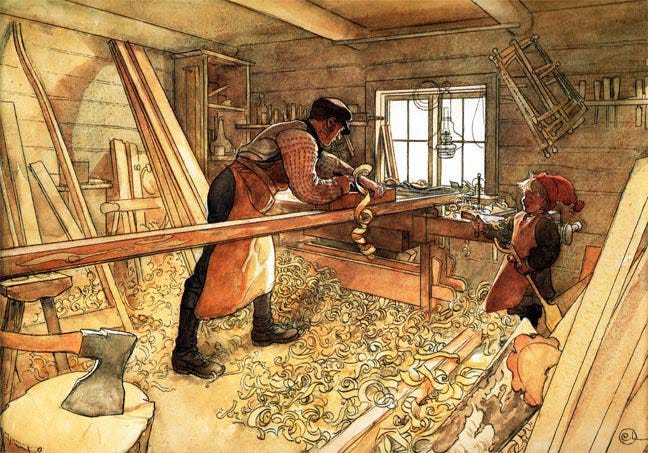
If you want a ten year old who can build a birdhouse - for a songbird or a chicken - you have to let them begin using tools and helping them build several years before that. (I suggest giving your 3 year old son a stump, a box of nails, and hammer.) If you want a seven year old who can cook without a recipe, you have to let them do it, with supervision, and gradually remove the training wheels.
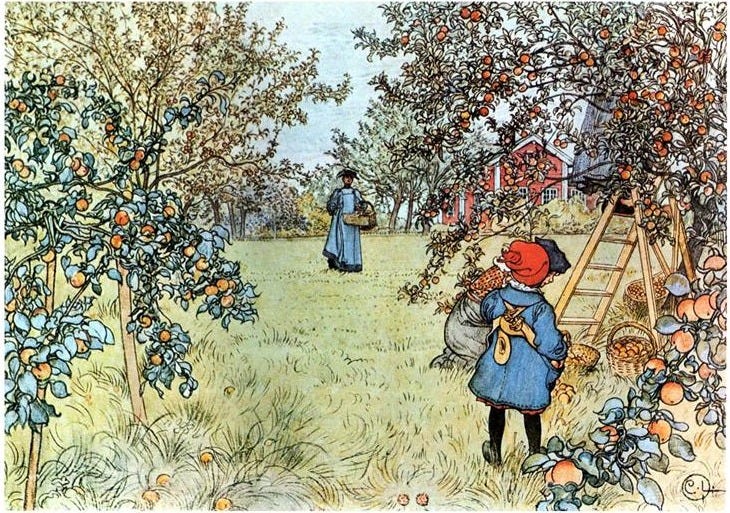
I remember when my husband and I had just one child and we visited another family with useful children - the kind of family with cool, interesting parents with 5 or 6 cool, interesting kids with varied hobbies and skills and knew about lots of things. As one of their preteen sons fixed a piece of machinery, I asked the father: “How did he learn to do that?” He answered, laughing: “I let him start early.” The boy was allowed to shadow his father as he worked, allowed to tinker, permitted to use his own tools to play and build and construct. With some direction and light supervision from his father, the boy was already useful, and on his way to becoming a well rounded adult. This made a big impression on me at the time.
However, giving your child raw materials alone and turning them loose rarely results in actual skill or task ownership. You can’t tell a six year old to clean her room and simply deem it done because she spent 15 minutes tugging her bedsheets around. No, an important cornerstone of teaching children useful things is that they are guided towards mastery as an inherent trajectory of the learning itself. This is important because it shows them that there is a semi-end point in learning skills throughout their whole life, and that end point is not 5 minutes or even 1 month after beginning.
For example, it is on you, the parent, to teach your child that the task of “taking out the garbage” consists of taking the garbage out of the inside receptacle, hauling it to the outside can, closing the lid, coming back inside, shutting the door behind them, and putting a new garbage bag inside the receptacle. This might look like: initially delegating the task, following up shortly afterwards if the child doesn’t initiate taking out the garbage with a warm but firm comment such as “Hey, do you need help completing the job or are you going to do it alone? Because it needs to be done now.” Then, if the child stops or gets distracted mid-task, prompting them with “Looks like the job is only half done. XYZ still needs to happen, then the job will be done. Let’s get to it.” If the child complains or whines, I usually say “I can’t understand you when you whine, try using your normal voice,” followed by “who is going to do the job if you don’t finish it? The work doesn’t magically disappear if you quit now. You will only be pushing the work off until later or onto somebody else.” Use your Mary Poppins voice and be warm, but firm.
The alternative to this, which takes about 15 seconds, is that I just complete the task myself. And sometimes I do take out the garbage myself. But what would I and my child be missing if I did everything for them, waiting for them to reach a magical undetermined age of competence at which point they could then begin learning?
Waiting until a child is a teenager to begin doing chores and learning skills is generally not a good idea, for the reason that teenagers are often narcissistic and self conscious. They do not want to look bad or dumb while doing things, and everyone is “bad” at doing things when they first begin. They may actually acquire certain task mastery faster, due to greater brain maturity, but then, children’s brains are wonderfully plastic and can pick so many skills up very quickly. Better to cement their useful place in the family and confidence in abilities while they are young, so your child knows the basic ropes before they have to then tackle the greater business of acquiring more adult occupations and skills.
Parents who are trying to lead their children don’t delegate tasks because they are lazy, or like to see their child suffer. They delegate jobs for many reasons, some of which might be: the child learns a skill, the child practices obedience, the parent practices their leadership skills, the child gains confidence and is reassured of their necessary role in the homes functioning.
As in all other matters of parenting, it is best to begin as we mean to continue, although this can be difficult because most of us have no idea what we are doing at the “beginning.” Toddlers can do a very simple bed-making and toy pickup. Young children can learn to perform basic cleaning tasks, self - care, feeding pets and farm animals, helping with dishes, and so on. Older children begin the heavier lifting of doing laundry, washing dishes, fixing things, constructing things, sorting things. And so it goes. (I touched on this topic more in this post ).
We raise useful children so that they may become happy, confident, and skilled in caring for themselves and, ultimately, others as well. It may be more work up front, but in the long run, the tedious training and discipline can result in a deeper, more comfortable relationship between parent and child, with roles having increasing interplay and replacement.
Thank you so much for stopping by. I am humbled by your support and words of kindness! If you’d like to follow along, you can subscribe below. Most of my writing is free because, well, I want lots of people to have the opportunity to read it. Paying subscribers help contribute towards our family’s livelihood.
Blessings,
Emily
No posts
Comments
Nothing yet. Say the first thing.
Sign in to join the conversation.