
I’ve been sick for over a week and have perhaps read too many articles and think pieces in order to satiate both my boredom and the short attention span of this dumb, relentless virus.
Two pieces really stuck with me: the first piece is about the internet’s favorite nerd, Hank Green, getting so addicted to AI that he was alienated even from his wife and brother - two people with whom he is famously and adorably close. The second one is called “The Anti-Cosmetic Surgery Essay Every Woman Should Read” which I did, in fact, send to all my closest friends. It’s about the proliferation of thinness and plastic surgery and how not all choices women make about our bodies are liberated.
And what I am trying to do in this piece is to connect some headlines to what I think is happening at least a little bit to all of us, and what we might do about it.
For starters, I don’t see a big motivational difference between a creator choosing to lean so hard on AI that he forgets to be a person and an actor damaging her body so much to be thin or youthful that it’s hard to see her as any real human characters. In both cases, creative people are trying to contend with capitalism. And capitalism has only one core driver of positive self-worth: productivity (which in this economy is extraction and exploitation). For a science creator, that’s the ability to make more science explainer videos faster to feed the unending machine of social media. For a woman in Hollywood, it’s the ability to conform to a relentless beauty standard under the threat of being sidelined (and constant scrutiny). And as it gets harder and harder to make a sustainable living, optimization is being presented as the answer.
You can use AI, plastic surgery and pharmaceuticals to get more out of yourself faster. Creative people are being fed tools to make the capitalism part of their jobs easier and - let’s be real - getting some satisfaction and plenty of reward. Hank Green said he was getting addicted to the dopamine hits of his increased productivity (which surely also came with monetary reward). And any woman with a body will tell you what it feels like to complimented on our weight loss in a society that tell us our bodies must constantly be under renovation. And in the extreme cases we’re seeing play out in public - Ariana Grande, Miley Cyrus, Kaia Gerber - extreme thinness is part of a social system in which the people around these women are there for profit, not for support. The women are profiting - they are getting HUGE jobs and contracts and endless attention - but their handlers and their labels/agents are also. In both cases, in extreme AI dependence and in extreme thinness, people are alienated from anything that resembles creativity or community.
Creativity is the opposite of optimization.
Creativity includes: being bored, mind wandering, being bad at something for a while, practice, reading a lot, listening to a lot of music, seeing other artists work…a lot of time spent on things that aren’t “productive” in the sense that it’s all input, not output. You can’t monetize the time spent being bored (although I did see a creator literally post a tiktok video of himself on the couch staring into space, explaining it’s an essential part of his creative process…so people are trying.)
Creativity is also a gift of being human, not something that has to be fed into a machine to print money. It’s a way of rolling through life, being amazed by the world outside and inside your own mind and curious about how it all works and why. It’s being struck by your own feelings and finding ways to externalize them that other people can experience. It’s a way of relating to ourselves, to other people, to nature. Sometimes it’s just doing something with your hands that makes pretty little things in between the part of the day where I have to send emails in order to make money to feed my family:
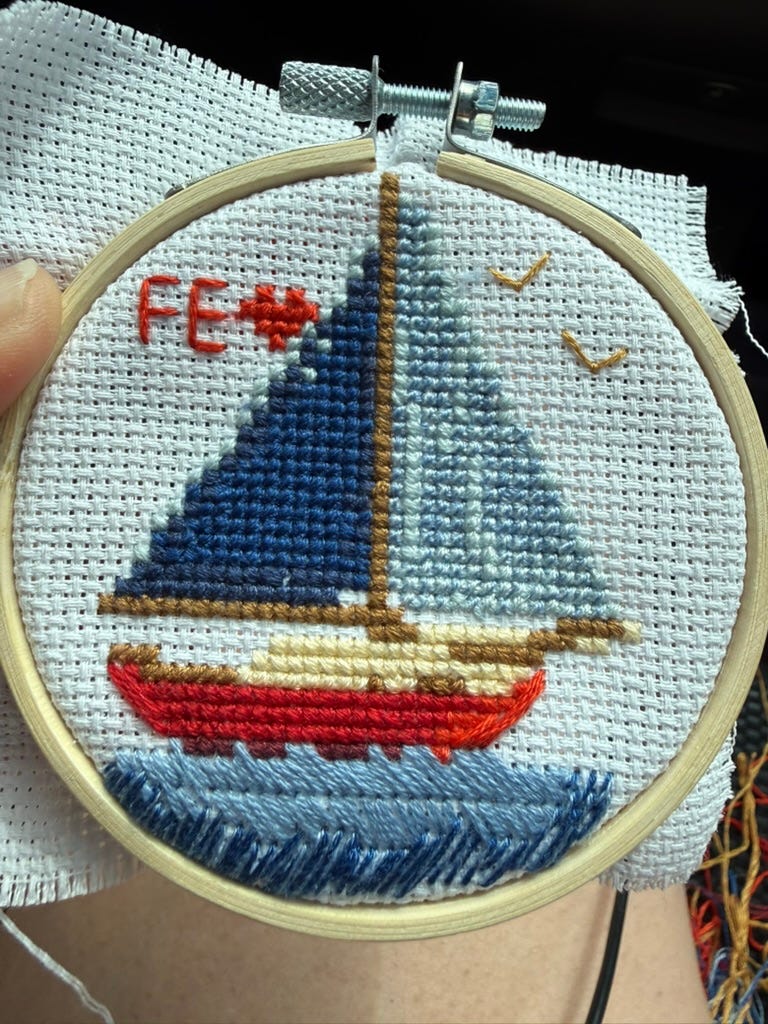
Many creative people would like to do creative work for a living, and all of them will tell you that in order to do that you have to contend with deeply uncreative forces all the time: the money guys giving notes on your script; the endless sucking sound of social media that requires MORE CONTENT ALL THE TIME; the brutal judgement of society on your every body part and the way you talk and how polite you are and if you smile enough or dress well enough and so forth (if you are a woman in public).
But it’s more than that - when I was in my 20s in New York City trying to do theater, my rent was $950 a month - utilities included - in a great Brooklyn neighborhood. I could pay my bills waiting tables three nights a week in a fancy restaurant and some occasional consulting work. And the rest of the time I could be creative. I could try things and take classes and start a new play reading series in my living room and put on plays that not many people would see but where we would learn a lot. (To the younger folks reading, I am so sorry. I am hoping somehow Mamdani brings back this New York for you.) Today it is so hard to make a sustainable living at literally anything, we are all being forced down the path of optimization. And that’s the perfect time to unleash these optimization tools that feel like shortcuts: when we feel we have to be as efficient and effective with our time in order to just survive. But these tools are not neutral. They come at a huge cost to self, society and planet and they represent a somewhat devastating interaction between productivity as the core personal value under capitalism and extraction of productivity by the already very wealthy and powerful.
And when everyone is optimizing for efficiency using these tools, we lose the relationality of creativity - the things that make us curious about ourselves and each other, about new ways to see the world and understand its systems. We stop connecting in meaningful ways. That is by design.
It’s in community that we could claw back our time, that we could more easily sustain by sharing resources, tools, income, space, and expertise, but perhaps most importantly by sharing care. Hank Green was called out by his community - super fans who felt betrayed by his obvious use of AI as a shortcut - but more importantly he was called out by his wife and brother. That’s what he said really gave him pause. A true community of care does not allow you to get to the point where we can see every rib in your chest and say, “ YOU LOOK HOT.” That is extraction, in physical form. In community, productivity is not more important than health. You don’t end up alienated from the people who love you most.
A community of care is honest when your writing sucks because AI did it, or, like, when your bones are too visible. And then a community of care would ask for the productivity to stop. To offer help. To have patience for recovery.
And care is inherently risky: giving someone you care about (and who cares about you) honest feedback can cause rupture, especially if delivered clumsily. It’s a skill that should be in taught in high school alongside personal finance and how to repair your own car. But even when feedback is clumsy, for a creative person it can be a gift - to ensure their vision is realized to the height of their taste and capabilities (rather than just as efficiently as possible). And if you’re giving feedback, you also have a responsibility to have grace for the person who may need to process that information and may even take a while to come around to it. (Though in my experience, most conversations go wildly better than you think they will if you don’t avoid having them because you’re scared of how they will go.)
It would be one thing if all this optimization brought us closer to that sustainability we all deserve for how fucking hard everyone is working. But the tools are designed to take us farther away - the more time we spend on social media and using AI, the richer a very few companies get. And as someone who lives in Georgia with the most data center projects in the nation and a power bill I can’t get below $400 a month, I will say to you personally: please knock it off using AI to write your emails. It’s costing literally ME AND MY NEIGHBORS money every month. This is community: considering the implications of your actions on other people over your own optimization. And considering how your actions, your care, can help others.
I can hear folks screaming WELL WHAT ARE WE SUPPOSED TO DO? JUST NOT USE AI? WE WILL GET LEFT BEHIND. And it sort of reminds me of how my childhood best friend crashed out when I told her I was worried about her weight. She threw every excuse at me about how careful she was being and how important it was to be in shape and then she just started hurtling insults. It was, in every way, sub-optimal. But I believed that she needed to know somebody still saw her for real and that some part of her wanted to be given permission to make different choices. And it put a wedge between us for years because I was clear that the way I loved her came with telling the truth about what I saw, that I wouldn’t ignore what I could see with my own eyes. (We have since reconnected. Over a meal. It was lovely.)
Part of care is making space for people to make mistakes - even big ones - and be able to find their way back to community. That’s why the folks raging at Hank Green for admitting his mistake and the Ariana fans screaming at anyone who claims she might be sick which we can see with our own eyes live in the same soup for me. They’re both shouting BETRAYAL over something that has not caused them personal harm. Because the connection to these people isn’t rooted in care, it’s in what these people produce for us. And listen, I know Hank Green and Ariana Grande have the resources to get themselves well and as public figures should be held to a higher standard. Their platforms and how they use them have real world impacts.
However I think if we spend too much time on Hank or Ari or their fans, we miss the bigger picture.
What I am hoping to critique here, to be very clear, is not any individual people but a social system that impacts our personal identity. The system of capitalism makes us all believe to some extent our own self-worth is connected to productivity. We can feel like we are making strong choices and forming clear opinions core to our identity that are products of the system and don’t actually reflect the values we claim to hold.
And I am not immune by any respect. Ask my husband: I am a relentless ball of tasks all day every day - and on weekends nothing gives me more pleasure than organizing things that got disorganized over the course of the week. I’m exhausting. Which is why getting personally knocked out by some virus whose only attribute seems to be making my body feel like a sandbag has rendered me philosophical on the point of productivity. Reading these articles on AI addiction and thinness/plastic surgery together made me reflect on all the ways the system we are in rewards us for the individual productivity optimization that strengthens the current system, often to the detriment of our bodies, our creativity, our communities and our natural environment.
And it will feel like we have no choice but to optimize as long as the system continues to create scarcity (real or perceived) and we only feel like good people when we are productive within it.
Community as an answer is messy. It’s relational so by it’s nature is slow, can’t be “optimized.” It requires a lot of discomfort, a lot of hard conversations, rupture and also, then, repair. We move away from how can I be the most best? to how can I be more deeply in relationship? It requires we are accountable to each other. To admit when we have done harm, and also to reflect when harm is being done.
It also requires letting go of a certain sense of scale. We can’t be deeply in relation to millions or even thousands of people. And that honestly gives me the most comfort. But if we are deeply in relation in our own communities, the network ends up including everyone.
I think there are about 450 subscribes to this newsletter and maybe 100 of you will read this if I am lucky. Most of those 100 are people who know me personally, and it’s for you first and foremost I write this. (And if it reaches anyone else who has feelings about this - BONUS!) Because I know how hard you work and how thankless it can feel. Because you are more to me than what you produce and I would be happy to be bored on a veranda with you, or sit side by side doing granny needlepoint together. And we would be able to do more of that if we were less scared of being left behind by a machine that seeks to chew us up and spit us out.
But sitting in this bed I feel better if I think about my relationships to you than if I think about what I produced this week. Because only one of those goes away when my body is not working, and all of us will - temporarily or permanently - lose bodily capabilities that contribute to productivity over time. Then what do we have?
Each other and our ability to wonder. And hopefully a planet to still enjoy together.
No posts
Comments
Nothing yet. Say the first thing.
Sign in to join the conversation.