
In an effort to keep our advice fresh and present, we just closed out an audit of every failed campaign on Seed&Spark from the last 60 days. The patterns were not subtle. But rather than bore you with what not to do, I want to share with you the things you absolutely must do if you would like crowdfunding to be a successful part of your strategy as a creator.
Roughly 40% of failed campaigns had visible AI fingerprints: GenAI images, AI generated writing, and other hallmarks of “I asked ChatGPT to design a crowdfunding campaign for me.”
Audiences back people, creativity, innovation, excitement. AI doesn’t have feelings and you can tell in the writing. AI doesn’t have taste and you can tell in what it generates. If you want to convince your audience that you are so in love with this project and you have the skills and the drive to make it successful, taking shortcuts they can see is not going to work. You must:
Write your synopsis and bio in your actual voice, with specific, ownable details (a real location, a real collaborator’s name, a real moment that started the project) instead of polished generalities. The more specific, the better! In specificity you find universality AND it’s also where you get people to really care about why this project should exist in the world.
Use your own production stills and behind-the-scenes photos, not generated imagery, even when your own photos are rougher. Or - and maybe this is wild - consider working with a human designer who has taste, experience and style. It might cost money or you might invite them into meaningful collaboration. A designer might be willing to defer payment until the campaign is complete. I have worked with designers on my last two campaigns and they have handed off a set of Canva templates I could use throughout the campaign to generate new content. It capped the work I needed to commission and handed me the tools to make beautiful updates. (I am, otherwise, a terrible designer.)
Let the page show process, not just a finished pitch: a photo of your notebook, your cast read, your location scout.
Just like you would in any professional pitch deck, create imagery that is utterly unique to your style - and if you need to borrow from other films you can do that (with attribution). Your audience needs to know what your vision will look like, and they need some evidence that you have both the taste and capacity to realize that vision.
If you are using AI, WHY? Disclose this to the audience, help them understand why it’s the right tool, and abide by our common-sense AI policies.
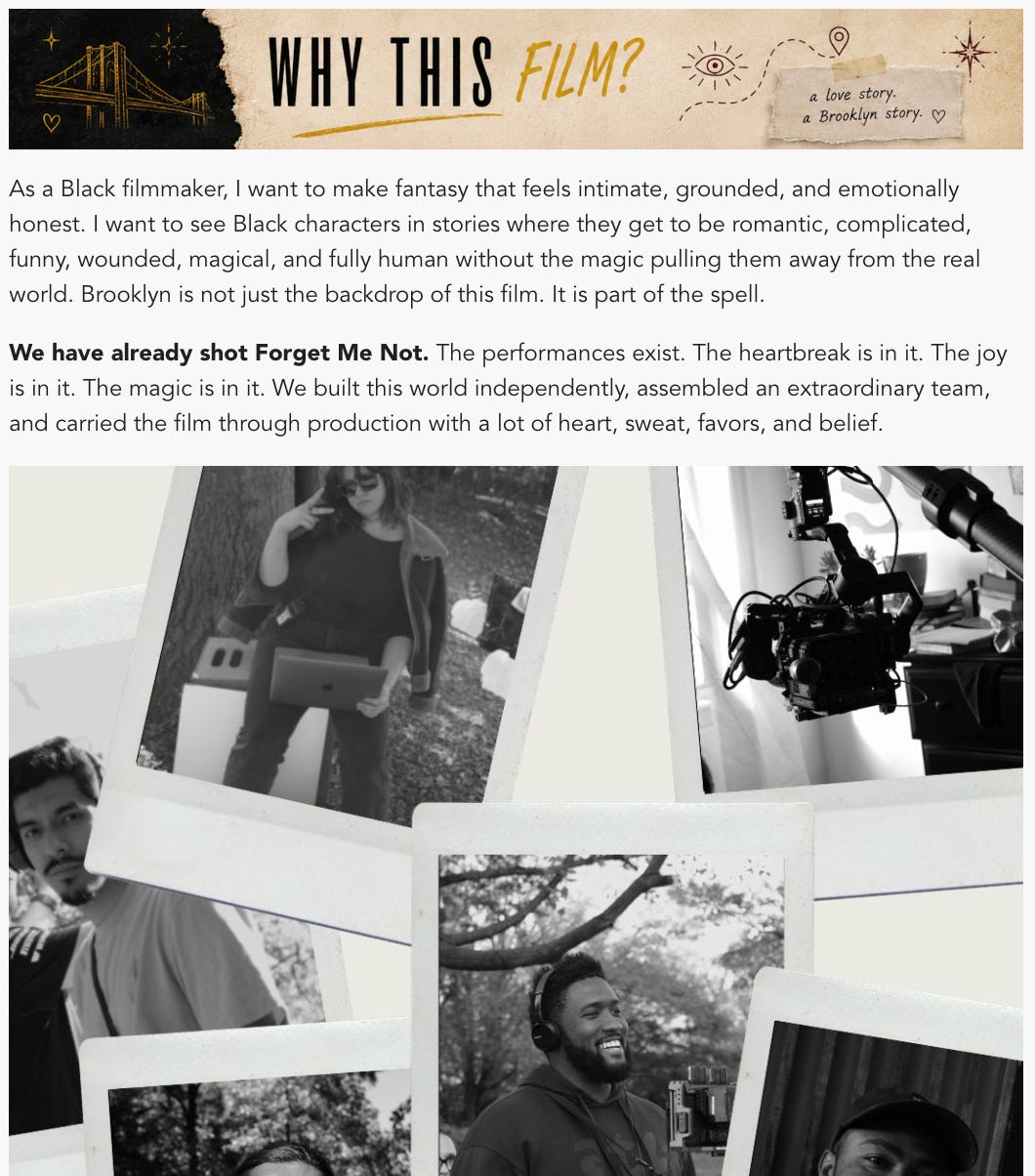
And just like your pitch video, the story section needs rhythm, visuals, and a clear mission. Pretty much every failed campaign treats the “story section” of the crowdfunding page - where you put the bulk of the information about your campaign- as an afterthought. But backers who are really interested in investing their time and contributing their dollars want to see you have a clear plan:
State your mission and premise in the first 100 words. A backer should know what they’re funding before they scroll
Alternate text blocks with images, stills, or embedded video every few paragraphs
Every section should answer a question a backer would actually ask: what is this, why now, why you, what does the money do, etc.
What is a supporter update? Once a campaign goes live, you have a blogging tool -with similar features to Substack for your campaign and its audience - that allows you to update the funders and followers to your campaign via email, and it also displays on your campaign page for new supporters to view. Almost all failed campaigns did not update their supporters even once. And I gotta be honest, this one I find the most confounding. Silence during a campaign reads as a project that lost momentum, even when it hasn’t. It reads as taking money into a vacuum. We have SO MUCH DATA on the importance of backer updates - how at least 3 a week make a campaign 3x more likely to succeed - and we share that data every time a creator comes to the platform. And yet!
So what should you do?
Post at least three updates to your crowdfunding campaign page per week while the campaign is live, and propagate those updates across all your outreach platforms (share them in emails to new potential supporters, push the updates to social media etc etc).
Demonstrate progress and momentum that might actually excite your audience: a new cast confirmation, a wild or weird location secured, a stretch goal explained. Every update should be rewarding enough to existing campaign supporters that they want to share the good news (and you should give them explicit calls to action for how to do that and on what platforms). Every update should be written with enough care that your supporters are excited to open your next one.
Go hard in the first and last weeks: It is not unreasonable to post one update per day in the first and last weeks of the campaign. If you know you are going to do this, you can build your outreach strategy around creating exciting things to share with your audiences.
The middle weeks of every campaign are the hardest, and this is where you want to have real actions to make updates worth getting supporters more deeply engaged: a matching contribution campaign, an event (live or virtual), a panel discussion or AMA.
A personal note: in my experience, towards the end of the campaingn I always start to feel really sappy. Like so excited to make the thing and so grateful to the community (and I’m always tired at that point so my defenses are down.) And I find myself writing at least one really heartfelt post late in the campaign about what the project means to me, what it means to be gathering community support, what you hope it does in the world. And I feel a bit embarrassed and sheepish posting it, but I’m trying to follow my own advice of posting at least once a day at the end. And this is always the post that drives the most contributions. Every time. Here is when I got sappy after an in-person event the last week of the Mr Jesus campaign. Just for reference.
Every time I teach the crowdfunding workshop I shout about this: DO YOU HAVE A SIGNED SCRIPT OF SOME INDIE FILM SITTING ON A DISPLAY SHELF IN YOUR HOUSE? NO YOU DON’T. DO YOU HAVE A POSTER OF A SUPER INDIE FILM YOU DIDN’T WORK ON IN A FRAME IN YOUR LIVING ROOM. NO YOU DON’T. In 15 years of running Seed&Spark and seeing hundreds of campaigns every month there have been 4 t-shirts I have been moved to buy, and one was for my own campaign for Fck Yes!
Incentives must be:
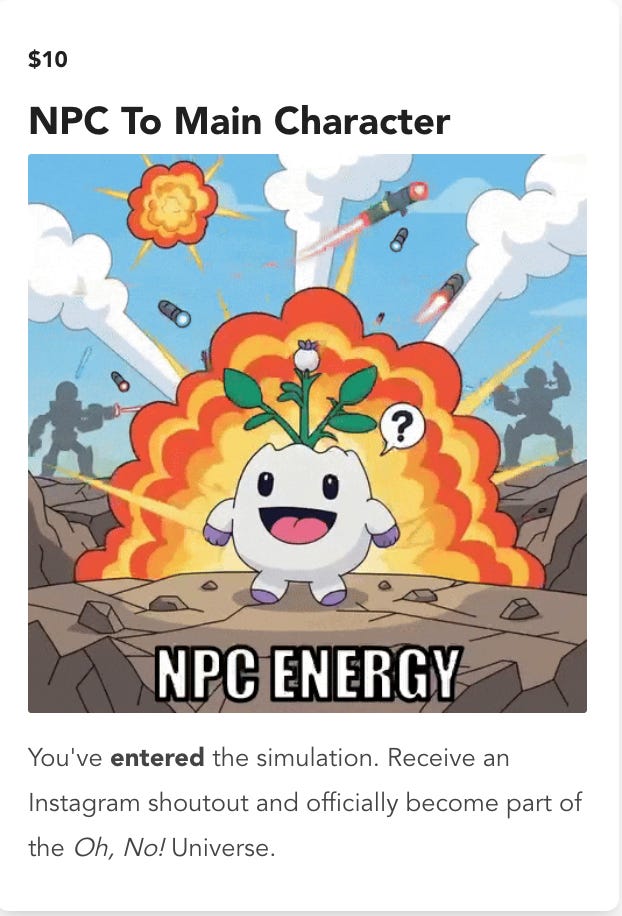
Financially inclusive: Build at least one tier under $25 that still feels meaningful (and does not require you manufacture anything). Can someone download a zine or sticker pack for $5? Get a social media shoutout by a creator they care about or vote on the name of the main character for $10? You need to know enoigh about your audience to know at what price they can really participate, and care for them by creating incentives that make them feel valued.
Tied to the actual story world instead of generic swag: stickers that highlight a quotable line from the script (good enough to put on a water bottle or computer case); a piece of the process like production art; access to something only this project could offer. Then, use the space to describe these incentives as another place to show you writing, style, and story. A recent campaign that got me to go from my standard $50 contribution to $150 because of SICK swag was A Giant Living Eye.
And this was the incentive description that made me say OMG TAKE MY MONEY: “Have you ever thought about how your career is a prison that you make for yourself and how you just keep choosing to get up every day and go to that same place and sit at that same desk and worry about that same stuff while time slips away and maybe time is the only resource that any of us should really value and do any of these people really like it here or are we all just suffering together and not saying anything because we think we’re the only one who hates it this much?
Well now you can bring that feeling with you everywhere with our Giant Living Eye mug and poster collection!”
Vary the tiers enough that a $10 backer and a $500 backer both feel like they got something specific to your project
We have so much more advice on this in the Crowdfunding Playbook
You can read more about our pitch video advice in the Playbook, but here are some tips that specifically came from our recent data analysis:
You need a horizontal version of your video for your crowdfunding page. Vertical video forced into the crowdfunding page looks janky (and audiences don’t respond). If you want to make a vertical version for social - do that - and make sure that social version is under 2 minutes or it will not get shared outside your existing followers on social media.
This is not new advice, but it was further supported by our analysis: The first 15 seconds of your video needs to be for the audience of the film, not your grandma. Sitting and talking to the camera if you are not famous to your audience is not going to cut it. We need ambiance, tone, style. Use footage, stills, or process shots. Or make the entire a video as a low budget demonstration of the concept of the film. A recent campaign for a film called Oh, no! did this brilliantly. You think it’s going to be one of those terrible direct-address pitch videos and then…it’s delightfully not.
On Seed&Spark we provide real human feedback to every single campaign. That feedback is driven by nearly fifteen years of data we have gathered as the crowdfunding platform with the highest campaign success rate in the world. Fill out the campaign page with images and text so our team can evaluate how ready you are to launch. Submit your pitch video script instead of what you think is the finished video (it never is) so we can help save you money in post.
Ignore the feedback at the risk of the success of your campaign. It’s not our opinion, it’s our data.
Now we’re at the end, I’ll give you the TL;DR pro-tip: The campaigns that succeed are the ones that show up as a specific, present, responsive human being, on every page, every update, and every round of notes. If you do the things listed here with care, you are very likely to raise the funds and gather the audiences that can propel you to the next stage of your project.
Happy crowdfunding!
No posts
Comments
Nothing yet. Say the first thing.
Sign in to join the conversation.