
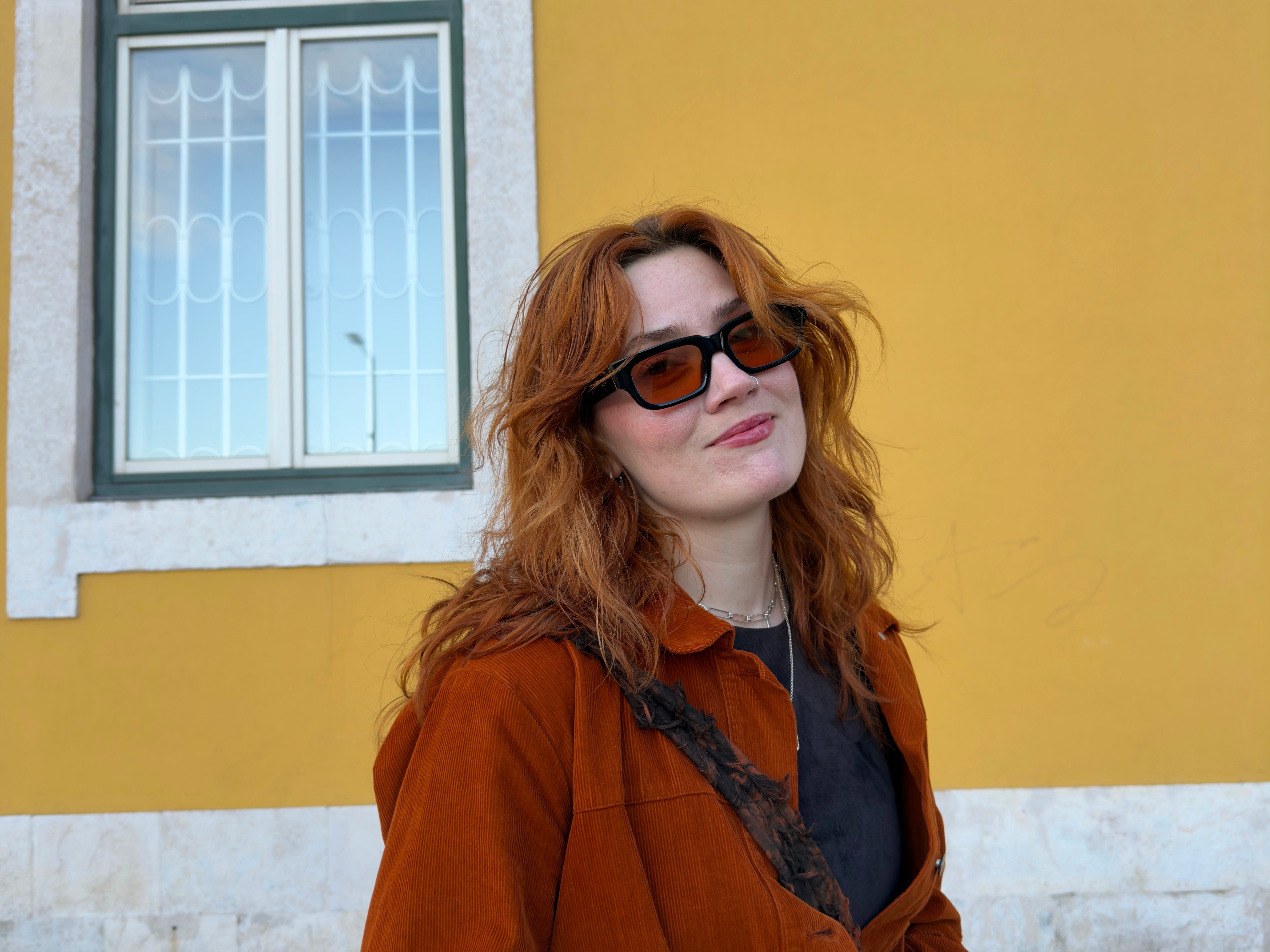
I can’t tell you when I first came across Kate Pasola. I do know that it was when she was a beauty writer at Cosmopolitan. And I know that at some point, I followed her on Instagram to keep up with her writing (and to torture myself with envy over her life in Lisbon). And I also know that somewhere along the way, she followed me back and we became internet pals who replied to each other’s work, stories and discovered that we share the same birthday, and the same unhinged love of Riverdance, despite having no obvious connection to Ireland.
Having an internet pal is a special thing. Sometimes, your internet pals will champion the work you put out into the world more than some of your closest friends. They’re often the first people to pay to subscribe to your newsletter, share something you wrote or champion you and your work loudly when no one else will.
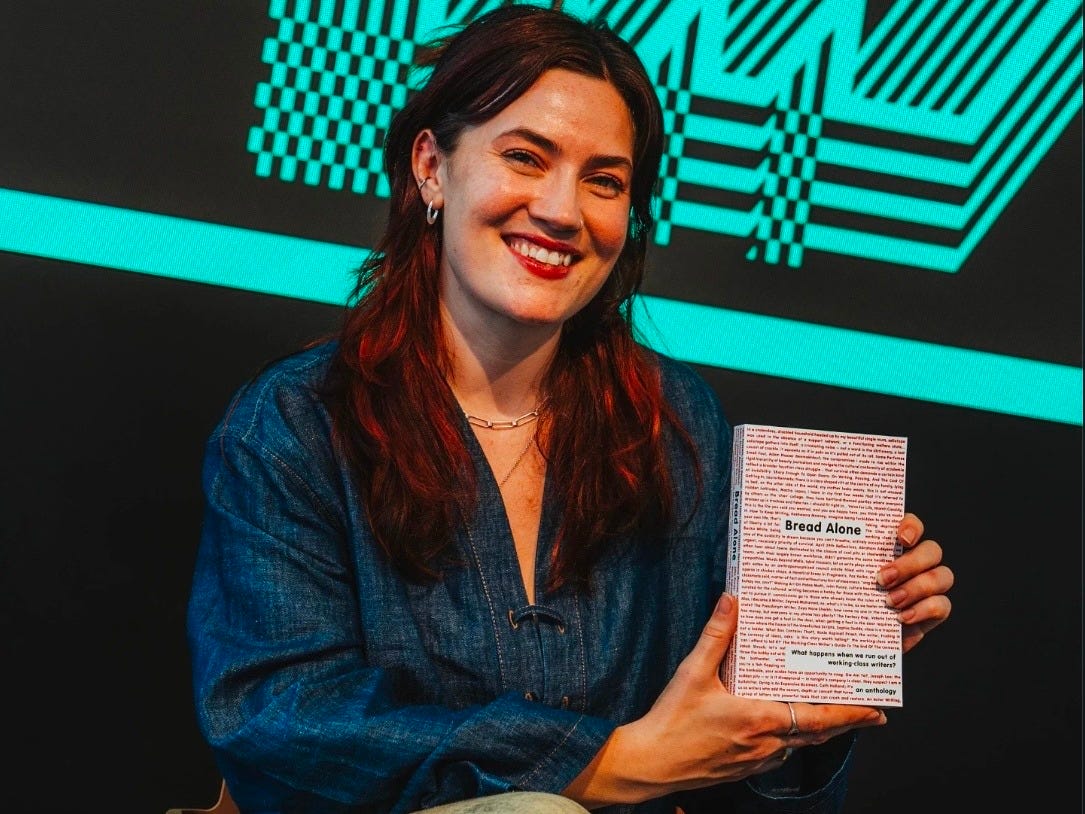
And that’s who Kate is: a champion of others. So much so, that she’s channelled her penchant for championing into a book, too. This spring, she published Bread Alone: what happens when we run out of working class writers, an essay collection which seeks to highlight the importance of working class voices in the creative industries – unravelling the knotty subject of class from writers across the UK, Ireland, Pakistan, Somalia, Canada, the USA, the Netherlands, Singapore, the Czech Republic and beyond. The essays are emotional, moving and a necessary reminder of how diverse voices enrich culture and widen perspective – and why all of us should offer our microphones to those who might not get to tell their story loudly.
Here, Kate tells me (with so much energy, personality and enthusiasm) all about her hurdles. She talks about the grief you suffer when the opportunity to do what you do best is taken away, why so much of the advice in The Artist’s Way infuriates her and why her favourite quality in a person is being ‘conversationally accepting’. And, perhaps most importantly, how excessive gratitude can stand in the way of presenting with confidence. Also, Kate has broken the record for the longest ever answer to my recurring question about the best advice you’ve ever been given, which she answered with eight separate pieces of advice.
I loved this interview. I love Kate. And I’m pretty sure you will too.
Hiya Kate. Please tell us a little bit about you as a person, and a snapshot of your life right now:
Well, it probably says a lot about me that I’m overthinking this question. I think a snapshot is easier to give first: I’m a journalist and editor who had a tech job hiatus because of financial pressures (and a subsequent burnout). I managed to crawl out the other side of that tricky time and am back to doing what I love every day, which feels like a miracle.
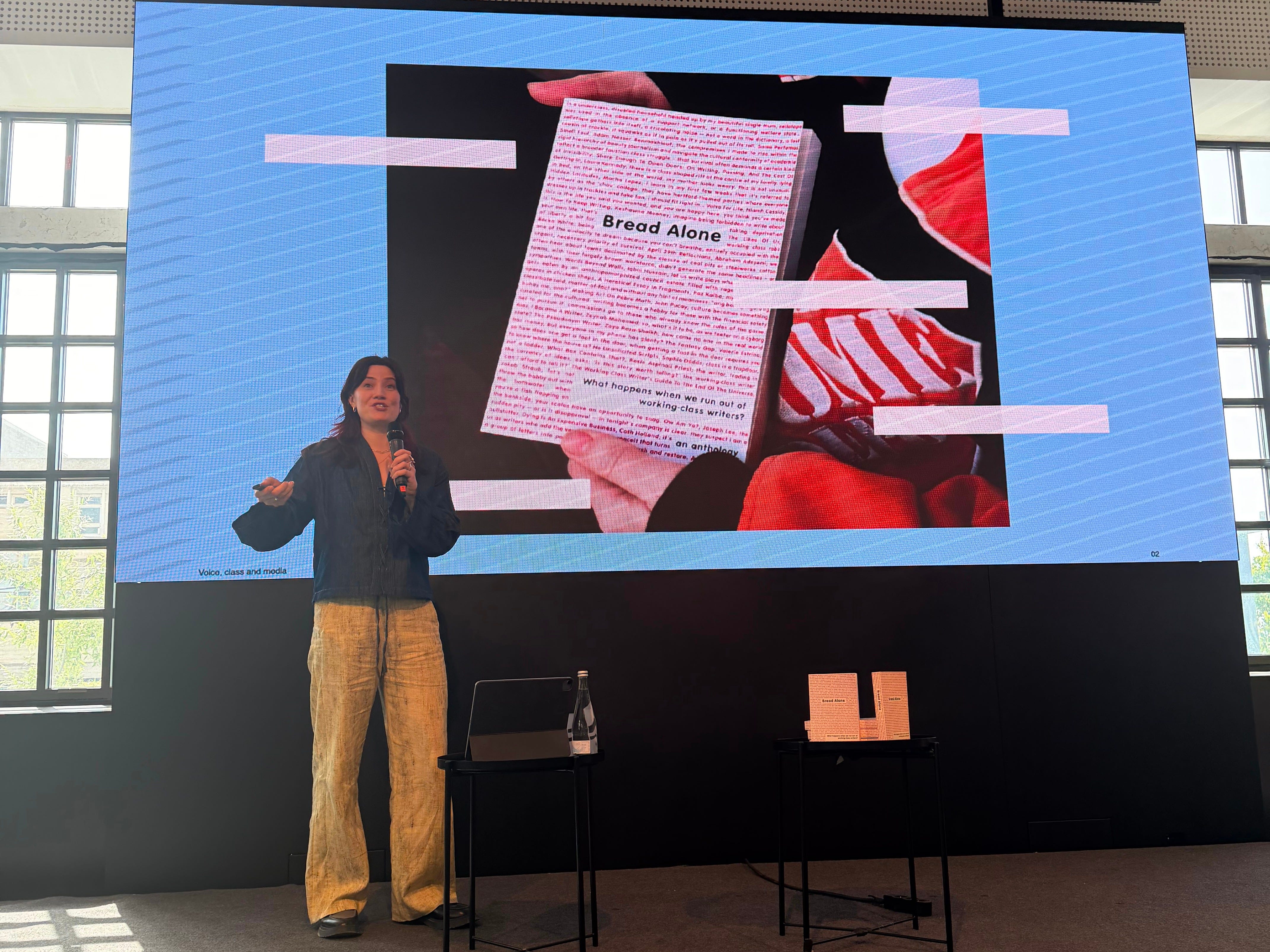
But I’ve returned to writing and editing freelance, with a new sense of class consciousness, a deepened awareness of how the tech world intersects with publishing, and fire in my belly about inclusion in media and publishing. I edited a book called Bread Alone that brings together over 30 voices from working class backgrounds, which came out in March – and next week I’m doing my first keynote talk on this topic, alongside some incredible professors, authors and philosophers (like Malcom Ferdinand, Geoffroy de Lagasnerie, Cynthia Cruz and Alice Cappelle) which feels utterly mad and I’m trying not to have impostor’s syndrome about it.
Full disclosure, though, if we’re talking right this second – I’m sitting at my kitchen breakfast counter that doubles as my WFH desk, with an iridescent zit sticker on my chin, two inches of roots, and an empty water bottle that urgently needs refilling. I am wearing my favourite Subu slippers because it’s somehow freezing despite it being literally mid-May.
Q: Where in the world do you live?
I live just across the river from Lisbon, in a city called Almada. I moved here a couple of years ago with my partner who’s Portuguese and French. Specifically, I live in a flat, in a building with what I can only describe as a rotating cast of absolute legends, most of whom are Portuguese. I can’t get over how different my relationship is with my neighbours here, compared to living in the UK. It’s one of my favourite things about living here. I want to write about them all someday.
Q: How would you describe yourself as a person? Tell me who you are, where you came from, where you’ve been and where you’re going.
I’m an exceedingly earnest, quite neurotic person who’s also an overactive listener. I have a devilishly sweet tooth and have been putting off getting an ADHD assessment for approx 2 years. My favourite smell is birthday candles that have just been blown out, and my former favourite smell was the smell of toasted hops in the air that I’ve only ever smelled in Edinburgh? Anyway, it’s too agonisingly nostalgic for me to enjoy any more (I went to uni there).
I’m from the North East of England (near Newcastle), I used to live in London, and the best place I’ve ever been is a place called Monsanto in Portugal, near the border with Spain. It was once voted the most Portuguese town in Portugal, and there are houses built into boulders there, I beg you to google it.
I’m not sure where I’m going next, geographically. But professionally speaking, I want to keep writing and editing as long as people are reading. I have three novels in my head I want to write desperately. I’ve secretly written poems since I was a pre-teen and I think I’m about ready to start sharing them.
Q: What were you like as a child? How would you describe how you showed up in the world, how you felt and how you interacted with your own life and the lives of others?
I’ve always been obsessed with food, eating, taste and words relating to those things. It’s a bit of a cliché to say you have synaesthesia these days, but I truly grew up telling my parents I could taste words and ideas in my mouth. Like when I said the word ‘town’, I could taste digestive biscuits(?!). And ‘Wednesday’ was specifically Birdseye fish fingers and swimming pool chlorine. Thursday was Orange Robinson’s diluting juice. I think that’s why I was always obsessed with writing and words – it was always a god damn feast.
I was very extroverted and audacious, and kind of went by the philosophy that if I thought something was cool, interesting, or just ‘the right thing to do’, it didn’t matter if doing it meant I didn’t fit in or looked like a loser. E.G performing Avril Lavigne songs at talent shows or taking my role on the school council extremely seriously. What a cute little earnest nerd.
Do you want to hear a copywriting story about my school council days? The school canteen once informed us councillors that they had budget to print a huge new sign for the canteen, but we needed to come up with a name for it, as if it was a restaurant. I came up with ‘Über Food’ (this was in like 2005 maybe, and actual Uber was still but a seed of an idea in some dude’s head). Anyway we voted and my suggestion won, and that became the name of our canteen. I can share that without concerns of copyright issues because my school was literally bulldozed a decade later and Über Food is no more. There is a photo that exists that is the last remaining proof of this copywriting triumph – you can see the signs in the background. We’re wearing coloured tights because I’d organised a protest against what I considered to be draconian rules on what colour tights we were allowed to wear (I used to get sent home for wearing purple and teal tights).
I was also a middle child and defffffinitely suffered from Middle Child Syndrome. But that’s one for my off-on long-suffering therapist.
Q. What are you like now? How would you describe how you show up in the world, how you feel and how you interact with your own life and the lives of others? What are the main differences between who you are now and your childhood self?
It’s only while thinking about this that I’m realising I had some sort of activist, organisational urge when I was a child! I guess it took me years to learn to actually channel into something I really care about. I did email / MSN message people petitions about Nestlé and animal testing and whatnot as a kid, but it wasn’t really from a place of deeply understanding the world – I was just copying my big sister and other cool crunchy girls.
Nowadays I’m somehow far less audacious than my childhood self, but I am far more confident, and don’t compare myself to people as much as I used to as a kid and teenager.
Q: When you were younger, what did you want to be when you ‘grew up’?
Obviously we all wanted to be Faye from Steps. My singing teacher called me ‘a little tone deaf’ at one point (nevertheless, I persisted, but that didn’t really pan out beyond school shows). But I was writing poems when I was like 11, which looking back is mad. So I knew I wanted to write – but journalism seemed a little less intimidating than creative writing, so I went into that. And I’m so glad I did. I thought I might be a chef at one point, but thought that meant having to eat meat, so I gave up on that dream pretty early. I wouldn’t have been able to handle it if The Bear (and my experiences as a waitress) is anything to go by.
Q: What do you do for a living? Tell me your current job title and all the job titles you’ve previously worn in the past.
Paper delivery girl (age 13, maybe I was even 12?). It was a mercifully short paper round and when it rained my blessed parents would drive me round the houses. I’d spend the £4.50 I earned on Shout/Bliss/Cosmo/Elle magazines and Dairy Milk and do it all again the following week.
Waitress in an Italian restaurant at the age of 14/15. I was exceptionally terrible and nicked biscuits from them all the time. In fairness, I worked from 10am-5pm, including cleaning toilets and lugging furniture up a flight of stairs, without a break. It was my lunch reparations. Anyway, they fired me when I left out probably hundreds of pounds worth of imported Italian gelato and it melted. They moved me to a smaller café in my hometown which I loved. I served horrifically burnt ‘cappuccinos’ to all the elderly people and they’d bring me tangerines and sweets. One only lady, Dorothy, used to talk about her granddaughter, and how she’d landed an internship at Dazed and Confused ‘down in London’. I pledged I, too, would do that. Hilarious and adorable and glorious that I now write for them freelance.
Shop assistant in French Connection aged 16-18 (I think). I worked Friday nights and Saturdays every week, so basically missed out on my entire teen social life, but they did give me my sixth form prom dress for free if I agreed to wear (‘model’) it three times at work shifts. It was literally a corseted cream chiffon wedding dress and I wore it with four-inch wedges to keep the hem clean for my prom.
’Charity fundraiser’ aka one of those people who accost you on the street in my early uni days. It was around the time a newspaper did a big investigation onto those companies and people would scream FUCK OFF in my face because of it. I cried a lot but I also got better at talking to strangers. Sometimes I wore bright green contact lenses because I thought it would lure people in and help me reach my targets but actually I just got really sore eyes. Rock bottom was when a seagull shat on my head in Sunderland just as I was wrapping up a successful pitch to a member of the public.
Through uni I also worked at the student union bars and at various cake shops. I landed my very first internship at an arts magazine called The Skinny by offering them leftover pastries from my job at patisserie valierie. Somehow it worked?!
I was an editor of various sections at that magazine for several years and it was glorious, but I had a hankering for The Big City Where Apparently Everything Happens (London). Luckily, I got my first commission from the incredible Katie Innes at Cosmopolitan to go undercover in a sort of cult in Glasgow, and I begged her (probably monthly) for an internship in the London office. Eventually they had a slot for me, and I literally moved my life to London for a two week internship, which became a month, which became a year-long assistant job, which then became a role as a beauty writer. That part of my life still gives me goosebumps, it was literally like something from a film. I couldn’t believe what was happening to me. My dream, ever since I was a little paper girl spending my paper round money on Cosmos and hiding the sexy bits while I read them on holiday.
After that, I moved to Which? Travel amid pandemic lockdowns, which was an incredible opportunity to work with the some of the very best journalists in the industry. It was only a fixed term contract though, and when it ran out, I ended up in a marketing type role at an app. It was OK at first, but, well, let’s just say it ended with be being prescribed antidepressants. I didn’t end up taking them, though, because I knew what really needed to happen. I needed to get myself out of that environment.
Anyway, I did, and now I’m back working freelance with the travel team at Which?, alongside other clients. I pinch myself every day about that – the fact I get to do investigations for a consumer rights advocacy publication. What the hell?!
Q: How do you feel about what you do? Does what you do define who you are? If so, has it always? If not, why not?
My generation was brought up to revere journalism, I think, because of all the 90s and 00s movies where cool, brave women were always journalists. I’ve talked to lots of journalist friends about the grief you suffer when the opportunity to do what you do best is taken away, either by redundancies or lack of work or because you can’t afford to live in the city where the jobs are. That’s something I certainly felt during my own, errr, hiatus. And part of me has some sort of anticipatory grief, too, that I probably won’t get to do what I do forever, that journalism is being eroded because of corporate greed and big tech. That, quite frankly, fucking sucks.
But I’m quite enjoying allowing myself to be defined these days by more than my job or even personal projects, but also just by my values (thanks, long-suffering therapist for that one). And also, by what I’m doing on a given day. I think coming out as queer helped with that too – it’s such a huge part of my identity that isn’t something I ‘worked for’ or was ambitious about… it’s just me. So I’m trying to find other parts of myself like that too, because they’re quite reassuring to hold in my mind when I’m feeling adrift. Like, this is who I am fundamentally, and no external circumstances can knock it flat.
Q: Tell me about your best job ever. Why did you love it? What did it give you? What did it teach you about yourself?
My best job ever is one I sort of built myself – conceptualising and editing a book called Bread Alone, which is a book of essays that came out in March. I’d been working freelance helping to edit novels for an independent publisher called Indie Novella, and they approached me at some point to curate an anthology. I’ve always been absolutely fascinated with class, and infuriated by how limiting class can be when it comes to accessing writing opportunities. It’s my proudest achievement and took me absolutely fucking ages and I can’t believe it exists! It also somehow ushered me into this unbelievable community of people who have similar feelings to me.
Q: Now tell me about your worst job ever. Why did you hate it? What made it so bad? What did it teach you about what you value in a job?
A semi-corporate role I did during my ‘hiatus’ (lol) from journalism. I’ll be diplomatic and say it was maybe just because my passion was writing and editing, and the opportunities to do it in that role, under its existing strategy, were just shrinking. Because I met so many brilliant and talented people there, some lifelong friends, and had some amazing managers I’ve learned so much from. But honestly, I would rather spend my life being shat on by seagulls than go back there. It taught me I deeply value empathy and compassion in a workplace.
Q: How did you get to where you are today? What did it take? What decisions did you make? What was the path like? What hurdles stood in your way? Was it extremely difficult? What did you say yes to? What did you say no to?
How did you get to where you are today?
I think sending extremely polite and earnest and enthusiastic emails helped – but I should probably also acknowledge the privilege that I got into journalism at a much easier time, a decade or so ago. There are of course several other privileges I just inherently benefit from – like being a white cis woman in a growingly racist and transphobic UK – that I don’t think people like me should overlook.
What did you say yes to?
I went through a bit of a phase in my early career of saying yes to every single bit of written work thrown my way. It was incredible practice, and I was lucky enough that it was such interesting work – about music, theatre, art, sex and politics – but I think I only managed it because my prefrontal cortex hadn’t developed yet and my 20 year old nervous system was able to cope.
These days, I’ll still have phases of gloriously frantic and adrenaline-driven writing sprints, but I do it sparingly, and take far better care of myself between.
What did you say no to?
OK, so one time I heard this Lady Gaga quote in which she said: “Some women choose to follow men, and some choose to follow their dreams. If you’re wondering which way to go, remember that your career will never wake up and tell you that it doesn’t love you anymore.”
I think I took that extraordinarily literally for my early twenties and really deprioritised dating and relationships. I probably also had this subconscious sense that if I was happy and in love, I’d maybe lose a bit of steam with my creativity. And to be honest, I probably came up with some of my best ideas and did my best writing absolutely furious after another shitty date.
Anyway, I have a girlfriend now, and that has seriously complicated matters as far as Lady Gaga’s quote is concerned. She puts up with me getting up at 5.30am writing crazed things on my laptop and endless verbal processing of my ideas, and I am heart-inflatingly grateful to her for that. I’m learning to put behind me the idea that I need to be in fight or flight mode to write my best stuff, but it’s taking time (and she’s helping).
Q: Is the reality of where you are today different to how you imagined it would be? If so, how? What are the biggest differences?
When I was a teenager the dream of being a full time writer seemed highly unlikely. I wasn’t ambitious, outside of getting decent grades, at all until I went to university. And then I was like ‘OH! There’s loads of stuff you can do!?!”. Let’s get cracking, then.
Another big difference is my queerness, and how much it forms part of my work now. Part of me thought I’d never come out as bi or whatever I am (*identity buffering*), let alone write publicly about it. I’m so happy about that.
Also, I have my first poem being published in a book next year. I never, ever, ever thought I’d ever publish any poems, because again, I’ve never dared to think of myself as a poet. When I got that email I dropped and smashed a bottle of red wine on the floor in glee/shock and it was gloriously dramatic.
Q: Who are the people you feel the most like yourself around? How did you meet them? What’s your relationship like? Why do you think they make you feel like this?
I have this term with my friend that I think is my favourite quality in a person: being ‘conversationally accepting’. My favourite type of people are the types you can throw anything (within reason) at, and they’ll volley it right back at you, even if you’re meeting for the very first time. I think it instantly reveals an open-mindedness, curiosity and compassion that is just exactly what I want to be around.
Unsurprisingly, I’ve met a LOT of people like this on the internet. Like you, Em! But also through journalism, through my linguistics degree at uni, through queer circles and the like.
I also find myself more drawn towards people I can speak openly about my values, beliefs and frankly the state of the world with. Everything is political, and if you have relationships where political discussion is seen as taboo, it kind of fucks things up… you find yourself skirting around topics, and it feels hollow.
Q: What’s the biggest hurdle you’ve ever had to get over? Why was it stood in your way? How did you get over it? Did anyone help you? What did getting over the hurdle unlock for you in your life? How do you feel about that particular hurdle when you look back on it now?
Excessive gratitude that spills over into apologising for my very existence!?! There’s this speech often cited in James Graham’s McTaggart lecture, about the ‘thank you for having me’ riff, or state of mind. When you feel, for whatever reason, that you should feel more grateful than others for something – whether that’s a job offer, a gig, a commission, or even something outside of work. Some people, often privately educated people, are brought up with a sense of universal belonging, and a steadfast belief they’re entitled to take up space. But when you’re from a different background, or queer, or from any other sort of margin, I think you’re more easily flattened into feeling unworthy.
And that excessive gratitude can stand in the way of presenting with confidence, in the way of asking for the right amount of compensation for a job, the right treatment from others. It also morphs so easily into shame, which is NOT a handy emotion to feel while you’re trying to realise your dreams.
The people who have helped most are people who took the time to mention, however briefly, that they want to work with me on the basis of my skills and work, rather than for any other reason – and who have encouraged me to ask for more.
My sister, also, is an incredible compass for that. So often she’ll text me back like: “What the fuck? No. Don’t put up with that.” I’d be a different person if it wasn’t for those reminders.
I’m really glad I’ve worked through that hurdle, but I’m aware it could, and probably will, reoccur. Hopefully my sister’s free for a chat if it does.
Q: What’s a hurdle that regularly trips you up?
The pursuit of stability. I love taking risks creatively, but not in my own life. Someone once casually uttered the phrase ‘gotta make hay while the sun shines’, and that exactly summarises my approach to work and building a life.
Inconveniently, my personal history shows that taking risks has tended to pay off, whether that’s packing up and leaving London, quitting a stable tech job, deciding to curate a book – even coming out as queer. These days I try to build calculated risks into my life more often, but I’m still learning to be brave.
Q: What’s the best thing about your life right now?
The fact I’m a full time writer and editor. It makes me want to cry. I cannot believe I get to do this every day. It’s unbelievable and I try never to take it for granted.
Q: Do you find life hard? If yes, why? If not, why not?
I find reckoning with the reality of the world we’re living in hard. The genocides and the weaponising of fear and hatred, and the erosion of our right to protest, the acceleration of AI and big tech’s endless quest for control, the scapegoating of queer and trans people, the chipping away at reproductive rights, the political gaslighting. That’s something that I try not to ignore, even though it feels heavy and hard, because burying my head in the sand feels worse. And I know life will be worse in the future for us all if we don’t get on with changing things, in whatever small way we can.
In comparison to the lives of people who’re more closely affected by all of the above, my life is easy, and so I think there is a responsibility to keep trying to educate myself and talk about all those things.
Q: What’s the best advice you’ve ever been given?
For the best opening line, write the thing you think you shouldn’t say. The shame is the hook, annoyingly.
To write a poem, just go outside and describe what you see. It will turn into a poem at some point.
If you’re stuck on a conclusion, it’s because there’s a truth you’re too scared to put to paper. That truth might even be that you’ve changed your mind about the topic you’re writing about. But write that, and then go back and edit the essay if you need to. Any time I’ve been honest with myself, the work ends up much bolder and more resonant.
Chuck Palanhniuk says you need to “shit out the lump of coal” when writing a first draft, no matter how painful, confronting and embarrassing it feels. That’s a good one.
Similarly, trust your intuition enough to shorten the time between idea and execution. I heard that one yesterday and was like WOW. I’m afraid I don’t have a credit – I saw it on TikTok.
“Be careful whose advice you buy, but be patient with those who supply it. Advice is a form of nostalgia. Dispensing it is a way of fishing the past from the disposal, wiping it off, painting over the ugly parts and recycling it for more than it’s worth.” Mary Schmich
I have some advice too: eat the figs! Eat every fucking fig! Don’t panic about how many figs there are to eat, and that they’re going to rot while you pick one. Have a bite, if you don’t like it, toss it away. Sylvia Plath was just hangry when she wrote the fig tree analogy, and she literally says as much on the next page. I have a fig tattoo to remind me of that one.
One from my sister: shiny legs are the best accessory. As in, no need to shave them if you don’t want to, but moisturise them.
Q: What’s the worst advice you’ve ever been given?
This is going to get me some haters, but lots of the advice in The Artist’s Way infuriates me, and it took me a while to realise it did. Some of it, in moderation and in isolation, is incredible advice. Like morning pages! Great! Everyone can grab a notebook and blurt three pages a day. Takes 15 mins. BUT! A lot of the advice isn’t applicable to writers without safety nets, in my opinion. In one chapter she advises people to spend a week without reading or writing for a week, even if they have jobs that require it?! There is, I recall, zero advice about what to do when you get sacked for doing that. It’s literally useless advice, and it’s chapter four of 12. So a third of the way into that 12 step programme, anyone without a financial safety net either gets fired or has to stop doing The Artist’s Way. I’d love to see a socioeconomic segmentation of who managed to get to the end of The Artist’s Way. I bet you it looks exactly as you’d imagine. Many people come to that book as a final attempt to figure out to tell their story, and they’re met with advice to go collect rocks and leaves and meditate on some imagined abundance? I get the point behind it, but it’s high time we took TAW with a pinch of salt and began to reshape society so would-be artists are able to experiment and explore, no matter how rich their parents are.
Q: After your days, how would you like to be remembered by those who knew you?
Me and my sister have this thing where we text each other things like “If you die I won’t be able to [INSERT THING HERE] any more, because it’ll make me cry.” For her it’s eating pomegranates and listening to Vulfpeck, for example. But if that happens I want people to push through that and reclaim those things from grief. If I reminded you of pastries and then die, please don’t stop eating pastries! That’s such an inconvenience to you, and will weigh heavy on my heavenly conscience. Just know I’ll be happy you’re enjoying that well-deserved patisserie.
I would like at least one thing I wrote to be interesting and useful to people for 100 years after I die. Can you imagine that? I’d love that. I think, again, that’s because whoever’s reading it won’t have met me, so I won’t be able to convince myself they’re just saying it to be nice.
I would like them to fondly remember my vegan potato salad and vegan mac and cheese.
I’d like them to remember that one time Lena Dunham read an article in which I turned myself into a Love Islander and said it was good. I hope I haven’t misremembered that. But I swear it happened. I even posted about it on IG.
I would like them to say I had good taste in funerals.
I would like them to PLEASE not let people go into my room and ‘choose an item to remember me by’. It freaks me out when that happens in films. My wardrobe will be disorganised! What if my diary is there? Consider this my will! Do not let that happen!
Q: Who is the person you admire the most? What is about them that makes you feel this way?
I admire activists and protesters who fight for a better world the most of all. I think it’s the bravest thing you can do, and the biggest sacrifice you can make, to use your time to make the world a better place. Same goes for journalists who put themselves in the world’s most dangerous situations in commitment to holding truth to power.
Q: What’s a secret you’ve always harboured, that you might like to share now?
I used to have this very bad habit of mentally logging away nice things I could say about people at their funerals. Not in a murderous way. Just because I think everyone deserves a beautiful eulogy and the idea of having to write a speech for someone under pressure and in a state of grief really scares me. It probably comes from the preparedness you have to bring to other writing tasks – you need a little bank of ideas you update, so you’re equipped when a relevant task comes along.
Anyway I realised that was a bit weird, and also a wasted compliment, so now I just tell the person the nice thing I just thought about them.
Q: Have you ever had a big revelation in your life that caused you to make a change? What prompted the revelation? What changes did you make?
I realised that my bones were CRUMBLING. My mobility was kaput. I’ve started weightlifting and I can’t believe how much easier it feels to move through the world. I want to be a strong old lady so better lay those foundations now.
Q: What’s one regret that you have in your life? (If you’re someone who says they have no regrets because everything that’s happened is what brought you to where you are today, tell me something that you’d go back and change – if it meant that nothing else would change as a consequence.)
I wish I’d known I was LGBTQ+ earlier in life. I didn’t realise it about myself until I was in my mid-twenties, really. We have this idea that people are born knowing if they’re attracted to the opposite sex, but many people need to meet the right person, be in the right circumstances, and even be able to access the amount of bravery it takes to reveal to themselves that they’re queer. For me, it took until I was well into my twenties, and I often lament what I missed out on, in terms of learning about myself, and the friends I could have made,
The TV show Heartstopper makes me sob, because I think looking back, part of me was pretty unhappy as a teenager because of it. There were maybe one or two people in my year group that were openly gay, or had rumours swirling about them, and there was a tonne of homophobia, both literal bullying but also casual, normalised homophobia, like calling lesbians ‘disgusting’. So I probably subconsciously decided pretty quickly that it wasn’t a safe place to even consider those things, and pressed snooze until uni. And then again until I was in my mid-twenties, to be honest, because Edinburgh uni was surprisingly straight too, bar a couple of little queer kisses here and there.
Q: What is something that’s made you laugh recently?
I went to see Hollie McNish do a poetry set at a bookshop last night, and she is absolutely fucking hilarious. She did a poem about the Virgin Mary from her new book, and quite rightly pointed out how we never say the Virgin Joseph?! She has an allergy to pretension that I really admire.
Q: Well me the one great story you have to tell. Maybe it’s the story you always dine out on. Or maybe it’s your favourite funny story. Or the one your friends and family always ask you to tell.
I’ll tell you about the worst first impression I’ve ever made.
I was about 20, and it was my first day as a waitress at a very busy Patisserie Valerie. I was nervous and NEEDED this to go well, I was skint. Anyway, the manager, a lovely woman called Kerry, wasn’t expecting me and sent me downstairs to the kitchen to wait, telling me “someone will come find me and give me a name badge.” So off I went, nervously hovering in by the kitchen in my freshly pressed shirt, little bow tie and striped waistcoat.
About 10 minutes later, someone in chef’s whites appeared and grumbled: “are you the KP?”. Now, you’ll see my name is Kate Pasola, meaning my initials are KP – and many of my friends call me this as a nickname. So, assuming my reputation had proceeded me, I was like: hell yeah I’m the KP! Anyway, he was like “Well, what are you doing?! Go wash the dishes!”.
It took me about 40 mins of loading the dishwasher and mopping the floor before the manager tracked me down asking where the heck I’d been. Turns out KP also stands for Kitchen Porter, and there’d been some very crossed wires. The more you know, eh?
Q: Tell me about the greatest loves of your life. (This could be a partner, friends, family members, a hobby, a job, a pet.) What made them so great?
Look, my Romanian rescue dog, Pumba, has changed me to my very core. He’s taught me so much about relationships, nervous systems, trust, bravery, resilience – I love him so much my heart could explode at the thought of it. I can’t believe I get to see him every day and he just hangs out in my house.
Q: Do you have any parting words?
Oh gosh I think I’ve said enough…
This interview is part of the Hurdling interview series. You can find more of them here. You can keep up with Kate, and see the work she shares, on her Instagram. You can also buy Bread Alone here.
Thank you so much for reading this little orange newsletter. It still both delights and stuns me that people are interested in what I have to say and share. You help more people to find and read my words by:
🧡 tapping the heart to ‘like’ this piece
🤝 sharing it somewhere and tagging me
📮 forwarding it to a friend
💌 becoming a paid subscriber
Comments
Nothing yet. Say the first thing.
Sign in to join the conversation.