
The first time I came across Alex Holder was back in my creative advertising agency days. I’d just been involved in a horrible situation with a friend, who’d asked me what I earned. I’d told him, and we discovered that he was being significantly underpaid – by about £10k. I urged him to benchmark his salary, pull a proposal together and present it to his line manager. He did so, but in his conversations, also mentioned his knowledge of my salary to his manager, too. This led his manager, a charismatic, well-liked figure around the agency, to pull me aside one day and tell me just how much of a gigantic problem I’d caused for him. By answering my friend’s question, he said, I’d created drama. I’d made my friend feel small. I’d made my friend feel like he wasn’t worth anything. And now, he said, I’d put the agency in a really difficult position.
But even at 24, I knew better. I waited for this manager too blow off all his steam as he tried to shift the blame onto me, the person who had simply unknowingly shone a light on a problem created by several other people. And once he was done, I told him that while I was sad to have caused upset for my friend, I was glad that he now had the information he needed to make informed decisions about the rest of his career. The manager kicked off. ‘If I give him any more money, he’ll be earning close to what I’m earning!’ he exploded. I cocked my head to one side, dressed my face in a puzzled expression and said, ‘So you’re being underpaid too, then?’ A few months later, that manager got a promotion. And my friend left to go elsewhere, in search of a salary that reflected the value he brought to the business.
It was around this time that I came across Alex Holder. Alex was an impressive creative director who’d just left adland to become a writer and consultant. And she’d just written her first book: Open Up: Why Talking About Money Will Change Your Life, the foundation of which was built upon her belief that talking more openly about money has a transformative effect on people’s lives and careers. For the first time in my creative career, I saw someone who’d forged a path that I could see myself taking – and who’d forged it in a way that felt right for me, too.
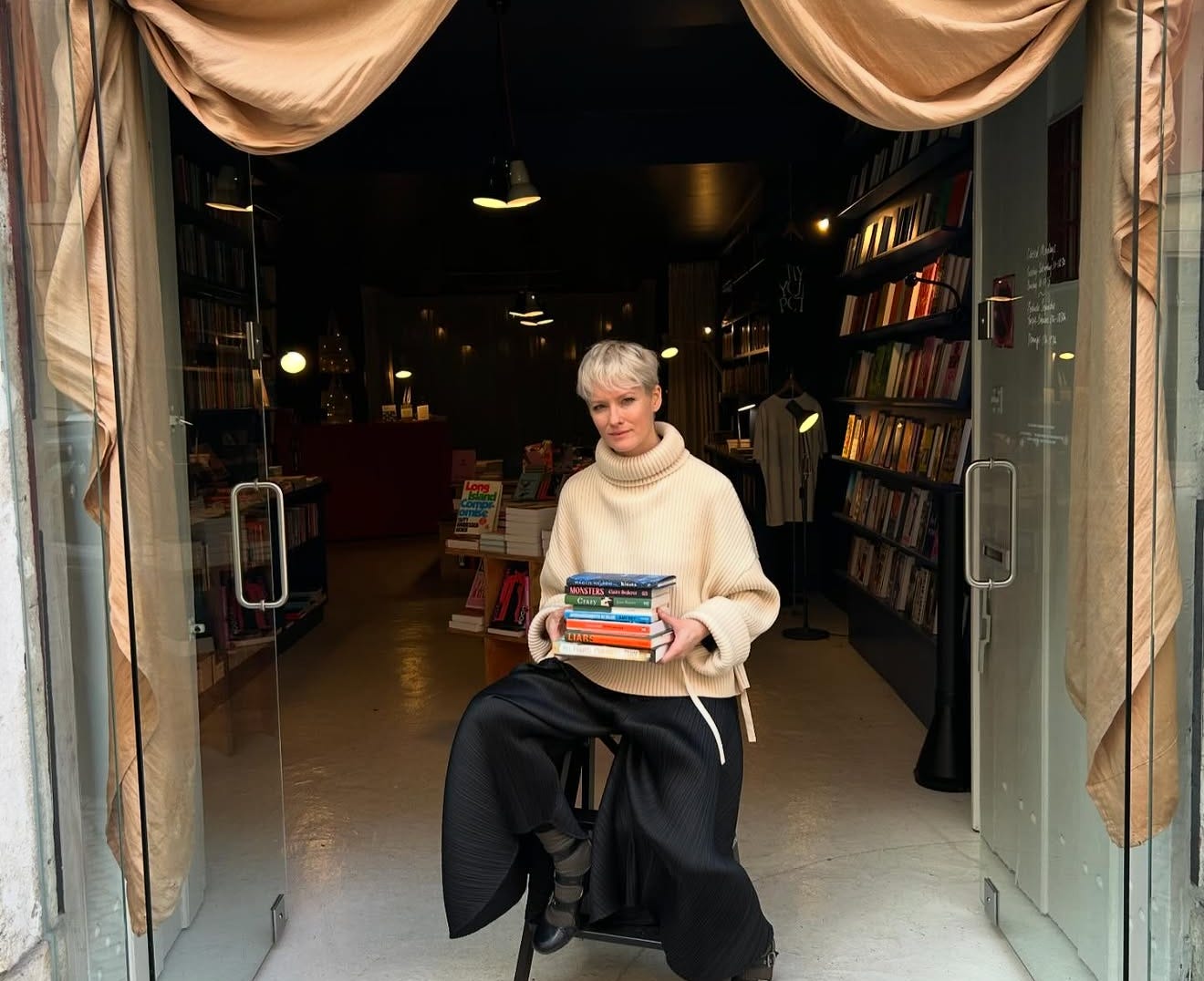
A few years later, Alex and I crossed paths. I was Global Head of Copy & Editorial at Bumble and she was our go-to writer for our brilliant, then-iconic billboards. She was excellent. And she was freelancing from Lisbon, while also running her bookshop, Salted Books, too. She was living my dream. Or so I thought.
Here, Alex tells me all about her hurdles, including the realities of moving her family’s life from London to Lisbon and then back to London again. She also talks about achieving financial fluidity, what she loved (and didn’t love) about her high flying advertising career and why no one financial advisor would ever tell you to open up a bookshop.
Hiya Alex. Please tell us a little bit about you as a person, and a snapshot of your life right now:
Panicking I haven’t finished my essay. Occasionally peeping through half closed eyes at Linkedin. Constantly thinking today will be the day I start a Substack.
Can you give us an overview of your CV?
Creative > ECD > Features Writer > Author > Freelance > Bookshop Owner > And Repeat?
Q: When you were younger, what did you want to be when you ‘grew up’?
A model.
Q: Tell us about your first job. Where did you work, how did you get that job and what did you learn?
My first proper job as part of a creative team seemed too good to be true, to go to work with a best friend, everyday. It had its pitfalls in the end (co-dependency being one of them), but for many years working in a partnership made work feel like play.
Q: Tell us about your worst ever job. Why did you hate it? What made it so bad?
Promoting Lucky Strike cigarettes whilst dressed in a red cap and matching red polo shirt. I had to walk across a motorway bridge to get to the warehouse, and even now when I’m asked to work on a morally corrupt brand I hear the raging traffic of the M27. When that happens I mostly say no.
Q: Tell us about how you got to where you are today? For example, what did it take? What decisions did you make? What was the path like? What hurdles stood in your way? Was it extremely difficult? What did you say yes to? What did you say no to?
I’ve just moved countries (from Portugal to the UK) and that took couples therapy and a lot of trusting my instinct because I could not prove to my family that this was the “right” decision, I just felt it in my bones. On the other side of the move, I can say it was the right decision, but making it felt very hard because I knew it was irreversible, you can’t just move back when you have two kids.
Q: Is the reality of where you are today different to how you imagined it would be? If so, how? What are the biggest differences?
I’ve achieved a financial fluidity that I never thought possible when I was younger.
Q: What’s the biggest mistake you’ve ever made at work? What happened? What did you do? And what did you learn from it?
Taking on a production right at the beginning of Covid lockdown. The job got pulled because the film wasn’t good enough. I learned that risky jobs that pay more, are often actually quite risky. I had to forsake all pay on that job.
Q: You started your career in advertising as a creative. What was your experience like? What did you learn, love and hate about the advertising industry?
I loved the oversized-ness of it all: Big shoots, big boardrooms, big salaries. It became hard when I realised I didn’t always believe in the final output. And that pretending I did was almost impossible.
Q: Alongside your work as a creative and creative director, you’ve also written for publications like Elle, Refinery29, Grazia, the Guardian and many others. Is having a varied working life important to you? Given that it’s notoriously difficult to become a (and afford to be!) a journalist, how did you manage to dip your toes into working across the two industries of advertising and publishing? Was it a case of getting to know editors, relentlessly pitching, attending workshops? How did you do it and how would you advise other creatives with a flair for writing?
Yes all of this, I attended workshops, I pitched, I got to know editors. There is no way I could make it as a career money-wise, but I love writing for publication. I still get a kick out of writing an argument tight enough to be printed. I enjoy all the conversations journalism allows me to have – from MP’s to psychologists – it keeps me close to work that is actually making a difference.
Q: Alongside your journalism, you also wrote the book Open Up: Why Talking About Money Will Change Your Life, in 2019. How did you get the opportunity to write this book? Why was it important for you to share this (incredibly useful, might I add!) knowledge with the world?
I was writing about money for Elle and Refinery29. I noticed when I wrote about money, those pieces did well – they circulated, people cared. And then an agent got in touch to see if I’d considered writing a book on the topic.
Q: What’s the one piece of advice you’d give to any young creative starting out today?
Done is better than perfect.
Q: How did you find the overall experience of becoming an author? Did it live up to your expectations?
Does it for anyone?
Q: You and your family moved to Lisbon in 2020. You’ve previously said it was, ‘not for work or family, but because I could.’ How difficult was it to uproot your family’s life and move?
It was easy moving there. Pre-Brexit, one kid, a healthy disdain for London work culture, sun awaiting us. We had a great few years there. Moving back was the hard bit – necessary for so many reasons, but hard.
Q: While in Lisbon, you set up your own independent bookshop, Salted Books. For anyone inspired by your mission to buy from indie bookshops and not from millionaires, what are the practical hurdles of opening up your own bookshop? What are the practical things you need to do (legally, physically, financially)? You mentioned recently that you poured your life savings into it – did you get any financial advice on this?
I did not get financial advice, and no one would ever financially advise someone to open a bookshop. My ten-year-old son asked me today if I regretted it. And I could answer him honestly – I don’t, because it was such a special chapter in my life, but also it was very difficult and the main difficulty was running a business in a country whose language I didn’t understand and whose business culture is SO different. The bureaucracy, oh my.
Q: You are a creative director, author, journalist, former bookshop owner and brand strategist. Above anything else, do you describe yourself as a writer first?
I do. Because it’s what I aspire to be, and it covers most of the above.
Q: What does a dream day of writing look like for you? What time do you get up? How many meetings do you have? What kind of work are you doing?
My dream day of writing would begin in a Writer’s Hour (I used to host them in the bookshop and so much writing can be done in one hour while sat in silence at a table of other writers). I would then write at home, either in bed or at my desk, phone away, no meetings, no one in the house. A tomato and a packet of biscuits for lunch. A deadline to send something to my writers group at the end of the day. And a printer on hand to print out drafts.
If I’m working for a client I stay in client land all day, which is also a nice day of writing. I’m embarrassed to say that I can get to flow state writing a deck.
Q: What does a nightmare day of writing look like for you?
Thinking I’ll write after I book those flights, buy my daughter some knickers, find a kids club for the Easter holidays…
Q: What does a realistic day of writing look like for you? Tell us the boring bits, the messy bits and the everything-else-in-between bits?
New material only comes under duress. So I set a timer and make myself write something. Or I find a deadline. I have bought a Brick device to block my phone. I often procrastinate and only get into a flow right at the end of the day, like it will take 7 hours of farting about for 15 minutes of key tapping to happen. Sometimes I write nothing at all on writing days and on a day where I’m in and out of lectures and on the train, I’ll fill a few pages of my notebook.
Q: When does inspiration tend to strike for you? Morning? Afternoon? Evening? In the middle of the night? In the middle of the swimming pool?
When reading. When listening. When talking.
Q: How do you get into the zone? Do you write to music? With headphones? Do you need silence? Is background noise okay?
Silence!
Q: What’s the best kind of feedback to get? What’s the worst?
I love being edited, so all feedback is welcome.
Q: What hurdle trips you up regularly? Confidence? Comparison? Time? Money? Fear?
The constant question I circle is: how to write my life while implicating no one I know and love.
Q: What’s the biggest hurdle you’ve ever had to get over?
Fertility treatment. That knocked my confidence for a while.
Q: What’s a recent hurdle (big or small!) you’ve had to get over?
Telling my therapist I wanted to become a therapist. Mortifying. I’m now in my first year of a 4 year masters in psychotherapy.
Q: One work-related object you can’t live without?
Muji notepads.
Q: Best advice you’ve ever been given?
Make the mistakes on the page.
Q: Worst advice you’ve ever been given?
To buy SOL.
Q: Your dream author to host a workshop or talk at Salted Books?
Arundhati Roy.
Q: The person you admire the most?
Right now, my mum, sister and cousin for everything they do for my brother.
Q: Ever faked being sick to get off work?
No!!
Q: Any last words?
I like a random career pivot and feel “indie bookshop owner” to “tech conglomerate” might be the one. Maybe I could do good from the inside??
Any recruitment agents out there who can get me a nice retainer with a big American company who want “quirky” headlines they will then remove all quirk from? Hi. Hello.
Also, Bette Midler put our Salted Books paper bag on her Instagram grid. That’s the power of good copy guys – the star of Hocus Pocus might think it smart enough for a repost.
This interview is part of the Hurdling interview series. You can find more of them here. You can keep up with Alex, and see the work she shares, on her Instagram here and on her website here. You can also buyOpen Up: Why Talking About Money Will Change Your Life here.
Thank you so much for reading this little orange newsletter. It still both delights and stuns me that people are interested in what I have to say and share. You help more people to find and read my words by:
🧡 tapping the heart to ‘like’ this piece
🤝 sharing it somewhere and tagging me
📮 forwarding it to a friend
💌 becoming a paid subscriber
Comments
Nothing yet. Say the first thing.
Sign in to join the conversation.