
Virginia Woolf famously wrote of Ulysses that she was “amused, stimulated, charmed interested by the first 2 or 3 chapters–to the end of the Cemetery scene;” and then “puzzled, bored, irritated, & disillusioned as by a queasy undergraduate scratching his pimples.”1 Ever the literary snob (though I adore her), she continued: “An illiterate, underbred book it seems to me: the book of a self-taught working man, & we all know how distressing they are, how egotistic, insistent, raw, striking, & ultimately nauseating. When one can have cooked flesh, why have the raw?”
It has been written and discussed to no end that Woolf’s Mrs. Dalloway is a shorter literary response to Ulysses, though I struggle with this comparison. She was, after all, already working on Dalloway when Ulysses was released. This is usually where the Woolf-Joyce rivalry discussion ends—most people assuming that Woolf despised or even detested Joyce, which is largely untrue.
Once she finishes Ulysses, she writes “I finished Ulysses, & think it a mis-fire. Genius it has I think; but of the inferior water. The book is diffuse. It is brackish. It is pretentious. It is underbred, not only in the obvious sense, but in the literary sense. A first rate writer, I mean, respects writing too much to be tricky; startling; doing stunts…one hopes he’ll grow out of it; but as Joyce is 40 this scarcely seems likely. I have not read it carefully…”2
This is Woolf the “well-bred” critic speaking. Dislike the book she might, but respect its genius and place in history she does. Later, in 1941, not long before Woolf herself died to suicide, she writes of Joyce’s death:
“Then Joyce is dead—Joyce about a fortnight younger than I am. I remember Miss Weaver [Harriet Shaw Weaver, Joyce’s patron], in wool gloves, bringing Ulysses in type script to our tea table at Hogarth House…Would we devote our lives to printing it? The indecent pages looked so incongruous: she was spinsterly, buttoned up. And the pages reeled with indecency…Then I remember Tom [T.S. Eliot] in Ottoline’s room at Garsington saying—it was published then—how could anyone write again after achieving the immense prodigy of the last chapter? He was for the first time in my knowledge, rapt, enthusiastic. I bought the blue paper book & read it here one summer I think with spasms of wonder, of discover, & then again with long lapses of intense boredom…This goes back to a pre-historic world. And now all the gents are furbishing up opinions, & the books, I suppose, take their place in the long procession.”3
I respect Woolf as a writer and a critic as much as I dislike her snobbery, but in the wake of Joyce’s death she writes with a profound and beautiful pen about the real reputation and reception of Ulysses. Wonderous, new, sometimes boring, but, importantly, a book that would stand the test of time in the “long procession” of literary history.
The highest rated one-star review of Ulysses on that ever-amusing source of pain, Goodreads, is “I Can't do it, It fell in my toilet and didn't dry well, and I'm accepting it as an act of god. I decided against burning it, and just threw it out.”
The general consensus of most negative reviews of Ulysses come in the form of “I tried it. I know it’s important and groundbreaking. But I was bored and/or I don’t get it.”
Echoes of Woolf, I think.
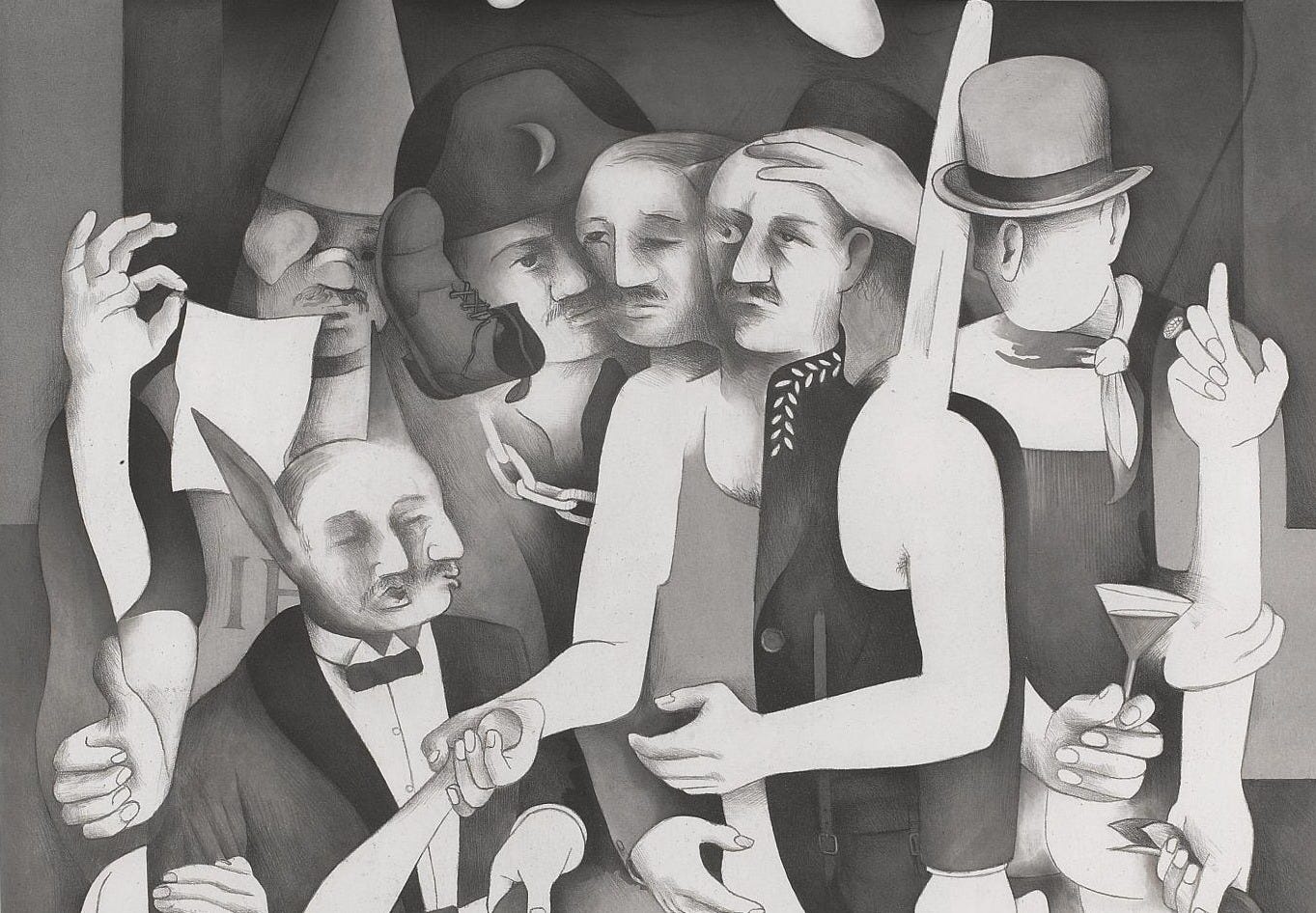
I have spent more time with Joyce than any other writer over the last 18 months or so. I have pored over his notebooks, typescripts, letters, drafts, and the final-proofed pages of his novels. In that time, I have become so intimate with his scrawling hand and his writing process that not too long ago I had a dream I was trapped inside of those rainbow-coloured pages of notes you can find in the National Library of Ireland archives.
The experience of reading Ulysses is akin to diving into a pool of very cold water. You sink under, freezing and teeth chattering, only to become acclimated. The gooseflesh stops, you start to swim, you warm up. bBt if you get out and dive back in, it starts all over again. How to describe Ulysses?
We might start with a brief outline of the plot: a day in Dublin; a father missing a son and a son missing a father; masturbation on the beach; an affair; a trial in a brothel that may or may not be entirely occurring inside one man’s head; a punctuation-less, stream-of-consciousness infinity of a final chapter. The final word: yes. The episodes: each like an episode of Homer’s Odyssey. Each chapter, as the book grows and evolves, changes shape. “Aeolus” takes the form of newspaper headlines. “Scylla and Charybdis” has a play within a play. “Sirens” is orchestral. “Oxen of the Sun” charts the development of the English language from Latin transliteration through to Cockney slang. “Ithaca,” my favourite of the chapters, is catechistic. There are two schemas, one given to Stuart Gilbert and the other to Carlo Linati, each a map of the colours, bodily organs, time of day, character associations, and locations of the episode. You can read and follow along with either, if you like.
Dublin, a city, becomes planetary; it grows to the size of all of history—literary and lived—and allows our main characters, Bloom and Stephen, to encounter all of life distilled in a single day. June 16th.
These days, on June 16th, if you go for a walk around Dublin—along Sandymount Strand, or down Eccles Street, or past the Ormond Hotel, or stop in Davy Byrne’s—you’ll probably encounter a bunch of nerds and Joyceans in Edwardian dress re-enacting and reliving the Odyssey of Leopold Bloom and Stephen Dedalus. This is a goofy annual tradition that I find wholly endearing. Joyce fans and (I’m sure very few) Dubliners will follow, in a literary, rather than funereal, procession, a map of 1904 Dublin. They’ll repast on gorgonzola and mustard sandwiches with a glass of burgundy at lunchtime. They’ll go to the Joyce Centre and listen to actors read the roles of Bloom, Molly, and Stephen.
Besides the unfortunate lot who go to King’s Cross every year on September 1st (heinous), or those who walk to Blackfriar’s Bridge (if you know this one, nice) to locate where Jem and Tessa finally reunited, I can’t think of any book that has such zealous followers. That’s the thing with Ulysses, it seems to inspire a zealotry in both its academic and non-academic fans, and an equal amount of zealotry in its haters.
I think all good books do. Woolf, Joyce’s supposed-nemesis, inspires a similar response. As does Pynchon, Joyce’s literary inheritor.
What value does reading Ulysses have in 2026, over a century on?
Lots of talk abounds as to what “classics” or canonical texts deserve their place on the hallowed lists of the best books of all time. The Guardian recently place Ulysses as third, wedged between Woolf’s To the Lighthouse at fourth, and Toni Morrison’s Beloved at second. Middlemarch came first. This list was compiled by academics, writers, and critics. The readers’ list ranked it tenth. This is, of course, a list compiled by people who read The Guardian. This ranking is accompanied by a review from ‘Jeremy Yapp, Hertfordshire, 52: “The best books contain worlds. This is one of those books. Immortal themes of love and loss; one of the best female characters written by a man in all of literature; fatherhood and filial complications; a magnificent structure; so much richness and pathos and exquisite sadness; a very funny book. And difficult, but every line repays the work.”’
I agree with Jeremy Yapp, Hertfordshire, 52, for the most part.
Ulysses has value not as a structurally innovative book, but as a book that manages to take existing themes and re-imagine them. This is a hokey point to make, but a true one. You can read “Oxen of the Sun” and be utterly bewildered by its linguistic complexity:
“To her nothing already then and thenceforward was anyway able to be molestful for this chiefly felt all citizens except with proliferant mothers prosperity at all not to can be and as they had received eternity gods mortals generation to befit them her beholding, when the case was so having itself, parturient in vehicle thereward carrying desire immense among all one another was impelling on of her to be received into that domicile.”4
Here is the chapter of childbirth (literally, the characters are in a maternity hospital). But here, too, is the birth of language. In the first few pages, we see English reduced to its exact Latin counterpart, arranged confusingly. The following paragraph suddenly transforms into alliterative Old-English style language, with kennings and all. Over the course of the chapter, as a woman labors to bring life into the world, Joyce shows the labor of language. Structurally, this is brilliant. It plays upon many of the thematic aspects Joyce seeks to exploit or explode: the history of literature, the history of England’s linguistic colonization of Ireland, the process of childbirth, the role of women in society, the ignorance of men. It is rich and brilliant and full of threads of analysis or inquiry. Pull on any one of them and you’ll still be researching them or thinking about them six months later.
But, you can also read “Ithaca,” and find, in its odd and catechistic style, one of the most profound reflections on love you might read outside of John Donne:
“What special affinities appeared to him to exist between the moon and woman?
Her antiquity in preceding and surviving successive tellurian generations : her nocturnal predominance : her satellitic dependence : her luminary reflection : her constancy under all her phases, rising, and setting by her appointed times, waxing and waning : the forced invariability of her aspect : her indeterminate response to inaffirmative interrogation : her potency over effluent and refluent waters : her power to enamour, to mortify, to invest with beauty, to render insane, to incite to and aid delinquency : the tranquil inscrutability of her visage : the terribility of her isolated dominant implacable resplendent propinquity : her omens of tempest and of calm : the stimulation of her light, her motion and her presence : the admonition of her craters, her arid seas, her silence : her splendour, when visible : her attraction, when invisible.”5
Ulysses, when taken as a whole, has many things that any “good” or canonical book has. Stephen struggles with his friendships; he is an artist who wants to create but has no faith in his art. Bloom is a father mourning the death of his son—the death that caused a massive rift in his relationship with his wife. Dublin is a city of characters that becomes a character in itself: it is a space through which we might be able to see the lives of everyday people, rather than just Bloom or Stephen or Molly. The relationship between Molly and Bloom is one that is simultaneously broken and repairing as the pages go on.
It is just a book that structurally or formally might be unfamiliar to its readers. After all, these are themes and ideas that you might find in Middlemarch or To the Lighthouse or In Search of Lost Time or Madame Bovary. Books that consistently take the place on readers’ and critics’ top lists and are read in any college-level lit class. To read Ulysses is to encounter those same universal themes you might encounter in any “classic” and many non-canonical works of literature. However, it requires that you not only encounter those themes, but encounter and assess your relationship to how they show up in literary history. Like Jeremy Yapp, Hertfordshire, 52, alluded to: it puts you to work as a reader. It forces you, in a lot of ways, to reconsider what belongs in a “novel,” and what is considered “low-brow” or “high-brow” in literary circles.
When you read “Aeolus” and see the headlines of the newspaper, hear the clinking and clunking thwacks of the printing press, you can be reminded that you, as well, live in an age of machinery and mass-media. The newspaper might not be the vessel by which we get our information, nor is it a means by which we might allow ourselves to submit to propagandizing, but it is the precursor to the internet, to TikTok, to instagram reels. Same goes for “Oxen of the Sun.” A chapter that ends with Cockney and Scots slang might seem dated; but you can still draw the line further, to internet slang now. What’s so groundbreaking about “Circe”? When Bloom, at one point, transforms into a woman and is dominated by Bella, the Madam, who has now transmogrified in Bello—is it because it’s in play-form? Or is it, perhaps, a reflection of the complicated relationship between Bloom and Molly? I pointed to Donne when I brought up the passage from “Ithaca” because “A Valediction: Forbidding Mourning” makes similar comparisons between the moon and woman (“dull sublunary lovers”)—but Joyce takes that comparison and explodes it: love is no longer worldly, but instead can transcend that sublunary plane. Literary history; literary invention. Two things that are often in conflict placed right atop each other endlessly in this book, forcing you, no matter what you do to avoid it, confront what you’re reading and how you read it.
So, does Ulysses have a place? Yes. Yes it does.
Do I think you should read it? Why not. Give it a go. If it’s not your cup of tea, it’s not your cup of tea. But I do think this book deserves its spot on those lists. If not for its prose, or its absurdity, or is structural innovations, but for the sheer fact that it manages, somehow, to still captivate me after the amount of time I’ve spent with it. It might captivate you, too.
The Diary of Virginia Woolf, Vol. II, ed. by Anne Olivier Bell, pp. 188-189, entry dated 16 August 1922, 6 months after Ulysses was first published by Sylvia Beach at Shakespeare and Co.
Diary, Vol. II, p. 199, dated 6 September 1922
The Diary of Virginia Woolf, Vol. V, ed. by Anne Olivier Bell, p. 353, entry dated Wednesday 15 January 1941, two months before she died.
James Joyce, Ulysses: The 1922 Text, ed. by Jeri Johnson, p. 367
Ulysses: The 1922 Text, p. 654
Comments
Nothing yet. Say the first thing.
Sign in to join the conversation.